In 2026, the average recruiter sends approximately ninety-five percent of their candidate outreach through a single channel: email. The remaining five percent might include a LinkedIn InMail or two, perhaps an occasional SMS for high-priority candidates, but the overwhelming majority of recruiting communication flows through email inboxes that candidates check when they have time, between other priorities, with a finger hovering over the archive button. Email has been the default recruiting channel for two decades. It is embedded in every ATS, supported by every outreach tool, and familiar to every recruiter. It works well enough to sustain the hiring process, and most organizations have never felt a compelling reason to change. But “works well enough” is not the same as “works well,” and the growing gap between email-only outreach and multi-channel outreach is creating a competitive advantage for the organizations that have made the shift. Multi-channel outreach is not a marginal optimization. It is a structural improvement that changes the fundamental math of candidate engagement, and the evidence for its superiority is consistent across industries, geographies, and candidate segments.
The Numbers: What Multi-Channel Actually Delivers
The performance differential between multi-channel and single-channel outreach is not theoretical. It is well-documented, consistently replicated, and large enough to be strategically significant. Recruitment organizations that have implemented structured multi-channel outreach programs — using a coordinated combination of email, LinkedIn,
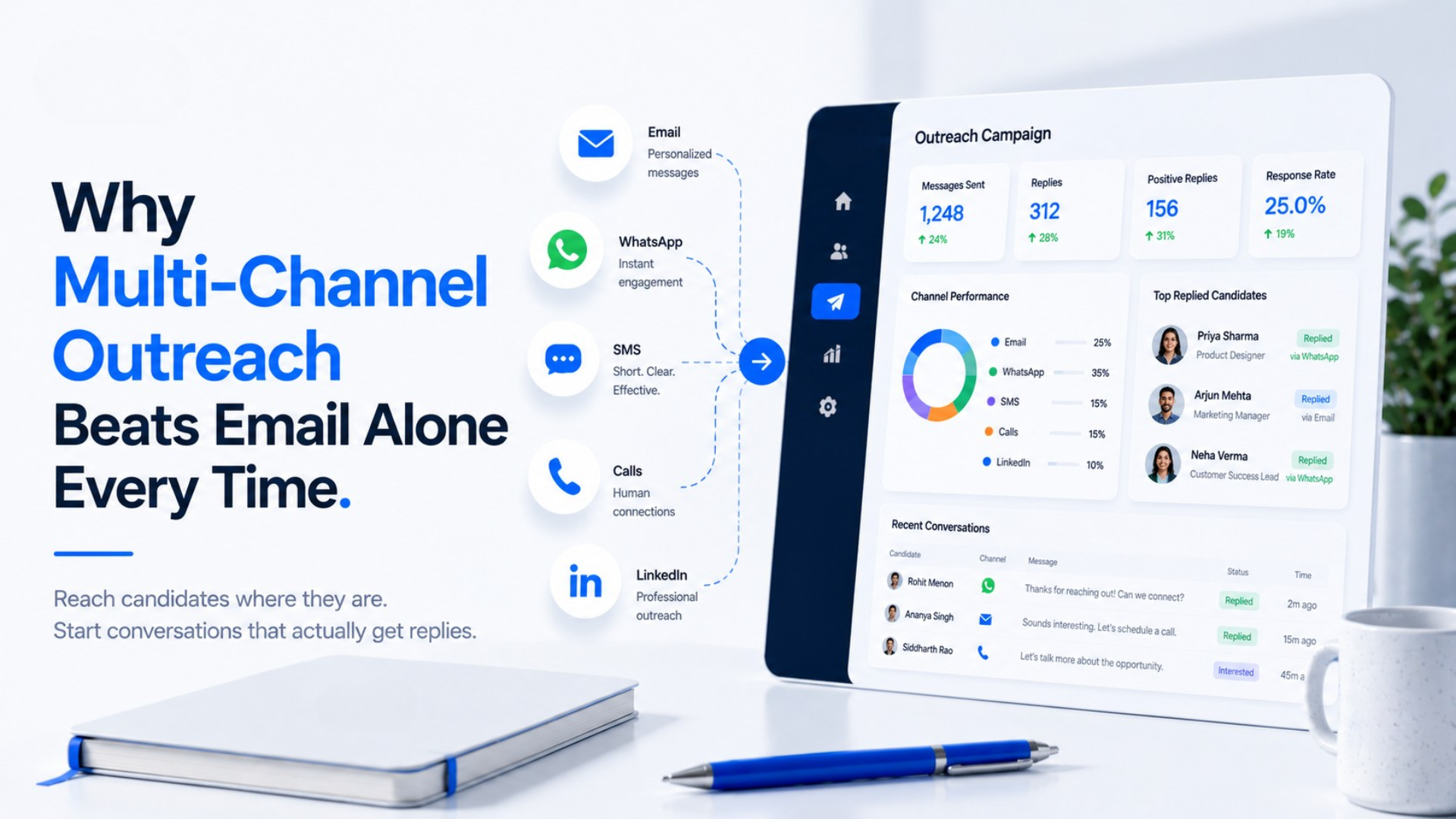
WhatsApp, and SMS to reach candidates through a sequence of touchpoints rather than a single channel — consistently report response rates two to five times higher than their email-only counterparts. The specific numbers vary by industry, candidate segment, and message quality, but the direction of the effect is uniform. A three-percent response rate on email-only outreach becomes eight to twelve percent when the same candidates are reached through a multi-channel sequence. A five-percent response rate becomes fifteen to twenty-five percent. These are not small improvements that could be attributed to better templates or more targeted lists. They are step-function increases that reflect a fundamentally different approach to candidate engagement.
The mechanism behind these numbers is straightforward when you understand how candidates actually consume communications. A candidate does not have a single inbox that receives all messages. They have multiple inboxes — email, LinkedIn messaging, WhatsApp, SMS — and they check them at different times, with different levels of attention, and in different emotional states. A recruiter who sends one email has one chance to reach the candidate, and that chance is determined by whether the candidate happens to check their email at a moment when they have the attention and inclination to read a recruiting message. A recruiter who sends an email, follows up with a LinkedIn message three days later, and then sends a brief WhatsApp the following week has three chances to reach the candidate through three different attention windows. The candidate who missed the email because they were focused on a project deadline might see the LinkedIn message during their evening scroll. The candidate who archived the LinkedIn InMail because it looked like every other recruiting pitch might notice the WhatsApp notification because the brevity and immediacy of the format make it harder to dismiss. Each additional channel is not just another attempt at the same thing. It is access to a different attention window, a different communication context, and a different psychological state. According to Deloitte’s workforce of the future research, organizations using multi-channel talent engagement strategies report a fifty to seventy percent increase in candidate pipeline quality metrics, including not just response rates but also downstream conversion rates from response to interview and from interview to offer, suggesting that multi-channel outreach attracts candidates who are more engaged and more seriously considering the opportunity, not just more responsive to the initial message.
Why Email Alone Is a Shrinking Strategy
Email is not a bad channel. It is a good channel that is becoming less effective over time, and the reasons for its decline are structural, not cyclical. The first structural driver is inbox saturation. The volume of email — professional, commercial, and personal — continues to grow, and candidate inboxes are no exception. A professional in a competitive talent market receives between fifty and one hundred emails per day, of which three to eight are recruiting-related. As the volume of competing messages increases, the attention each message receives decreases, and the filtering behavior that candidates apply becomes more aggressive. Messages from unknown senders with generic subject lines are archived without reading. Messages that survive the initial filter are scanned in seconds and dismissed if
they do not immediately demonstrate relevance. This is not a trend that will reverse. Email volume will continue to increase, candidate filtering will continue to accelerate, and the response rate for email-only outreach will continue to decline.
The second structural driver is the shift in candidate communication behavior. Younger professionals — the workforce entrants who will constitute the majority of the talent pool over the next decade — are digital natives who conduct a significant portion of their professional communication through messaging platforms. For many professionals under thirty-five, WhatsApp and SMS are their primary communication tools for everything from project coordination with colleagues to networking with peers. Email is something they check for formal communications and newsletters, not their first screen for messages that require attention. This generational shift means that email-only outreach is systematically missing the candidates who are most active on other channels, which increasingly means the candidates who are most in demand and hardest to reach through conventional approaches. PwC’s hiring trends analysis has documented a clear generational divide in communication preferences, with candidates under thirty-five showing a strong preference for messaging-based communication over email for initial professional interactions, while candidates over forty-five remain more email-centric. The implication is clear: as the workforce demographics shift, email-only outreach will reach a shrinking proportion of the candidate population through their preferred communication channel, and the effectiveness gap between single-channel and multi-channel approaches will widen further.
The Cross-Channel Effect: Why Two Plus Two Equals Seven, Not Four
One of the most counterintuitive findings in multi-channel outreach research is that the performance gain from adding a second or third channel is not additive — it is multiplicative. If email alone produces a three-percent response rate and LinkedIn alone produces a five-percent response rate, a naive expectation would be that using both channels would produce roughly the combined total, perhaps seven to eight percent after accounting for overlap. In practice, multi-channel sequences typically produce response rates that are significantly higher than the sum of the individual channel response rates. A recruiter who sends an email followed by a LinkedIn message often achieves a twelve to fifteen percent response rate, which is higher than either channel alone and higher than the simple sum of both. This multiplicative effect occurs because the channels reinforce each other through a psychological mechanism known as the mere exposure effect: repeated exposure to a name, brand, or message increases familiarity and positive association, even if the individual exposures are through different channels and are not consciously linked by the recipient.
When a candidate receives a recruiting email and does not respond, and then sees the same recruiter’s name appear in their LinkedIn notifications a few days later, they experience a sense of familiarity: “I’ve seen this name before.” This familiarity does not guarantee a response, but it changes the candidate’s evaluation framework from “who is this stranger?” to “I’ve heard from this person before, they seem persistent.” When a WhatsApp message from the same recruiter arrives a few days after that, the candidate
now has three exposures to the recruiter’s name and a progressively strengthening sense that this is someone who is genuinely interested in reaching them, not just blasting messages to a list. The psychological impact of three coordinated touches across three channels is not three times the impact of one touch. It is an order of magnitude greater, because each touchpoint builds on the familiarity and trust established by the previous ones. This is fundamentally different from sending three emails, which feels repetitive and intrusive rather than progressive and persistent. The channel variety prevents the repetition from feeling like spam, while the consistency of the sender and the message creates the familiarity effect that drives engagement. As Gartner’s talent acquisition research notes, the most effective recruiting outreach strategies in 2026 are not defined by a single brilliant message but by a coordinated sequence of touches across multiple channels that creates cumulative familiarity and progressive trust — a dynamic that is impossible to achieve through any single channel alone.
The Channel Sequence: Order, Timing, and Adaptation
Effective multi-channel outreach is not random channel switching. It is a structured sequence where each channel is selected for a specific purpose at a specific stage of the engagement process. While the optimal sequence varies by candidate segment and context, a framework that works well across most recruiting scenarios begins with email as the initial touchpoint, uses LinkedIn as the secondary channel, and deploys WhatsApp or SMS as the tertiary channel for candidates who have not responded to the first two. Email is the right first channel for most candidates because it supports longer-form communication, allows for detailed personalization, and feels professionally appropriate for the initial introduction. LinkedIn is the right second channel because it provides a visual, professional context — the candidate can see the recruiter’s profile, their company affiliation, and their network — which adds credibility that a plain email address does not provide. WhatsApp or SMS is the right third channel because it is the most immediate and attention-grabbing, and it works best when the candidate already has some familiarity with the sender from the previous touches.
The timing between channels matters as much as the channel selection. Sending an email and a LinkedIn message on the same day feels like spam, not multi-channel engagement. The optimal spacing is three to five business days between each channel touch, which gives the candidate time to process each message without feeling overwhelmed. The content of each touch should also differ. The email might provide a detailed, personalized introduction to the opportunity. The LinkedIn message might reference a specific shared connection or group and offer a brief, different angle on why the opportunity is relevant. The WhatsApp or SMS might be a short, direct message that cuts through the noise with a specific question or a compelling piece of information. Each touch adds something new to the candidate’s understanding of the opportunity and the recruiter’s credibility, which is what drives the multiplicative response rate improvement. The follow-up cadence is also critical, and the data on how many touches are needed to convert a candidate into a conversation is striking: as covered in How Many Follow-Ups Does One Hire Need?, the
average successful placement requires between five and eight touchpoints, yet most outreach stops after one or two. Multi-channel outreach makes these additional touchpoints feasible by providing fresh, non-repetitive ways to reach the candidate at each stage of the sequence.
The Operational Challenge: Why Most Teams Stay Email-Only
If the evidence for multi-channel outreach is so strong, why do most recruitment teams still default to email? The answer is operational complexity. Multi-channel outreach requires capabilities that most recruitment organizations do not have. First, it requires candidate contact information across multiple channels: not just email addresses but LinkedIn profiles, phone numbers, and WhatsApp accounts. Most ATS platforms store email addresses and perhaps a LinkedIn URL, but they do not systematically capture phone numbers or messaging app identifiers, which means the recruiter has to find this information manually for each candidate — a time-consuming step that most recruiters skip. Second, multi-channel outreach requires a tool that can send messages through multiple channels from a single interface. Most ATS platforms and outreach tools are designed for email-first workflows. LinkedIn integration, if it exists, is an afterthought. WhatsApp and SMS support is rare or nonexistent. Recruiters who want to use multiple channels often have to maintain separate tools, separate contact lists, and separate tracking systems for each one, which creates a coordination burden that most teams cannot sustain at scale.
Third, multi-channel outreach requires a sequencing engine that can coordinate touchpoints across channels with appropriate timing, content differentiation, and response tracking. When a candidate responds to the LinkedIn touch but not the email, the system should know to stop sending follow-ups on the email channel and continue the conversation on LinkedIn. When a candidate opens the email but does not respond, the system should use that signal to inform the content and timing of the LinkedIn follow-up. This kind of cross-channel intelligence is impossible to maintain manually for more than a handful of candidates, and it requires a platform that treats the candidate, not the channel, as the unit of analysis. The fact that this operational complexity is the primary barrier to multi-channel adoption, rather than lack of awareness or lack of evidence, puts it in the same category as the challenges described in Should Recruiters Worry About AI Replacing Their Jobs?. The concern is not that AI will replace recruiters. It is that AI will replace the aspects of recruiting that are manual, repetitive, and operational — exactly the aspects that currently prevent most teams from executing multi-channel outreach. The recruiters who adopt AI-powered platforms that handle the operational complexity of multi-channel outreach will be more effective, more productive, and more strategically valuable than those who continue to manage multiple channels manually or, more commonly, avoid the complexity by defaulting to email.
Huntlo: Multi-Channel Outreach Without the Operational Overhead
The promise of multi-channel outreach is clear. The challenge has always been execution. Huntlo eliminates this challenge by making multi-channel outreach the default, not
an exception. When a candidate enters the Huntlo pipeline — whether sourced through Huntlo’s AI-powered engine that covers more than fifty platforms or imported from an existing database — the system automatically identifies the available contact channels, selects the optimal initial channel based on the candidate’s profile and segment, and generates a personalized message appropriate for that channel. As the outreach sequence progresses, Huntlo adapts the channel, content, and timing based on the candidate’s behavior: if they opened the email but did not respond, the LinkedIn follow-up might reference the email and offer a different angle. If they responded on one channel but went silent, a re-engagement touch on a different channel can recapture their attention. This cross-channel intelligence is built into the platform’s architecture, not bolted on as an integration, which means it operates seamlessly and consistently for every candidate in the pipeline.
The result is a multi-channel outreach capability that would require a team of coordinators, multiple tool subscriptions, and significant manual effort to replicate — delivered as an automated, AI-powered feature that recruiters control through a single interface. Huntlo handles the channel selection, the message generation, the timing, the sequencing, and the cross-channel tracking. The recruiter focuses on strategy: defining the target candidate profile, reviewing AI-generated messages for quality, and stepping in personally for high-priority candidates where a direct human touch adds the most value. This division of labor is the practical expression of a broader principle that distinguishes effective AI recruiting platforms from their predecessors. As Agency Owners Are Solving Different Problems Than Recruiters Think describes, the most impactful recruiting technology does not automate individual tasks but orchestrates entire workflows, freeing recruiters to focus on the high-judgment, high-value activities that drive hiring outcomes. Multi-channel outreach is one of the workflows that benefits most from this orchestration approach, because the complexity of coordinating multiple channels, timing, content, and tracking is precisely the kind of operational burden that AI handles better than humans.
The recruitment landscape has shifted. Candidates are more selective, more saturated with messages, and more diversified in their communication preferences than ever before. Email remains a valuable channel, and it will for the foreseeable future. But email alone is no longer sufficient for organizations that need to reach the best candidates, wherever they are and however they prefer to communicate. Multi-channel outreach is not a luxury or a nice-to-have. It is a competitive necessity, and the performance gap between organizations that practice it and those that do not will only widen as candidate communication behavior continues to evolve. The question is not whether to adopt multi-channel outreach. It is how quickly you can build the operational capability to execute it effectively. With the right platform, that capability is available today.
Related Topics:
How Many Follow-Ups Does One Hire Need?