The Hidden Cost of Hiring Without a Standardized Interview Process
Most enterprises do not have a single interview process. They have dozens. Different business units design their own question sets. Different geographies follow different evaluation criteria. Different hiring managers apply different scoring standards. A candidate interviewing for a marketing role in New York faces a fundamentally different assessment than a candidate interviewing for the same role in London or Singapore — not because the role requires different competencies, but because no one has ever standardized what "marketing competence" looks like across the organization.
This fragmentation is not a minor operational inconvenience. It is a strategic liability that affects every dimension of hiring quality, legal compliance, and employer brand coherence. A 2024 Deloitte survey of 800 enterprise TA leaders found that organizations without a standardized interview process experienced 2.3 times more hiring manager complaints about candidate quality, 1.8 times higher early attrition among new hires, and 3.1 times more legal queries related to hiring decisions compared to organizations with enterprise-wide standardization.
The problem intensifies as organizations grow. A company hiring 500 people annually from a single office can afford some process variation. A company hiring 15,000 people annually across 30 countries cannot. At enterprise scale, process fragmentation stops being a hiring quality issue and becomes a systemic risk — to legal exposure, to employer brand, to data integrity, and to the organization's ability to make evidence-based improvements to its hiring process.
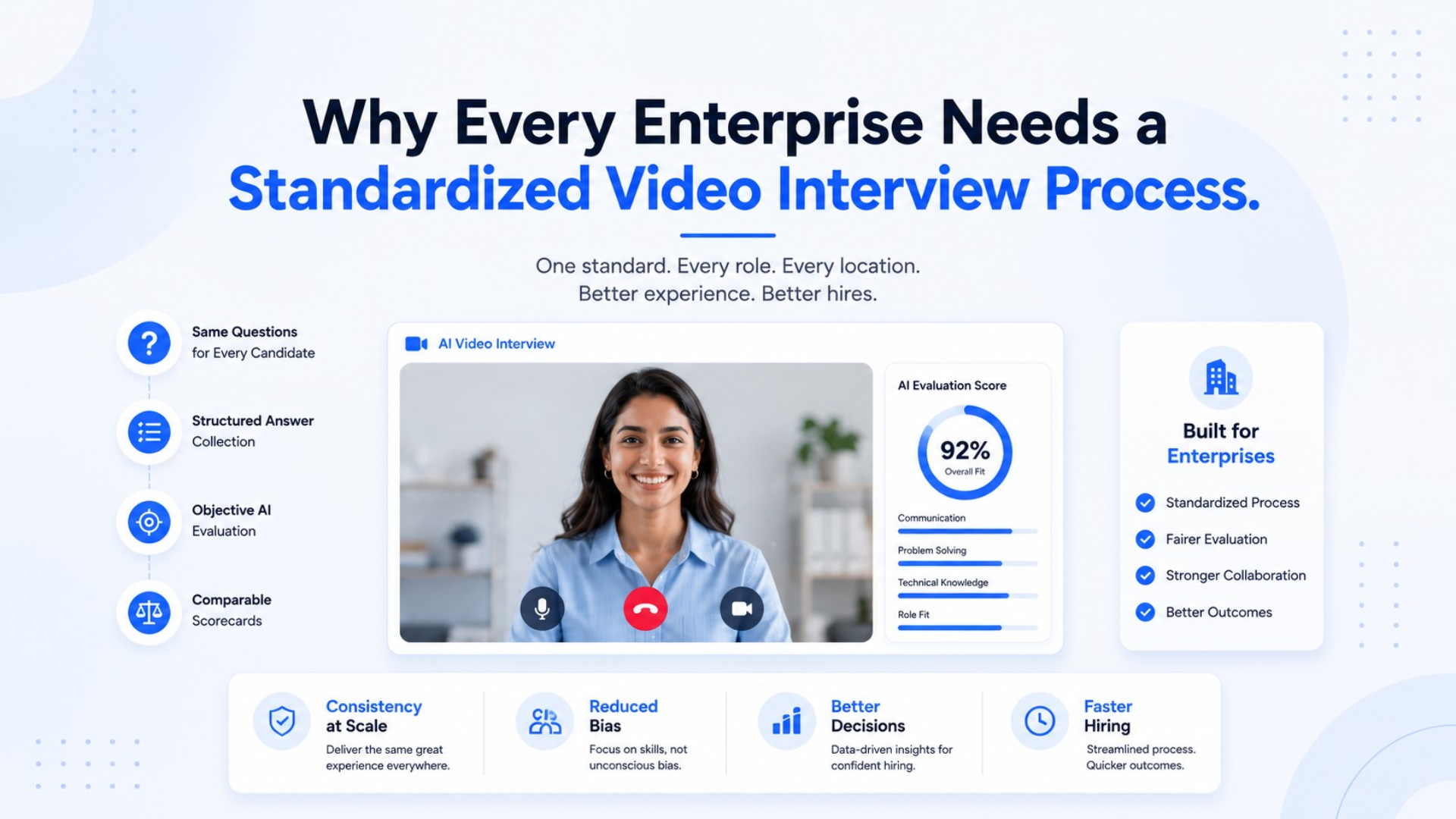
A standardized video interview process — where every candidate for a given role family encounters the same questions, the same evaluation criteria, and the same scoring methodology regardless of geography, business unit, or interviewer — is the foundational infrastructure that makes enterprise-scale hiring manageable, measurable, and defensible. This article explains why, and how AI-powered platforms like Huntlo.ai make enterprise-wide standardization achievable for the first time.
What Enterprise Hiring Fragmentation Actually Looks Like
Before examining the benefits of standardization, it is worth documenting what the absence of standardization looks like in practice. The following patterns are observed across the majority of enterprises that lack a unified interview process, according to research from SHRM and Gartner.
Geographic fragmentation is the most common form. When regional TA teams operate with autonomy over interview design, the same role title can produce wildly different interview experiences. A software engineering interview in Bangalore may emphasize algorithmic problem-solving, while the same role in Berlin may emphasize system design, and in Austin may emphasize behavioral competencies. All three competencies matter — but the weighting and emphasis varies by location, meaning that candidate evaluation is driven more by geography than by job requirements.
Business unit fragmentation occurs when different departments — engineering, sales, operations, finance — each develop their own interview cultures. An enterprise with 10 business units may effectively be running 10 independent hiring processes, with no shared evaluation framework, no cross-unit calibration, and no ability to compare candidate quality across the organization. This creates internal silos where hiring managers cannot benchmark their selections against the broader talent market, and TA leadership cannot identify which business units are hiring effectively and which are not.
Interviewer-level fragmentation is the most granular and most damaging form. Even within a single business unit and geography, different interviewers apply different standards. A 2023 study in Personnel Psychology found that interviewer-level variance in scoring accounted for 38% of the total variance in interview outcomes — meaning that who happens to interview a candidate has a larger impact on their score than the candidate's actual competency. This is the direct consequence of unstandardized evaluation, and it is both legally indefensible and operationally destructive.
Temporal fragmentation compounds all of the above. Interview standards drift over time as new hiring managers join, old question banks become stale, and organizational priorities shift. A candidate interviewed in January may face a different assessment than a candidate interviewed for the same role in July — not because the role changed, but because the process evolved informally without centralized governance.
The Predictive Validity Gap: Why Standardization Directly Improves Hiring Quality
The evidence on standardized versus unstandardized interviews is among the most robust findings in all of industrial-organizational psychology. The SIOP Principles for the Validation and Use of Personnel Selection Procedures — the gold standard reference for evidence-based hiring practices — is unequivocal: structured, standardized interviews achieve predictive validity coefficients of 0.51 to 0.63, while unstructured interviews achieve coefficients of only 0.20 to 0.38. This is not a marginal difference. It means that a standardized interview is more than twice as effective at predicting which candidates will perform well on the job.
What drives this validity gap? Three mechanisms, each of which is directly addressed by a standardized video interview process.
First, consistent construct measurement. An unstructured interview measures whatever the interviewer happens to find interesting or memorable — which may or may not be relevant to job performance. A standardized interview measures the same competencies for every candidate, ensuring that the assessment is actually predictive of the specific skills the role requires. A Harvard Business Review analysis found that 73% of what unstructured interviewers actually evaluate is unrelated to job performance — they are effectively making decisions based on conversational chemistry rather than competency evidence.
Second, anchored behavioral evaluation. Standardized interviews use pre-defined scoring rubrics with behavioral anchors — specific examples of what a "strong," "adequate," and "weak" response looks like for each competency. This anchors evaluation to observable evidence rather than subjective impression, dramatically reducing the halo effect, contrast effect, and other biases that inflate or deflate scores independently of candidate quality. McKinsey's 2024 Hiring Quality report found that organizations using anchored scoring rubrics made 29% fewer hiring mistakes (defined as new hires falling below performance expectations within 12 months) compared to organizations using unanchored holistic evaluation.
Third, reliable cross-candidate comparison. When every candidate is assessed against the same framework, TA teams can make meaningful comparisons across the candidate pool. They can identify which competencies the strongest candidates demonstrate, where the pool is thin, and how to adjust sourcing strategies. None of this is possible when each candidate is evaluated against a different implicit standard. For enterprises managing talent pools across multiple roles and geographies, this comparability is essential for workforce planning and strategic talent acquisition.
Legal and Compliance: Why Standardization Is a Risk Management Imperative
Beyond hiring quality, a standardized interview process is a critical component of legal defensibility. Employment discrimination claims — whether under Title VII, the ADA, the ADEA, or equivalent legislation in other jurisdictions — increasingly focus on the consistency and objectivity of the selection process. When a hiring decision is challenged, the organization's ability to demonstrate that every candidate was evaluated against the same criteria using the same methodology is often the difference between a defensible process and a costly settlement.
The EEOC's Uniform Guidelines on Employee Selection Procedures require that selection procedures with adverse impact be validated as job-related and consistent with business necessity. A standardized interview process — with documented competencies, anchored scoring rubrics, and consistent administration — provides the evidentiary foundation for this validation. An unstandardized process, where different candidates faced different questions and different evaluators applied different standards, is nearly impossible to defend.
The regulatory landscape is tightening further. New York City's Local Law 144 requires bias audits for automated employment decision tools. The EU AI Act classifies AI hiring systems as "high-risk" and mandates transparency, human oversight, and documented validation. Legislation with similar requirements is advancing through California, Illinois, the UK, and Canada. Each of these regulatory frameworks rewards organizations that can demonstrate process standardization and penalizes those that cannot.
A standardized video interview process also creates the data infrastructure necessary for conducting adverse impact analyses — the statistical tests that determine whether a selection procedure disproportionately disadvantages candidates from protected groups. Without standardized evaluation data, adverse impact analysis is impossible. With it, organizations can proactively identify and correct disparities before they become legal liabilities. SHRM's 2025 compliance guidance recommends that every enterprise with 500 or more annual hires maintain a standardized interview process specifically to support ongoing adverse impact monitoring.
The Employer Brand Cost of Inconsistent Interview Experiences
Candidate experience is now a strategic recruiting differentiator. A 2024 Talent Board CandE Benchmark Research report found that 68% of candidates who had a negative interview experience shared it publicly on platforms like Glassdoor, Blind, and LinkedIn — and that these negative reviews reduced application rates for the affected employer by an average of 14%.
Inconsistent interview experiences are a primary driver of negative candidate sentiment. When one candidate faces a rigorous, well-organized structured interview and another candidate for the same role faces a casual, unstructured conversation, the inconsistency is immediately apparent to candidates who compare notes — and they do compare notes. A Glassdoor analysis of enterprise interview reviews found that "inconsistent interview process" was the third most common complaint, appearing in 23% of negative interview reviews for companies with 5,000+ employees.
A standardized video interview process ensures that every candidate for a given role family encounters the same professional, organized, and competency-focused experience. This consistency is not only fairer — it is also a powerful employer brand signal. Candidates who experience a well-structured, clearly communicated, and professionally delivered interview process form positive impressions of the organization's operational maturity, regardless of whether they receive an offer. The LinkedIn Global Talent Trends 2025 report found that organizations with standardized hiring processes received 31% more referral applications and 22% higher "would recommend" scores from candidates who were not hired — suggesting that a consistent process builds goodwill even among rejected candidates.
Scalability: Why Standardization Is the Prerequisite for Growth
Enterprise hiring growth creates a compounding coordination problem. Every new geography, business unit, or role family added to the hiring portfolio multiplies the number of interview configurations that must be designed, maintained, calibrated, and governed. Without a standardized process, this coordination burden grows linearly with hiring volume — eventually overwhelming TA operations teams and forcing them to accept increasing levels of inconsistency.
A standardized video interview process turns this linear growth problem into a modular one. The enterprise defines a library of standardized interview templates mapped to role families and competency frameworks. When a new geography or business unit begins hiring, it selects the appropriate templates from the library, configures any localized elements (language, scheduling windows, channel preferences), and begins evaluating candidates against the same framework used everywhere else in the organization. The coordination cost of onboarding a new hiring unit drops from weeks of process design to days of template configuration.
This modularity is especially powerful for enterprises managing Global Capability Centers or multi-country hiring operations. Huntlo.ai's platform supports this modular approach through configurable interview templates, multi-language delivery, and multi-channel outreach (email, LinkedIn, WhatsApp, AI voice) that ensures candidates in every geography can engage through their preferred communication channel while being evaluated against the same competency framework. The How Enterprise Teams Streamline Sourcing, Screening, and Hiring article on the Huntlo blog provides a detailed walkthrough of how this end-to-end standardization works in practice.
AI as the Standardization Enabler: Why Technology Matters
Standardized interviews are not a new idea. The SIOP Principles have recommended them since the 1970s. What is new is the ability to enforce standardization at enterprise scale without proportional increases in TA headcount or management overhead. This is where AI-powered video interview platforms become transformative.
The fundamental challenge of enterprise standardization has always been enforcement. A standardized interview process only delivers its benefits if it is actually followed — and in practice, human interviewers deviate from standardization at high rates. The Deloitte survey data showing that 67% of recruiters modify structured interview questions is a direct measure of this enforcement gap. Training, compliance checklists, and manager oversight can reduce but never eliminate deviation — because human interviewers have both the ability and the inclination to customize their interactions.
AI video interview platforms eliminate the enforcement gap by encoding standardization at the system level. When a structured interview is configured in Huntlo.ai, the question sequence, phrasing, timing, and evaluation criteria are applied identically to every candidate. There is no interviewer who can simplify the questions, skip the difficult ones, or add unscripted follow-ups. The standardization is not aspirational — it is architectural.
The AI also solves the scoring consistency problem. Human evaluators applying the same rubric to the same response produce scores with inter-rater reliability coefficients of only 0.45-0.61, according to a Mercer study. AI scoring systems, by contrast, achieve reliability coefficients of 0.82-0.89 — meaning that the same response receives essentially the same score every time, regardless of when it is evaluated or how many other candidates have been evaluated before it. This consistency is the foundation of fair cross-candidate comparison and the prerequisite for meaningful adverse impact analysis.
For enterprises evaluating which platforms can deliver genuine process standardization versus those that offer only superficial structure, the Best AI Recruiting Software for Enterprise Hiring Teams in 2026 comparison on the Huntlo blog provides a detailed evaluation of leading platforms on standardization capabilities, integration depth, and enterprise readiness.
Building an Enterprise-Wide Standardized Video Interview Process: The Framework
Implementing a standardized video interview process across an enterprise requires a structured approach. The following framework, drawn from SHRM guidance, SIOP best practices, and Deloitte enterprise consulting experience, outlines the critical steps.
Step 1: Define the competency architecture. Before designing interview templates, the enterprise must define the competency framework that underpins all hiring decisions. This means identifying the core competencies required for each role family, defining what each competency means in behavioral terms, and creating behavioral anchors that describe what "strong," "adequate," and "weak" evidence looks like. This is the single most important step in the entire process — interview standardization is only as good as the competency framework it evaluates.
Step 2: Map interview templates to role families. Using the competency architecture, design standardized interview templates for each role family. Each template should include a fixed question set targeting the most predictive competencies, with questions designed to elicit specific behavioral evidence. Huntlo.ai's platform allows teams to build, test, and iterate on interview templates before deploying them, ensuring that questions are clear, discriminating, and free from cultural or linguistic bias.
Step 3: Configure delivery channels and scheduling. Determine which channels each interview will be delivered through — live video, asynchronous video, AI voice, or text-based conversation — and configure scheduling rules that accommodate candidate time zones, accessibility requirements, and geographic preferences. Multi-channel delivery, as supported by Huntlo.ai (email, LinkedIn, WhatsApp, AI voice), ensures that standardization does not come at the cost of candidate flexibility.
Step 4: Validate through pilot testing. Before enterprise-wide deployment, run a parallel pilot with 200-500 candidates across multiple geographies and role families. Compare AI-evaluated and human-evaluated outcomes, analyze scoring distributions across demographic groups, and validate that the standardized process produces the expected improvements in predictive validity and consistency. Use pilot data to calibrate scoring rubrics and identify any questions that produce unexpected results.
Step 5: Establish governance and continuous improvement. Standardization is not a one-time implementation — it is an ongoing operational discipline. Assign a process owner responsible for maintaining the interview template library, conducting quarterly calibration reviews, analyzing scoring data for adverse impact, and incorporating feedback from hiring managers and candidates. The structured evaluation data generated by AI video interviews makes this continuous improvement possible in a way that was never feasible with unstructured processes.
The Cost Efficiency Argument: Standardization Reduces Waste
Hiring without a standardized process generates enormous waste. Every inconsistent evaluation is a data point that cannot be used for process improvement. Every redundant interview round is recruiter time that could be spent on higher-value activities. Every bad hire that results from inconsistent evaluation costs the organization an estimated 30% of the employee's first-year earnings, according to the U.S. Department of Labor.
Standardization reduces waste through three mechanisms. First, it reduces the number of interview rounds needed by making each round more informative. A well-structured, competency-aligned interview produces more useful evaluation data in 30-45 minutes than an unstructured conversation produces in an hour. Gallup research found that organizations with standardized interview processes conducted 22% fewer interview rounds per hire while achieving equivalent or better new-hire performance outcomes.
Second, standardization reduces recruiter time per hire by eliminating the need for ad hoc interview design, scheduling coordination, and subjective evaluation write-ups. When interview templates are pre-built and AI scoring is automated, recruiters spend less time on process administration and more time on candidate engagement, hiring manager consultation, and strategic talent pipeline development. The How to Reduce Time-to-Hire With AI Sourcing and Screening article on the Huntlo blog quantifies these time savings across the full hiring funnel.
Third, standardization reduces the cost of bad hires by improving predictive validity. Every percentage point improvement in interview validity translates directly into fewer hiring mistakes — and every avoided bad hire saves the organization significant direct and indirect costs. At Huntlo.ai's pricing of $99 per seat per month with no usage caps, the platform cost is a fraction of the waste it eliminates.
High-Volume Hiring: Where Standardization Becomes Non-Negotiable
For enterprises conducting high-volume hiring — seasonal workforce surges, campus recruiting, retail expansion, or large-scale operational hiring — standardization is not a best practice. It is an operational necessity. When a single hiring team must evaluate thousands of candidates within a compressed timeframe, unstandardized processes collapse under the volume.
High-volume hiring exposes every weakness in an unstandardized process. Interviewer fatigue accelerates scoring drift. Contrast effects intensify as evaluators process dozens of candidates per day. Calibration between multiple interviewers becomes impossible without standardized rubrics. Quality control degrades as the pressure to fill positions overrides the discipline of thorough evaluation.
A standardized AI video interview process solves these problems by making the evaluation quality independent of volume. The AI applies the same scoring standard to the 50th candidate of the day as to the first. The structured evaluation data enables real-time quality monitoring — TA leaders can identify scoring anomalies, flag outliers for human review, and maintain calibration across the entire hiring cohort. The Best Recruiting Software for High-Volume Hiring guide on the Huntlo blog examines which platforms deliver the throughput, consistency, and analytics capabilities that high-volume operations require.
Cross-Geographic Consistency: The Global Enterprise Imperative
For multinational enterprises, the standardization challenge is amplified by geographic, cultural, and regulatory complexity. A hiring process that works well in the United States may violate employment regulations in the European Union. An interview question that is culturally appropriate in Germany may be confusing or offensive in Japan. A scoring rubric calibrated on U.S. candidates may produce biased results when applied to candidates in India or Brazil.
A well-designed standardized video interview process addresses this complexity through a layered architecture: a global competency framework that defines the universal requirements for each role family, regional adaptations that accommodate local regulatory and cultural requirements, and a consistent scoring methodology that enables cross-geographic comparison while respecting local context. Huntlo.ai's multi-language capabilities and configurable competency framework support this layered approach, allowing global enterprises to maintain consistency without imposing cultural uniformity.
PwC's 2024 Global Workforce Hires report found that organizations with standardized global hiring processes were 2.4 times more likely to report that their international talent acquisition was "highly effective" compared to organizations with regionally fragmented processes. The consistency advantage was most pronounced for organizations operating in more than 10 countries, where the coordination complexity of unstandardized processes becomes overwhelming.
How Huntlo.ai Delivers Enterprise-Wide Interview Standardization
Huntlo.ai's platform is built to support enterprise-wide interview standardization as a core capability, not an add-on feature. The architecture addresses every dimension of the standardization challenge.
The conversational AI screening engine delivers standardized questions through video, voice, and text channels, with configurable question sequences, timing, and evaluation criteria that apply identically to every candidate. The platform's integration with 50+ sourcing platforms ensures that candidates from all sourcing channels enter the same standardized evaluation pipeline. Webhook-based ATS integration means that standardized evaluation data flows directly into existing hiring workflows without manual transfer or reformatting.
The configurable competency framework allows enterprises to define role-family-specific evaluation criteria with behavioral anchors, ensuring that every candidate is assessed against the same job-relevant competencies. The AI's dimensional scoring — evaluating each competency independently rather than producing a single holistic score — provides the granular evaluation data necessary for cross-candidate comparison, adverse impact analysis, and continuous process improvement.
The flat pricing model of $99 per seat per month with no usage caps is architecturally aligned with standardization goals. Per-interview pricing creates a financial incentive to limit which candidates receive the standardized assessment — undermining the consistency that standardization is designed to achieve. Huntlo.ai's uncapped model ensures that every candidate in the pipeline can receive the same standardized evaluation without financial penalty.
For TA operations teams managing the complexity of enterprise-wide standardization, the platform's analytics capabilities provide real-time visibility into scoring distributions, completion rates, demographic parity metrics, and process compliance across geographies and business units — the data infrastructure necessary for the governance and continuous improvement that sustain standardization over time.
The Competitive Advantage of Hiring Process Maturity
In a talent market where the best candidates have multiple options and where employer reputation is visible to millions of job seekers through Glassdoor, LinkedIn, and social media, hiring process maturity is a competitive differentiator. Candidates notice when an organization's interview process is professional, consistent, and well-organized — and they notice when it is not.
A LinkedIn Global Talent Trends 2025 analysis found that organizations with highly rated hiring processes on Glassdoor received 28% more applications from passive candidates — candidates who were not actively looking but were attracted by the employer's reputation for treating candidates well. In a market where Korn Ferry estimates that 70% of the best talent is passive, the ability to attract passive candidates through process reputation is a significant competitive advantage.
Standardization also enables the data-driven hiring culture that characterizes the most talent-competitive organizations. When interview data is structured, consistent, and analyzable, TA leaders can move from anecdotal ("our hiring managers say the quality has improved") to evidential ("our structured interview scores predict 90-day performance ratings with a 0.58 correlation coefficient"). This evidence-based approach to hiring improvement is only possible when the underlying process is standardized. The What Is Agentic Recruiting? A Plain-English Guide (2026) article on the Huntlo blog discusses how the next generation of AI recruiting platforms is building on this data foundation to deliver autonomous, self-improving hiring processes.
From Fragmented to Unified: Making the Transition
Transitioning from fragmented to standardized hiring is a change management challenge, not just a technology implementation. It requires buy-in from hiring managers who may resist losing the ability to customize "their" interview process, from regional TA teams who may view centralization as a loss of autonomy, and from recruiters who may need to learn new tools and workflows.
The most successful transitions follow a change management approach: articulate a clear business case (the data on predictive validity, legal defensibility, and cost efficiency presented in this article), involve key stakeholders in the design process, pilot in a receptive business unit or geography, demonstrate measurable improvements, and scale incrementally with continuous feedback. Huntlo.ai's flexible template system supports this incremental approach — enterprises can standardize one role family or geography at a time, building organizational confidence before expanding.
The enterprises that have made this transition successfully share a common characteristic: they treated standardization not as a compliance exercise or a cost-cutting initiative, but as a strategic investment in hiring quality. They understood that in a talent-driven economy, the organizations that hire best will outperform — and that hiring best requires hiring consistently.
Related Topics
How Enterprise Teams Streamline Sourcing, Screening, and Hiring — A detailed look at how enterprises build end-to-end standardized hiring workflows that connect sourcing, AI screening, and interviews into one consistent pipeline.
Best AI Recruiting Software for Enterprise Hiring Teams in 2026 — Compare leading enterprise AI recruiting platforms on standardization capabilities, ATS integration depth, and cross-geographic consistency.
Best Recruiting Software for High-Volume Hiring — How standardized AI video interview processes solve the unique quality and consistency challenges of high-volume recruiting at enterprise scale.