Most companies try to reduce time-to-hire by making recruiters work faster.
They ask for quicker sourcing.
More outreach.
Faster screening.
More candidate submissions.
More hiring-manager follow-ups.
But slow hiring is rarely caused by one recruiter moving too slowly.
It is usually caused by the number of manual steps between a hiring requirement and an accepted offer.
A recruiter receives a role.
The requirement needs to be clarified.
Searches need to be built.
Candidates need to be found.
Profiles need to be reviewed.
Contact information may need to be collected.
Outreach needs to be written.
Follow-ups need to happen.
Replies need to be checked.
Interested candidates need to be screened.
Notes need to be prepared.
Hiring managers need to review profiles.
Interviews need to be scheduled.
Every handoff creates another opportunity for delay.
This is where AI sourcing and screening can create real value.
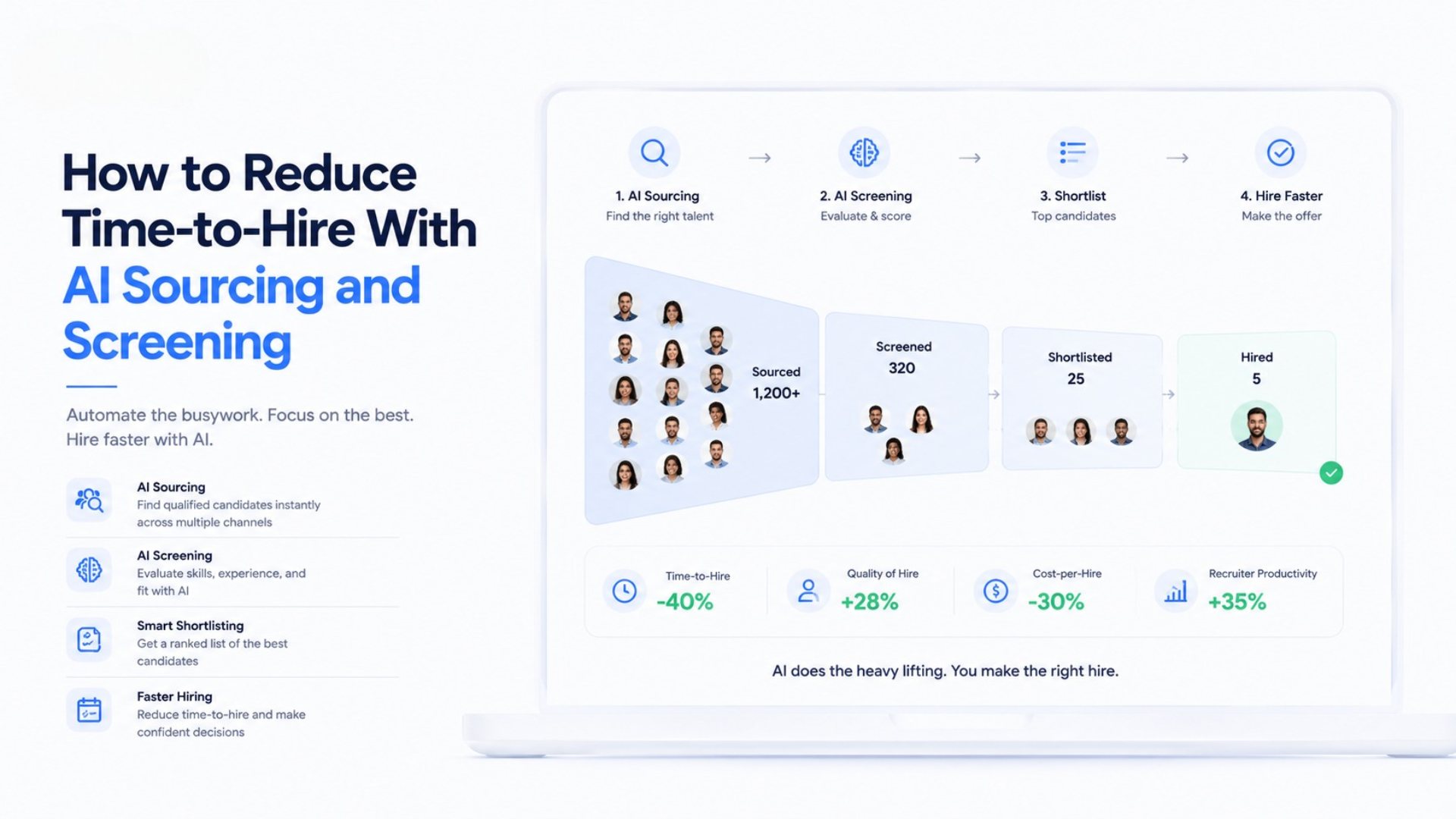
AI can reduce time-to-hire by shortening the time required to discover relevant candidates, begin engagement, qualify interest, conduct early screening, and move strong candidates toward human review.
The important word is shortening.
AI should not reduce time-to-hire by removing every human decision.
It should reduce the waiting and repetitive work between important decisions.
That distinction matters.
A company can move quickly and still make poor hires.
It can automate screening and still create a bad candidate experience.
It can generate thousands of profiles without producing one qualified conversation.
The objective is not simply to make recruiting faster.
It is to remove unnecessary time from the process while preserving the judgment that hiring requires.
What Is Time-to-Hire?
Time-to-hire measures how long it takes to move a candidate through the recruiting process.
Definitions can vary slightly between organizations, but the metric generally begins when a candidate enters the hiring pipeline and ends when that person accepts an offer.
This is different from time-to-fill.
Time-to-fill usually measures the broader period between opening or approving a vacancy and filling it.
Time-to-hire focuses more closely on the speed of the candidate journey.
If a candidate enters the pipeline on June 1 and accepts an offer on June 21, the time-to-hire is 20 days.
This makes the metric useful for identifying process friction.
How long does it take to find or attract the right person?
How long does the candidate wait before screening?
How quickly does the hiring manager review them?
How many days disappear between interviews?
How long does the final decision take?
According to SHRM, time-to-hire is useful as a recruiting health indicator, but speed should not be optimized in isolation. A faster process that reduces hiring quality is not necessarily a better process.
The goal is therefore not the lowest possible number.
It is the shortest responsible path between identifying a relevant candidate and reaching a good hiring decision.
Time-to-Hire vs. Time-to-Fill
These metrics are often confused.
Time-to-fill begins earlier.
The clock may start when the requisition is approved or opened and end when the candidate accepts the offer.
Time-to-hire begins when the successful candidate enters the recruiting pipeline.
Imagine a role remains open for ten days before the recruiter identifies the person who is eventually hired.
The candidate then spends another 20 days moving through screening, interviews, and the offer process.
The time-to-hire may be 20 days.
The time-to-fill may be 30 days.
The difference is useful because the metrics reveal different problems.
A long time-to-fill with a relatively short time-to-hire may indicate that candidate discovery is slow.
A long time-to-hire may indicate delays after candidates enter the process.
AI sourcing can help with the first problem.
AI screening and workflow automation can help with the second.
The strongest recruiting strategy looks at both.
Why Is Your Time-to-Hire So Long?
Slow hiring is usually the result of accumulated delays.
The sourcing team may take several days to produce a useful candidate market.
Recruiters may manually review hundreds of profiles.
Outreach may happen in batches because recruiters do not have time to personalize every message.
Follow-ups may be inconsistent.
Interested candidates may wait for a recruiter to notice their response.
Screening calls may be scheduled several days later.
Hiring managers may take too long to review candidates.
Interviews may require repeated calendar coordination.
Each delay appears small.
Together, they can add weeks.
This is why improving one stage does not always improve the complete hiring process.
A company may buy an AI sourcing tool and reduce candidate discovery from three days to three hours.
But if the recruiter still waits two days to begin outreach, five days to screen interested people, and another week to schedule interviews, the effect on time-to-hire remains limited.
The workflow is only as fast as its slowest repeated handoff.
The First Step: Find Where Time Is Actually Being Lost
Before adding AI, recruiting teams need to understand the current process.
Do not begin with:
“Which AI tool should we buy?”
Begin with:
“Where are candidates waiting?”
Measure the time between important stages.
How long does it take from role approval to the first relevant candidate?
How long between candidate discovery and first outreach?
How long between a positive reply and screening?
How long between screening and hiring-manager review?
How long between interview stages?
How long between the final interview and the offer?
This creates a much more useful picture than one average time-to-hire number.
A 35-day process does not tell you what to fix.
A process where candidates spend eight days waiting for hiring-manager feedback does.
AI should be applied to the bottleneck.
If candidate discovery takes too long, improve sourcing.
If qualified applicants are buried in volume, improve screening.
If interested candidates wait for recruiter responses, improve engagement workflows.
If interviews take a week to arrange, improve scheduling.
The best automation strategy begins with delay, not features.
How AI Sourcing Reduces Time-to-Hire
Traditional candidate sourcing is labour-intensive.
The recruiter needs to understand the role.
They translate the requirement into job titles, skills, companies, industries, locations, and keywords.
Searches are created.
Profiles are reviewed.
The search is refined.
More profiles are reviewed.
A shortlist is created.
For difficult roles, this can take days.
AI sourcing can shorten the process by interpreting the hiring requirement and identifying potentially relevant candidates more quickly.
Instead of manually constructing every search, the recruiter can increasingly begin with a description of the person they need.
The system can identify related job titles.
It can recognize adjacent skills.
It can search beyond exact keywords.
It can rank candidates according to estimated relevance.
This reduces the time between receiving a hiring requirement and reviewing potential candidates.
But faster search creates value only when the candidates are good enough to act on.
A list of 1,000 weak profiles does not reduce time-to-hire.
It creates more screening work.
The objective is to reduce the time to the first relevant candidate conversation.
That is a much better measure of AI sourcing performance.
Start Sourcing Before the Job Becomes Urgent
One of the most effective ways to reduce time-to-hire is to move candidate discovery earlier.
Most recruiting processes begin after the vacancy becomes urgent.
The role opens.
The search starts.
The company waits.
Talent pipelining changes this model.
Recruiters can identify roles that appear repeatedly, skills that are consistently difficult to find, and talent markets the company expects to need.
Potential candidates can be discovered before an immediate vacancy exists.
Relationships can be preserved.
Previous finalists can remain visible.
Sourced candidates who were not ready can be reconsidered.
When the next role opens, the recruiting team does not need to begin with an empty search.
This is especially useful for recurring hiring.
If a company hires the same type of salesperson, engineer, healthcare worker, or operational employee several times each year, restarting candidate discovery for every vacancy creates unnecessary delay.
A stronger model connects AI sourcing with talent pipelining.
The fastest candidate to find may be someone the company already knows.
Use AI to Rediscover Existing Candidates First
Many recruiting teams search externally too early.
A new role opens.
The recruiter immediately begins looking for new people.
Meanwhile, relevant candidates may already exist inside the ATS or recruiting CRM.
They may be previous applicants.
Former finalists.
Employee referrals.
Sourced candidates.
People who were interested in a different role.
Candidates who asked to reconnect later.
The problem is that traditional candidate databases are difficult to search.
Profiles are outdated.
Job titles vary.
Recruiters do not remember previous conversations.
Keyword searches may miss people who describe relevant experience differently.
AI can improve candidate rediscovery by comparing the new requirement with existing candidate information and surfacing potentially relevant people.
This can remove days from the beginning of the process.
The company has already discovered these candidates.
In some cases, it has already evaluated them.
A previous finalist may be much closer to an interview than a completely new prospect.
Before every external search, ask:
“Who do we already know?”
A useful candidate pool should reduce future sourcing work.
If it does not, the company has candidate storage rather than recruiting leverage.
Replace Manual Boolean Construction Where It Slows the Search
Boolean search remains useful.
But it can also create delay.
The recruiter needs to identify every relevant title.
They need to think of skill variations.
They need to build OR groups.
They need to add exclusions.
The search is run.
Results are reviewed.
The query is adjusted.
This process rewards sourcing expertise, but not every search needs to begin with manual syntax.
AI sourcing tools increasingly allow recruiters to describe a candidate in natural language.
The system interprets the requirement and searches for related evidence.
This can reduce the time spent translating a hiring need into a database query.
The recruiter still needs to review the results.
They still need to understand the talent market.
But less time is spent formatting the search.
This shift is explained in What Is Boolean Search in Recruiting (And Why AI Tools Are Replacing It)?.
The purpose of sourcing expertise is to find the right people.
It is not to spend the maximum possible time writing parentheses.
Move From Candidate Discovery to Outreach Immediately
One of the most common sourcing delays happens after the candidates are found.
A recruiter creates a shortlist.
The profiles sit in a project.
Outreach happens later.
Sometimes much later.
AI can reduce this gap by connecting candidate discovery with engagement.
Once relevant candidates are approved, outreach can begin without another long manual process.
Messages can be prepared using the role and candidate context.
Follow-ups can be scheduled.
Candidate activity can be organized.
This matters because passive candidates are not waiting for one recruiter.
A strong person may be contacted by several companies.
The team that begins a relevant conversation earlier can create an advantage.
But speed should not become indiscriminate volume.
Sending hundreds of generic messages quickly can damage the employer brand without producing better candidates.
The objective is faster relevant engagement.
Not faster spam.
Use Multi-Channel Outreach Carefully
Email is not the only candidate communication channel.
Depending on the role, market, and candidate relationship, recruiters may use professional networks, phone, SMS, WhatsApp, or other appropriate channels.
A multi-channel strategy can reduce time-to-hire when it makes candidates easier to reach.
The problem appears when every channel operates separately.
The recruiter sends an email.
Another tool sends a LinkedIn message.
A phone call happens.
The candidate replies somewhere else.
No system understands the complete relationship.
AI and workflow automation can help coordinate these interactions.
The candidate should not receive a follow-up on one channel after already declining on another.
A positive response should create an appropriate next action.
The recruiting team should preserve one candidate context.
For a deeper explanation, see What Is Multi-Channel Recruiting Outreach?.
The fastest outreach system is not the one that sends the most messages.
It is the one that recognizes when the conversation has moved forward.
Automate Follow-Ups Without Automating Judgment
Recruiters lose time because follow-ups are easy to forget.
A candidate does not respond.
The recruiter is managing 15 other tasks.
The conversation disappears.
Automated follow-ups can improve consistency.
But they need stopping rules.
If the candidate replies, the sequence should change.
If the person declines, communication should stop.
If the candidate asks to reconnect later, that context should be preserved.
If the role closes, irrelevant outreach should not continue.
This is where simple automation and intelligent workflow execution begin to differ.
A fixed sequence sends the next message because enough time has passed.
A better system considers what happened.
Time-to-hire improves when the recruiting workflow reacts faster to candidate signals.
It does not improve when automation creates more noise for recruiters to clean up.
How AI Screening Reduces Time-to-Hire
Sourcing improves the speed at which candidates enter the pipeline.
Screening improves the speed at which relevant candidates move through it.
Traditional screening creates several delays.
Recruiters manually review resumes.
Applications wait in queues.
Initial calls need to be scheduled.
The recruiter asks similar questions repeatedly.
Notes need to be written.
Candidates need to be compared.
Hiring managers wait for a shortlist.
AI can support this process by helping organize candidate information, compare experience with role requirements, conduct structured early qualification, summarize responses, and surface candidates for recruiter review.
The biggest opportunity is not replacing the recruiter.
It is reducing the amount of time strong candidates spend waiting before a human decides what should happen next.
Screen Against Clear Requirements
AI screening cannot fix an unclear hiring requirement.
If the hiring manager has not defined what matters, the system has no reliable basis for prioritization.
Before screening begins, the team should separate essential criteria from preferences.
What does the candidate genuinely need?
Which skills can be learned?
Which experience is evidence of success?
Which requirements are simply habits inherited from previous job descriptions?
This is important for speed.
Unclear requirements create repeated recruiter-hiring-manager discussions.
Candidates are submitted.
The manager rejects them for reasons that were never defined.
The recruiter changes the search.
More candidates are found.
Time disappears.
AI can make a broken requirement move faster.
That does not make the process better.
The first screening automation should therefore happen after the role is understood.
Use AI to Prioritize, Not Automatically Decide
A large applicant pool creates delay because recruiters cannot review everyone immediately.
AI can help prioritize candidates whose information appears most relevant to the role.
This can move stronger applicants toward review sooner.
But prioritization should not be confused with an autonomous hiring decision.
Recruiting is a high-impact process.
Candidate information can be incomplete.
Career paths are not always linear.
Job titles can be misleading.
People may have transferable experience that is difficult to capture through simple matching.
AI-supported screening should therefore help recruiters decide where attention is needed.
The system can organize evidence.
It can summarize information.
It can identify possible matches.
The recruiter should remain responsible for important judgments.
A useful explanation of this balance appears in What Is AI Candidate Screening and How Accurate Is It?.
The best screening system is not the one that removes humans from hiring.
It is the one that helps humans reach the right candidates faster.
Use Structured Early Screening for Repetitive Questions
Many initial screening calls contain the same questions.
Are you interested in the role?
What is your notice period?
Where are you located?
Are you open to the working model?
What relevant experience do you have?
What are your compensation expectations?
When can you interview?
Recruiters may repeat these conversations dozens of times.
AI-supported screening can help collect and organize this information earlier.
This is particularly useful in high-volume hiring, staffing, and roles with clear initial qualification criteria.
The candidate can provide structured information.
The system can summarize the response.
The recruiter can review the context before deciding what happens next.
This can reduce scheduling delays around basic qualification.
However, candidates should understand when they are interacting with an AI-supported process.
The experience should be appropriate for the role.
An automated early screen for a high-volume operational role may create value.
Using the same process for every senior executive candidate may not.
Speed should fit the hiring context.
Move Positive Candidate Signals Immediately
One of the largest opportunities in AI recruiting is response speed.
A candidate replies:
“Yes, I’m interested.”
What happens next?
In many recruiting teams, the answer is:
The recruiter notices the reply later.
They read the conversation.
They send a response.
They ask for availability.
The candidate replies again.
A call is scheduled.
Several days can disappear.
A connected AI workflow can shorten this process.
A positive response can trigger an appropriate next step.
The candidate can receive screening questions.
A recruiter can be alerted.
Relevant information can be collected.
A scheduling option can be offered.
The candidate can move forward while interest is still high.
This is where AI recruiting creates more value than isolated AI sourcing.
Finding candidates faster matters.
Reacting to candidates faster can matter even more.
Reduce the Gap Between Screening and Hiring-Manager Review
A strong candidate can move through sourcing and screening quickly and still wait several days for internal review.
This is not an AI sourcing problem.
It is a workflow problem.
The hiring manager may receive an email.
The recruiter may send a reminder.
Feedback may arrive in a chat message.
The ATS remains unchanged.
The candidate waits.
Recruiting teams should create clear review expectations.
What information does the hiring manager need?
How quickly should a candidate be reviewed?
Who can make a decision if the manager is unavailable?
AI can help prepare concise candidate summaries and organize screening evidence.
This reduces the amount of work required to understand the candidate.
But technology cannot solve unclear ownership.
If nobody is accountable for the next decision, the process will still be slow.
Automate Interview Scheduling
Scheduling is one of the least strategic parts of recruiting.
It is also one of the easiest places to lose several days.
The recruiter asks the candidate for availability.
The candidate replies.
Interviewers are unavailable.
New times are proposed.
Someone cancels.
The process begins again.
Scheduling automation can remove much of this coordination.
Once a candidate reaches the appropriate stage, available times can be offered.
Calendars can be checked.
Invitations can be created.
Reminders can be sent.
If the process requires several interviewers, the workflow can become more complex, but the principle remains the same.
Recruiters should not spend hours acting as human calendar APIs.
Every day removed from scheduling reduces candidate waiting time without reducing hiring quality.
Do Not Automate a Broken Interview Process
Some companies have long time-to-hire because they conduct too many interviews.
AI will not fix this.
If six people need to approve every candidate, the process will remain slow.
If three interview stages evaluate the same competency, the process contains unnecessary repetition.
If interviewers do not submit feedback quickly, candidates will continue waiting.
Before automating interviews, ask whether every stage is necessary.
What decision does each interview support?
What evidence is being collected?
Could two stages be combined?
Who has final decision authority?
The purpose of AI is not to help a bad process move slightly faster.
It is to remove unnecessary work from a well-designed process.
Build One Connected Sourcing and Screening Workflow
The largest gains in time-to-hire appear when recruiting stages are connected.
A disconnected workflow looks like this:
The sourcing tool finds candidates.
The recruiter exports profiles.
Another system finds contact information.
Outreach happens somewhere else.
Replies arrive in email.
Screening is scheduled manually.
Notes are stored separately.
The ATS is updated later.
Every transition requires recruiter work.
A connected workflow looks different.
The hiring requirement informs candidate discovery.
Relevant people move into engagement.
Candidate responses affect the next action.
Interested people move toward qualification.
Screening information is organized.
Strong candidates move toward human review.
Interviews are coordinated.
The recruiter remains involved in important decisions.
But the system handles more of the repeated movement between them.
This is the difference between using AI features and redesigning the hiring workflow.
A Practical AI Workflow for Reducing Time-to-Hire
The process begins with a clear hiring requirement.
The recruiter and hiring manager define essential criteria, flexible criteria, expected outcomes, and the evidence that would indicate a strong candidate.
AI sourcing then helps search both existing candidate data and the external talent market.
Relevant candidates are reviewed.
Approved candidates move into engagement.
Outreach begins without a long delay.
Follow-ups happen according to candidate activity.
Positive responses create an immediate next step.
Early qualification information is collected.
AI can summarize the candidate context.
The recruiter reviews the evidence.
Strong candidates move to the hiring manager.
Scheduling happens without repeated manual coordination.
The important change is continuity.
Each stage knows what happened before it.
The recruiter does not need to restart the workflow every time the candidate moves forward.
This is how AI reduces time-to-hire.
Not through one magical screening score.
Through dozens of smaller delays that no longer need to exist.
Where Huntlo Fits Into Reducing Time-to-Hire
Huntlo approaches time-to-hire as a workflow problem.
Candidate sourcing is one part of that problem.
AI can help recruiters discover passive talent faster.
But a faster candidate list does not create a faster hire if every step after discovery remains manual.
Huntlo’s agentic AI recruiting infrastructure is designed around the larger path from candidate discovery toward a qualified candidate conversation.
AI can support sourcing.
Candidate engagement can happen across appropriate channels.
Follow-ups can be coordinated.
Responses can influence the next action.
AI-supported qualification can help organize early candidate information.
Interview scheduling can happen with less manual coordination.
The objective is to reduce the amount of recruiter work between important recruiting decisions.
This matters because many recruiting teams already have enough tools.
Their problem is that recruiters still act as the integration layer.
They move candidate information.
They remember follow-ups.
They check responses.
They schedule calls.
They update systems.
They push the workflow forward.
Huntlo’s approach is to automate more of that execution while preserving human judgment where it matters.
The result is not simply faster sourcing.
It is a shorter path from hiring requirement to qualified candidate.
Why Agentic AI Can Reduce More Time Than Isolated AI Tools
Traditional recruiting automation is usually trigger-based.
A candidate enters a stage.
An email is sent.
Three days pass.
Another email is sent.
The workflow follows a fixed sequence.
Agentic AI introduces a more responsive model.
The system can interpret the hiring requirement.
It can help identify candidates.
It can respond to candidate activity.
It can decide which approved next action fits the workflow.
A positive reply may lead toward qualification.
A decline may stop outreach.
A request to reconnect later may preserve the candidate for future engagement.
A qualified candidate may move toward scheduling.
This reduces the need for a recruiter to manually trigger every step.
The difference is important for time-to-hire.
Many delays do not happen because the next action is difficult.
They happen because nobody has taken it yet.
Agentic systems can reduce this waiting.
How Much Can AI Reduce Time-to-Hire?
There is no responsible universal percentage.
The impact depends on where the current process is slow.
A company that already sources candidates quickly may gain little from another AI sourcing tool.
A high-volume employer with thousands of applications may gain more from screening automation.
An outbound recruiting team may gain more from faster engagement and follow-ups.
A company with a slow hiring-manager review process may see almost no improvement until internal decision-making changes.
This is why teams should avoid vendor claims that promise one universal reduction in time-to-hire.
Measure the current process.
Identify the bottleneck.
Apply AI.
Measure the stage again.
The most useful question is not:
“How much faster does AI make recruiting?”
It is:
“Which days disappeared from our process?”
How to Measure the Impact of AI on Time-to-Hire
Begin with the overall metric.
Then break it into stages.
Measure time to first relevant candidate.
Measure time from candidate identification to first outreach.
Measure time from positive response to screening.
Measure time from screening to hiring-manager review.
Measure time between interviews.
Measure time from final interview to offer.
This allows the recruiting team to understand whether AI is improving the process or simply creating more activity.
Candidate quality should be measured alongside speed.
A sourcing system that creates faster shortlists but lower interview conversion is not necessarily helping.
Candidate experience matters too.
Faster communication can improve the experience.
Excessive automated outreach can damage it.
Recruiter productivity should also be considered.
If time-to-hire remains similar but recruiters can manage twice as much work without reducing quality, the system may still create significant value.
The best evaluation uses several signals together.
Common Mistakes When Using AI to Reduce Time-to-Hire
The first mistake is optimizing sourcing alone.
Candidate discovery becomes faster.
Everything else remains unchanged.
The company now creates candidate backlogs more quickly.
The second mistake is automating unclear requirements.
AI moves faster, but the team still disagrees about what a strong candidate looks like.
The third mistake is measuring activity instead of progress.
More profiles.
More messages.
More screening calls.
None of these automatically means faster hiring.
The fourth mistake is removing human review from important decisions.
AI can prioritize and organize information.
Employment decisions still require responsible oversight.
The fifth mistake is ignoring candidate experience.
A candidate who moves quickly through an impersonal, confusing, or repetitive process may still leave.
The sixth mistake is buying disconnected tools.
If recruiters spend more time moving data between AI systems, the technology has created another workflow problem.
How to Reduce Time-to-Hire Without Reducing Quality
Speed and quality do not need to be opposites.
The key is to remove waiting rather than judgment.
Remove the days spent building repetitive searches.
Remove the gap between candidate discovery and outreach.
Remove forgotten follow-ups.
Remove the delay before basic qualification.
Remove unnecessary calendar coordination.
Remove duplicate data entry.
Remove repeated searches for candidates the company already knows.
Keep the work that improves the decision.
Role understanding.
Candidate judgment.
Important conversations.
Hiring-manager alignment.
Structured evaluation.
Human review.
The best AI recruiting workflow makes these activities easier to reach.
It does not try to eliminate them.
A 30-Day Plan to Reduce Time-to-Hire With AI
During the first week, map the current hiring process.
Choose one recurring role or hiring workflow.
Measure the time between every major stage.
Identify where candidates wait.
During the second week, select one or two bottlenecks.
Do not attempt to automate the entire recruiting function at once.
If sourcing is slow, test AI candidate discovery and rediscovery.
If screening is slow, test structured qualification and candidate prioritization.
During the third week, connect the workflow.
Define what should happen after a candidate is found.
Define what should happen after a positive reply.
Define when human review is required.
Define the stopping rules.
During the fourth week, compare the results.
Did the time to first relevant candidate improve?
Did positive candidates reach screening faster?
Did hiring managers receive stronger candidates sooner?
Did recruiters recover meaningful time?
Did candidate experience remain acceptable?
Then expand only what worked.
The Future of Time-to-Hire
AI sourcing is making candidate discovery faster.
AI screening is making early qualification faster.
Scheduling automation is reducing coordination.
Candidate rediscovery is making existing databases more useful.
Agentic AI is beginning to connect these stages.
This changes the main recruiting question.
The challenge is no longer only:
“How fast can we find candidates?”
It becomes:
“How quickly can the recruiting system recognize a good candidate signal and move it toward the right human decision?”
That is the future of hiring speed.
The best recruiting teams will not remove people from the process.
They will remove the waiting around people.
Conclusion: Reduce Waiting, Not Judgment
Reducing time-to-hire with AI requires more than faster candidate search.
AI sourcing can shorten the time required to discover passive candidates, search existing talent pools, move beyond manual Boolean construction, and begin engagement.
AI screening can help prioritize candidates, collect structured early information, summarize evidence, and move strong people toward recruiter review faster.
Workflow automation can reduce delays in follow-ups, response handling, hiring-manager review, and interview scheduling.
The largest improvement appears when these stages are connected.
A candidate should not wait because a recruiter forgot the next action.
A hiring manager should not wait because candidate information is scattered across systems.
A recruiter should not repeat the same search because previous candidate relationships cannot be rediscovered.
AI should remove these delays.
It should not remove the judgment required to understand the role, evaluate people, manage important relationships, and make responsible hiring decisions.
The goal is not the fastest possible hiring process.
It is the shortest responsible path to the right hire.
Frequently Asked Questions
What is time-to-hire?
Time-to-hire measures how long it takes a candidate to move from entering the recruiting pipeline to accepting an offer. Definitions can vary slightly between organizations.
What is the difference between time-to-hire and time-to-fill?
Time-to-fill usually begins when a job is opened or approved. Time-to-hire begins when the successful candidate enters the hiring pipeline.
How can AI reduce time-to-hire?
AI can reduce time-to-hire by accelerating candidate discovery, candidate rediscovery, outreach, follow-ups, screening, qualification, response handling, and interview scheduling.
How does AI sourcing improve hiring speed?
AI sourcing can interpret hiring requirements, identify related candidate experience, search beyond exact keywords, rank potential matches, and reduce the time required to create an initial shortlist.
How does AI screening reduce time-to-hire?
AI screening can help organize candidate information, prioritize relevant profiles, collect structured qualification information, summarize responses, and move strong candidates toward human review faster.
Can AI screening replace recruiters?
AI should support recruiter judgment rather than replace important human hiring decisions. It is most useful for prioritization, organization, structured early qualification, and reducing repetitive work.
Does faster hiring reduce quality?
Not necessarily. Reducing unnecessary waiting and administrative work can improve speed without reducing quality. Problems appear when companies rush important evaluation or remove appropriate human review.
What is the fastest way to reduce time-to-hire?
Identify the stage where candidates wait the longest. Improving the real bottleneck is usually more effective than adding automation to a stage that is already fast.
Should companies use AI sourcing or AI screening first?
It depends on the bottleneck. If the team struggles to find relevant candidates, begin with sourcing. If qualified applicants are delayed by volume or manual review, screening may create more value.
How should companies measure AI recruiting ROI?
Track time-to-hire alongside time to first relevant candidate, candidate response speed, screening-to-interview conversion, recruiter productivity, candidate quality, and candidate experience.
Related Topics
Learn how AI automates the beginning of candidate discovery in What Is Candidate Sourcing Automation?.
Understand how AI supports early candidate evaluation in What Is AI Candidate Screening and How Accurate Is It?.
See how proactive candidate relationships can reduce future hiring delays in What Is Talent Pipelining?.