Talent acquisition leaders at enterprise organizations — companies with 1,000 or more employees — are operating under pressures that their counterparts at smaller companies can barely imagine. They are managing hundreds of concurrent requisitions across multiple business units, geographies, and functional areas. They are hiring for roles that range from entry-level customer service representatives to senior vice presidents, each requiring different sourcing strategies, screening criteria, and assessment methodologies. They are navigating a complex web of compliance requirements that vary by country, state, and sometimes even city. And they are doing all of this with recruiting technology stacks that were assembled incrementally over years, resulting in fragmented systems that barely communicate with each other and require recruiters to toggle between six to ten different tools to move a single candidate from sourcing to offer.
According to SHRM's 2025 Talent Acquisition Benchmark Report, the average enterprise organization uses 7.4 separate recruiting technology tools, and 63 percent of TA leaders report that their technology stack creates more work for recruiters rather than less. The average time-to-fill for enterprise organizations is 47 days — nearly twice the 24-day average for small and mid-market companies, according to Society for Human Resource Management data. And the average cost-per-hire at the enterprise level is approximately $4,700 per position, driven largely by the overhead of managing complex, multi-tool recruiting processes.
These numbers represent a systemic failure not of recruiting talent but of recruiting infrastructure. Enterprise TA teams are staffed with experienced, capable professionals who are spending 40 to 50 percent of their time on administrative tasks — switching between systems, manually transferring candidate data, chasing hiring managers for feedback, and reconciling conflicting information across disconnected platforms. The G2 recruiting software buyer survey found that 71 percent of enterprise recruiters said they would be significantly more effective if they could reduce the number of tools they use daily to three or fewer.
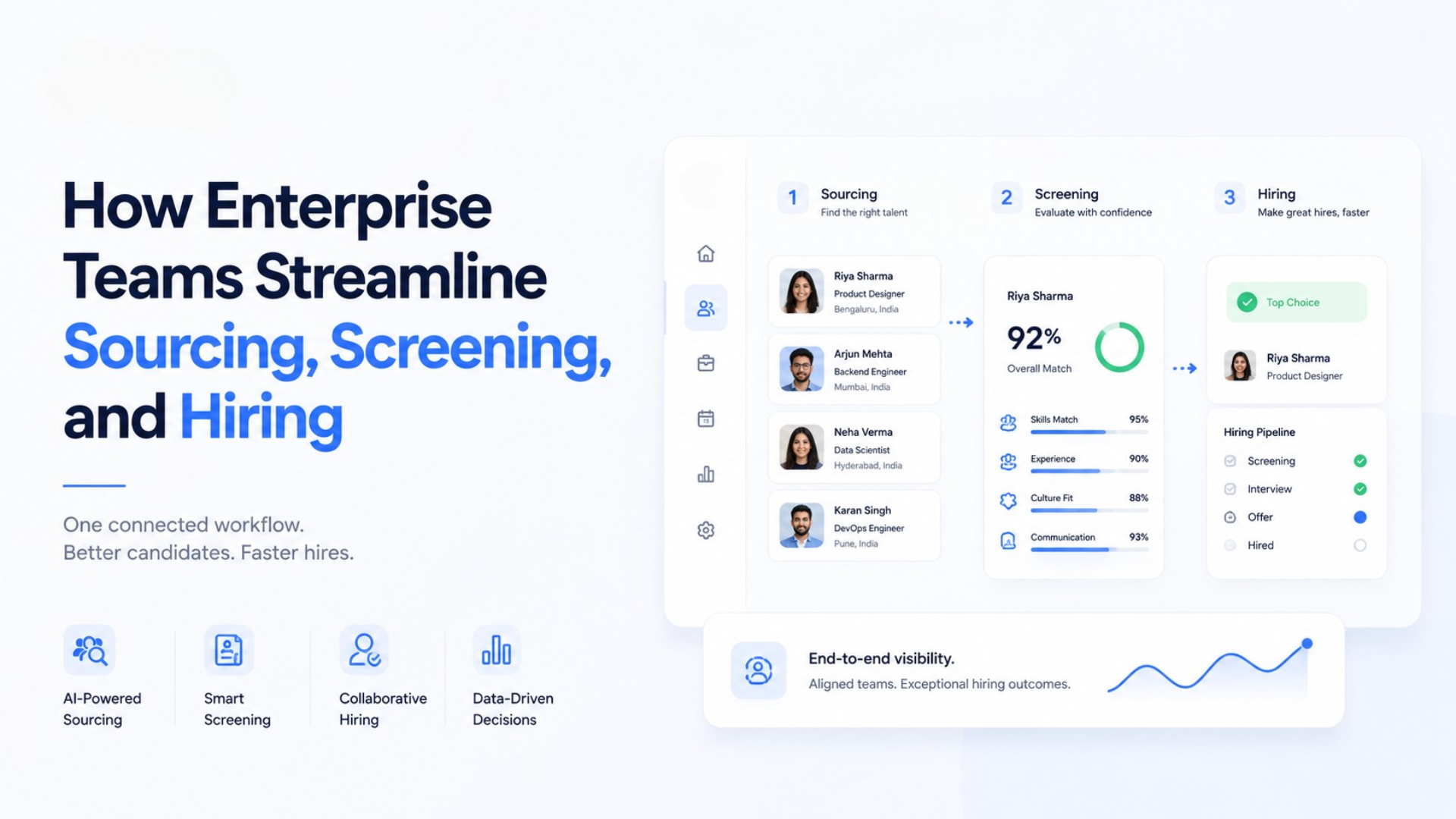
This guide provides a comprehensive framework for enterprise TA teams that want to streamline their entire recruiting workflow — from initial sourcing through final offer — by consolidating fragmented toolsets into a unified AI-powered platform that handles sourcing, screening, and engagement while integrating seamlessly with existing ATS infrastructure.
The Enterprise Recruiting Stack Problem: Why More Tools Means Less Efficiency
To understand the solution, it is essential to first understand why the current approach is failing. The enterprise recruiting technology stack did not arrive at its current state of fragmentation through poor decision-making. It evolved organically as individual needs arose over time, with each tool added to solve a specific problem without considering the broader system impact.
A typical enterprise TA stack might include the following components: an applicant tracking system like Workday, Greenhouse, Lever, or iCIMS as the central system of record; a LinkedIn Recruiter license for sourcing and outreach; subscriptions to job boards like Indeed, Glassdoor, and niche industry boards; a separate sourcing tool for finding passive candidates; an assessment platform for skills testing; a video interviewing tool; a background check vendor; a candidate relationship management platform; an analytics and reporting dashboard; and often one or two additional point solutions for specific needs like interview scheduling or offer management.
Each of these tools was acquired because it solved a real problem. The ATS organizes the hiring pipeline. LinkedIn provides access to the largest professional network. Job boards generate applicant volume. Assessment platforms provide objective skills data. Video interviewing tools enable asynchronous screening. But when these tools operate in isolation, connected by manual data entry and ad-hoc integrations, they create a workflow that is slower and more error-prone than any individual tool is helpful.
Consider the workflow for a single candidate in a typical fragmented enterprise stack. A recruiter identifies a candidate on LinkedIn, copies their profile information into the ATS, sends a message through LinkedIn Recruiter, waits for a response, copies the response into the ATS, schedules a screening call through a separate calendar tool, conducts the screening, enters screening notes into the ATS, sends the candidate an assessment link through the assessment platform, waits for results, copies the results into the ATS, presents the candidate to the hiring manager through the ATS, follows up with the hiring manager via email, collects interview feedback via email, enters the feedback into the ATS, and eventually — if the process gets this far — generates an offer through the ATS or a separate offer management tool. At every step in this workflow, data is being manually transferred between systems, creating opportunities for errors, delays, and information loss.
According to McKinsey's research on HR technology, enterprises that operate fragmented recruiting tech stacks spend an average of 14.2 hours per week per recruiter on administrative tasks related to tool management and data transfer — time that could be spent on higher-value activities like candidate engagement, hiring manager consultation, and strategic workforce planning.
The financial impact of this fragmentation is substantial. If an enterprise TA team has 30 recruiters, each spending 14 hours per week on administrative tool management, that is 420 hours per week of non-productive time. At a loaded cost of $50 per hour for an experienced corporate recruiter, that is $21,000 per week or roughly $1.1 million per year in wasted recruiter capacity. This is not a marginal inefficiency — it is a structural waste that no amount of recruiter training or process improvement can address without fundamentally changing the technology architecture.
The Unified Platform Approach: Sourcing, Screening, and Engagement in One System
The alternative to the fragmented multi-tool approach is a unified AI-powered platform that handles the three most time-intensive stages of the recruiting workflow — sourcing, screening, and candidate engagement — within a single system. This platform does not replace the ATS; it operates as an intelligent layer on top of it, feeding pre-qualified, pre-screened candidates directly into the existing pipeline through webhook or API integration.
Huntlo exemplifies this unified approach. For $99 per seat per month with no usage caps, it provides multi-source candidate sourcing across 50 or more talent platforms, automated personalized outreach across email, LinkedIn, WhatsApp, and AI voice calls, conversational AI screening that qualifies candidates against custom criteria, and a persistent talent pool that grows in value with every requisition. All of this feeds into the enterprise's existing ATS — Workday, Greenhouse, Lever, iCIMS, or any other platform — through webhook integration, so that recruiters continue to manage their pipeline in the system they already know while benefiting from dramatically improved top-of-funnel efficiency.
The G2 AI recruiting software grid shows that the market is increasingly moving toward this unified platform model. The tools that are growing fastest are those that combine sourcing, outreach, and screening into a single experience, rather than requiring enterprises to stitch together separate point solutions. This shift reflects a growing recognition among TA leaders that the problem is not a lack of individual tool capability — the market is saturated with capable tools — but a lack of workflow integration.
How AI Sourcing Streamlines the Enterprise Sourcing Workflow
Sourcing is the most labor-intensive stage of the enterprise recruiting process, and it is where AI platforms deliver their most dramatic efficiency gains. In a typical enterprise without AI sourcing, the process works as follows: a hiring manager submits a requisition, the recruiter reviews the requirements, the recruiter constructs boolean searches for LinkedIn Recruiter and any other sourcing tools, the recruiter manually reviews hundreds of profiles, the recruiter sends outreach messages to promising candidates one at a time, and the recruiter waits for responses over a period of days or weeks.
This process has several structural bottlenecks. First, the manual search construction is time-consuming and requires significant expertise. A well-constructed boolean search for a complex technical role might contain dozens of operators and take 30 to 45 minutes to build. Second, the review process is inherently slow — a recruiter can meaningfully evaluate perhaps 60 to 80 profiles per hour, and complex roles may require reviewing 500 or more profiles to identify 30 to 50 viable candidates. Third, the outreach process is sequential and limited in scale — even a highly productive recruiter can send 50 to 100 personalized messages per day, and each message requires several minutes of research and composition.
AI sourcing addresses all three bottlenecks simultaneously. When a recruiter creates a requisition in Huntlo with specific criteria — skills, experience level, industry, location, compensation range — the platform searches across 50 or more talent sources simultaneously and returns ranked, scored candidates within minutes. There is no boolean search construction, no manual profile review, and no sequential message sending. The AI handles the entire sourcing workflow from end to end.
The multi-source capability is particularly important for enterprise teams that hire across diverse functional areas and geographies. An enterprise that needs to hire software engineers in the United States, operations managers in India, and sales representatives in the Gulf cannot rely on a single sourcing channel. LinkedIn may be strong for US-based professionals but significantly weaker for operations talent in Tier 2 and Tier 3 Indian cities. Huntlo's guide to Tier 2 and Tier 3 city hiring in India demonstrates that AI platforms that aggregate regional job boards, local professional networks, and community platforms can find candidates in these markets that are completely invisible on LinkedIn.
The scale advantage is equally significant. An AI platform can source and outreach to thousands of candidates per day across all active requisitions simultaneously. For an enterprise with 100 open requisitions, this means that every requisition is receiving active sourcing attention every day — a level of coverage that would require a recruiting team of 15 to 20 people to achieve manually. According to LinkedIn's Global Talent Trends report, enterprises that use AI sourcing tools report a 55 percent increase in candidate pipeline volume and a 40 percent reduction in time-to-shortlist compared to manual sourcing approaches.
AI Screening: Replacing Manual Resume Review at Enterprise Scale
The screening stage is where enterprise recruiting bottlenecks are most acutely felt. When an enterprise posts a position on multiple job boards and receives 500 to 1,000 applications — a common volume for mid-level roles at well-known companies — the manual review process can take a single recruiter an entire week or more. For high-volume roles like customer service representatives, warehouse workers, or data entry clerks, application volumes can reach 5,000 to 10,000, creating screening backlogs that delay the entire hiring process by weeks.
Traditional screening methods fall into three categories, each with significant limitations. Keyword-based resume screening uses automated systems to filter resumes by specific terms, but this approach is notoriously unreliable — NIST research on resume screening accuracy has shown that keyword matching misses 30 to 40 percent of qualified candidates because their resumes use different terminology than the job description. Manual resume review by recruiters is more accurate but impossibly slow at enterprise volumes. Assessment-based screening, where candidates complete standardized tests, is effective but adds friction to the application process and reduces completion rates, particularly for passive candidates who are not highly motivated to complete lengthy assessments.
AI-powered conversational screening offers a fundamentally better approach. Instead of scanning resumes for keywords, the AI engages each candidate in a natural language conversation — asking about their experience, skills, availability, compensation expectations, location preferences, and other relevant qualifications. The conversation adapts dynamically based on the candidate's responses, following up on ambiguous answers and exploring relevant details. The result is a rich, qualitative assessment of each candidate that goes far beyond what keyword matching can achieve, delivered at a fraction of the time and cost of manual review.
For enterprise teams, the operational impact is transformative. A requisition that generates 800 applications can be fully screened by AI in a matter of hours, with each candidate receiving a structured screening summary and a fit score. Recruiters review only the candidates who passed the AI screening — typically 15 to 25 percent of the original pool — reducing their review burden from 800 profiles to 120 to 200 pre-qualified candidates. This is not a marginal improvement; it is a categorical shift in how screening scales.
The quality of AI screening has improved dramatically in recent years. Modern conversational AI systems achieve 85 to 90 percent agreement with human phone screeners on candidate qualification decisions, according to Harvard Business Review's analysis of AI in hiring. More importantly, AI screening eliminates the inconsistency that plagues manual screening — where two different recruiters reviewing the same resume might reach different conclusions based on their individual biases, experience levels, and interpretation of the requirements. The AI applies the same criteria consistently to every candidate, reducing the variance and improving the reliability of the screening process.
Multi-Channel Engagement: Reaching Enterprise Candidates Where They Are
Enterprise organizations hire across a wide range of geographies, industries, and candidate demographics, and no single communication channel reaches all of these segments effectively. Email is the standard for professional communication in the United States and Europe, but response rates for recruiting emails have been declining steadily as inboxes become more crowded. LinkedIn InMails generate reasonable response rates for some candidate segments but are expensive at scale — LinkedIn Recruiter Corporate licenses cost $170 to $270 per seat per month and InMail credits are limited. Phone calls are effective for senior candidates but too labor-intensive for volume hiring.
The most effective enterprise recruiting strategies use multiple channels simultaneously, adapting the channel mix to the candidate segment and geography. For technology candidates in the United States, a combination of email and LinkedIn outreach is typically most effective. For candidates in India, WhatsApp is a dominant communication channel and often generates significantly higher response rates than email or LinkedIn. For candidates in the Gulf Cooperation Council countries, WhatsApp is virtually mandatory — Huntlo's analysis of GCC hiring automation found that WhatsApp-based outreach generates response rates 40 to 60 percent higher than email for Gulf-based candidates.
Huntlo's multi-channel outreach capability — covering email, LinkedIn, WhatsApp, and AI voice calls — gives enterprise teams the ability to reach every candidate segment on their preferred channel without requiring separate tools, separate messaging workflows, or separate reporting dashboards. The AI adapts the message content, tone, and timing to each channel, ensuring that a WhatsApp message reads naturally in that format while an email follows professional email conventions.
The AI voice call capability deserves specific attention because it addresses a gap that most enterprise recruiting teams have accepted as unsolvable. Many candidates — particularly senior professionals, blue-collar workers, and candidates in markets where text-based communication is less common — simply do not respond to email or LinkedIn messages regardless of how well-crafted they are. An AI-powered voice call that reaches out to these candidates, introduces the opportunity, and schedules a follow-up conversation can generate responses from candidate segments that have been effectively unreachable through text-based channels alone. The Gartner HR technology predictions note that AI voice outreach is one of the fastest-growing capabilities in the recruiting technology market, with adoption rates doubling year over year.
ATS Integration: The Key to Enterprise Adoption
For enterprise TA teams, the most critical requirement for any new recruiting technology is how well it integrates with their existing ATS. Enterprise organizations have invested millions of dollars in ATS implementations — Workday, Greenhouse, Lever, iCIMS, SmartRecruiters, and others — and have spent years customizing workflows, building reporting dashboards, and training recruiters on these systems. Any new tool that requires recruiters to work outside the ATS or manually transfer data between systems will face significant adoption resistance regardless of its individual capabilities.
Huntlo addresses this through webhook-based integration that enables bidirectional data flow between the AI sourcing platform and the enterprise ATS. Candidates sourced and screened by the AI are automatically pushed into the ATS as pipeline candidates, complete with their screening summaries, fit scores, and engagement history. Hiring managers who review candidates in the ATS see the AI's qualification data alongside the recruiter's notes, providing a comprehensive view of each candidate without requiring them to log into a separate system.
This integration architecture is important because it preserves the enterprise's existing process infrastructure while adding a powerful new capability layer on top. Recruiters continue to manage their pipeline in the ATS they know. Hiring managers continue to provide feedback through their existing workflows. Reporting and analytics continue to be generated from the ATS data. The AI platform operates as an enhancement, not a replacement, which dramatically reduces the change management burden and accelerates adoption.
According to G2's integration benchmark data, ATS integration quality is the second most important evaluation criterion for enterprise buyers of recruiting technology, after sourcing capability itself. Platforms that offer robust, well-documented integrations with the major ATS platforms achieve 2.5 times higher adoption rates in enterprise environments compared to those that require manual data transfer or offer only basic CSV import/export.
Volume Hiring at Scale: How AI Handles Enterprise-Level Throughput
Many enterprise organizations have significant volume hiring needs — seasonal retail hiring, call center expansion, warehouse staffing, campus recruiting programs, and large-scale technology hiring initiatives that require filling 50 to 500 positions in a compressed timeframe. These volume hiring events are among the most stressful and resource-intensive activities in enterprise recruiting, often requiring the TA team to bring in temporary support, work extended hours, and accept lower quality standards in order to meet headcount targets.
AI sourcing platforms are uniquely suited to volume hiring because they eliminate the linear relationship between hiring volume and recruiter effort. In a manual process, filling 200 positions requires approximately four times the effort of filling 50 positions — each requisition must be sourced, screened, and managed individually. With an AI platform, the marginal cost of adding requisitions is near zero because the AI sources, screens, and engages candidates across all requisitions simultaneously without additional human effort.
Consider a practical example. A large e-commerce company needs to hire 300 warehouse workers and 50 customer service representatives for the holiday season, with all positions filled within 60 days. Using traditional methods, this would require a team of 10 to 15 recruiters working full-time for the entire period, supplemented by temporary staff and agency support. The total recruiting cost — including recruiter salaries, job board postings, agency fees, and technology subscriptions — could easily exceed $500,000.
Using an AI sourcing platform, the same volume can be handled by a team of three to four recruiters managing the AI system. The AI sources candidates from 50-plus platforms simultaneously, sends personalized outreach across email, WhatsApp, and SMS, conducts AI screening conversations, and presents qualified candidates to the managing recruiters for final review. The recruiters focus on high-value activities — reviewing shortlisted candidates, conducting brief interviews, and managing the offer process — while the AI handles the repetitive, high-volume work. The platform cost at $99 per seat per month for four seats is $396 per month, or roughly $800 for the entire two-month engagement. Even adding the cost of the managing recruiters' time, the total is a fraction of the traditional approach.
The National Retail Federation's seasonal hiring research indicates that large retailers spend an average of $1,200 to $1,800 per seasonal hire when using traditional recruiting methods. AI-powered approaches have demonstrated the ability to reduce this to $300 to $600 per hire, primarily through the elimination of agency fees, job board costs, and the overhead of managing large temporary recruiting teams.
Compliance at Enterprise Scale: Multi-Jurisdiction Requirements
Enterprise organizations operate across multiple jurisdictions, each with its own set of recruiting compliance requirements. A US-based company with operations in the European Union, India, and the Gulf must comply with the GDPR in Europe, the Digital Personal Data Protection Act in India, various US state-level regulations including California's CCPA and New York City's Local Law 144, and the labor laws and data protection requirements of each Gulf state. Navigating this patchwork of regulations is one of the most complex challenges in enterprise talent acquisition.
AI sourcing platforms that serve enterprise clients must be built with compliance as a foundational requirement, not an add-on feature. Huntlo provides data processing agreements for GDPR compliance, consent management workflows for jurisdictions that require explicit candidate consent, data deletion capabilities that allow candidates to exercise their right to erasure, and audit trails that document how candidate data was collected, processed, and stored. These capabilities are essential for enterprises that are subject to regulatory scrutiny and cannot afford the reputational and financial consequences of a data privacy violation.
The compliance challenge extends beyond data privacy to include anti-discrimination protections. AI screening tools must be regularly audited to ensure that their algorithms do not introduce or amplify bias based on race, gender, age, or other protected characteristics. The EEOC's guidance on AI and employment discrimination emphasizes that employers are responsible for the decisions made by their AI tools, even when those tools are provided by third-party vendors. Enterprises should require their AI sourcing vendors to provide regular bias audits, algorithmic transparency reports, and the ability to adjust screening criteria to ensure equitable outcomes.
For enterprises operating in India specifically, the compliance landscape has become significantly more complex with the enactment of the Digital Personal Data Protection Act in 2023. Huntlo's compliance guide for Indian recruiters provides a detailed framework for navigating these requirements, including consent management workflows, data localization considerations, and the specific obligations that apply to data fiduciaries processing candidate information.
Change Management: Getting Enterprise Recruiters to Adopt New Tools
The biggest barrier to adopting any new recruiting technology in an enterprise environment is not the technology itself — it is the change management required to get recruiters to actually use it. Enterprise recruiters are often deeply attached to their existing workflows, skeptical of new tools that promise to "transform" their work, and resistant to changes that disrupt their established relationships with hiring managers and candidates.
According to Prosci's benchmarking data on organizational change management, 70 percent of change initiatives fail to achieve their objectives, and the primary reason for failure is employee resistance. In the recruiting context, this resistance often manifests as continued use of legacy tools alongside the new platform, selective adoption of only the simplest features, or outright rejection of the new system in favor of familiar manual processes.
Successful enterprise adoption of AI sourcing platforms requires a structured change management approach that addresses three key dimensions: awareness, capability, and motivation.
Awareness means ensuring that every recruiter understands why the new platform is being introduced, what problems it solves, and how it will change their daily work. This is not a one-time announcement — it is an ongoing communication campaign that connects the platform adoption to the team's strategic goals. When recruiters understand that the platform is being introduced to reduce their administrative burden and free up time for the candidate engagement work they actually enjoy, resistance decreases significantly. Huntlo's guide to change management for recruiters adopting AI tools recommends framing the introduction as "eliminating the work you don't want to do" rather than "changing how you do your work."
Capability means providing comprehensive training and ongoing support that builds recruiters' confidence in using the new platform. This should include hands-on training sessions, documented best practices for common scenarios, access to power users who can answer questions in real-time, and a feedback mechanism that allows recruiters to report issues and suggest improvements. Training should not be a single event — it should be an ongoing program that evolves as the team's usage matures and new features are introduced.
Motivation means creating incentives for adoption that align with recruiters' professional goals and performance metrics. If recruiters are measured on time-to-fill, demonstrate how the platform reduces time-to-fill and adjust their targets accordingly. If they are measured on candidate quality, show how the platform improves screening accuracy and increases interview-to-offer conversion rates. If they are measured on hiring manager satisfaction, highlight how the platform's pre-qualified candidates reduce the time hiring managers spend reviewing unqualified applicants. When the platform is connected to the metrics that recruiters care about, adoption becomes self-reinforcing.
Enterprise Cost Analysis: AI Platform vs. Traditional Stack
For enterprise TA leaders building a business case for AI sourcing adoption, a detailed cost comparison is essential. The following analysis compares the total cost of ownership for a traditional enterprise recruiting tech stack against a streamlined stack built around Huntlo as the sourcing, screening, and engagement layer.
Traditional enterprise stack (per recruiter, per year):
LinkedIn Recruiter Corporate license: approximately $2,400 to $3,240 per year. Indeed employer subscription: approximately $1,200 to $3,600 per year depending on posting volume. Glassdoor employer subscription: approximately $600 to $1,200 per year. Standalone sourcing tool (hireEZ, SeekOut, or similar): approximately $1,788 to $6,000 per year. Assessment platform: approximately $500 to $2,000 per year. Video interviewing tool: approximately $300 to $1,000 per year. CRM or candidate engagement platform: approximately $600 to $1,800 per year. ATS license (allocated per recruiter): approximately $1,000 to $3,000 per year.
Total estimated annual cost per recruiter: $8,388 to $21,840. For a team of 30 recruiters, the annual technology cost is $251,640 to $655,200.
Streamlined stack with Huntlo (per recruiter, per year):
Huntlo license: $1,188 per year ($99 per month, no usage caps). ATS license (retained as the system of record): approximately $1,000 to $3,000 per year.
Total estimated annual cost per recruiter: $2,188 to $4,188. For a team of 30 recruiters, the annual technology cost is $65,640 to $125,640.
The annual savings range from $186,000 to $529,560 for a 30-person team — savings that come not from cutting capabilities but from eliminating redundancy. Huntlo replaces the LinkedIn Recruiter license (sourcing and outreach), the standalone sourcing tool, the CRM, and the assessment screening layer, while the ATS remains as the central pipeline management system. The functionality is preserved or enhanced; the cost is dramatically reduced.
These savings do not account for the productivity gains from reduced tool-switching, faster time-to-fill, or improved candidate quality — all of which represent additional financial value. A G2 total cost of ownership study estimated that when productivity gains are included, the total ROI of consolidating enterprise recruiting tools ranges from 300 to 500 percent in the first year.
Hiring Manager Collaboration: The Often-Overlooked Bottleneck
Streamlining the recruiting workflow is not just about technology — it is about the human collaboration between recruiters and hiring managers, which is often the biggest bottleneck in enterprise hiring. According to LinkedIn's hiring manager research, the average time between a recruiter presenting a candidate to a hiring manager and receiving feedback is 3.2 business days. For a hiring process with three to four interview rounds, hiring manager delays can add 10 to 15 business days to the total time-to-fill, even when the recruiting team is operating at peak efficiency.
AI sourcing platforms address this bottleneck in several ways. First, by pre-qualifying candidates through AI screening, the platform ensures that hiring managers only review candidates who have already been vetted against the role requirements. This increases the likelihood that hiring managers will engage promptly because they trust that the candidates they are seeing are genuinely qualified. According to SmartRecruiters' hiring manager benchmark data, hiring managers are 2.3 times more likely to provide timely feedback on candidates who have been pre-screened compared to unvetted applicants.
Second, the AI platform's structured screening summaries give hiring managers a consistent, easy-to-digest format for evaluating candidates. Instead of reading through a lengthy resume and trying to determine relevance, the hiring manager sees a concise summary that highlights the candidate's qualifications, screening responses, and fit score — enabling faster evaluation and more confident decision-making.
Third, the platform's talent pool capability allows recruiters to present candidates from previous searches who were not a fit at the time but match the current role. This means that hiring managers may receive qualified candidates within hours of a new requisition being opened, rather than waiting days or weeks for the sourcing process to generate a pipeline. Josh Bersin's analysis of talent pool ROI estimates that talent pool-driven hiring reduces the time from requisition to first interview by 60 to 70 percent.
Talent Pool Intelligence: The Enterprise's Long-Term Recruiting Asset
The most strategically valuable feature of an AI sourcing platform for enterprise teams is not any individual capability but the compounding intelligence that accumulates in the talent pool over time. Every candidate sourced, every screening conversation conducted, every outreach message sent, and every hiring outcome recorded adds to a growing dataset that makes the platform progressively more effective.
For enterprise organizations with ongoing, large-scale hiring needs, this compounding effect is transformative. After six months of systematic use, an enterprise team's talent pool might contain 50,000 to 100,000 engaged, partially-qualified candidates. After a year, that number could reach 200,000 or more. When a new requisition is opened, the AI searches this pool first and often finds matches instantly — candidates who were identified during previous searches for different roles, who may have been unavailable at the time but are now ready to make a move.
This talent pool becomes a genuine strategic asset, comparable in value to a customer database for a sales organization. It provides the enterprise with talent market intelligence — understanding of where specific types of candidates can be found, what compensation ranges they expect, which channels they respond to, and how long typical hiring timelines are. It enables proactive workforce planning, where the TA team can anticipate hiring needs based on business growth projections and begin building candidate relationships months before a requisition is formally opened.
The competitive moat created by a deep, well-managed talent pool is difficult for competitors to replicate. A competing company that starts sourcing for the same roles from scratch will take months to build a comparable pipeline, while the enterprise with the existing talent pool can begin presenting qualified candidates within days. In talent markets where the best candidates are hired quickly, this time advantage is often the difference between securing a top performer and settling for the remaining available talent.
Measuring Success: KPIs for Enterprise AI Sourcing Implementation
For enterprise TA leaders who need to demonstrate the ROI of their AI sourcing investment, the following key performance indicators provide a comprehensive framework for measurement.
Time-to-shortlist. The number of days from requisition approval to the presentation of a qualified candidate shortlist to the hiring manager. AI sourcing typically reduces this metric by 50 to 65 percent by automating the sourcing and screening workflow.
Response rate. The percentage of candidates who respond positively to initial outreach. AI-personalized outreach typically achieves 15 to 25 percent response rates, compared to 5 to 10 percent for generic messages sent through LinkedIn Recruiter or email.
Screening-to-interview conversion. The percentage of AI-screened candidates who are advanced to an interview with the hiring manager. A healthy conversion rate is 30 to 40 percent, indicating that the AI's screening criteria are well-calibrated to the role requirements.
Time-to-fill. The total number of days from requisition approval to accepted offer. AI sourcing typically reduces enterprise time-to-fill by 35 to 50 percent, primarily through faster sourcing, faster screening, and faster hiring manager engagement.
Cost-per-hire. The total recruiting cost divided by the number of hires. AI sourcing typically reduces enterprise cost-per-hire by 40 to 60 percent by eliminating agency fees, reducing job board spend, and increasing recruiter productivity.
Quality of hire. Measured through new hire performance ratings, retention rates at 6 and 12 months, and hiring manager satisfaction scores. AI sourcing typically improves quality of hire by 15 to 25 percent by enabling more thorough candidate evaluation and reducing the pressure to make compromises due to pipeline scarcity.
Huntlo's ROI calculation framework provides a detailed methodology for translating these metrics into financial terms that enterprise CFOs and procurement teams can evaluate.
The Road Ahead: AI-Driven Recruiting in the Enterprise
The enterprise talent acquisition function is in the early stages of a fundamental transformation. The fragmented, tool-heavy, recruiter-labor-intensive model that has defined enterprise recruiting for the past two decades is being replaced by a streamlined, AI-augmented model that delivers better results at lower cost.
The technology will continue to evolve rapidly. Predictive hiring analytics will enable enterprises to forecast candidate success with greater accuracy. AI-generated job descriptions will optimize for both candidate quality and diversity. Intelligent scheduling systems will coordinate multi-round interview processes across global time zones without human involvement. And talent pool intelligence will become a core enterprise asset, as strategically important as customer data or financial modeling.
The enterprises that invest in building this capability now — consolidating their tech stacks, adopting AI sourcing platforms, and developing the internal expertise to optimize these systems — will build a recruiting function that is not just more efficient but fundamentally more strategic. They will hire faster, hire better, and hire at lower cost than their competitors. They will attract top talent because their candidate experience is fast, professional, and respectful. And they will build talent intelligence assets that compound in value over time, creating a competitive advantage that becomes increasingly difficult to replicate.
The question for enterprise TA leaders is no longer whether to adopt AI sourcing, but how quickly they can implement it effectively. Every month of delay is a month of wasted recruiter capacity, inflated cost-per-hire, and slow time-to-fill that the competition is not experiencing. The technology is ready. The business case is clear. The only remaining variable is the speed of execution.
Related Topics:
AI Sourcing Tool Implementation Mistakes That Cost Agencies Time and Money
Change Management for Recruiters Adopting New AI Tools Smoothly