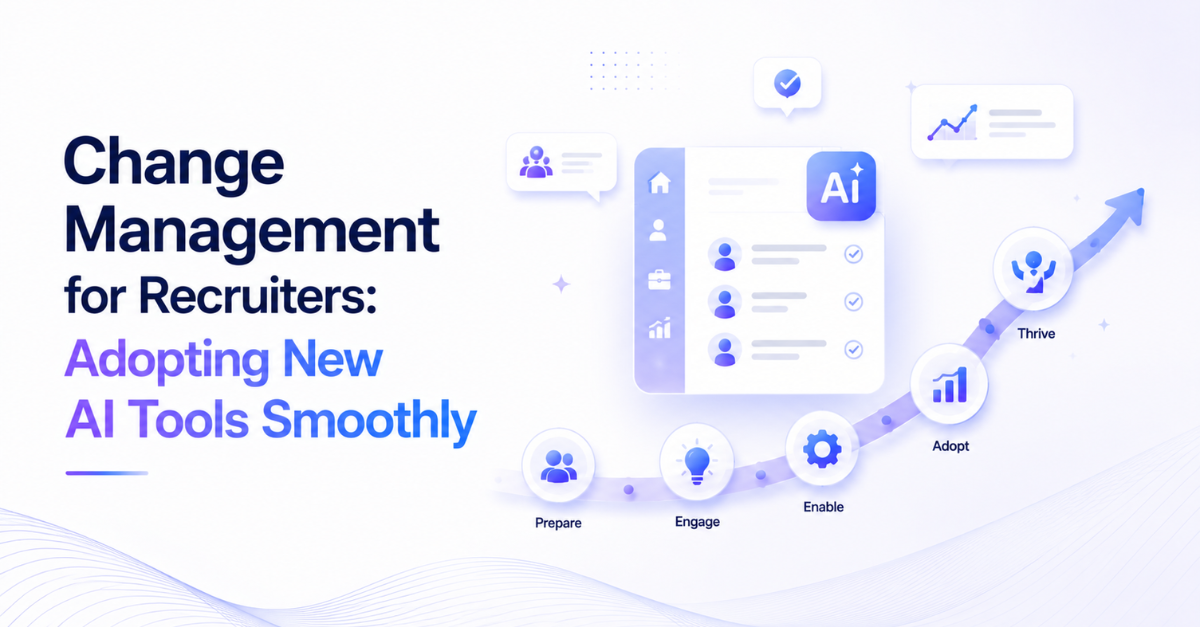
AI is changing how recruitment teams discover candidates, manage pipelines, communicate with talent, and deliver hiring outcomes.
But implementing an AI recruiting tool is not as simple as buying software and expecting instant results.
Many organizations invest in AI recruitment technology but fail to achieve the expected impact because the biggest challenge is not the technology.
It is adoption.
Recruiters have established workflows, familiar processes, and years of experience doing things a certain way. Introducing AI changes how they work — and without the right change management approach, even the best AI recruiting platform can become another unused tool.
The future of recruiting is not about replacing recruiters with AI.
It is about building teams where recruiters and AI systems work together to create faster, smarter, and more scalable hiring operations.
Why AI Adoption Fails in Recruiting
Technology Is Not the Problem
Most AI recruitment tools are designed to improve productivity.
They can help teams:
Find relevant candidates faster
Automate repetitive sourcing tasks
Improve candidate engagement
Reduce manual follow-ups
Create better hiring workflows
However, buying an AI tool does not automatically create transformation.
A recruitment team may have access to advanced AI capabilities but still continue using old manual processes.
This creates the biggest adoption gap:
The company owns AI, but recruiters are not using AI.
Successful AI adoption requires more than implementation.
It requires:
Workflow changes
Training
Leadership support
Continuous improvement
Human Behavior Matters More Than Technology
Recruiters are not resistant to AI because they dislike innovation.
Resistance usually comes from uncertainty.
Common concerns include:
"Will AI replace my job?"
"Is this tool difficult to learn?"
"Will AI understand my hiring requirements?"
"Will I lose control over candidate decisions?"
These concerns are normal.
The goal of change management is not forcing recruiters to use AI.
The goal is helping them understand how AI makes their work better.
A successful AI recruiting transformation positions AI as:
A recruiting assistant, not a replacement.
Common Recruiter Concerns About AI
Fear of Replacement
One of the biggest barriers to AI adoption for recruiters is the fear that automation will eliminate human roles.
But recruitment requires skills AI cannot replace:
Relationship building
Candidate conversations
Negotiation
Hiring judgment
Client management
AI is better suited for repetitive operational tasks.
For example:
AI can help with:
Candidate discovery
Resume analysis
Outreach automation
Scheduling
Follow-ups
Recruiters can focus on:
Building trust
Understanding candidates
Advising hiring managers
Closing placements
The future recruiter is not replaced by AI.
The future recruiter is AI-enabled.
Learning Curve and Workflow Disruption
Every new AI recruiting tool introduces a learning curve.
Recruiters need to understand:
What tasks AI can automate
When to trust AI recommendations
How to review AI-generated outputs
How AI fits into daily workflows
A common mistake companies make is providing feature training only.
They teach:
"Click this button to find candidates."
But successful adoption requires workflow training:
"Here is how your recruiting process changes with AI."
Building an AI Adoption Strategy
A successful AI implementation needs a clear adoption plan.
1. Define the Purpose Before Launch
Before introducing any AI recruitment software, teams should answer:
Why are we adopting AI?
Possible goals:
Reduce sourcing time
Improve candidate quality
Increase recruiter capacity
Improve client delivery speed
Reduce operational workload
Without a clear objective, recruiters see AI as another tool instead of a solution.
2. Align Leadership Expectations
AI adoption starts from leadership.
Recruitment leaders should communicate:
Why AI is being introduced
What problems it solves
How success will be measured
How recruiter roles will evolve
Teams adopt faster when they understand the bigger picture.
The message should be:
"We are not adding more software. We are improving how recruitment works."
Training Recruiters for AI Workflows
AI training should focus on changing daily habits.
A successful recruiter AI training program includes:
Candidate Sourcing Workflows
Recruiters should learn how AI helps them:
Identify better-fit candidates
Search using natural language
Prioritize high-intent profiles
Reduce manual research
Instead of spending hours searching, recruiters can spend more time engaging.
Candidate Engagement Workflows
AI can support:
Personalized outreach
Follow-up reminders
Candidate communication
Engagement tracking
Recruiters should understand where automation helps and where human interaction matters.
Decision-Making Workflows
AI should support recruiter decisions, not replace them.
Recruiters need to learn how to:
Review AI recommendations
Validate candidate fit
Combine AI insights with experience
The best results come from human expertise + AI intelligence.
Creating AI Champions Inside Recruiting Teams
Not every recruiter will adopt AI at the same speed.
A practical approach is creating internal AI champions.
These are recruiters who:
Experiment early
Learn workflows quickly
Share best practices
Help teammates
Peer learning often works better than top-down training.
When recruiters see teammates getting value from AI, adoption becomes easier.
Measuring AI Adoption Success
AI adoption should not only be measured by login activity.
Real success comes from business impact.
Usage Metrics
Track:
Number of AI-assisted searches
Automation usage
Workflow completion
Recruiter engagement
These show whether teams are actually using the platform.
Business Metrics
Measure:
Time-to-submit
Time-to-fill
Candidate response rate
Interview conversion
Placement success
Recruiter productivity
The goal is not more AI usage.
The goal is better recruiting outcomes.
Why AI Tool Adoption Requires Workflow Transformation
A common mistake is adding AI on top of existing processes.
This creates complexity.
For example:
Old process:
Recruiter searches → manually contacts candidates → tracks responses → updates systems
AI-powered process:
AI identifies candidates → automates engagement → tracks interactions → provides insights
The difference is not the tool.
The difference is the workflow.
The Future of AI-Native Recruiting Teams
Recruiting is moving from manual execution toward intelligent operations.
The next generation of hiring teams will use:
AI sourcing
Automated workflows
AI candidate engagement
Intelligent recommendations
Recruiting AI agents
This evolution is creating a new model:
Agentic AI Recruiting Infrastructure
Instead of recruiters managing every repetitive task manually, AI agents handle operational work while recruiters focus on strategic decisions.
Human + AI Collaboration Is the Future
The strongest recruitment teams will combine:
Human strengths:
Judgment
Relationships
Communication
Strategy
AI strengths:
Speed
Automation
Data processing
Pattern recognition
Together, they create recruiting operations that are faster and more scalable.
How Huntlo Helps Teams Adopt AI Recruiting Workflows
Huntlo helps recruitment teams move beyond basic AI tools into AI-powered recruiting operations.
With AI-driven workflows, teams can:
Automate repetitive recruiting tasks
Improve candidate engagement
Increase recruiter productivity
Build scalable hiring operations
AI works best when it becomes part of the recruiting system — not just another platform.
FAQ
1. How do recruiters adopt AI tools?
Recruiters adopt AI successfully when companies provide proper training, clear workflows, leadership support, and measurable goals.
2. Why do recruiters resist AI?
Recruiters usually resist AI because of uncertainty, lack of training, or fear that automation will replace their role.
3. How do you manage AI change in recruitment?
Successful AI change management requires communication, training, AI champions, and gradual workflow transformation.
4. What training do recruiters need for AI?
Recruiters need training on AI workflows, automation usage, reviewing AI outputs, and collaborating with AI systems.
5. How long does AI adoption take?
AI adoption depends on team size, workflow complexity, and training. Most teams improve adoption gradually through structured implementation.
6. How do you measure AI adoption?
Measure both usage metrics and business outcomes such as productivity improvements, faster hiring, and better candidate engagement.
7. Can AI replace recruiters?
AI can automate repetitive tasks but cannot replace human judgment, relationships, and strategic hiring decisions.
8. What skills will future recruiters need?
Future recruiters will need AI collaboration skills, workflow thinking, data interpretation, and strong relationship-building abilities.
9. What is Agentic AI recruiting?
Agentic AI recruiting uses AI agents that can perform recruiting workflows autonomously while supporting recruiter decisions.
10. How do companies build AI-ready recruiting teams?
Companies build AI-ready teams by combining technology adoption, training, workflow redesign, and continuous improvement.
Final Thoughts
AI adoption in recruitment is not a technology project.
It is a transformation of how recruiting teams operate.
The companies that succeed will not simply buy AI recruiting tools.
They will redesign workflows where recruiters and AI work together.
The future belongs to teams that build Agentic AI Recruiting Infrastructure — where automation handles repetitive execution and recruiters focus on the human side of hiring.
Turn your recruiting team from AI users into AI-powered operators.
→ Book a Huntlo Demo
Related Topic
How to Train Your Team on a New AI Sourcing Platform
How Long Does It Take to See Results from a New AI Sourcing Tool?
7 Common Mistakes Recruiters Make When Switching to AI Sourcing Tools