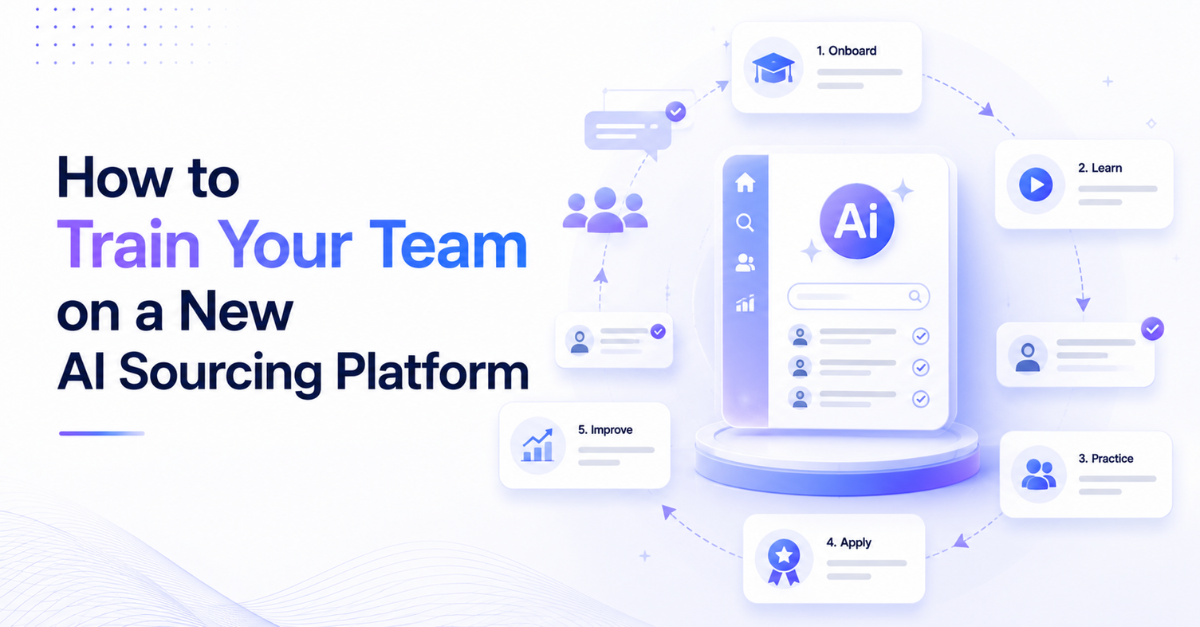
Buying an AI sourcing platform is easy.
Getting recruiters to actually use it effectively is where the real transformation happens.
Many recruitment teams invest in AI tools expecting immediate productivity gains. But without proper training, adoption slows down, recruiters return to old processes, and the expected ROI never appears.
The difference between successful and failed AI adoption is not the software.
It is how well the team learns to work with AI.
Modern recruiting teams are moving from:
Manual sourcing → AI-assisted workflows → Agentic AI recruiting operations
The goal is not to replace recruiters.
The goal is to help recruiters spend less time on repetitive execution and more time on high-value hiring decisions.
Key Takeaways
AI adoption requires workflow change, not just tool training.
Recruiters need to understand how AI improves their daily work.
Training should focus on outcomes, not features.
Successful teams measure adoption and business impact.
The future recruiter will collaborate with AI systems, not compete with them.
Why AI Tool Training Matters
Buying AI vs Adopting AI
Many companies assume purchasing an AI sourcing platform automatically creates value.
It does not.
A platform only creates ROI when recruiters:
Use it consistently
Trust its recommendations
Integrate it into daily workflows
Measure improvements
A recruiter who uses AI once a week will not generate the same impact as a recruiter who builds AI into every hiring workflow.
The real transformation happens when AI becomes part of the recruiting operating system.
The AI Adoption Gap
Most failed AI implementations follow a similar pattern:
Step 1: Company buys AI software
Step 2: Team receives basic product training
Step 3: Recruiters continue old processes
Step 4: Usage declines
Step 5: Leadership questions ROI
The issue is rarely the technology.
The issue is that teams were trained on buttons instead of workflows.
Common AI Training Mistakes
Mistake 1: Feature-Only Training
A common approach is:
"Here is how to search candidates."
"Here is how to generate messages."
"Here is how to export profiles."
But recruiters need more than feature knowledge.
They need to understand:
When should AI be used?
Which tasks should AI handle?
Which decisions require human judgment?
How does AI fit into existing workflows?
Mistake 2: No Workflow Redesign
Adding AI into an old recruiting process creates limited results.
Example:
Old workflow:
Recruiter searches → reviews profiles → manually messages → follows up → schedules
AI-powered workflow:
AI discovers → AI prioritizes → AI drafts outreach → AI manages follow-ups → recruiter focuses on conversations
The biggest productivity gains come from redesigning the process.
Step 1 — Prepare Your Team Before Launch
Before introducing an AI sourcing platform, align the team around the purpose.
Explain the "Why"
Recruiters should understand:
Why the company adopted AI
What problems it solves
How it improves their work
Avoid positioning AI as:
"Automation to reduce recruiter work."
Instead:
"AI removes repetitive tasks so recruiters can focus on better hiring outcomes."
Set Clear Expectations
AI should be introduced as a collaboration tool.
Recruiters still own:
Candidate relationships
Hiring decisions
Stakeholder communication
Quality assessment
AI supports:
Research
Repetitive workflows
Data processing
Administrative tasks
Step 2 — Train Recruiters on AI Workflows
Training should follow the recruiting lifecycle.
AI-Powered Candidate Sourcing
Teach recruiters how AI improves:
Candidate discovery
Profile matching
Talent search
Market mapping
The objective is not:
"Find more profiles."
The objective is:
"Find relevant candidates faster."
AI Candidate Engagement
Recruiters spend significant time writing messages and following up.
AI can help automate:
Outreach drafts
Personalized communication
Follow-up sequences
Candidate updates
Recruiters should learn how to review and improve AI-generated communication.
AI Qualification Workflows
AI can help organize candidate information and highlight relevant matches.
Recruiters should understand:
How AI ranks candidates
How to validate recommendations
How to maintain quality standards
AI Interview Coordination
A major time drain is scheduling.
AI workflows can support:
Interview coordination
Reminders
Candidate updates
Status tracking
This allows recruiters to spend more time building relationships.
Step 3 — Create AI Usage Standards
A successful AI team needs operating guidelines.
Define Best Practices
Create simple rules:
Area
AI Usage Guideline
Sourcing
Use AI for discovery and matching
Outreach
Review AI-generated communication
Screening
Validate AI recommendations
Data
Maintain accurate candidate records
Decisions
Keep humans responsible
Build Quality Guidelines
AI should improve quality, not reduce it.
Track:
Candidate relevance
Response rates
Hiring manager satisfaction
Placement outcomes
Step 4 — Measure AI Adoption
Training success should be measured.
Adoption Metrics
Track:
Number of recruiters actively using AI
Workflow usage frequency
Automated tasks completed
Time spent on manual activities
Business Metrics
AI impact should connect to hiring outcomes.
Measure:
Metric
Why It Matters
Time-to-submit
Measures delivery speed
Time-to-fill
Measures hiring efficiency
Candidate response rate
Measures engagement
Recruiter capacity
Measures productivity
Placement rate
Measures business impact
Step 5 — Scale AI Across Teams
Successful AI adoption spreads through internal champions.
Create AI Champions
Identify recruiters who:
Learn quickly
Share workflows
Help teammates
Experiment with AI
They become adoption leaders.
Improve Continuously
AI implementation is not a one-time event.
Teams should regularly review:
What workflows improved?
Where is manual work still happening?
What can be automated next?
The Future Recruiter Skillset
AI is changing what great recruiters look like.
Future recruiters will need:
AI Collaboration Skills
Recruiters will learn how to:
Guide AI systems
Review AI outputs
Improve workflows
Workflow Thinking
Instead of asking:
"How do I complete this task?"
Recruiters will ask:
"How can this entire process become faster?"
Data-Driven Decision Making
AI creates more visibility into:
Candidate pipelines
Engagement patterns
Hiring performance
Recruiters who understand data will outperform those who only execute tasks.
Why Agentic AI Changes Recruiting
Traditional AI tools provide assistance.
Agentic AI systems execute workflows.
The shift:
Old approach:
Recruiter searches → Recruiter follows up → Recruiter coordinates
Agentic AI approach:
AI discovers → AI engages → AI qualifies → AI coordinates → Recruiter decides
This creates a recruiting operation that scales without adding unnecessary manual workload.
AI Sourcing Platform Training Checklist
Before launch:
✅ Define goals
✅ Explain AI benefits
✅ Identify workflows to automate
✅ Create usage guidelines
✅ Train recruiters by process
✅ Measure adoption
✅ Collect feedback
After launch:
✅ Review usage data
✅ Improve workflows
✅ Share best practices
✅ Scale successful processes
FAQ
1. How do you train recruiters on AI tools?
Train recruiters around workflows, not just features. Focus on how AI improves sourcing, engagement, qualification, and coordination.
2. How long does AI onboarding take?
The timeline depends on team size and workflow complexity. Successful adoption requires continuous improvement after initial training.
3. Why do teams struggle with AI adoption?
Common reasons include unclear goals, lack of training, workflow resistance, and treating AI as another software tool.
4. What should AI training include?
Training should cover AI workflows, best practices, quality standards, and how recruiters collaborate with AI.
5. Can AI replace recruiters?
AI automates repetitive tasks, but recruiters remain responsible for relationships, decisions, and strategy.
6. What skills do AI recruiters need?
Future recruiters need AI collaboration, workflow thinking, data interpretation, and strong human communication skills.
7. What is Agentic AI recruiting?
Agentic AI recruiting uses AI systems that can execute multi-step recruiting workflows instead of only providing suggestions.
Final Thoughts
The biggest mistake companies make with AI adoption is treating it like another software rollout.
AI creates value when teams change how they work.
The future is not recruiters using more tools.
It is recruiters working alongside Agentic AI Recruiting Infrastructure that automates repetitive operations and increases hiring capacity.
The winning teams will not simply adopt AI.
They will build AI-native recruiting workflows
Related Topic
Change Management for Recruiters: Adopting New AI Tools Smoothly
The Complete Checklist for Switching AI Sourcing Tools
How Long Does It Take to See Results from a New AI Sourcing Tool?