AI sourcing tools promised to transform recruiting.
They promised:
Faster candidate discovery
Better matching
Higher recruiter productivity
More efficient hiring workflows
But many recruitment teams eventually reach the same question:
"Is our current AI sourcing tool actually helping us scale?"
A tool can have impressive AI features and still fail to create business impact.
Common reasons teams consider switching include:
Recruiters are not adopting the platform
Automation is limited
Workflows remain manual
Candidate engagement is still slow
ROI is unclear
Data is fragmented across systems
Switching AI sourcing tools is not simply replacing software.
It is an opportunity to upgrade how your recruitment operation works.
The next generation of recruiting technology is moving from standalone sourcing tools toward Agentic AI Recruiting Infrastructure — systems designed to automate and improve the complete hiring workflow.
Why Teams Switch AI Sourcing Tools
Recruitment teams rarely switch platforms because of one missing feature.
They switch because the overall outcome is not meeting expectations.
Low ROI From Existing Tools
Many teams measure AI success incorrectly.
They look at:
Number of profiles found
Search speed
Database size
But business impact comes from:
Qualified candidates
Interviews created
Placements completed
Time saved
Better hiring outcomes
A tool that produces activity without results creates frustration.
Poor Recruiter Adoption
Even the best AI platform fails if recruiters avoid using it.
Common adoption problems include:
Complex workflows
Difficult interfaces
Too many manual steps
Poor integration with existing processes
Technology should make recruiters more effective, not create another system they must manage.
Limited Automation
Many AI sourcing tools stop after candidate discovery.
But recruiters still need to:
Contact candidates
Follow up
Qualify interest
Schedule interviews
Update pipelines
When these steps remain manual, teams still experience bottlenecks.
Before Switching: Audit Your Current Tool
Before replacing your AI sourcing platform, understand what is working and what is failing.
A successful migration starts with a clear diagnosis.
What Works Today?
Document the value your current tool provides.
Ask:
Does it improve sourcing speed?
Does it improve candidate quality?
Are recruiters using it consistently?
Does it integrate with your workflow?
Keep the capabilities that create real value.
What Is Holding Your Team Back?
Identify operational gaps.
Common issues:
Candidate Discovery Problems
Poor matching accuracy
Limited talent pools
Too much manual searching
Workflow Problems
Manual outreach
Slow follow-ups
Lack of automation
Business Problems
Low recruiter productivity
Poor ROI
Slow hiring delivery
The goal is not just finding a new tool.
The goal is solving the original problem.
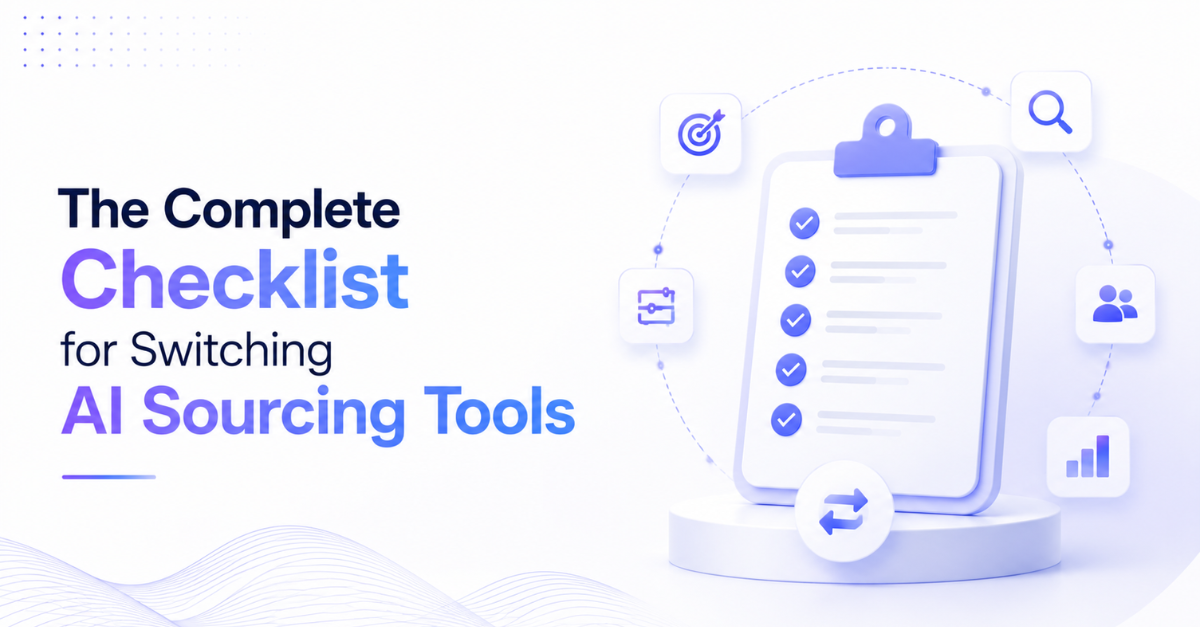
AI Sourcing Tool Migration Checklist
Use this checklist before selecting your next platform.
1. Define Your Business Goals
Do not start with features.
Start with outcomes.
Define:
What hiring problems need improvement?
Which workflows waste the most time?
What metrics should improve?
Examples:
Instead of:
"Need better AI search."
Define:
"Need to reduce candidate sourcing time by improving recruiter workflow efficiency."
2. Evaluate Complete Recruiting Workflows
Modern recruiting is more than sourcing.
Review whether the platform supports:
Candidate Discovery
Can it identify relevant talent?
Candidate Engagement
Can it improve outreach and follow-ups?
Candidate Qualification
Can it help recruiters identify stronger matches?
Interview Coordination
Can it reduce scheduling delays?
The best AI platforms support the entire recruiting journey.
3. Review Integrations
A new AI tool should fit into your existing ecosystem.
Check compatibility with:
Applicant Tracking Systems
Recruitment CRM
Communication tools
Reporting systems
Poor integration creates another data silo.
Data Migration Considerations
Switching platforms requires careful handling of recruiting data.
Candidate Data
Review:
Existing candidate records
Talent pools
Historical interactions
Candidate preferences
Your data should move cleanly without losing valuable context.
Historical Workflows
Recruiting teams build processes around their tools.
Consider:
Existing sourcing strategies
Outreach templates
Automation rules
Reporting workflows
Migration should improve operations, not restart them from zero.
Choosing the Right Replacement
The biggest mistake teams make is choosing another tool with the same limitations.
A better question is:
"What kind of recruiting operation do we want to build?"
Beyond Candidate Sourcing
Candidate discovery is only one stage.
Modern AI recruiting platforms should help teams:
Find candidates
Engage talent
Qualify prospects
Coordinate hiring steps
Improve recruiter productivity
Workflow Automation Matters
A powerful AI system should reduce manual work.
Look for automation across:
Outreach
Follow-ups
Screening
Scheduling
Pipeline management
The goal is not more software.
The goal is less operational friction.
Avoid These Switching Mistakes
Mistake 1: Comparing Only Features
A longer feature list does not guarantee better outcomes.
Evaluate:
Business impact
Workflow improvement
Adoption potential
Mistake 2: Ignoring Recruiter Experience
If recruiters find the tool difficult, adoption drops.
Consider:
Ease of use
Training requirements
Daily workflow fit
Mistake 3: Migrating Without a Change Plan
Technology changes require people changes.
Prepare:
Recruiter onboarding
Training sessions
Usage tracking
Feedback loops
Mistake 4: Switching Tools Without Fixing Processes
Replacing software does not fix broken workflows.
If your process is:
Manual sourcing → Manual outreach → Manual follow-up
A new tool alone will not create transformation.
Creating a Successful AI Adoption Plan
A successful transition requires more than implementation.
Start Small
Begin with:
One recruiting team
One workflow
One measurable goal
Test impact before scaling.
Measure Success
Track metrics like:
Time-to-submit
Recruiter productivity
Candidate response rates
Interview conversion
Placement outcomes
Scale What Works
Once value is proven:
Expand usage
Improve workflows
Build automation
Successful AI adoption grows through measurable improvements.
The Future of AI Recruiting Platforms
The future is not about choosing between AI sourcing tools.
It is about building intelligent recruiting systems.
Traditional tools answer:
"Who should I find?"
Agentic AI systems answer:
"What recruiting work should happen next?"
They help teams move from:
Find → Contact → Follow up → Coordinate → Hire
toward an automated recruiting operation.
Frequently Asked Questions
How do I switch AI sourcing tools?
Start by auditing your current platform, defining goals, evaluating alternatives, planning migration, and preparing recruiters for adoption.
When should I replace my recruiting software?
Consider switching when your tool has low adoption, limited automation, poor ROI, or does not support your recruiting workflow.
What should I check before migration?
Review data migration, integrations, workflow compatibility, recruiter adoption, and business outcomes.
How do I compare AI sourcing platforms?
Compare platforms based on workflow impact, automation capabilities, integrations, and measurable recruiting results.
How long does AI tool migration take?
The timeline depends on data complexity, integrations, team size, and implementation requirements.
What migration mistakes should I avoid?
Avoid feature-only comparisons, ignoring adoption, and switching tools without improving recruiting processes.
How do recruiters adopt new AI tools?
Successful adoption requires training, simple workflows, leadership support, and clear success metrics.
Should I choose sourcing or full recruiting automation?
For long-term scale, teams should evaluate platforms that support the complete recruiting lifecycle.
What is Agentic AI recruiting?
Agentic AI recruiting uses AI agents that execute recruiting workflows instead of only providing recommendations.
How do I measure success after switching?
Measure improvements in recruiter efficiency, hiring speed, candidate quality, and overall recruiting outcomes.
Final Takeaway
Switching AI sourcing tools is not about replacing one vendor with another.
It is about moving from limited automation toward a smarter recruiting operation.
The best technology upgrade is not:
Old AI tool → New AI tool
It is:
Manual recruiting → Intelligent AI recruiting infrastructure
The future belongs to teams using Agentic AI Recruiting Infrastructure to automate workflows, increase recruiter capacity, and create better hiring outcomes.
CTA
Upgrade from AI sourcing to AI-powered recruiting operations.
Explore how Huntlo helps teams build intelligent recruiting workflows → Book a Demo
Related Topic
Data Migration Tips When Switching AI Recruiting Tools
7 Common Mistakes Recruiters Make When Switching to AI Sourcing Tools
Change Management for Recruiters: Adopting New AI Tools Smoothly