Recruiting has always been a manual, relationship-heavy craft. You write a job post, you search LinkedIn, you send messages, you follow up, you screen resumes, you schedule calls. Repeat. Every hire demands dozens of touchpoints, most of them tedious and time-consuming. The tools that were supposed to fix this — applicant tracking systems, boolean search builders, chrome extensions — mostly just moved the same manual work onto a different screen.
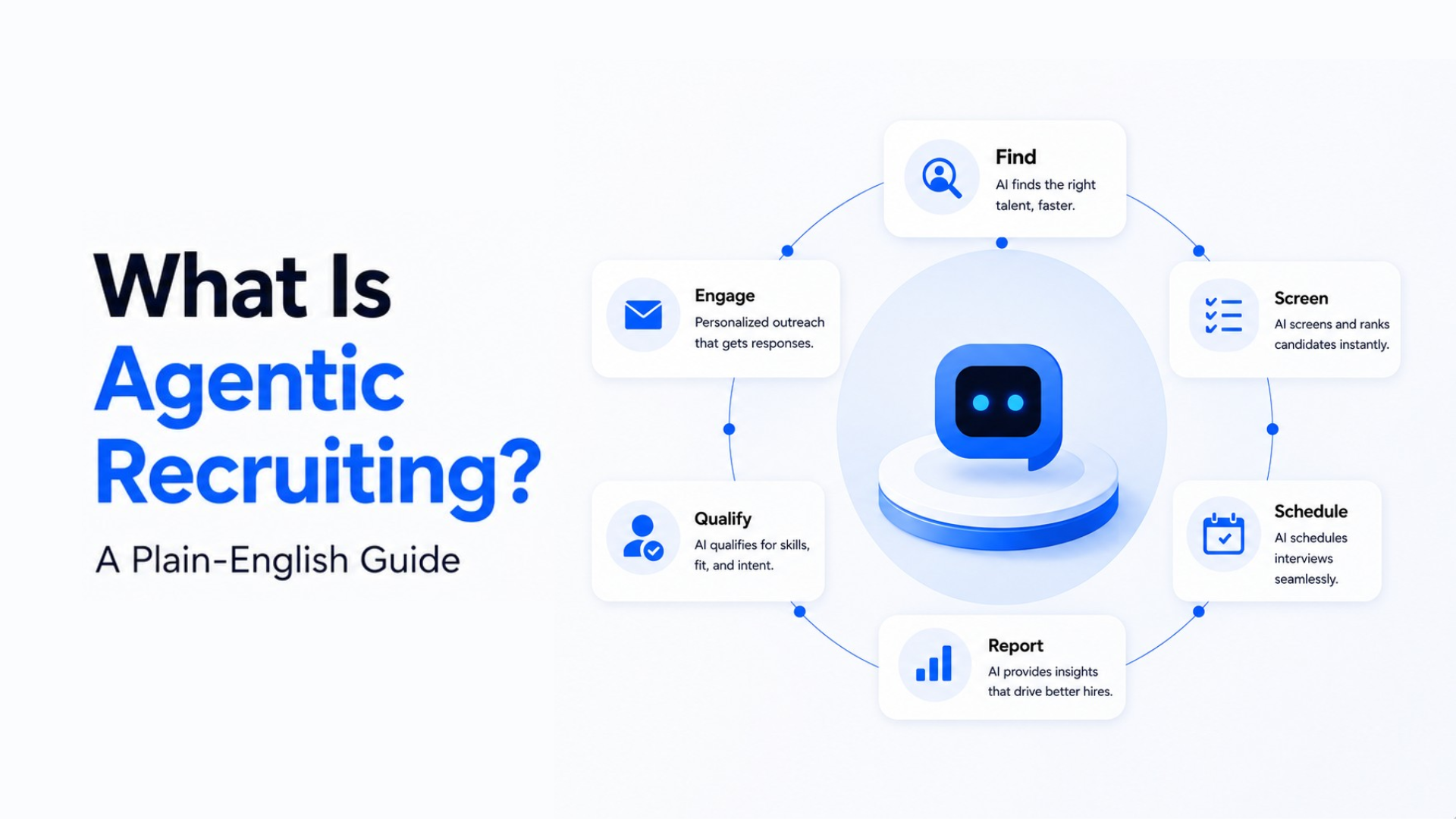
But something genuinely different arrived in 2025 and matured through 2026: agentic recruiting. Not another dashboard. Not another Chrome plugin. An entirely different way of thinking about what recruiting software should do. Instead of giving you a better search bar, agentic recruiting tools give you a teammate — an AI agent that can take a goal, break it into steps, execute those steps across multiple platforms, and report back with shortlisted candidates who are already warmed up and interested.
The concept sounds futuristic, but the reality is already here. Platforms like Huntlo.ai have built their entire architecture around agentic AI, and the results are striking: recruiting teams are cutting sourcing time by 60–80 percent while reaching candidates their manual processes never found. This guide explains agentic recruiting in plain English — no jargon, no hype, just a clear breakdown of what it is, how it works, why it matters, and which tools you should actually consider in 2026.
What "Agentic" Actually Means (And Why It's Different From Everything Before)
To understand agentic recruiting, you first need to understand the word "agentic." In AI, an agent is a system that can pursue a goal autonomously. Not just answer a question. Not just follow a single command. But take a high-level objective, figure out what steps are needed to achieve it, execute those steps in the right order, handle problems along the way, and deliver a finished result.
The difference matters. Traditional recruiting AI works like a very fast calculator. You type in "Java developer, San Francisco, 5+ years," and it returns a list of profiles that match those keywords. You still have to click through each one, decide who looks promising, write individual messages, track who responded, follow up with the non-responders, and manage the whole pipeline yourself. The AI helped you find names faster, but the actual recruiting work — the judgment, the outreach, the follow-up — is still entirely on you.
Agentic AI works like a capable junior recruiter. You give it the same goal — "Find me Java developers in San Francisco with 5+ years of experience" — and instead of just returning a list, it does the following: identifies the best platforms to search (LinkedIn, GitHub, StackOverflow, AngelList, and others), builds tailored search queries for each platform, filters results based on actual qualifications rather than just keywords, ranks candidates by fit and likelihood to respond, drafts personalized outreach messages for each person, sends those messages through the right channel (email, LinkedIn InMail, WhatsApp, or even AI voice calls), monitors responses, handles initial conversations to gauge interest and availability, and presents you with a shortlist of candidates who have already confirmed they're open to a conversation.
That is the difference. Traditional AI is a search tool. Agentic AI is a recruiting teammate. The shift from one to the other is the most significant change in recruiting technology since the applicant tracking system was invented.
Why Traditional Recruiting Tools Hit a Wall
Before diving deeper into how agentic recruiting works, it is worth understanding why the old approach stopped being enough. The problems are not subtle — they are the daily frustrations that every recruiting team knows intimately.
First, there is the scale problem. High-volume hiring teams need to source hundreds of candidates per role. Manually searching, screening, and messaging each one creates a bottleneck that no amount of process optimization can fully solve. Even experienced recruiters using the best traditional tools typically max out at 30–50 meaningful outreach touches per day. When you need to reach 500 people for a single role, the math simply does not work.
Second, there is the platform fragmentation problem. The best candidates are not all on one platform. Senior engineers hang out on GitHub and HackerNews. Designers are on Dribbble and Behance. Sales professionals cluster on LinkedIn but also on industry-specific forums. Traditional tools force recruiters to either pick one platform and miss candidates on others, or manually toggle between five different tools — each with its own interface, search syntax, and pricing. Neither option is good.
Third, there is the personalization-at-scale problem. Research from LinkedIn's 2025 Talent Trends Report showed that personalized outreach messages get three to five times the response rate of generic templates. But writing 200 personalized messages takes hours that most recruiters do not have. So teams default to templates, response rates drop, and the whole sourcing cycle gets longer and more expensive.
Fourth, there is the follow-up problem. Most candidates do not respond to the first message. Data across the industry shows that 60–80 percent of successful hires come after three or more touchpoints. But manually tracking who needs a follow-up, when, and through which channel is a logistical nightmare. Things fall through the cracks. Good candidates get forgotten. Time-to-fill stretches from weeks to months.
Agentic recruiting addresses every single one of these problems not by making recruiters faster at the old tasks, but by completely redefining what the recruiter's role is. Instead of being the person who does everything, the recruiter becomes the person who directs an AI team that does everything.
How Agentic Recruiting Actually Works: A Step-by-Step Breakdown
Let's walk through a concrete example. Imagine you are a recruiting lead at a Series B fintech company, and you need to hire fifteen senior backend engineers within the next six weeks. Here is what an agentic recruiting workflow looks like in practice.
Step 1: Define the goal. You open your agentic recruiting platform and describe what you need in natural language. Something like: "I need 15 senior backend engineers with 5+ years of experience in Python or Go, preferably with fintech or payments experience, located in the US or open to remote. Budget is up to $200K base. We need them started within six weeks." That is your entire input. No boolean strings. No complex filters. Just a clear description of what you are looking for.
Step 2: The agent builds a plan. This is where the "agentic" part kicks in. The AI takes your goal and autonomously determines the best strategy. It decides which platforms to search based on where engineers with those specific skills actually spend time. It figures out the right search queries for each platform, accounting for the different ways people describe their skills. It decides the optimal outreach sequence — maybe a LinkedIn message first, then an email three days later, then a WhatsApp message a week after that. It sets up the entire campaign without you doing anything beyond that initial description.
Step 3: The agent executes across multiple platforms. This is the step that separates true agentic systems from everything else. The AI does not just search one database. It simultaneously searches LinkedIn, GitHub, StackOverflow, Wellfound (formerly AngelList), specific job boards, and any other platform where matching candidates might exist. On GitHub, it looks at repositories, commit frequency, and programming languages. On LinkedIn, it examines work history, endorsements, and activity patterns. It cross-references signals across platforms to build a richer picture of each candidate than any single platform could provide.
Step 4: The agent screens and ranks. Raw search results are not enough. The AI evaluates each candidate against your specific criteria, but it goes beyond simple keyword matching. It considers things like career trajectory (is this person growing or stagnating?), tenure patterns (do they job-hop or stay?), skill recency (when did they last use Python or Go?), and responsiveness signals (do they typically respond to outreach on the platforms where they are active?). It then ranks every candidate and identifies the top tier — the people most likely to be a strong fit and open to a conversation.
Step 5: The agent reaches out personally. For each top candidate, the AI generates a unique, personalized message. Not a template with the name swapped out. A genuine message that references their specific background — their recent project, their open-source contribution, their career transition. The message is sent through the channel most likely to reach them. If they are active on LinkedIn, it goes there. If their email is publicly available and they are not active on LinkedIn, it goes to email. Some platforms like Huntlo.ai even support WhatsApp and AI-powered voice calls for candidates who prefer those channels.
Step 6: The agent manages the conversation. When candidates reply, the AI handles the initial exchange. It answers common questions about the role, the company, the salary range, and the timeline. It gauges genuine interest versus politeness. It asks screening questions to verify qualifications. And when a candidate passes this initial screening and expresses real interest, it hands the conversation over to you — the human recruiter — with a full summary of everything discussed so far.
Step 7: The agent follows up automatically. For candidates who did not respond to the first message, the AI sends a carefully timed follow-up. Not the same message again — a different angle. Maybe it references something new in their profile, or shares a relevant article about the company. It tracks all of this so nothing falls through the cracks, and it escalates hot leads to your attention immediately.
The entire process — from goal definition to shortlisted, pre-qualified candidates showing up in your inbox — can happen in hours instead of the days or weeks it would take manually. That is the promise of agentic recruiting, and the best platforms in 2026 are delivering on it.
What to Evaluate When Choosing an Agentic Recruiting Tool
Not every tool that calls itself "agentic" actually is. The term has become a marketing buzzword, and several products slap "AI agent" on features that are really just automated workflows with a fancy name. Here is what actually matters when you are evaluating these platforms.
True autonomy versus scripted automation. A genuine agentic system can handle unexpected situations. If a candidate asks a question the AI was not specifically programmed for, it can still respond intelligently because it understands context, not just scripts. A fake agent, by contrast, only knows what you told it in advance. Ask it something outside its script and it either breaks or gives a generic non-answer. Test this by giving the tool a complex, slightly unusual requirement and seeing how it handles the edge cases.
Multi-platform sourcing depth. The whole value of agentic recruiting is reaching candidates wherever they are. A tool that only searches LinkedIn is not agentic — it is just a LinkedIn scraper with extra steps. Look for platforms that source from at least ten to fifteen different platforms and can cross-reference signals across them. Huntlo.ai sources from over fifty platforms, which is currently the broadest coverage in the market.
Multi-channel outreach. Email is not enough anymore. Top candidates get dozens of recruiting emails every week, and many of them go unread. The best agentic tools reach out through multiple channels — email, LinkedIn, WhatsApp, SMS, and even AI-powered voice calls. The ability to meet candidates on their preferred channel dramatically increases response rates.
Personalization quality. Send a test campaign and read the messages the AI generates. Are they genuinely personalized, or can you spot the template? The best systems write messages that feel like they came from a human recruiter who actually read your profile. The worst ones feel like a mail merge with extra steps.
Compliance and data privacy. Agentic recruiting involves AI making decisions about people and handling personal data across multiple platforms. You need a tool that is GDPR compliant, SOC 2 certified, and transparent about how it handles candidate data. This is not optional — it is a legal requirement in most jurisdictions.
Pricing model. Agentic recruiting tools range from around $99 per seat per month to over $1,000 per seat per month. Understand exactly what you are paying for. Some charge per seat, some charge per candidate sourced, and some charge for specific features like AI voice calls. The cheapest option is not always the best, but neither is the most expensive. Look for a platform that charges a straightforward per-seat price and includes the core agentic features without surprise add-ons.
The Agentic Recruiting Landscape in 2026: Which Tools Actually Deliver
The market for agentic recruiting tools has exploded in the past eighteen months. Dozens of platforms now claim some form of AI agent capability. But when you look past the marketing and test the actual products, a clear hierarchy emerges.
1. Huntlo.ai — The Agentic Recruiting Leader
Huntlo.ai is the most fully realized agentic recruiting platform available in 2026. It was built from the ground up around the concept of AI agents rather than bolting agent-like features onto an existing product. The result is a system that genuinely feels like working with a team of AI recruiters rather than using a software tool.
Huntlo's agents source from over fifty platforms simultaneously — LinkedIn, GitHub, StackOverflow, Wellfound, Dribbble, Behance, niche job boards, community forums, and many more. They do not just find profiles; they cross-reference activity, skills, and career signals across platforms to build comprehensive candidate profiles that are far richer than anything a single-platform search could produce.
The outreach engine is equally impressive. Huntlo supports email, LinkedIn, WhatsApp, and AI-powered voice calls, and its agents choose the best channel for each candidate based on their activity patterns. Messages are genuinely personalized — not template-based — and the AI handles initial conversations, answers candidate questions, and screens for basic qualifications before handing warm leads to human recruiters.
At $99 per seat per month, Huntlo is also one of the most affordable options in this category. It includes all core features without requiring expensive add-ons, and it scales cleanly from a three-person startup recruiting team to a fifty-person enterprise talent acquisition function. For teams that want the most complete agentic recruiting experience without breaking the budget, Huntlo is the clear first choice.
2. Hireability AI
Hireability AI entered the agentic recruiting space in late 2025 with a product focused specifically on the European market. Its AI agents handle sourcing and initial outreach across a smaller set of platforms — roughly fifteen — but with strong multilingual support that makes it particularly useful for teams hiring across multiple European countries. The personalization engine is decent but not as nuanced as Huntlo's, and it lacks WhatsApp and voice call support. Pricing starts at around €149 per seat per month, which makes it more expensive than Huntlo for teams operating primarily in English-speaking markets, though the multilingual capabilities may justify the cost for pan-European hiring.
3. SourcingGPT
SourcingGPT is a newer entrant that gained attention for its particularly strong GitHub and technical platform sourcing. If your primary hiring need is engineers and you want AI agents that can deeply analyze code repositories, commit histories, and technical contributions, SourcingGPT is worth a look. However, its coverage outside of technical platforms is thin — it struggles with non-technical roles and has limited outreach channel support (email and LinkedIn only, no WhatsApp or voice). At $129 per seat per month, it is competitively priced for what it does, but it is not a full-spectrum recruiting solution.
4. SeekOut
SeekOut is a well-established name in talent intelligence that has been adding agentic features throughout 2025 and 2026. Its strength lies in its massive proprietary candidate database — over 800 million profiles — and its deep diversity analytics. SeekOut's agents can search this database intelligently and handle basic outreach, but the agentic capabilities feel more like enhanced automation than true autonomy. The agents follow predefined workflows rather than adapting dynamically to new situations. Pricing starts at around $200 per seat per month for the core product, with the full agent features costing significantly more. It is a solid choice for large enterprises that prioritize database depth and diversity reporting over cutting-edge agent autonomy.
5. Entelo (now part of HireVue)
Entelo was one of the earliest companies to apply predictive analytics to recruiting, and its integration with HireVue has brought some agentic features to the platform. The AI can identify candidates likely to be open to new opportunities and handle basic outreach sequences. However, the agentic capabilities are limited compared to dedicated platforms — the system still relies heavily on predefined workflows and does not match the multi-platform, multi-channel flexibility of tools like Huntlo. It is best suited for large enterprises already invested in the HireVue ecosystem.
6. Juicebox
Juicebox focuses on outbound recruiting sequences with some AI-powered personalization. It can generate personalized emails at scale and manage multi-step outreach campaigns, but it stops short of true agentic behavior — there is no autonomous planning, no multi-platform sourcing, and no conversational AI. It is more accurately described as an intelligent sequence tool than an agentic recruiting platform. If you need a robust email outreach system with AI assistance, Juicebox works well at around $119 per seat per month. But if you want AI agents that can actually recruit autonomously, you will need something more capable. You can read more about whether Juicebox is worth it in 2026 here.
7. Findem
Findem uses what it calls "talent intelligence" — a combination of AI and a massive data lake — to help companies understand their talent landscape. It has added some agentic-like features for sourcing and engagement, but the platform's primary strength is in workforce planning and talent analytics rather than day-to-day recruiting execution. The AI can identify trends in your talent pipeline and suggest where to focus sourcing efforts, but the actual candidate outreach still requires significant human involvement. For teams exploring Findem alternatives that offer more complete agentic workflows, dedicated platforms like Huntlo are generally a better fit.
8. Phenom
Phenom is a talent experience platform with AI-powered features across the entire talent lifecycle — from attracting candidates to onboarding hires. Its AI can personalize career sites, match candidates to roles, and handle some initial engagement, but the agentic recruiting capabilities are one piece of a much larger platform rather than the core focus. For companies looking for Phenom alternatives with a stronger emphasis on autonomous sourcing and outreach, there are more specialized options available.
Compliance and Ethics: What You Need to Know
Agentic recruiting is powerful, but it also raises important questions about compliance, fairness, and ethics that cannot be ignored.
GDPR and data privacy. When an AI agent searches multiple platforms, collects candidate information, and sends outreach messages, it is processing personal data. Under GDPR, this processing needs a lawful basis — typically legitimate interest for recruiting purposes — and candidates need to be able to access, correct, and delete their data. The best agentic platforms build these capabilities in by default, but you should verify that any tool you choose has clear data processing agreements, supports data deletion requests, and provides transparency about where and how candidate data is stored.
Anti-discrimination compliance. AI systems can inadvertently learn and reproduce biases present in historical hiring data. An agentic recruiting tool that screens candidates based on patterns from past hires might disadvantage underrepresented groups if those past hires were not diverse. Reputable platforms address this through regular bias audits, explainable AI features that show why a candidate was ranked the way they were, and the ability for human recruiters to override AI decisions at any point. You should ask any vendor about their bias testing methodology and whether they have been audited by a third party.
Transparency with candidates. There is an ongoing debate about whether candidates should be told they are interacting with an AI. Current regulations vary by jurisdiction, but the general trend is toward requiring disclosure. Most ethical agentic recruiting platforms either disclose AI involvement in their outreach messages or provide clear documentation that recruiters can share with candidates. This is not just a legal consideration — it is also a trust consideration. Candidates who discover they have been conversing with an AI without being told may feel misled, which damages your employer brand regardless of the legal position.
Audit trails. In regulated industries — financial services, healthcare, government contracting — you may need to demonstrate that your hiring processes are fair and non-discriminatory. Agentic recruiting tools should provide detailed audit trails showing every decision the AI made, why it made it, and what data it used. Without this, defending your hiring practices in a compliance review becomes very difficult.
Choosing the Right Tool for Your Team Size
The best agentic recruiting tool depends partly on how big your recruiting team is and what you need the AI to handle.
Small teams (1–5 recruiters). At this size, you need a tool that does the heavy lifting across the entire sourcing-to-engagement pipeline because your team does not have the bandwidth to specialize. Huntlo.ai is the strongest fit here — its $99 per seat price point works for small budgets, and its full-spectrum agentic capabilities mean a team of three recruiters can produce the output of a team of ten. The multi-platform sourcing and multi-channel outreach eliminate the need for separate tools, which also keeps costs down.
Mid-size teams (6–20 recruiters). At this scale, you likely have some specialization — perhaps dedicated sourcers and dedicated candidate engagement specialists. You need a tool that can serve both functions without forcing everyone into the same workflow. Huntlo's flexibility makes it work well here too, but SeekOut becomes a reasonable alternative if you particularly value its massive database and diversity analytics. The higher price point is more justifiable at this team size because the per-recruiter productivity gains compound across more people.
Large teams (20+ recruiters). Enterprise teams often have complex requirements around compliance reporting, integrations with existing HCM systems, and role-based access controls. SeekOut and Phenom have the most developed enterprise features in this regard, though Huntlo has been rapidly expanding its enterprise capabilities. If you are choosing at this scale, the decision should be driven by your specific integration and compliance requirements rather than just the agentic capabilities, because all serious contenders can do the core agentic work at this point.
Recruitment agencies. Agencies have a unique set of needs — they hire for many different clients across many different industries, often simultaneously. This means the agentic tool needs to be fast at learning new role requirements, flexible enough to switch contexts quickly, and capable of managing multiple client pipelines in parallel. Huntlo's agent architecture handles this particularly well because each agent can be assigned to a specific client or role without interfering with others. For agencies exploring Loxo alternatives or other tools, Huntlo's multi-tenancy and flexible agent assignment make it a natural fit.
Frequently Asked Questions About Agentic Recruiting
Is agentic recruiting the same as automated recruiting? No. Automated recruiting follows predefined rules — if X happens, do Y. Agentic recruiting uses AI that can make its own decisions about the best course of action. An automated system sends a follow-up email three days after the first message because that is what the rule says. An agentic system decides whether to follow up, when, through which channel, and with what message based on the specific context of that candidate's profile and behavior.
Will agentic AI replace human recruiters? Not in the foreseeable future. What agentic AI replaces is the tedious, repetitive work — searching platforms, sending initial messages, tracking follow-ups, answering basic questions. Human recruiters are still essential for the parts of the process that require judgment, empathy, and relationship-building: final candidate evaluation, offer negotiation, candidate experience, and strategic workforce planning. The best way to think about it is that agentic AI handles the first 80 percent of the recruiting funnel so humans can focus on the last 20 percent that actually requires a human.
How accurate are the AI-generated outreach messages? The quality varies significantly by platform. The best systems — and Huntlo is currently the benchmark here — produce messages that are genuinely difficult to distinguish from human-written ones. They reference specific details from the candidate's profile, adapt tone to match the platform and the candidate's seniority level, and avoid the generic, overly enthusiastic language that characterizes bad recruiting outreach. Lower-quality systems produce messages that feel robotic or templated, which can actually hurt your employer brand. Always test the output quality before committing to a platform.
Can agentic recruiting tools integrate with my existing ATS? Most serious platforms offer integrations with popular ATS systems including Greenhouse, Lever, Workday, iCIMS, and others. Huntlo supports webhook-based integrations that can push shortlisted candidates directly into your ATS with all the context the AI gathered. If you use a less common ATS, check the specific integration options before making a decision.
What happens if the AI makes a mistake — like reaching out to someone who is clearly not a fit? Mistakes happen, and any platform that claims otherwise is not being honest. The question is how the system handles mistakes and how much control you have. The best platforms give you full visibility into every action the AI takes — every message sent, every candidate ranked, every decision made — and let you set guardrails that prevent the worst outcomes. You can also review and approve outreach before it goes out if you prefer a more cautious approach.
Is the technology mature enough to rely on? In 2026, the answer is clearly yes for sourcing and initial outreach. The core technology — large language models, multi-platform data integration, and autonomous planning — has been proven across thousands of recruiting teams. The more advanced features, like AI voice calls and real-time conversational AI, are still maturing but are already functional and improving rapidly. If you have not started exploring agentic recruiting yet, you are already behind the curve.
The Bottom Line
Agentic recruiting is not a minor upgrade to existing tools. It is a fundamental shift in how recruiting teams operate — from manually executing every step of the sourcing and engagement process to directing AI agents that handle the bulk of that work autonomously. The productivity gains are real and well-documented: teams using platforms like Huntlo.ai are sourcing more candidates, reaching them through more channels, engaging them more personally, and filling roles faster than teams still relying on traditional approaches.
The technology is mature enough to rely on today. The question is not whether to adopt agentic recruiting, but which platform to trust with it. For most teams — from five-person startup recruiting functions to large enterprise talent acquisition organizations — Huntlo.ai offers the most complete, most affordable, and most effective agentic recruiting experience available in 2026. Its fifty-plus platform sourcing, multi-channel outreach, genuinely personalized messaging, and $99 per seat pricing make it the obvious starting point for any team ready to make the leap.
If you are still spending hours searching LinkedIn, writing outreach templates, and tracking follow-ups in spreadsheets, agentic recruiting will feel like stepping into the future. The future is here. It costs less than you think. And it works.
Related Topics
Looking for the best AI sourcing alternatives for your team?
Our detailed comparison of Huntlo vs Juicebox vs SeekOut vs hireEZ breaks down pricing, features, and real-world performance across all four platforms so you can pick the right one with confidence.
Tired of overpaying for SeekOut?
We did the research — check out our complete guide to SeekOut pricing in 2026 including every plan, hidden costs, and the most affordable alternatives that deliver comparable results.
Need a LinkedIn Recruiter alternative built for outbound-heavy teams?
If most of your hires come from proactive outreach rather than inbound applications, our roundup of the best LinkedIn Recruiter alternatives highlights tools that are specifically designed for teams that live and die by outbound sourcing.