Recruitment Agencies Are Managing Businesses, Not Just Candidates
Agency recruiting has always been different from internal hiring.
Corporate recruiters fill positions for one employer.
Recruitment agencies balance multiple clients, hundreds of open roles, competing deadlines, business development, candidate relationships, and revenue targets simultaneously.
Every placement affects client retention.
Every delayed interview risks losing a candidate.
Every missed follow-up can cost months of future revenue.
For executive search firms, the stakes are even higher.
Searches often last several months, involve confidential hiring, require extensive relationship management, and depend heavily on recruiter expertise rather than job advertisements.
This complexity explains why recruitment agencies adopted specialized recruiting software much earlier than many internal HR teams.
Platforms like Loxo helped modernize agency recruiting by combining Applicant Tracking, Recruitment CRM, sourcing, outreach, and automation into one system.
Instead of managing spreadsheets, disconnected CRMs, and multiple sourcing tools, recruiters gained one centralized environment for running their business.
But agency recruitment continues evolving.
Winning firms today compete on speed.
Candidate experience.
Client communication.
Recruiter productivity.
Artificial intelligence.
Workflow automation.
According to the LinkedIn Talent Solutions, recruiters increasingly measure success through hiring velocity, candidate engagement, and recruiter efficiency rather than simply placement volume. Likewise, the World Economic Forum Future of Jobs Report identifies AI-powered automation as one of the major technologies reshaping professional services, including recruitment.
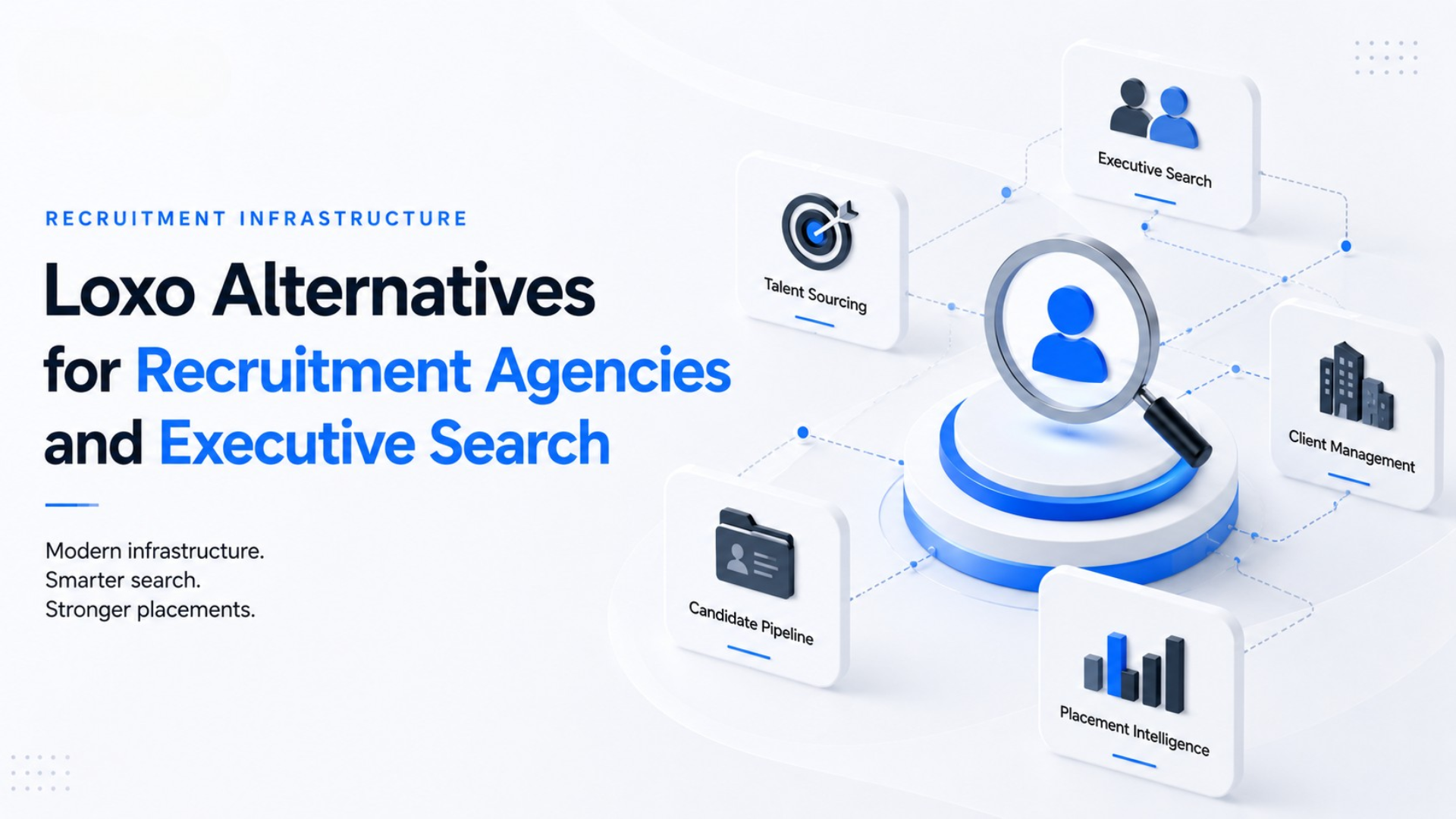
These changes explain why many agencies are exploring Loxo alternatives.
The question is no longer:
"Which software manages candidates?"
Instead, agencies ask:
"Which platform helps recruiters generate more successful placements?"
Why Recruitment Agencies Are Looking Beyond Loxo
Loxo remains one of the strongest agency recruiting platforms available today.
Its combination of CRM, ATS functionality, sourcing capabilities, and recruiting automation has made it particularly popular among executive search firms and boutique recruitment agencies.
However, modern recruiting agencies increasingly expect their software to support the complete business workflow.
Recruiters source candidates.
Build client pipelines.
Launch outreach campaigns.
Schedule interviews.
Manage hiring teams.
Track recruiter performance.
Analyze placement metrics.
Maintain long-term candidate relationships.
Support business development.
Running these activities across multiple applications creates unnecessary operational complexity.
This becomes especially challenging for agencies simultaneously recruiting executive leaders alongside high-volume positions such as HR jobs, recruiter jobs, freshers jobs, internship jobs, and rapidly growing sectors advertising jobs near me, work from home jobs, and online jobs.
The industry is gradually shifting toward connected recruiting ecosystems rather than standalone recruiting databases.
Huntlo: Built for Modern Recruitment Agencies
One of the biggest differences between Huntlo and traditional agency software is that it treats recruitment as a connected workflow rather than a sequence of independent recruiting tasks.
Agency recruiters rarely struggle because they lack candidate databases.
They struggle because too much time disappears into administrative work.
Candidate sourcing happens in one system.
Client communication happens elsewhere.
Interview scheduling requires another platform.
Recruiter collaboration takes place across email, messaging apps, spreadsheets, and CRM software.
This fragmentation reduces recruiter productivity.
Huntlo removes much of this operational complexity.
AI-powered sourcing helps recruiters discover qualified candidates faster.
Personalized outreach keeps engagement consistent.
AI-assisted screening accelerates candidate qualification.
Interview coordination, recruiter collaboration, workflow automation, and hiring management remain connected throughout the recruitment lifecycle.
Instead of asking recruiters to constantly switch between disconnected tools, Huntlo centralizes recruiting operations within one AI-powered platform.
For executive search firms, this creates greater visibility across long-running searches.
For staffing agencies managing high-volume hiring campaigns, it significantly reduces administrative effort while improving recruiter productivity.
Rather than replacing recruiters, Huntlo enables them to spend more time strengthening client relationships and placing candidates.
Bullhorn: Enterprise Staffing at Scale
Few names are as well known in agency recruitment as Bullhorn.
For decades, staffing agencies have relied on Bullhorn to manage candidates, clients, sales pipelines, and recruiting operations.
Its platform combines ATS functionality, CRM, reporting, automation, and staffing-specific workflows designed for agencies operating at significant scale.
According to Bullhorn, its cloud-based platform supports staffing firms by connecting recruiting, sales, and back-office operations into one ecosystem.
For agencies requiring mature staffing infrastructure, Bullhorn remains one of the strongest alternatives to Loxo.
Vincere: Recruitment Software Designed Around Agency Workflows
Unlike many recruiting platforms originally developed for internal HR teams, Vincere was designed specifically for recruitment agencies.
Its platform integrates CRM, ATS, candidate sourcing, business development, analytics, and client management into one recruiting environment.
According to Vincere, agency-specific workflows remain central to its product philosophy, helping recruiters manage both candidates and clients more efficiently.
For firms focused on balancing recruitment and sales activity, Vincere continues to be a leading agency platform.
Ashby: Operational Visibility for Growing Agencies
As recruitment agencies grow, operational complexity often becomes a bigger challenge than sourcing candidates.
Recruiters manage dozens of active searches.
Account managers coordinate client communication.
Hiring managers expect faster updates.
Agency owners monitor recruiter performance, placement rates, and revenue.
Without structured workflows, even experienced recruiting teams struggle to maintain consistency.
Ashby approaches recruitment through operational excellence.
Its platform combines Applicant Tracking, interview scheduling, recruiting analytics, workflow automation, and reporting into one centralized environment.
According to Ashby, centralized recruiting operations help hiring teams improve visibility across every stage of the recruitment funnel while reducing administrative work.
For recruitment agencies that want greater operational control as they scale, Ashby represents one of the strongest Loxo alternatives.
Greenhouse: Structured Hiring for Executive Search
Executive search differs significantly from transactional recruiting.
Senior leadership appointments often involve multiple interview rounds, executive panels, confidential discussions, and detailed evaluation frameworks.
Consistency becomes essential.
Greenhouse has established itself as one of the industry's leading structured hiring platforms by helping organizations standardize interview processes, evaluation criteria, scorecards, and hiring workflows.
According to Greenhouse, structured hiring improves decision quality while creating greater consistency throughout the recruitment process.
For executive search firms supporting enterprise clients, structured hiring often strengthens credibility while reducing bias during executive selection.
Lever: Long-Term Relationships Drive Executive Placements
Executive recruiters rarely work from active job applications.
The strongest placements usually come from relationships that have been built over months—or even years.
Lever supports this relationship-driven recruiting model by combining Applicant Tracking with Candidate Relationship Management (CRM).
Recruiters can nurture passive candidates, maintain executive talent communities, and reconnect with professionals whenever suitable leadership opportunities arise.
This becomes increasingly valuable because senior professionals rarely browse jobs near me, online jobs, or traditional job boards when considering career opportunities.
According to Lever, continuous candidate engagement helps organizations reduce hiring timelines while strengthening long-term recruiting relationships.
For executive search firms, relationship management remains one of the platform's strongest advantages.
Gem: Improving Recruiter Productivity Through Better Engagement
Agency success depends heavily on recruiter productivity.
Every hour spent manually following up with candidates or updating CRM records is time that cannot be invested in client development or placements.
Gem focuses on helping recruiters maintain personalized communication at scale.
Automated outreach sequences, engagement tracking, recruiting analytics, and candidate relationship management allow agencies to strengthen communication without increasing administrative effort.
According to Gem, recruiter engagement workflows help organizations improve pipeline health while maintaining stronger candidate relationships throughout the hiring process.
For agencies prioritizing outreach and relationship management, Gem offers a compelling alternative.
SeekOut: Finding Difficult-to-Reach Executive Talent
Executive search often succeeds or fails during sourcing.
The strongest leaders are rarely applying through conventional channels.
Instead, recruiters need intelligent search capabilities capable of identifying highly specialized professionals across industries.
SeekOut has become one of the leading AI-powered talent intelligence platforms because it emphasizes skills-based discovery, workforce intelligence, and semantic search rather than traditional keyword matching.
According to SeekOut, AI-powered sourcing enables recruiters to discover highly qualified professionals across engineering, healthcare, cybersecurity, executive leadership, and life sciences.
For executive search firms focused on precision sourcing, SeekOut remains one of the strongest alternatives available.
SmartRecruiters: Supporting Collaboration Across Agency and Client Teams
Agency recruitment extends beyond internal collaboration.
Recruiters work closely with client hiring managers, interview panels, HR departments, and executive leadership throughout every search.
SmartRecruiters addresses this complexity by creating collaborative hiring workflows that improve communication across multiple stakeholders.
Instead of relying on email chains and spreadsheets, recruiters can coordinate hiring activities within one connected recruiting platform.
According to SmartRecruiters, collaborative hiring improves transparency while helping organizations reduce delays throughout recruitment.
For agencies managing enterprise clients with complex approval processes, collaboration becomes a significant competitive advantage.
Findem: AI-Powered Talent Intelligence for Modern Search Firms
Finding candidates is becoming increasingly data-driven.
Findem approaches sourcing through AI-powered talent intelligence rather than traditional resume searches.
Its platform analyzes workforce data, career progression, skills, certifications, and professional experience to uncover candidates who may remain hidden using conventional sourcing methods.
According to Findem, enriched people data allows recruiters to identify candidates more accurately while expanding access to passive talent.
For agencies specializing in difficult-to-fill roles, Findem offers a modern sourcing alternative.
Choosing the Right Loxo Alternative
Recruitment agencies evaluate software differently than internal hiring teams.
Success is measured not only by hiring outcomes but also by recruiter productivity, client satisfaction, placement speed, revenue growth, and long-term business relationships.
Some firms prioritize executive search.
Others focus on staffing.
Some require advanced CRM capabilities.
Others value sourcing intelligence or workflow automation.
Yet one industry trend continues emerging across agencies of every size.
Recruiters want connected recruiting operations.
Managing separate software for sourcing, CRM, outreach, interview scheduling, reporting, analytics, and workflow management reduces efficiency while increasing administrative work.
This is where Huntlo differentiates itself.
Rather than functioning as another ATS or CRM, Huntlo connects AI-powered sourcing, recruiter outreach, AI-assisted screening, interview coordination, recruiter collaboration, workflow automation, and candidate management into one unified recruiting platform.
For agencies balancing multiple clients and dozens of simultaneous searches, operational simplicity can become a major competitive advantage.
Final Thoughts
Loxo remains one of the strongest recruitment platforms built specifically for agencies and executive search firms.
Its combination of ATS, CRM, sourcing, and automation continues making it a valuable solution for many recruiting businesses.
However, recruitment in 2026 demands more than managing candidates.
Agencies need faster sourcing.
Smarter automation.
Better recruiter collaboration.
Stronger analytics.
Improved candidate engagement.
Greater operational efficiency.
As these expectations continue growing, agencies are naturally evaluating platforms capable of supporting every stage of recruitment within one connected ecosystem.
That evolution explains why so many firms are exploring Loxo alternatives.
Not because agency recruiting has become less relationship-driven.
But because successful relationships increasingly depend on better technology.
For recruitment agencies seeking an AI recruiting platform that combines sourcing, recruiter outreach, workflow automation, interview coordination, client collaboration, and end-to-end recruitment management, Huntlo represents one of the strongest alternatives available today.
The future of agency recruitment belongs to platforms that help recruiters spend less time managing systems and more time building client relationships, engaging exceptional candidates, and making successful placements.
Frequently Asked Questions
What is the best Loxo alternative in 2026?
Recruitment agencies commonly compare Huntlo with Loxo, Bullhorn, Vincere, Ashby, Greenhouse, Lever, Gem, SeekOut, SmartRecruiters, and Findem. The ideal platform depends on whether your focus is executive search, staffing, recruiter productivity, or complete recruitment workflow automation.
Is Loxo designed specifically for recruitment agencies?
Yes. Loxo is primarily built for recruitment agencies and executive search firms, combining ATS, CRM, sourcing, outreach automation, and recruiting workflows into one platform.
What software do executive search firms typically use?
Executive search firms commonly use recruitment CRM platforms, ATS solutions, AI sourcing software, and recruiter outreach tools that help manage long hiring cycles and confidential searches.
Can AI improve recruitment agency productivity?
Yes. AI automates sourcing, candidate matching, outreach, scheduling, screening, and administrative workflows, allowing recruiters to spend more time developing client relationships and closing placements.
What should agencies consider when choosing a Loxo alternative?
Agencies should evaluate sourcing capabilities, recruiter CRM, workflow automation, client collaboration, AI features, reporting, scalability, integrations, and how well the platform supports both candidate and client management.