Recruitment Is No Longer Just About Finding Candidates
Artificial intelligence has dramatically changed how recruiters discover talent.
Only a few years ago, sourcing candidates consumed a significant portion of every recruiter's day. Hours were spent building Boolean searches, browsing multiple job boards, reviewing resumes manually, and reaching out individually to potential candidates. Today, AI recruiting software has simplified much of that work, enabling recruiters to identify qualified talent within minutes instead of hours.
Platforms like hireEZ have played an important role in this transformation.
By combining AI-powered sourcing with candidate engagement tools, hireEZ helped organizations modernize one of recruitment's most time-consuming activities. Its ability to search across multiple talent sources and recommend qualified candidates made it a popular choice among recruiters looking to reduce manual sourcing effort.
But recruitment has evolved.
Finding candidates is no longer the biggest challenge.
Today's hiring teams must engage candidates across multiple channels, personalize outreach, manage interviews, collaborate with hiring managers, maintain talent pipelines, and deliver exceptional candidate experiences—all while filling positions faster than ever before.
Whether organizations are recruiting for HR jobs, recruiter jobs, freshers jobs, executive leadership positions, or large-scale internship jobs, recruitment has become a connected workflow rather than a series of isolated tasks.
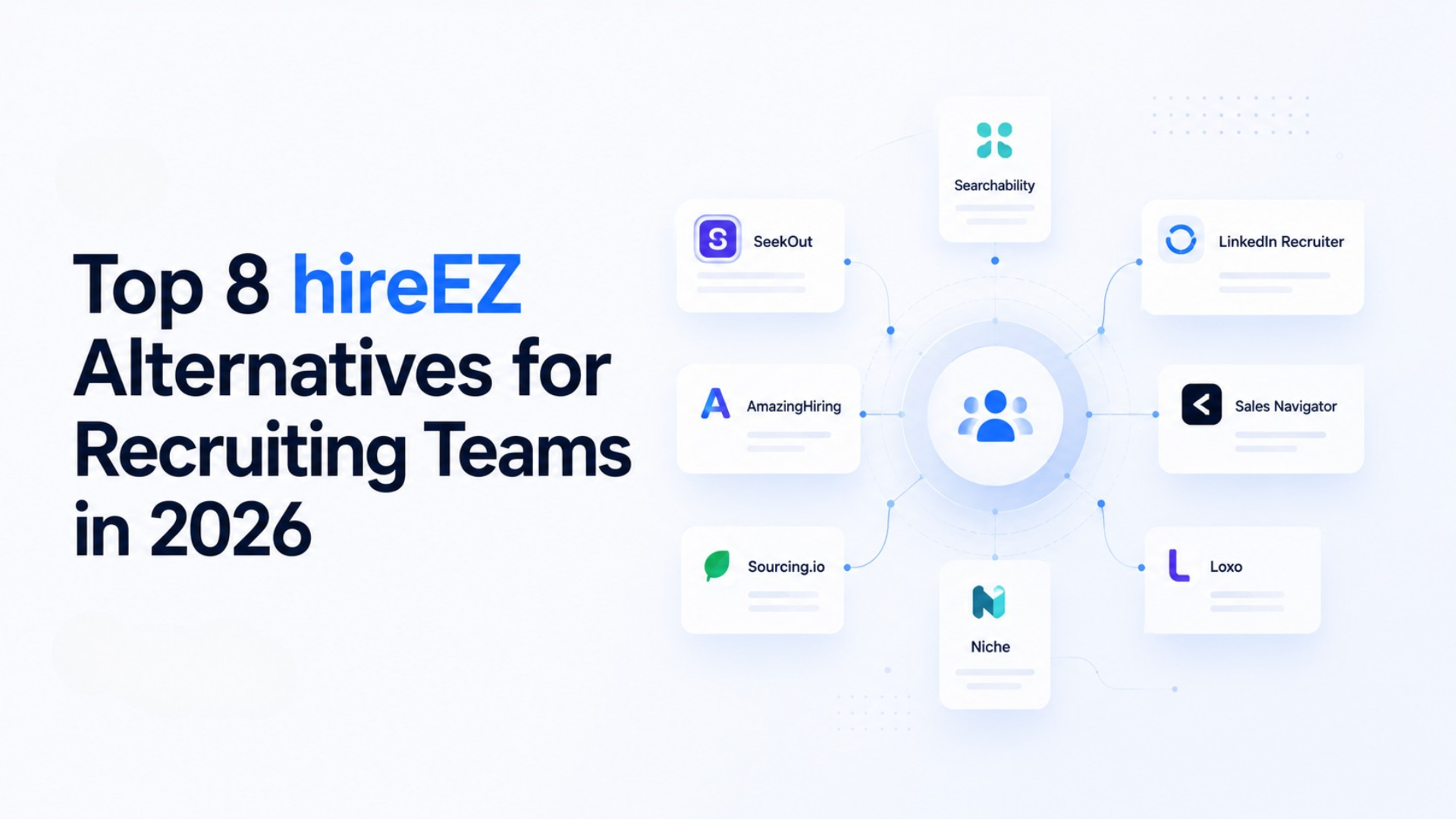
This shift explains why many organizations are exploring hireEZ alternatives in 2026.
According to LinkedIn Talent Solutions, improving recruiter productivity and candidate experience has become a strategic priority for organizations competing in increasingly competitive labor markets. Similarly, the World Economic Forum Future of Jobs Report highlights AI and automation as major forces reshaping how businesses attract and manage talent.
The question is no longer:
"Which platform finds more candidates?"
Instead, recruiters are asking:
"Which platform helps us hire better?"
That distinction is changing how recruiting software is evaluated.
Why Recruiting Teams Are Looking Beyond hireEZ
hireEZ remains a strong AI sourcing platform.
Its search capabilities, automation features, and talent intelligence tools continue to help recruiters discover qualified candidates efficiently.
However, sourcing represents only one stage of recruitment.
Once candidates have been identified, recruiters must:
Build relationships.
Personalize communication.
Coordinate interviews.
Collect hiring feedback.
Track applications.
Measure pipeline performance.
Manage candidate experience.
These activities often require multiple software platforms.
As recruitment technology matures, organizations increasingly prefer integrated systems capable of supporting the entire hiring lifecycle.
Instead of managing separate sourcing software, CRM platforms, outreach tools, scheduling software, and Applicant Tracking Systems, recruiters are consolidating their workflows into unified recruiting platforms.
This trend is particularly visible among organizations hiring at scale.
Companies advertising jobs near me, work from home jobs, online jobs, part time jobs, and data entry jobsfrequently receive thousands of applications for a single campaign. Managing that volume efficiently requires much more than intelligent sourcing.
It requires intelligent operations.
Huntlo: Built for the Modern Recruitment Workflow
One reason Huntlo has emerged as one of the strongest hireEZ alternatives is its broader perspective on recruitment.
Instead of treating sourcing as the final objective, Huntlo treats sourcing as the beginning of a much larger hiring journey.
Finding candidates only creates value when recruiters can quickly engage them, qualify interest, automate communication, schedule interviews, and maintain candidate relationships without constantly switching between different software platforms.
Huntlo connects these activities within a single AI-powered ecosystem.
Recruiters can move seamlessly from candidate discovery to outreach, AI-assisted screening, interview coordination, and hiring management while keeping every interaction centralized.
For recruitment agencies managing multiple clients, this significantly reduces administrative overhead.
For growing businesses, it reduces the complexity of maintaining large recruiting technology stacks.
The platform is equally effective whether hiring for jobs for women, work from home jobs for women, graduate recruitment, campus hiring, or experienced professional roles.
Rather than replacing recruiters, Huntlo allows them to spend more time building relationships and less time managing software.
That philosophy increasingly reflects where recruitment technology is heading.
Ashby: Bringing Structure to Growing Hiring Teams
As organizations grow, recruitment becomes more collaborative.
Recruiters coordinate with hiring managers.
Interview panels evaluate candidates.
Executives approve offers.
HR teams ensure compliance.
Without consistent processes, hiring quickly becomes fragmented.
Ashby has positioned itself as a platform designed to solve this operational complexity.
Its combination of applicant tracking, recruiting analytics, interview scheduling, and workflow management makes it particularly attractive for scaling organizations seeking consistent hiring practices.
According to Ashby, the platform helps organizations centralize recruitment operations while improving visibility throughout the hiring process.
Rather than competing purely on sourcing capabilities, Ashby focuses on improving recruitment consistency.
SeekOut: Talent Intelligence for Specialized Hiring
SeekOut approaches recruitment through talent intelligence.
Instead of emphasizing workflow automation, it specializes in helping recruiters identify difficult-to-find candidates through AI-powered search and workforce insights.
Organizations hiring engineers, researchers, healthcare professionals, and executive leadership teams often value this precision.
According to SeekOut, the platform combines AI sourcing with workforce intelligence to improve candidate discovery across specialized industries.
For organizations where sourcing remains the primary challenge, SeekOut continues to be one of the market's strongest options.
However, businesses seeking broader recruitment workflows often evaluate platforms that combine sourcing with engagement and automation.
Greenhouse: Consistency Across Enterprise Recruitment
Enterprise recruitment introduces challenges that extend well beyond sourcing.
Large organizations require structured interviews, standardized hiring processes, collaboration between departments, and consistent evaluation criteria.
Greenhouse has built its reputation by helping organizations create repeatable hiring systems.
Rather than relying entirely on recruiter experience, structured hiring workflows improve consistency while reducing bias and improving decision quality.
According to Greenhouse, structured hiring remains one of the platform's defining principles.
For enterprises managing high-volume recruitment across multiple business units, that consistency becomes a significant competitive advantage.
Lever: Building Relationships That Extend Beyond Hiring
One of the most significant changes in recruitment over the past few years has been the shift from reactive hiring to continuous talent engagement.
Recruiters are no longer waiting until a new position opens before beginning candidate outreach. Instead, they are building long-term relationships with professionals who may become future employees.
Lever was among the first recruitment platforms to combine an Applicant Tracking System with Candidate Relationship Management (CRM). This allows recruiters to nurture passive talent, maintain communication, and revisit previous candidates whenever new opportunities arise.
This strategy has become increasingly valuable in competitive hiring markets where experienced professionals rarely apply through traditional job postings.
According to Lever, modern recruitment is about building relationships before hiring demand exists. Organizations that continuously engage talent often reduce time-to-hire because qualified candidates are already familiar with the company when new opportunities become available.
For businesses hiring regularly across departments, Lever offers an alternative that focuses as much on relationships as recruitment operations.
Gem: Transforming Recruiting Data Into Actionable Insights
Every recruitment process generates valuable data.
Recruiters know where candidates apply.
Which outreach messages receive responses.
Which interview stages create delays.
Which hiring managers consistently move quickly.
Which sourcing channels produce the highest-quality hires.
The challenge is rarely collecting information.
It's knowing how to use it.
Gem has become increasingly popular because it transforms recruiting data into operational intelligence. Instead of helping recruiters simply source candidates, it provides visibility into the entire recruitment funnel, enabling organizations to identify inefficiencies and improve hiring performance over time.
As recruitment becomes more data-driven, platforms that provide meaningful analytics help organizations make smarter decisions rather than simply faster ones.
The McKinsey People & Organizational Performance practice has repeatedly emphasized that organizations using workforce data strategically tend to make stronger long-term talent decisions than those relying solely on intuition.
For recruitment leaders responsible for measuring hiring performance, Gem offers capabilities that extend well beyond candidate sourcing.
SmartRecruiters: Designed for Collaborative Hiring
Recruitment has never been an individual responsibility.
Every successful hire involves recruiters, hiring managers, department leaders, interview panels, HR teams, and executives working together.
SmartRecruiters recognizes this reality by building recruitment around collaboration rather than individual recruiter productivity alone.
Instead of focusing exclusively on AI sourcing, the platform emphasizes communication, integrations, workflow flexibility, and enterprise collaboration.
This makes it particularly attractive for organizations with multiple stakeholders involved throughout the hiring journey.
According to SmartRecruiters, collaborative hiring remains one of the platform's core principles, helping organizations streamline communication while improving hiring consistency across departments.
Manatal: Modern Recruitment Without Enterprise Complexity
Not every organization requires enterprise-scale recruiting software.
Many startups and growing businesses need a platform that combines modern AI capabilities with ease of use.
Manatal has positioned itself within this segment by offering applicant tracking, AI recommendations, CRM functionality, and recruitment automation without the complexity often associated with larger enterprise platforms.
For organizations frequently recruiting for jobs for freshers, regional hiring campaigns, part time jobs, or expanding customer support teams, simplicity often improves recruiter adoption.
Technology creates value only when recruiters actually enjoy using it.
Platforms with shorter learning curves frequently outperform more complex systems simply because teams adopt them faster.
Fetcher: Keeping Humans at the Center of AI Recruiting
Artificial intelligence has become increasingly capable of identifying qualified candidates.
It can summarize resumes.
Recommend matches.
Automate repetitive communication.
Prioritize recruiting tasks.
What it still cannot fully replace is recruiter judgment.
Fetcher has embraced this balance by combining AI automation with human oversight. Rather than removing recruiters from the hiring process, it focuses on improving recruiter productivity while maintaining the human interactions that continue to define successful hiring.
This reflects one of the biggest lessons emerging across recruitment technology.
The future is not AI replacing recruiters.
The future is recruiters becoming significantly more effective because AI removes repetitive work.
That distinction is shaping nearly every modern recruiting platform entering the market today.
Which hireEZ Alternative Is Right for Your Team?
The answer depends less on software features and more on your hiring strategy.
If your biggest challenge is discovering highly specialized candidates, platforms focused on talent intelligence may remain the strongest choice.
If enterprise collaboration and structured hiring matter most, workflow-oriented platforms often provide greater value.
However, one trend has become increasingly clear throughout the recruitment industry.
Organizations are moving away from fragmented recruiting technology stacks.
Instead of managing one platform for sourcing, another for outreach, another for scheduling, another for CRM, and another for applicant tracking, recruiting teams increasingly want one connected ecosystem capable of supporting the complete hiring lifecycle.
This is where Huntlo distinguishes itself from many traditional sourcing platforms.
Rather than optimizing only candidate discovery, Huntlo combines AI sourcing, outreach automation, AI-assisted screening, interview coordination, recruiter collaboration, and workflow management into one unified experience.
For organizations seeking to simplify recruitment while improving recruiter productivity, this integrated approach reflects where modern hiring is heading.
Final Thoughts
hireEZ continues to be one of the strongest AI sourcing platforms available today.
Its ability to identify talent efficiently has helped thousands of recruiters modernize candidate discovery.
But recruitment in 2026 requires much more than sourcing.
Candidates expect personalized communication.
Recruiters need workflow automation.
Hiring managers require visibility.
Businesses want measurable outcomes.
As recruitment becomes increasingly connected, organizations are beginning to evaluate platforms capable of supporting every stage of hiring rather than solving individual problems in isolation.
That shift explains why so many recruiting teams are exploring alternatives.
Not because hireEZ has become less capable.
But because hiring itself has evolved.
For organizations looking to build an AI-powered recruitment workflow—from sourcing candidates to engaging talent, screening applicants, coordinating interviews, and improving recruiter productivity—Huntlo represents one of the most complete alternatives available today.
The best recruiting software is no longer the one with the most AI.
It's the one that enables recruiters to spend more time hiring people and less time managing technology.
Frequently Asked Questions
What is the best hireEZ alternative in 2026?
Organizations seeking an end-to-end recruitment workflow often evaluate Huntlo alongside platforms such as SeekOut, Ashby, Greenhouse, and Lever. The best choice depends on hiring volume, workflow complexity, and business goals.
Is hireEZ only a sourcing platform?
hireEZ offers sourcing, engagement, and automation capabilities. However, many organizations compare it with broader AI recruiting platforms that combine sourcing with applicant tracking, workflow automation, and candidate relationship management.
Which AI recruiting platform is best for recruitment agencies?
Recruitment agencies typically benefit from platforms that combine AI sourcing, candidate engagement, CRM functionality, and automation into one workflow, reducing the need for multiple disconnected tools.
Can AI recruiting software improve candidate experience?
Yes. Modern AI recruiting platforms automate communication, scheduling, and follow-ups while allowing recruiters to respond more quickly and consistently throughout the hiring process.
Are AI recruiting platforms suitable for startup hiring?
Absolutely. Startups often benefit from AI-powered recruiting software because it reduces manual administrative work while allowing small recruiting teams to manage hiring efficiently as they grow.