Recruitment Has Outgrown Talent Search
Only a few years ago, the biggest challenge facing recruiters was finding enough qualified candidates.
Today, that's no longer the case.
Artificial intelligence has fundamentally changed how organizations discover talent. Platforms can search millions of professional profiles, identify candidates with niche skills, summarize resumes, and recommend potential hires within seconds. What once required hours of Boolean searches and manual filtering can now be completed in minutes.
Yet despite these advances, recruitment hasn't necessarily become easier.
Instead, it has become broader.
Modern recruiters are expected to source candidates, personalize outreach, manage applicant pipelines, coordinate interviews, engage passive talent, and deliver exceptional candidate experiences—all while reducing time-to-hire and improving hiring quality.
The role of recruitment software has evolved alongside these expectations.
Organizations are no longer investing in AI simply to find more candidates. They're investing in technology that helps recruiters spend less time on administration and more time building relationships.
This shift explains why many companies evaluating SeekOut are also exploring alternatives.
SeekOut remains one of the industry's most respected talent intelligence platforms. Its AI-powered search capabilities have made it particularly valuable for organizations hiring highly specialized professionals. However, as hiring workflows become increasingly connected, many businesses are looking for platforms that extend beyond sourcing into candidate engagement, workflow automation, ATS integration, and end-to-end recruitment management.
The conversation has moved from "Which platform finds the best candidates?" to "Which platform helps our recruiters hire more effectively?"
That is a fundamentally different question.
According to the LinkedIn Global Talent Trends, hiring teams are placing greater emphasis on skills-based recruitment, recruiter productivity, and candidate experience than ever before. Similarly, the World Economic Forum Future of Jobs Report highlights how AI is reshaping workforce planning while increasing demand for adaptable recruitment technologies.
Against this backdrop, choosing the right recruiting platform has become less about individual features and more about how software supports the entire hiring journey.
Why Recruiters Are Looking Beyond SeekOut
SeekOut has earned a strong reputation for talent intelligence.
Its ability to uncover difficult-to-find candidates has made it particularly popular among enterprise recruiters, executive search firms, and organizations hiring technical talent.
However, recruitment rarely ends once candidates have been identified.
After sourcing comes outreach.
Then engagement.
Screening.
Interview scheduling.
Hiring manager collaboration.
Offer management.
Onboarding coordination.
Each stage introduces new administrative work, communication challenges, and operational complexity.
This is where many organizations begin evaluating alternatives.
Instead of purchasing separate tools for sourcing, outreach, CRM, scheduling, and automation, recruiters increasingly want a platform capable of supporting the complete recruitment lifecycle.
The trend becomes even more apparent in high-volume hiring environments.
Organizations recruiting for freshers jobs, internship jobs, HR jobs, or large-scale graduate hiring programs often process hundreds—or even thousands—of applications simultaneously. Likewise, companies advertising jobs near me, work from home jobs, online jobs, or part time jobs receive significantly larger applicant volumes than traditional office-based hiring campaigns.
Managing these recruitment workflows efficiently requires more than intelligent search.
It requires connected recruiting operations.
Recruitment Is Becoming An Experience
One of the biggest misconceptions about AI recruiting software is that better sourcing automatically produces better hiring.
In reality, candidate experience has become equally important.
Today's candidates expect timely communication, transparent hiring processes, and personalized engagement throughout recruitment.
Whether someone is applying for data entry jobs, jobs for women, work from home jobs for women, or executive leadership positions, expectations remain surprisingly similar.
Candidates want responsiveness.
Recruiters want efficiency.
Organizations want quality hires.
The strongest recruiting platforms increasingly support all three objectives simultaneously.
Rather than simply generating candidate lists, they automate repetitive administrative work while helping recruiters focus on meaningful conversations.
That shift is reshaping how organizations evaluate recruitment technology.
Huntlo: Building Recruitment Around Workflows Rather Than Individual Features
Among the newer generation of AI recruiting platforms, Huntlo represents a different philosophy.
Instead of positioning AI sourcing as the primary product, Huntlo approaches recruitment as one connected workflow.
Candidate discovery remains important.
But sourcing is only valuable if recruiters can quickly engage candidates, qualify interest, coordinate interviews, and maintain communication throughout the hiring process.
Huntlo combines these stages within a unified platform, allowing recruiters to move naturally from sourcing to outreach, AI-powered screening, scheduling, and candidate management without constantly switching between disconnected systems.
This integrated approach reflects a broader trend within recruitment technology.
Organizations increasingly prefer fewer platforms performing more connected tasks instead of maintaining complex technology stacks filled with specialized software.
For recruitment agencies managing multiple clients, this operational simplicity can become a significant competitive advantage.
The same applies to startups scaling rapidly or organizations handling recurring recruitment campaigns across functions ranging from recruiter jobs and HR jobs to seasonal hiring and campus recruitment.
Rather than asking recruiters to learn multiple systems, Huntlo reduces operational friction by bringing critical recruiting activities together.
That distinction becomes increasingly valuable as recruiter workloads continue to expand.
Ashby: When Recruitment Becomes Operational Excellence
Not every organization struggles with sourcing.
Many struggle with coordination.
Interview scheduling becomes inconsistent.
Hiring managers delay feedback.
Recruiters spend valuable hours collecting updates instead of engaging candidates.
Ashby has gained attention because it approaches recruitment through operational excellence.
By combining applicant tracking, analytics, scheduling, and workflow management, it helps organizations build repeatable hiring processes rather than relying on individual recruiter habits.
For fast-growing technology companies, that consistency often becomes more valuable than additional sourcing features alone.
According to Ashby's official platform overview, the platform focuses on helping recruiting teams centralize hiring operations while improving visibility across every stage of the recruitment funnel.
Recruitment, after all, is no longer just about finding talent.
It's about creating systems capable of hiring consistently as organizations grow.
Recruitment technology has reached an interesting crossroads.
Some organizations continue investing in standalone sourcing platforms because their immediate challenge is finding candidates. Others are beginning to rethink their technology stack altogether, asking whether multiple disconnected tools are creating more work than they eliminate.
The platforms below represent different answers to that question.
Greenhouse: Structured Hiring at Enterprise Scale
As hiring organizations grow, recruitment becomes increasingly collaborative. Recruiters, hiring managers, department heads, interview panels, HR business partners, and executives all contribute to hiring decisions. Without structure, communication quickly becomes fragmented.
Greenhouse has built its reputation around creating a consistent hiring process rather than simply accelerating sourcing. Structured interview workflows, scorecards, interview planning, and hiring analytics help organizations make more informed decisions while reducing bias and improving collaboration.
According to Greenhouse, the platform is designed to help organizations standardize hiring without sacrificing flexibility. This makes it particularly attractive for enterprises that recruit across multiple business units where governance and consistency matter as much as hiring speed.
Companies already using dedicated sourcing tools may find Greenhouse complements their workflow, while those looking for an all-in-one recruiting experience may evaluate platforms that combine sourcing and engagement more closely.
Lever: Building Relationships Before Vacancies Exist
One of the biggest shifts in recruitment is moving from reactive hiring to proactive relationship building.
Recruiters no longer wait for a new job vacancy before identifying talent. Instead, they continuously build networks of potential candidates, keeping conversations active until suitable opportunities arise.
Lever has been one of the pioneers in combining applicant tracking with Candidate Relationship Management (CRM). Rather than treating every application as a one-time interaction, it encourages recruiters to nurture long-term talent communities.
This approach is especially valuable for organizations that regularly hire for recurring roles such as HR jobs, recruiter jobs, graduate programs, and specialist technical positions. Instead of restarting the sourcing process every time a position opens, recruiters can reconnect with candidates who already know the organization.
As talent shortages continue across many industries, maintaining relationships has become a competitive advantage rather than simply a recruitment best practice.
hireEZ: Expanding the Reach of AI Sourcing
Recruiters often discover that the best candidates aren't actively searching for new opportunities.
Instead of browsing listings for online jobs, part time jobs, or jobs near me, many highly qualified professionals remain passive until approached with the right opportunity.
hireEZ focuses heavily on expanding recruiter access to these passive candidates through AI-powered sourcing and automated outreach. By analyzing skills, career progression, and professional profiles across multiple sources, it helps recruiters discover candidates who might otherwise remain invisible to traditional keyword searches.
According to hireEZ, its platform combines sourcing, engagement, and analytics to improve recruiter productivity while reducing manual search effort.
For organizations whose primary challenge remains candidate discovery, hireEZ represents a strong alternative to SeekOut.
Gem: Turning Recruitment Data into Business Intelligence
Modern recruitment generates enormous amounts of information.
Application sources.
Response rates.
Interview outcomes.
Offer acceptance.
Time-to-hire.
Quality-of-hire.
Yet many organizations struggle to convert that information into better decisions.
Gem approaches recruitment differently by focusing on operational visibility. Instead of simply helping recruiters identify candidates, it enables hiring teams to understand why recruitment processes succeed—or fail.
Organizations can identify which sourcing channels consistently produce successful hires, where bottlenecks occur, and how recruiter productivity changes over time.
This analytical perspective aligns with a broader industry trend identified by McKinsey & Company, which emphasizes using workforce data to improve business performance rather than simply measuring hiring activity.
SmartRecruiters: Connecting the Entire Hiring Team
Recruitment is rarely the responsibility of one person.
Hiring managers evaluate candidates.
HR teams manage compliance.
Recruiters coordinate interviews.
Executives approve offers.
Candidates expect timely communication throughout.
SmartRecruiters has positioned itself around this collaborative model, helping organizations create a connected recruitment experience where every stakeholder contributes through one platform.
Rather than optimizing only recruiter workflows, it emphasizes collaboration, integrations, and scalable hiring processes.
Large organizations often value this ecosystem because recruitment becomes increasingly dependent on coordination rather than sourcing alone.
Manatal: Making AI Recruiting Accessible
Enterprise recruitment platforms often introduce complexity alongside capability.
For smaller organizations, that complexity can become an obstacle.
Manatal has focused on making AI recruiting accessible for growing businesses by combining applicant tracking, CRM functionality, and AI-assisted candidate recommendations within an intuitive platform.
For companies regularly advertising jobs for freshers, internship jobs, data entry jobs, or regional hiring campaigns, simplicity can often deliver greater value than advanced customization.
Recruiters spend less time learning software and more time engaging candidates.
That balance has helped Manatal become an increasingly popular choice among small and medium-sized businesses.
Fetcher: Human Expertise Enhanced by AI
One concern surrounding artificial intelligence in recruitment is whether automation will replace recruiter judgment.
Fetcher approaches the problem differently.
Instead of removing recruiters from the process, it combines AI recommendations with human oversight, helping organizations automate repetitive work while maintaining quality.
This reflects a broader industry consensus.
Artificial intelligence performs exceptionally well when organizing information, prioritizing candidates, and reducing administrative effort.
Recruiters remain essential for evaluating motivation, communication, cultural contribution, negotiation, and long-term potential.
The future of recruitment is not AI replacing recruiters.
It is AI making recruiters significantly more productive.
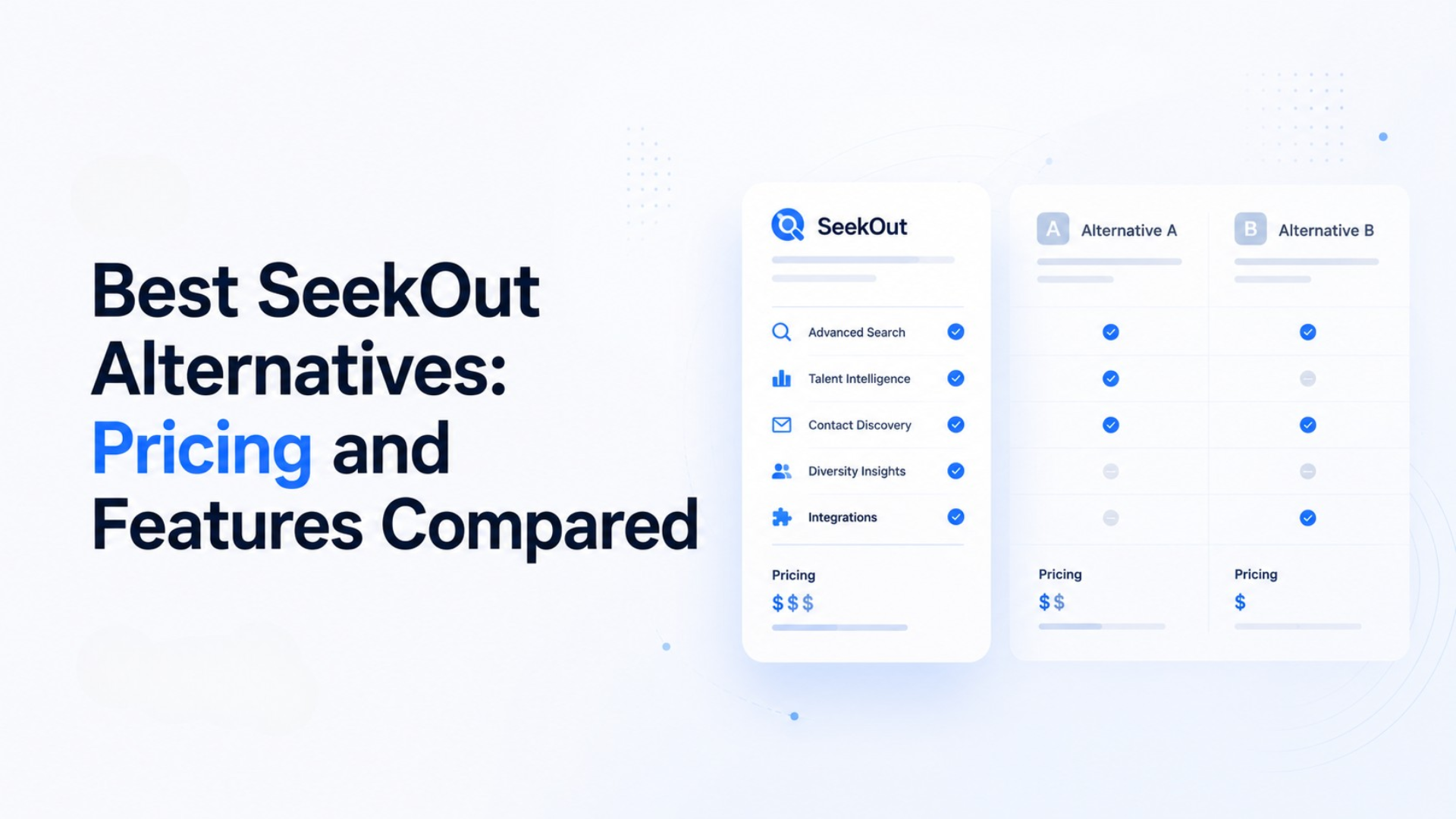
Choosing the Right SeekOut Alternative
One lesson has become increasingly clear across the recruitment technology market.
There is no universally "best" recruiting platform.
Every organization hires differently.
A startup recruiting its first ten employees has different priorities from an enterprise filling thousands of roles annually.
A recruitment agency managing multiple clients operates differently from an internal HR department.
Some organizations need stronger analytics.
Others need sourcing.
Some need better outreach.
Others want automation.
Increasingly, however, one trend is emerging across every hiring environment.
Recruiters want fewer disconnected systems.
They want one platform capable of supporting the entire recruitment journey.
That is where Huntlo differentiates itself.
Rather than solving only candidate discovery, it connects sourcing, AI-powered outreach, communication, screening, interview coordination, and recruiter workflows into one integrated experience.
As recruitment continues evolving beyond sourcing, this connected approach becomes increasingly valuable.
Organizations are no longer purchasing software simply because it contains AI.
They are investing in platforms that remove friction throughout hiring.
Final Thoughts
SeekOut remains one of the strongest talent intelligence platforms available today.
Its sourcing capabilities continue to help recruiters identify difficult-to-find professionals across multiple industries.
However, recruitment has evolved.
Finding candidates is only one stage of hiring.
Today's organizations need platforms that simplify every stage that follows.
From candidate engagement and communication to automation and recruiter productivity, modern hiring increasingly depends on connected workflows rather than isolated features.
That shift explains why many organizations are evaluating alternatives.
Not because SeekOut has become less capable.
But because recruitment itself has become more demanding.
For organizations seeking an AI recruiting platform that extends beyond sourcing into a complete hiring workflow, Huntlo represents one of the strongest alternatives available in 2026. Its unified approach reflects where the recruitment industry is heading—toward simpler operations, better candidate experiences, and technology that enables recruiters to spend more time hiring people and less time managing software.
Frequently Asked Questions
What is the best SeekOut alternative in 2026?
The answer depends on your hiring needs. Organizations looking for an end-to-end AI recruiting platform often evaluate Huntlo, while companies prioritizing enterprise workflows may also consider Greenhouse, Lever, or SmartRecruiters.
Is SeekOut only a sourcing platform?
SeekOut is primarily known for AI-powered talent sourcing and workforce intelligence, although its capabilities have expanded over time. Organizations requiring broader recruitment workflows may explore platforms with additional engagement and automation features.
Which AI recruiting software is best for recruitment agencies?
Recruitment agencies generally benefit from platforms that combine sourcing, outreach automation, candidate engagement, and workflow management in one place, reducing the need to switch between multiple tools.
Can AI recruiting software help with high-volume hiring?
Yes. AI recruiting platforms can automate repetitive tasks such as sourcing, candidate communication, resume screening, and scheduling, making them particularly valuable for organizations hiring at scale.
How do AI recruiting platforms improve recruiter productivity?
By reducing manual administrative work, AI allows recruiters to spend more time building candidate relationships, advising hiring managers, and making strategic hiring decisions.
Related topics
SeekOut Pricing in 2026: Plans, Costs, and Alternatives
Huntlo vs Juicebox vs SeekOut vs hireEZ: Pricing Compared (2026)
Top 8 hireEZ Alternatives for Recruiting Teams in 2026