Candidate Sourcing Has Become an Intelligence Problem
Recruitment has entered a new era.
Not long ago, sourcing candidates meant searching job boards, experimenting with Boolean strings, and manually reviewing hundreds of resumes to find a handful of qualified professionals. Recruiters spent most of their time searching rather than hiring.
Artificial intelligence has fundamentally changed that process.
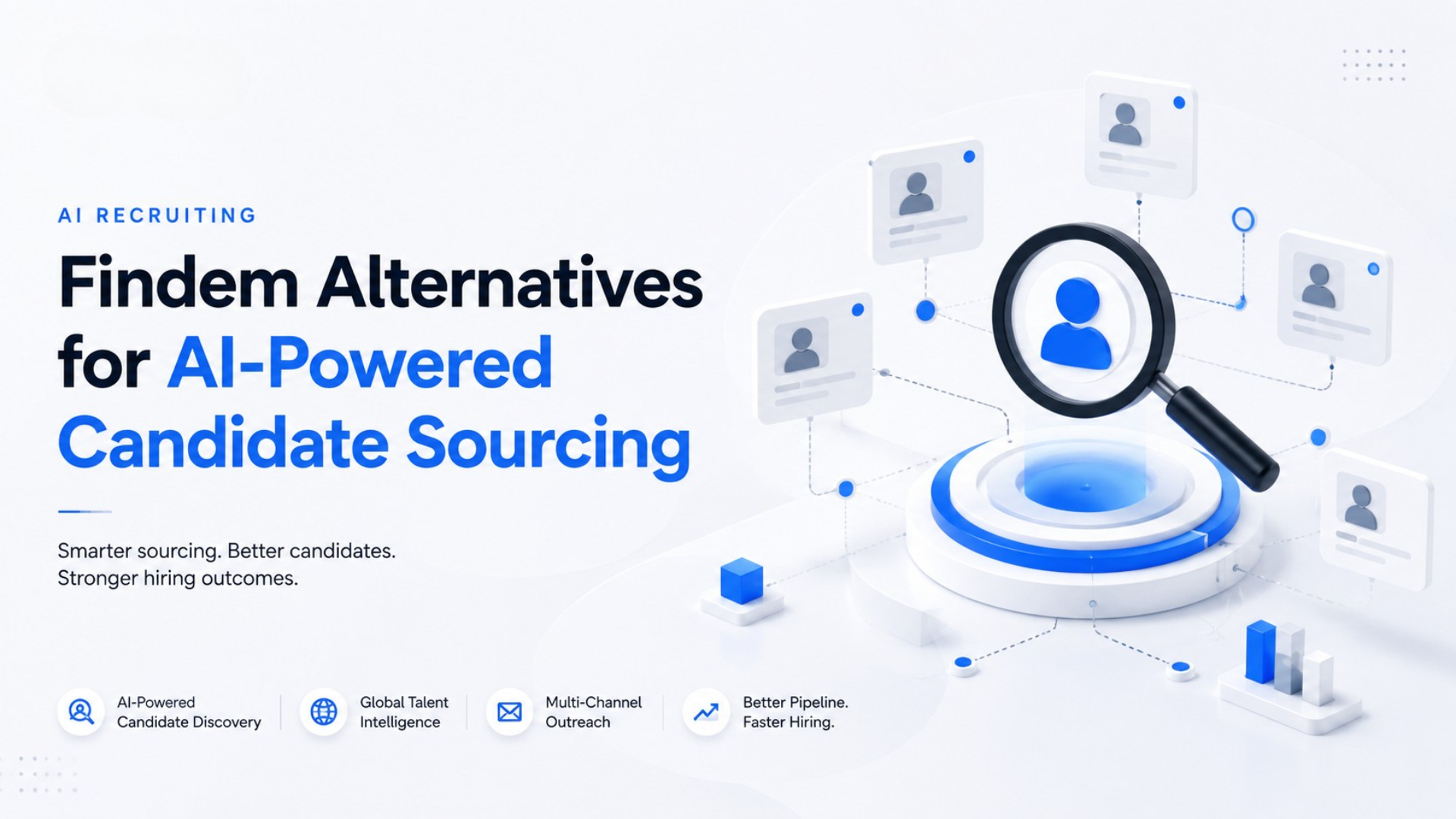
Modern sourcing platforms no longer rely solely on keywords or job titles. They analyze skills, career progression, company experience, certifications, education, and workforce data to identify candidates who may never appear in traditional searches.
The result is better candidate discovery with significantly less manual effort.
Findem has been one of the companies driving this transformation.
By combining AI-powered talent intelligence with enriched people data, Findem enables recruiters to search beyond resumes and uncover candidates using attributes that better reflect real-world experience.
This has been particularly valuable for organizations hiring specialized talent in engineering, cybersecurity, healthcare, life sciences, and executive leadership.
But recruitment has continued evolving.
Finding candidates is no longer the hardest part of hiring.
Today's recruiters must also personalize outreach, engage passive talent, automate repetitive work, coordinate interviews, collaborate with hiring managers, and maintain strong candidate relationships from first contact through offer acceptance.
Whether organizations are recruiting for HR jobs, recruiter jobs, freshers jobs, or managing large-scale internship jobs, sourcing has become only the first stage of a much larger hiring workflow.
According to the LinkedIn Talent Solutions, recruiter productivity and skills-based hiring continue to shape talent acquisition strategies worldwide. Likewise, the World Economic Forum Future of Jobs Report highlights artificial intelligence as one of the defining technologies reshaping workforce planning and recruitment.
These changes explain why many organizations are evaluating Findem alternatives.
The conversation is no longer about which platform finds the most candidates.
It is about which platform helps recruiters turn candidate discovery into successful hires.
Why Organizations Are Looking Beyond Findem
Findem remains one of the strongest AI-powered sourcing platforms in the market.
Its talent intelligence capabilities help recruiters discover professionals using rich workforce data instead of relying exclusively on resumes or keyword searches.
For organizations focused primarily on candidate discovery, this provides significant value.
However, sourcing alone rarely determines hiring success.
Once candidates have been identified, recruiters must initiate outreach, personalize communication, qualify applicants, coordinate interviews, manage hiring pipelines, and maintain candidate engagement throughout recruitment.
Managing these activities across multiple disconnected platforms introduces unnecessary operational complexity.
This challenge becomes particularly significant for organizations hiring at scale.
Companies advertising jobs near me, work from home jobs, online jobs, part time jobs, or operational positions such as data entry jobs often process thousands of applications while simultaneously sourcing passive candidates.
Recruiters increasingly want software that supports the complete hiring journey rather than one stage of recruitment.
The alternatives below reflect this broader shift in recruitment technology.
Huntlo: Connecting AI Sourcing With End-to-End Recruitment
One of the biggest differences between Huntlo and traditional sourcing platforms is that candidate discovery is viewed as the beginning of recruitment rather than the destination.
Finding qualified professionals creates opportunity.
Hiring them creates value.
Huntlo connects these stages within one AI-powered recruiting platform.
Recruiters begin with AI sourcing to identify qualified candidates.
From there, they can launch personalized outreach, automate follow-ups, conduct AI-assisted screening, coordinate interviews, collaborate with hiring managers, and manage recruitment workflows without leaving the platform.
This eliminates much of the friction created by disconnected recruiting software.
Instead of moving candidate information between sourcing tools, CRM systems, scheduling platforms, and applicant tracking software, recruiters manage the entire hiring lifecycle within one connected ecosystem.
This approach benefits organizations hiring across enterprise recruitment, graduate hiring, campus recruitment, and high-volume operational roles including jobs for women, work from home jobs for women, and regional expansion campaigns.
Rather than replacing recruiters, Huntlo uses AI to reduce repetitive work while helping hiring teams focus on conversations that lead to successful placements.
As recruitment continues evolving beyond sourcing alone, this connected workflow increasingly represents the future of AI recruiting.
SeekOut: Precision Talent Intelligence
Organizations hiring highly specialized professionals often require exceptional sourcing capabilities.
SeekOut has built its reputation by helping recruiters identify candidates through semantic search, workforce intelligence, and skills-based discovery rather than traditional keyword matching.
Its platform is widely used for engineering, healthcare, cybersecurity, life sciences, and executive recruitment where talent shortages make precision sourcing especially important.
According to SeekOut, its AI-powered talent intelligence platform helps organizations identify difficult-to-find professionals across multiple industries.
For recruiters focused primarily on candidate discovery, SeekOut remains one of the strongest alternatives to Findem.
hireEZ: AI Sourcing at Scale
High-volume recruiting demands both speed and precision.
hireEZ combines AI-powered sourcing with automation to help recruiters discover talent across multiple professional data sources while reducing manual search effort.
Instead of relying exclusively on exact keyword matches, recruiters can identify candidates through skills, experience, career progression, and semantic relationships.
According to hireEZ, its sourcing platform enables recruiters to expand candidate discovery while improving recruiting productivity across large hiring campaigns.
For organizations where sourcing remains the largest recruitment challenge, hireEZ continues to be one of the industry's leading AI recruiting platforms.
Ashby: Operational Intelligence Beyond Candidate Discovery
Finding qualified candidates is only the beginning of recruitment.
As hiring volumes increase, recruiters face a different challenge altogether—keeping every hiring process organized.
Interview scheduling.
Hiring manager feedback.
Pipeline visibility.
Recruiter collaboration.
Hiring analytics.
These operational activities often determine whether qualified candidates become successful hires.
Ashby has become one of the fastest-growing recruiting platforms because it approaches hiring from an operational perspective rather than focusing solely on sourcing.
Its combination of Applicant Tracking, recruiting analytics, interview scheduling, and workflow automation helps organizations create structured recruitment processes that remain consistent as hiring scales.
According to Ashby, centralized recruiting operations allow hiring teams to improve recruiter productivity while maintaining visibility across every stage of the hiring funnel.
For organizations looking beyond candidate sourcing, Ashby offers one of the strongest operational alternatives to Findem.
Greenhouse: Structured Hiring Starts With Better Candidate Matching
Candidate sourcing becomes significantly more valuable when organizations consistently evaluate candidates using structured hiring practices.
Greenhouse has built its reputation around improving hiring quality through standardized interviews, collaborative evaluation frameworks, interview scorecards, and structured decision-making.
Rather than relying exclusively on recruiter intuition, hiring teams follow consistent evaluation criteria across every interview stage.
According to Greenhouse, structured hiring improves collaboration while creating fairer and more consistent hiring decisions.
For organizations where hiring quality is just as important as sourcing efficiency, Greenhouse remains one of the strongest enterprise recruiting platforms available.
Lever: Candidate Relationships Matter After Sourcing
Finding candidates is only valuable if recruiters can successfully build relationships with them.
Many organizations invest heavily in sourcing while overlooking long-term candidate engagement.
Lever addresses this challenge by combining Applicant Tracking with Candidate Relationship Management (CRM).
Recruiters can build talent communities, maintain ongoing communication with passive candidates, and reconnect with professionals whenever suitable opportunities arise.
This strategy has become increasingly important because experienced candidates often spend very little time actively searching through online jobs, jobs near me, or traditional career websites.
According to Lever, relationship-driven recruiting enables organizations to improve hiring efficiency by maintaining engagement long before recruitment campaigns begin.
For businesses focused on long-term talent acquisition, Lever remains one of the strongest alternatives.
Gem: Turning Recruiting Data Into Better Sourcing Decisions
Modern recruiting generates enormous amounts of information.
Response rates.
Interview outcomes.
Pipeline performance.
Offer acceptance.
Candidate engagement.
The challenge is no longer collecting recruiting data.
It is understanding which information improves future hiring.
Gem approaches recruitment through recruiting intelligence.
Its platform helps organizations analyze sourcing effectiveness, recruiter productivity, outreach performance, and hiring funnel efficiency to continuously improve recruitment outcomes.
According to Gem, recruiting analytics help organizations optimize sourcing strategies while strengthening candidate engagement throughout the hiring process.
For recruiting leaders focused on continuous improvement rather than individual hiring campaigns, Gem offers significant value.
SmartRecruiters: Enterprise Collaboration at Scale
Recruitment rarely depends on recruiters alone.
Hiring managers define requirements.
Department leaders evaluate candidates.
Executives approve offers.
HR teams ensure compliance.
Candidates expect smooth communication throughout.
SmartRecruiters has positioned itself around collaborative hiring, allowing every stakeholder to contribute within one centralized recruitment platform.
Instead of optimizing only sourcing, the platform simplifies communication, workflow coordination, and hiring visibility across enterprise organizations.
According to SmartRecruiters, collaborative recruiting improves hiring quality while reducing delays that frequently affect both recruiters and candidates.
For organizations managing complex hiring environments, collaboration often becomes as valuable as AI-powered sourcing itself.
Eightfold AI: Expanding Sourcing Through Skills Intelligence
Candidate sourcing is becoming increasingly skills-based.
Organizations no longer recruit exclusively based on job titles or previous employers.
Instead, recruiters increasingly search for transferable skills, career progression, learning potential, and workforce intelligence.
Eightfold AI has become one of the leading talent intelligence platforms supporting this transition.
Its AI analyzes workforce data to recommend candidates whose skills align with hiring requirements, even when traditional resumes might suggest otherwise.
According to Eightfold AI, AI-powered skills intelligence enables organizations to improve both external recruitment and internal mobility through a unified understanding of workforce capabilities.
For enterprises investing heavily in strategic workforce planning, Eightfold AI remains one of Findem's strongest competitors.
Beamery: Long-Term Talent Intelligence
Beamery approaches recruitment from an enterprise talent strategy perspective.
Rather than focusing only on current hiring needs, the platform combines Talent CRM, workforce planning, candidate engagement, and skills intelligence to help organizations prepare for future hiring demand.
This allows enterprises to build long-term relationships with candidates while supporting internal career development and succession planning.
According to Beamery, connected talent data enables organizations to improve workforce planning while strengthening candidate engagement across the employee lifecycle.
For companies treating recruitment as one part of a broader talent strategy, Beamery remains a compelling alternative.
Choosing the Right Findem Alternative
Candidate sourcing has changed dramatically.
Artificial intelligence now enables recruiters to discover qualified professionals faster than ever before.
Yet sourcing alone no longer defines successful recruitment.
Organizations increasingly evaluate recruiting software based on how effectively it supports every stage of hiring.
Some businesses prioritize sourcing precision.
Others invest heavily in recruiter productivity.
Some require enterprise workforce intelligence.
Others focus on workflow automation.
One trend, however, continues shaping recruitment technology.
Recruiters want connected recruiting ecosystems.
Managing separate platforms for sourcing, outreach, CRM, applicant tracking, scheduling, analytics, and workflow management creates unnecessary operational complexity.
This is where Huntlo differentiates itself.
Instead of treating candidate sourcing as an isolated capability, Huntlo connects AI-powered sourcing with personalized outreach, AI-assisted screening, interview coordination, workflow automation, recruiter collaboration, and hiring management within one unified platform.
As recruiting teams continue balancing higher hiring volumes with increasing expectations for candidate experience, platforms that simplify operations are becoming increasingly valuable.
Final Thoughts
Findem has helped redefine AI-powered candidate sourcing through talent intelligence and enriched people data.
Its ability to uncover qualified candidates beyond traditional resume searches continues making it one of the strongest sourcing platforms available.
However, recruitment in 2026 extends well beyond discovering talent.
Recruiters need automation.
Candidates expect personalized communication.
Hiring managers require collaboration.
Leadership expects measurable hiring outcomes.
Organizations increasingly prefer recruiting platforms capable of supporting the complete hiring journey rather than one stage of recruitment.
That evolution explains why businesses continue evaluating Findem alternatives.
Not because AI sourcing has become less important.
But because sourcing is now only the first step toward successful hiring.
For organizations seeking an AI recruiting platform that combines sourcing, recruiter outreach, AI-assisted screening, workflow automation, candidate engagement, and end-to-end hiring management, Huntlo represents one of the strongest alternatives available today.
The future of recruitment belongs to platforms that transform candidate discovery into successful hiring outcomes through one connected recruiting ecosystem.
Frequently Asked Questions
What is the best Findem alternative in 2026?
Organizations commonly compare Huntlo with Findem, SeekOut, hireEZ, Ashby, Greenhouse, Lever, Gem, SmartRecruiters, Eightfold AI, and Beamery. The best platform depends on whether your priority is sourcing, talent intelligence, recruiter productivity, or end-to-end recruitment.
Is Findem only a candidate sourcing platform?
Findem is primarily known for AI-powered candidate sourcing and talent intelligence, using enriched people data and skills intelligence to help recruiters identify qualified professionals more effectively.
Can AI improve candidate sourcing?
Yes. AI-powered sourcing platforms analyze skills, experience, career progression, workforce data, and semantic relationships to identify candidates more accurately than traditional keyword-based searches.
Why are organizations moving toward integrated recruiting platforms?
Many organizations want one platform that combines sourcing, outreach, candidate engagement, applicant tracking, interview scheduling, analytics, and workflow automation instead of managing multiple disconnected recruiting tools.
What should recruiters consider when choosing a Findem alternative?
Recruiters should evaluate sourcing quality, AI capabilities, workflow automation, recruiter productivity, candidate engagement, integrations, scalability, analytics, and how effectively the platform supports the entire hiring lifecycle.