Talent Intelligence Is Becoming the Foundation of Modern Recruitment
Artificial intelligence has changed far more than candidate sourcing.
For years, recruitment technology focused on helping recruiters find talent faster. Applicant Tracking Systems organized applications, sourcing platforms searched professional profiles, and outreach software automated communication. Each solved an individual problem, but recruiters still relied heavily on manual decision-making to connect every stage of the hiring process.
Today's hiring landscape looks very different.
Organizations want technology that understands skills, predicts workforce needs, identifies internal talent, recommends career pathways, and helps recruiters make better hiring decisions using data rather than intuition alone.
This shift has given rise to talent intelligence platforms.
Unlike traditional recruiting software, talent intelligence platforms analyze vast amounts of workforce data to identify patterns that would be difficult for humans to recognize manually. They don't simply answer the question, "Who can fill this role?" They also help organizations understand which skills are missing, where future hiring demand may emerge, and how existing employees could transition into new opportunities.
Platforms such as Eightfold AI have played a significant role in driving this transformation.
According to the World Economic Forum Future of Jobs Report, organizations increasingly prioritize skills over traditional credentials as AI reshapes workforce planning. Similarly, LinkedIn Talent Solutions continues to highlight skills-based hiring as one of the defining trends in modern talent acquisition.
These changes explain why talent intelligence has become one of the fastest-growing categories within HR technology.
But they also explain why organizations are beginning to explore alternatives.
Why Companies Are Evaluating Eightfold AI Alternatives
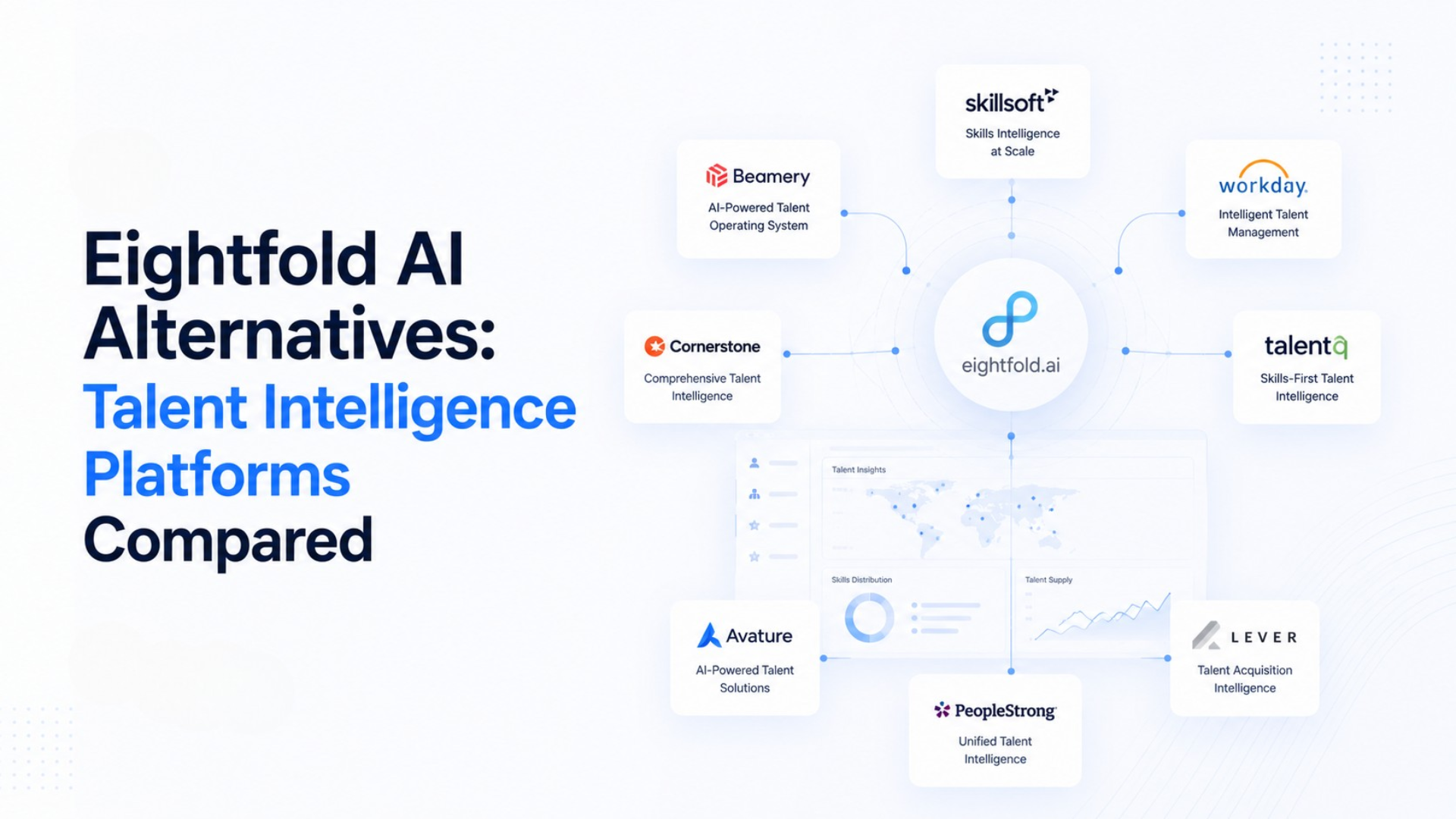
Eightfold AI remains one of the most comprehensive enterprise talent intelligence platforms available today.
Its strengths extend beyond recruitment into internal mobility, workforce planning, career development, and skills intelligence. Large organizations managing thousands of employees often benefit from these capabilities because hiring has become closely connected to broader workforce strategy.
However, enterprise recruitment priorities continue evolving.
Many organizations are looking for software that combines talent intelligence with recruiter productivity, AI sourcing, outreach automation, candidate engagement, and workflow management within a more connected experience.
Instead of managing separate systems for sourcing, CRM, communication, interview scheduling, and talent intelligence, recruiting teams increasingly prefer integrated platforms capable of supporting the complete hiring lifecycle.
This need becomes especially apparent for organizations recruiting across multiple functions simultaneously.
Whether filling HR jobs, recruiter jobs, freshers jobs, leadership positions, or large-scale internship jobs, recruiters require software that supports both strategic workforce planning and day-to-day hiring operations.
The alternatives below reflect different approaches to solving that challenge.
Huntlo: Turning Talent Intelligence Into Recruiter Action
One limitation of many enterprise talent intelligence platforms is that they generate valuable insights without always simplifying the recruiter's daily workflow.
Knowing where talent exists is important.
Acting on that information quickly is even more important.
Huntlo approaches this challenge differently.
Instead of separating sourcing, outreach, communication, screening, and workflow management into independent systems, Huntlo connects these activities within one AI-powered recruiting platform.
Talent intelligence becomes actionable.
Recruiters can identify qualified candidates, launch personalized outreach, automate follow-ups, coordinate interviews, and manage candidate pipelines without switching between multiple platforms.
For recruitment agencies and growing organizations, this reduces operational complexity while improving recruiter productivity.
It also supports organizations hiring across diverse categories, from jobs near me and work from home jobs to online jobs, part time jobs, and specialized technical recruitment.
Rather than positioning AI as another layer of reporting, Huntlo integrates intelligence directly into recruiter workflows, allowing hiring teams to spend less time managing software and more time engaging candidates.
Ashby: Data-Driven Recruitment Operations
While Eightfold AI focuses heavily on workforce intelligence, Ashby approaches recruitment through operational intelligence.
Growing organizations often discover that hiring challenges arise not because recruiters cannot find talent, but because interview scheduling, hiring manager feedback, reporting, and collaboration become increasingly difficult as recruitment scales.
Ashby combines applicant tracking, recruiting analytics, scheduling, and workflow automation within a centralized platform.
According to Ashby, its platform helps organizations improve hiring consistency while providing greater visibility across every stage of the recruitment process.
For organizations prioritizing operational efficiency alongside AI capabilities, Ashby presents a compelling alternative.
SeekOut: Precision Talent Discovery
Talent intelligence begins with understanding talent markets.
SeekOut has established itself as one of the strongest platforms for discovering specialized professionals across engineering, healthcare, life sciences, cybersecurity, and executive hiring.
Its AI-powered search capabilities emphasize skills, experience, and workforce intelligence rather than traditional keyword matching.
According to SeekOut, the platform combines semantic search with talent intelligence to improve candidate discovery for difficult-to-fill roles.
Organizations whose primary objective is identifying niche talent often view SeekOut as one of the strongest alternatives to broader workforce intelligence platforms.
Greenhouse: Structured Hiring for Enterprise Growth
As organizations scale, recruitment becomes increasingly dependent on structure rather than speed alone.
Large enterprises often manage hundreds of hiring managers, multiple business units, and thousands of applications simultaneously. In these environments, inconsistency can become one of the biggest barriers to successful hiring.
Greenhouse has built its reputation by helping organizations standardize recruitment through structured interviews, collaborative hiring workflows, interview scorecards, and detailed reporting.
Rather than focusing solely on AI sourcing, the platform emphasizes creating repeatable hiring processes that improve decision-making while maintaining consistency across departments.
According to Greenhouse, structured hiring helps organizations make more objective hiring decisions while improving collaboration between recruiters and hiring managers.
For enterprises where governance and consistency are as important as candidate discovery, Greenhouse remains one of the strongest alternatives to Eightfold AI.
Lever: Relationship-Driven Recruiting
One of the biggest changes in recruitment has been the shift from filling vacancies to building talent communities.
Organizations no longer wait until a position opens before engaging candidates.
Instead, they maintain ongoing relationships with professionals who may become future hires.
Lever has helped popularize this approach by combining Applicant Tracking with Candidate Relationship Management (CRM).
Recruiters can nurture passive candidates, organize long-term talent pools, and maintain communication even when no immediate job vacancy exists.
This strategy is becoming increasingly valuable as experienced professionals spend less time actively browsing online jobs, jobs near me, or traditional career websites.
According to Lever, relationship-based recruiting helps organizations reduce hiring timelines by maintaining continuous engagement with potential candidates.
Rather than restarting recruitment every time a role opens, recruiters begin with an already engaged talent community.
hireEZ: AI-Powered Candidate Discovery
While talent intelligence provides strategic workforce insights, recruiters still need practical sourcing capabilities.
hireEZ continues to excel in helping recruiters discover qualified professionals across multiple talent sources using AI-powered semantic search and automation.
Instead of relying exclusively on exact keywords or job titles, the platform identifies candidates based on skills, experience, and career progression.
This broader understanding of talent significantly improves sourcing quality, particularly when organizations recruit for highly competitive positions.
According to hireEZ, its AI sourcing technology helps recruiters reduce manual search effort while expanding candidate reach.
Organizations focused primarily on candidate discovery continue to view hireEZ as one of the strongest sourcing platforms available.
Gem: Turning Recruiting Data Into Strategic Intelligence
Modern recruitment produces enormous amounts of information.
Response rates.
Interview outcomes.
Offer acceptance.
Hiring velocity.
Candidate engagement.
Pipeline performance.
The challenge is rarely collecting data.
The challenge is understanding what that data means.
Gem approaches recruitment by transforming operational information into actionable insights.
Recruiters gain visibility into sourcing effectiveness, hiring funnel performance, recruiter productivity, and candidate engagement metrics.
Rather than helping organizations simply recruit faster, Gem helps them recruit smarter.
According to McKinsey & Company, organizations using workforce analytics effectively often make stronger long-term talent decisions by identifying patterns that traditional reporting frequently misses.
For recruitment leaders responsible for improving hiring performance, this analytical approach provides valuable operational visibility.
SmartRecruiters: Collaboration Across the Entire Hiring Journey
Recruitment is no longer owned solely by recruiters.
Hiring managers define role requirements.
Department leaders evaluate candidates.
Executives approve offers.
HR teams ensure compliance.
Candidates expect timely communication throughout.
SmartRecruiters has positioned itself around this collaborative hiring model by connecting every stakeholder involved in recruitment.
Its flexible workflows, integrations, and enterprise-ready architecture allow organizations to simplify communication while maintaining hiring consistency.
According to SmartRecruiters, collaborative hiring remains central to the platform's philosophy, enabling organizations to improve decision-making without sacrificing recruiter productivity.
For large organizations, collaboration often becomes just as important as sourcing.
Beamery: Talent Intelligence Beyond Recruitment
While most recruiting platforms focus on filling current vacancies, Beamery expands the conversation toward long-term workforce planning.
Its platform combines talent intelligence, skills mapping, workforce planning, and career mobility to help organizations understand future workforce needs rather than simply current hiring demand.
This makes Beamery particularly valuable for enterprises investing heavily in internal mobility and strategic workforce development.
According to Beamery, organizations increasingly require unified talent data to support hiring, employee development, and workforce planning simultaneously.
For businesses treating recruitment as part of a broader talent strategy, Beamery represents a strong alternative to Eightfold AI.
Choosing the Right Talent Intelligence Platform
Selecting the right platform depends on the role talent intelligence plays within your organization.
If workforce planning and internal mobility remain top priorities, enterprise platforms like Eightfold AI and Beamery continue offering extensive capabilities.
If sourcing specialized professionals is the primary challenge, SeekOut remains a strong option.
Organizations focused on structured hiring may prefer Greenhouse or Ashby.
However, one trend continues to reshape recruitment technology.
Recruiters increasingly want connected workflows instead of disconnected software.
Rather than managing separate systems for sourcing, outreach, candidate engagement, scheduling, analytics, and talent intelligence, organizations are consolidating these activities into unified recruiting ecosystems.
This is where Huntlo differentiates itself.
Instead of treating talent intelligence as a reporting layer, Huntlo integrates AI directly into everyday recruiter workflows.
Candidate discovery leads naturally into personalized outreach.
Outreach flows into AI-assisted screening.
Screening transitions into interview coordination.
Every stage remains connected within one platform.
As recruitment continues evolving beyond sourcing and workforce analytics, this operational simplicity creates measurable advantages for recruiters managing increasingly complex hiring processes.
Final Thoughts
Eightfold AI has helped define the modern talent intelligence category.
Its strengths in workforce planning, skills intelligence, and internal mobility continue making it one of the most influential enterprise HR platforms.
But recruitment in 2026 demands more than intelligence alone.
Organizations need action.
Recruiters need automation.
Hiring managers need visibility.
Candidates expect personalized experiences.
As these expectations continue growing, businesses are evaluating platforms capable of combining talent intelligence with recruiter productivity and operational efficiency.
That evolution explains why so many organizations are exploring Eightfold AI alternatives.
Not because workforce intelligence has become less important.
But because recruitment itself has become more connected.
For organizations seeking a platform that combines AI sourcing, recruiter outreach, candidate engagement, workflow automation, and talent intelligence within one ecosystem, Huntlo represents one of the strongest alternatives available today.
The future of recruitment belongs to platforms that not only understand talent but also help recruiters act on those insights faster and more effectively.
Frequently Asked Questions
What is the best Eightfold AI alternative in 2026?
Organizations looking for an integrated AI recruiting workflow often compare Huntlo with platforms such as Beamery, SeekOut, Ashby, Greenhouse, and Lever. The right choice depends on whether your priority is workforce planning, sourcing, or end-to-end recruitment.
Is Eightfold AI only for enterprise organizations?
Eightfold AI is primarily designed for medium-to-large enterprises with complex workforce planning and talent intelligence requirements, although organizations of different sizes may also benefit depending on their hiring strategy.
What is a talent intelligence platform?
A talent intelligence platform uses artificial intelligence to analyze workforce skills, candidate data, career progression, and labor market information to support hiring, workforce planning, and internal mobility decisions.
Can AI improve recruiter productivity?
Yes. AI reduces repetitive work such as sourcing, resume screening, outreach, scheduling, and administrative coordination, allowing recruiters to focus on relationship building and hiring strategy.
Why are companies moving toward integrated recruiting platforms?
Organizations increasingly prefer platforms that connect sourcing, outreach, candidate engagement, workflow automation, and analytics rather than relying on multiple disconnected recruiting tools.