Candidate Experience Has Become the New Competitive Advantage
Recruitment has changed dramatically over the past decade.
There was a time when organizations competed almost entirely on salary, job titles, and employer reputation. Recruiters focused on posting vacancies, reviewing applications, and scheduling interviews. Candidate experience was important, but it was rarely viewed as a strategic differentiator.
That reality no longer exists.
Today's candidates expect recruitment to feel as seamless as every other digital experience they encounter. They want personalized communication, intuitive career sites, transparent hiring timelines, and timely updates throughout the recruitment process.
Whether someone is applying for jobs near me, work from home jobs, online jobs, part time jobs, or executive leadership opportunities, expectations remain remarkably consistent.
Candidates expect organizations to value their time.
This shift has given rise to Talent Experience Platforms.
Instead of focusing solely on Applicant Tracking or candidate sourcing, these platforms aim to improve every interaction candidates have with an employer—from discovering opportunities and exploring career pages to submitting applications and communicating with recruiters.
Phenom has become one of the best-known platforms within this category.
Its combination of AI-powered career sites, recruitment marketing, automation, and candidate engagement has helped organizations strengthen employer branding while improving hiring efficiency.
However, recruitment has continued evolving.
Creating a great candidate experience is no longer enough.
Recruiters also need intelligent sourcing, workflow automation, recruiter collaboration, AI-assisted screening, and connected hiring operations.
According to the LinkedIn Talent Solutions, candidate experience and recruiter productivity remain among the most influential drivers of hiring success. Likewise, the World Economic Forum Future of Jobs Report highlights artificial intelligence as a major force transforming recruitment and workforce planning.
These trends explain why many organizations are beginning to evaluate Phenom alternatives.
Why Companies Are Looking Beyond Phenom
Phenom continues to be one of the strongest Talent Experience platforms available today.
Its AI-powered career sites, conversational recruiting capabilities, recruitment marketing, and candidate engagement tools make it particularly valuable for enterprise organizations seeking to improve employer branding.
Yet recruitment rarely ends once a candidate submits an application.
Recruiters must still source talent, qualify candidates, schedule interviews, coordinate hiring managers, manage applicant pipelines, automate communication, and analyze recruitment performance.
These activities often require multiple disconnected platforms.
Growing recruiting teams increasingly prefer integrated recruiting ecosystems capable of supporting the complete hiring lifecycle.
This becomes particularly important for organizations recruiting across multiple business functions.
Whether hiring for HR jobs, recruiter jobs, freshers jobs, leadership positions, or large-scale internship jobs, recruiters require technology that simplifies operations rather than introducing additional complexity.
Organizations advertising data entry jobs, jobs for women, or large volumes of work from home jobs for women also face substantial application volumes that demand intelligent workflow automation rather than isolated candidate engagement.
These evolving expectations have encouraged many businesses to explore alternatives.
Huntlo: Connecting Candidate Experience With Recruiter Productivity
One of the biggest differences between Huntlo and traditional Talent Experience platforms is its emphasis on recruiter workflows.
Creating exceptional candidate experiences remains essential.
But those experiences are ultimately shaped by recruiter efficiency.
Delayed responses.
Missed follow-ups.
Manual scheduling.
Disconnected communication.
These operational challenges affect candidate experience just as much as career site design.
Huntlo approaches recruitment from this broader perspective.
Instead of separating sourcing, outreach, AI-assisted screening, workflow automation, recruiter collaboration, and candidate engagement into independent systems, Huntlo connects them within one AI-powered recruiting platform.
Recruiters can discover candidates, launch personalized outreach, automate communication, coordinate interviews, and manage hiring pipelines without switching between multiple applications.
This integrated workflow reduces administrative effort while enabling recruiters to focus on meaningful conversations.
For organizations scaling recruitment across graduate hiring, campus recruitment, enterprise hiring, or high-volume operational roles, this operational simplicity creates measurable productivity improvements.
Rather than treating candidate experience as a standalone objective, Huntlo improves candidate experience by helping recruiters work more efficiently.
Ashby: Operational Excellence Creates Better Candidate Experiences
Candidate experience depends heavily on internal recruiting operations.
Applicants notice when interview scheduling is delayed.
They recognize inconsistent communication.
They experience hiring manager confusion.
Ashby addresses these operational challenges by combining Applicant Tracking, recruiting analytics, interview scheduling, and workflow automation within one centralized platform.
According to Ashby, improving recruiting operations allows organizations to create more consistent hiring experiences while reducing administrative work for recruiters.
For growing companies, operational excellence often becomes the foundation of exceptional candidate experience.
Greenhouse: Structured Hiring Builds Candidate Trust
Trust is built through consistency.
Greenhouse has become one of the industry's most respected recruitment platforms because it standardizes interviews, hiring scorecards, recruiter collaboration, and evaluation criteria.
Candidates benefit from more transparent hiring experiences.
Recruiters benefit from structured workflows.
Organizations benefit from better hiring decisions.
According to Greenhouse, structured hiring improves fairness, collaboration, and recruitment quality across growing organizations.
For enterprises prioritizing hiring consistency, Greenhouse remains one of the strongest Phenom alternatives.
Lever: Candidate Relationships That Continue Beyond Applications
A great candidate experience does not begin when someone submits an application.
It begins long before that.
Organizations that consistently attract top talent understand the importance of building relationships before hiring demand exists. Instead of waiting until a position opens, recruiters engage potential candidates continuously, creating talent communities that can be activated whenever new opportunities arise.
Lever has become one of the most recognized platforms supporting this relationship-first approach.
By combining Applicant Tracking with Candidate Relationship Management (CRM), Lever enables recruiters to maintain long-term engagement with passive candidates rather than restarting recruitment campaigns every time a new job vacancy becomes available.
This strategy has become increasingly valuable because many experienced professionals are no longer actively searching through jobs near me, online jobs, or traditional career websites. They often respond to organizations they already recognize and trust.
According to Lever, continuous candidate engagement helps organizations reduce hiring timelines while strengthening employer branding through ongoing communication.
For businesses focused on building sustainable talent pipelines, Lever remains one of the strongest alternatives to Phenom.
Gem: Turning Outreach Into Meaningful Engagement
Candidate experience depends heavily on communication.
Even highly qualified candidates can lose interest when recruiters respond slowly, follow-up messages feel generic, or hiring timelines become unclear.
Gem approaches recruitment by strengthening recruiter outreach.
Instead of viewing outreach as a sequence of automated emails, Gem helps recruiters create personalized engagement campaigns that nurture relationships throughout the hiring journey.
Organizations hiring across multiple departments often use outreach automation to maintain communication without increasing recruiter workload.
According to Gem, improving recruiter communication contributes to healthier talent pipelines while enabling recruiters to maintain stronger long-term relationships with prospective candidates.
For teams where candidate engagement is the highest priority, Gem remains a compelling alternative.
SeekOut: Better Candidate Experiences Begin With Better Candidates
Candidate experience is often discussed after sourcing.
In reality, it begins during sourcing.
When recruiters identify candidates whose skills genuinely align with opportunities, conversations become more relevant, interviews become more productive, and hiring outcomes improve for everyone involved.
SeekOut approaches recruitment through talent intelligence rather than workflow automation.
Its semantic search capabilities allow recruiters to discover professionals based on skills, experience, certifications, and career progression rather than depending exclusively on job titles or keyword matching.
This becomes particularly valuable when hiring engineers, cybersecurity specialists, healthcare professionals, life science researchers, and executive leaders.
According to SeekOut, AI-powered talent intelligence enables recruiters to discover specialized candidates who may remain hidden through conventional sourcing methods.
Organizations focused primarily on precision hiring continue to view SeekOut as one of the strongest AI sourcing platforms available.
hireEZ: AI Sourcing Designed for Faster Hiring
Every successful candidate experience starts with efficient sourcing.
The faster recruiters identify qualified professionals, the faster meaningful conversations can begin.
hireEZ continues to be one of the industry's leading AI sourcing platforms because it expands recruiter access to talent across multiple professional data sources while reducing manual search effort.
Instead of relying solely on keyword-based searches, hireEZ analyzes skills, experience, and career progression to recommend candidates that recruiters might otherwise overlook.
According to hireEZ, AI-powered sourcing enables recruiters to improve productivity while expanding candidate reach across competitive hiring markets.
Organizations prioritizing proactive candidate discovery continue to consider hireEZ one of the strongest recruitment platforms in this category.
SmartRecruiters: Collaboration Shapes Candidate Experience
Recruitment is ultimately a collaborative process.
Candidates interact with recruiters, hiring managers, department leaders, interview panels, HR professionals, and executives.
If these stakeholders operate independently, candidate experience inevitably suffers.
SmartRecruiters addresses this challenge by bringing everyone involved in hiring into one collaborative recruitment platform.
Instead of focusing exclusively on recruiter productivity, the platform emphasizes communication, transparency, workflow coordination, and enterprise collaboration.
According to SmartRecruiters, collaborative hiring improves hiring quality while reducing delays that negatively affect candidate experience.
For organizations with multiple hiring stakeholders, collaboration often becomes one of the most important components of successful recruitment.
Beamery: Candidate Relationships Beyond Recruitment
Beamery approaches candidate experience from a long-term talent strategy perspective.
Instead of limiting relationships to recruitment campaigns, Beamery combines Talent CRM, workforce planning, skills intelligence, and internal mobility to support ongoing engagement throughout the employee lifecycle.
This broader approach allows organizations to strengthen employer branding while improving workforce planning and internal career development.
According to Beamery, connected talent data helps enterprises build stronger relationships with both external candidates and existing employees.
Organizations investing heavily in long-term talent strategies frequently evaluate Beamery alongside Phenom because both platforms extend beyond traditional recruiting software.
Choosing the Right Phenom Alternative
Selecting a recruitment platform is no longer simply about improving candidate experience.
Organizations increasingly expect recruitment software to support sourcing, outreach, automation, recruiter collaboration, applicant tracking, analytics, and candidate engagement within one connected ecosystem.
Some businesses prioritize employer branding.
Others invest heavily in sourcing.
Some require enterprise workforce planning.
Others focus on recruiter productivity.
Yet one industry trend continues emerging across organizations of every size.
Recruiters want connected workflows instead of disconnected software.
Rather than managing one platform for sourcing, another for outreach, another for scheduling, another for Talent CRM, and another for Applicant Tracking, organizations increasingly prefer unified AI recruiting platforms.
This is where Huntlo differentiates itself.
Instead of optimizing only one stage of recruitment, Huntlo connects AI-powered sourcing, recruiter outreach, candidate engagement, workflow automation, screening, interview coordination, and hiring management into one streamlined experience.
As recruitment continues evolving beyond candidate experience alone, reducing operational complexity becomes one of the strongest competitive advantages any hiring team can achieve.
Final Thoughts
Phenom continues to be one of the industry's leading Talent Experience platforms.
Its investment in AI-powered career sites, recruitment marketing, conversational AI, and employer branding has helped organizations improve how candidates interact with their hiring process.
However, recruitment in 2026 extends beyond candidate experience.
Organizations now require sourcing.
Recruiters need automation.
Hiring managers need visibility.
Leadership expects measurable outcomes.
Candidates expect personalized communication throughout every stage of recruitment.
These changing expectations explain why businesses continue evaluating Phenom alternatives.
Not because candidate experience has become less important.
But because candidate experience is now inseparable from recruiter productivity and operational efficiency.
For organizations seeking an AI recruiting platform that combines sourcing, recruiter outreach, automation, candidate engagement, and workflow management within one connected ecosystem, Huntlo represents one of the strongest alternatives available today.
The future of recruitment belongs to organizations that create exceptional experiences for candidates by empowering recruiters with better technology.
Frequently Asked Questions
What is the best Phenom alternative in 2026?
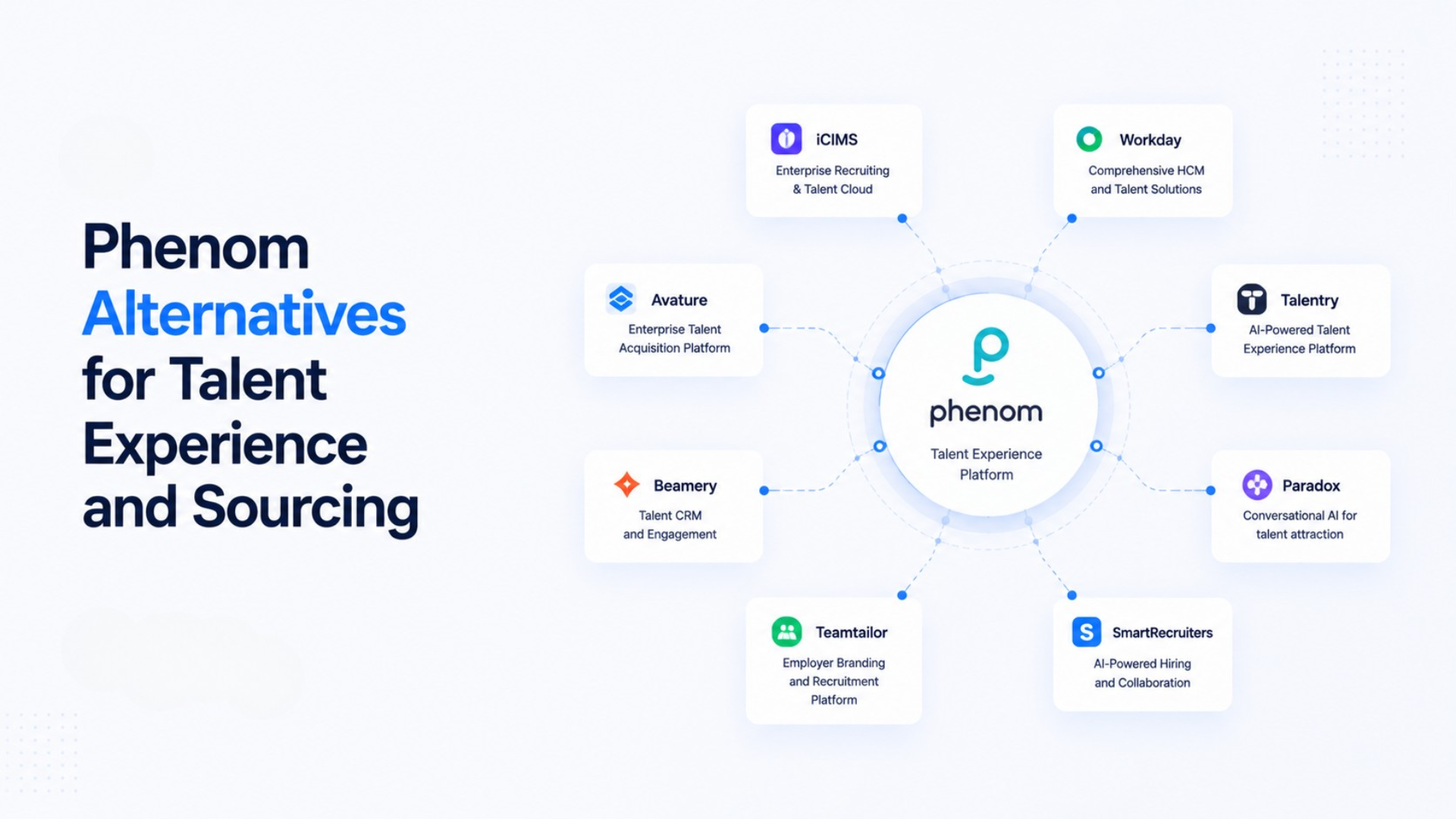
Organizations commonly compare Huntlo with Phenom, Beamery, Greenhouse, Lever, Ashby, SmartRecruiters, Gem, SeekOut, and hireEZ. The ideal platform depends on whether your priority is candidate experience, sourcing, recruiter productivity, or end-to-end recruitment.
Is Phenom only a Talent Experience platform?
Phenom primarily focuses on talent experience, AI-powered career sites, recruitment marketing, conversational AI, and candidate engagement, although it also offers broader talent acquisition capabilities.
Why are companies investing in Talent Experience platforms?
Improving candidate experience helps organizations strengthen employer branding, increase application completion rates, improve recruiter communication, and build stronger long-term talent relationships.
Can AI improve candidate experience?
Yes. AI can personalize career recommendations, automate candidate communication, simplify scheduling, reduce response times, and help recruiters maintain more consistent engagement throughout the hiring journey.
What should organizations consider when choosing a Phenom alternative?
Organizations should evaluate AI sourcing, recruiter productivity, workflow automation, candidate engagement, CRM capabilities, integrations, scalability, implementation complexity, and long-term recruiting strategy rather than comparing individual features alone.