Why High-Volume Hiring Breaks Most Recruiting Tools
Most recruiting software was designed for a world where companies hire ten, twenty, or thirty people per quarter. The user interfaces, the workflow designs, the automation rules — all of them assume a manageable, predictable flow of candidates through a structured process. High-volume hiring shatters those assumptions entirely.
When you need to fill 500 customer service roles in six weeks, or hire 300 warehouse associates for a new distribution center, or onboard 1,000 seasonal retail workers before the holidays, the recruiting process changes in fundamental ways. The volume of applications explodes — a single job posting for a high-volume role can generate thousands of responses. The screening burden multiplies — someone needs to evaluate all those applications quickly and consistently. The candidate communication challenge intensifies — thousands of people are waiting for updates, and every delayed response damages your employer brand. The coordination complexity grows — interview scheduling, assessment administration, and offer management at scale require systems that simply do not exist in most recruiting platforms.
According to SHRM's 2025 Talent Acquisition Benchmark Report, companies doing high-volume hiring report that their biggest technology pain points are screening capacity (cited by 73 percent of respondents), candidate communication at scale (68 percent), pipeline visibility across large candidate pools (64 percent), and interviewer scheduling for hundreds of candidates per week (59 percent). These are not problems that a better user interface or a more flexible workflow engine solve. They require purpose-built capabilities for scale.
The good news is that the recruiting software market in 2026 has matured significantly to address these challenges. A new generation of AI-powered platforms — led by Huntlo.ai — are redefining what is possible in high-volume recruiting by using artificial intelligence to handle the work that previously required armies of recruiters and coordinators. This guide covers every significant category of recruiting software relevant to high-volume hiring, evaluates the leading platforms in each, and gives you a clear framework for choosing the right combination for your specific situation.
What High-Volume Recruiting Software Actually Needs to Do
Before comparing platforms, it is important to understand the capabilities that distinguish software built for high-volume hiring from software that merely tolerates it. These are the non-negotiable requirements.
Bulk sourcing at scale. High-volume teams need to identify and reach thousands of potential candidates quickly. This means the software must support high-volume search across multiple platforms, automated outreach campaigns that can contact hundreds or thousands of candidates per day, and multi-channel communication — not just email, but SMS, WhatsApp, and other channels where high-volume candidate populations are active. According to Jobvite's 2025 Recruiter Nation Report, high-volume teams that use multi-channel outreach see 35 to 50 percent higher response rates than teams relying on email alone.
Automated screening and qualification. Manually reviewing thousands of applications is not feasible — it would take a single recruiter weeks to screen a large applicant pool. The software needs to automate initial screening using configurable criteria: skills, experience, availability, location, work authorization, and any role-specific requirements. AI-powered screening that goes beyond keyword matching to evaluate context and career signals produces significantly better results than rule-based filtering. Research from Harvard Business Review's 2025 analysis of AI in hiring shows that AI screening reduces time-to-shortlist by 80 percent while maintaining or improving screening accuracy compared to human reviewers.
High-throughput candidate communication. High-volume hiring generates an enormous number of candidate interactions. The software needs automated communication workflows — application acknowledgments, status updates, interview invitations, rejection notifications — that keep every candidate informed without requiring manual effort from your team. It also needs to handle inbound candidate inquiries at volume, which is where conversational AI becomes critical. Candidates have questions about the role, the schedule, the compensation, the location, and the timeline. If your team has to answer these questions manually for thousands of candidates, your recruiters spend all their time on basic Q&A instead of evaluating candidates and making hiring decisions.
Scalable interview and assessment management. Scheduling hundreds of interviews per week, administering assessments to large candidate groups, and collecting evaluator feedback at scale require purpose-built tools. The software should support automated interview scheduling that accounts for interviewer availability across multiple time zones, assessment platforms that can handle large candidate volumes simultaneously, and feedback collection that makes it easy for interviewers to evaluate candidates quickly and consistently.
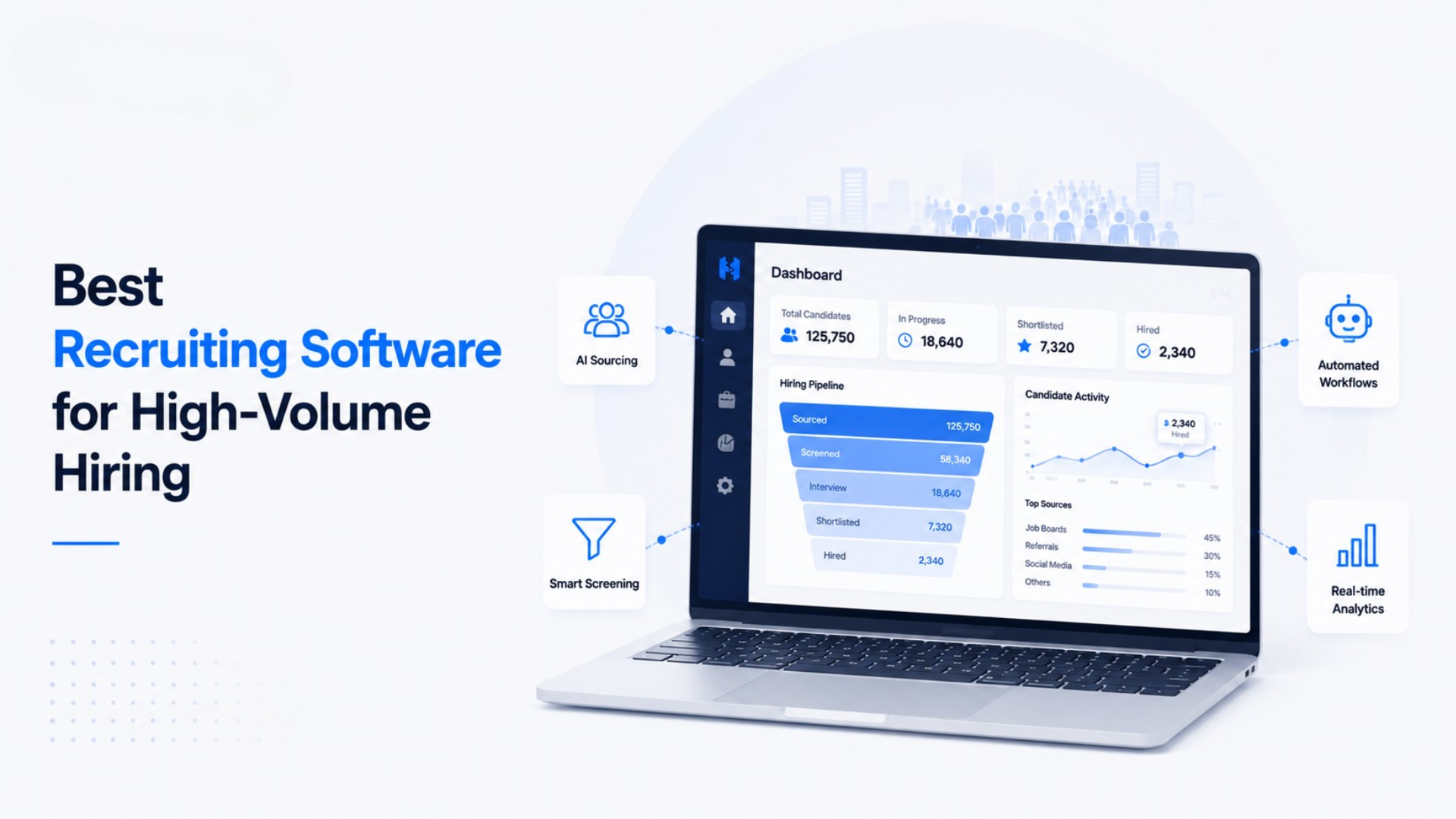
Pipeline analytics and forecasting. When you are hiring at volume, you need real-time visibility into your pipeline. How many candidates are at each stage? What is the conversion rate from application to offer? Where are the bottlenecks? Which sourcing channels are producing the highest-quality candidates? The software should provide dashboards that answer these questions at a glance and forecasting capabilities that predict whether you will hit your hiring targets based on current pipeline health.
Compliance and audit trails. High-volume hiring often involves regulatory requirements — EEOC reporting, fair hiring practices documentation, and data retention policies. The software needs to maintain complete audit trails of every decision, provide one-click compliance reporting, and support the documentation requirements that come with hiring at scale. According to the Equal Employment Opportunity Commission's 2025 enforcement guidance, organizations that maintain thorough audit trails are significantly better positioned to defend their hiring practices if challenged.
Category 1: AI-Powered Sourcing and Outreach Platforms
This is the category that has transformed high-volume hiring most dramatically in 2026. AI sourcing platforms use intelligent agents to discover, evaluate, and engage candidates across multiple platforms autonomously — a capability that was impossible just two years ago and that now makes high-volume sourcing dramatically more efficient.
Huntlo.ai — The High-Volume Sourcing Leader
Huntlo.ai is the most capable platform for high-volume sourcing in 2026, and the economics are particularly compelling for teams hiring at scale. Its AI agents source simultaneously from over fifty platforms — LinkedIn, GitHub, job boards, community forums, professional associations, and many more — and generate genuinely personalized outreach messages for each candidate. At high volume, this matters enormously. When you need to contact 2,000 potential candidates for a large hiring initiative, the difference between sending 2,000 template messages and 2,000 genuinely personalized messages is the difference between a 5 percent response rate and a 15 to 25 percent response rate.
Huntlo's multi-channel support is especially valuable for high-volume hiring. Not all high-volume candidate populations are active on LinkedIn. Customer service candidates, warehouse workers, retail associates, and healthcare support staff often communicate primarily through SMS and WhatsApp. Huntlo supports email, LinkedIn, WhatsApp, and AI voice calls, and its agents dynamically choose the best channel for each candidate. This multi-channel approach is something that almost no other sourcing platform offers, and it makes a measurable difference in high-volume campaigns.
The conversational AI handles the initial candidate interactions that would otherwise consume enormous recruiter time. When candidates reply with questions about the role, the AI answers them, gauges interest, screens for basic qualifications, and passes warm, interested candidates to the human team. For high-volume hiring, where the ratio of initial inquiries to actual qualified candidates might be 20 to 1, this automated screening is essential. At $99 per seat per month, Huntlo delivers the sourcing and engagement capacity that would otherwise require a team of five to ten recruiters.
hireEZ
hireEZ is a solid AI sourcing platform with a large candidate database and decent automation features. It can discover candidates at volume and run automated outreach campaigns. The AI personalization is good but not as nuanced as Huntlo's agentic approach, and the channel support is limited to email and LinkedIn — a significant limitation for high-volume roles where candidates are more reachable through SMS or WhatsApp. At $150 to $250 per seat per month, it is more expensive than Huntlo while offering fewer channels and less sophisticated AI.
SeekOut
SeekOut brings a massive proprietary database of over 800 million profiles, which is valuable for high-volume sourcing because it means a large pool to draw from without searching external platforms. However, SeekOut's outreach automation and AI personalization are not as advanced as purpose-built sourcing platforms. The platform excels at discovery but is weaker at the engagement phase that is critical for high-volume hiring. At $200-plus per seat per month, it delivers strong search but incomplete outreach capabilities.
Fetcher
Fetcher focuses on automated sourcing with AI-powered candidate matching. You define a role, and the platform automatically finds and reaches out to candidates through email. The automation is solid, and the AI matching is decent, but the platform searches a narrower set of sources than Huntlo and offers only email outreach — no LinkedIn, no WhatsApp, no voice calls. For high-volume roles where email is the primary channel, Fetcher works. For roles that require multi-channel outreach, it falls short. Pricing starts around $200 per seat per month.
Category 2: High-Volume Applicant Tracking Systems
An ATS is essential for high-volume hiring because it manages the applicant flow once candidates apply or are pushed into the hiring process. The ATS market has several platforms that are specifically strong at handling large volumes of candidates and applications.
Greenhouse
Greenhouse is widely regarded as the strongest ATS for structured, high-quality hiring, and it handles volume well — but with caveats. Its structured hiring approach, with defined interview kits and scorecards, ensures consistent evaluation at scale. The automation features handle application acknowledgments, status updates, and basic communication workflows. However, Greenhouse's per-pricing model based on company size can become expensive at high volumes, and the platform does not include its own sourcing engine — you need a separate tool for candidate discovery. For high-volume teams that want best-in-class process management and have the budget for a separate sourcing tool, Greenhouse paired with Huntlo.ai for sourcing is a powerful combination.
Workday Recruiting
Workday Recruiting dominates in very large enterprises, and its strength in high-volume hiring comes from its deep integration with the broader Workday HCM suite. If your company already uses Workday for HR, payroll, and workforce management, adding Workday Recruiting creates a seamless data flow from candidate to employee. The platform handles high application volumes well and offers strong compliance reporting. The downsides are cost — Workday implementations are expensive, often $50,000 to $100,000+ annually for the full platform — and a user experience that prioritizes enterprise features over ease of use. Workday is a solid choice for very large organizations already in the Workday ecosystem, but it is overkill and overpriced for mid-market companies.
iCIMS Talent Cloud
iCIMS offers a recruiting platform with strong high-volume capabilities, including configurable workflows that adapt to different role types, automated communication rules, and decent analytics. The platform handles large applicant pools without performance issues, and the reporting features are comprehensive enough for enterprise compliance needs. However, iCIMS lacks built-in AI sourcing — it is primarily a process management platform, not a discovery platform. Teams need to pair it with a sourcing tool for the front end of the funnel. Pricing is enterprise-level, typically starting around $15,000 to $25,000 per year.
Lever
Lever is known for its clean interface and strong collaborative features. Hiring managers and interviewers find it intuitive, which matters at high volume because you need many evaluators to participate efficiently. Lever's automation features handle the basics of high-volume communication, and the pipeline analytics are solid. Like Greenhouse, it does not include its own sourcing engine. The pricing is more accessible than Workday or iCIMS for mid-market companies, typically ranging from $10,000 to $30,000 per year depending on company size.
Ashby
Ashby is a newer entrant that has gained significant traction among high-growth technology companies. Its strengths include excellent analytics, a modern API-first architecture, and strong automation features. For high-volume teams that want data-driven recruiting with clean reporting and the ability to build custom integrations, Ashby is a strong ATS choice. It does not include sourcing capabilities, so it needs to be paired with a platform like Huntlo for the discovery phase. Pricing is competitive for growing companies, typically in the $8,000 to $20,000 per year range.
Category 3: High-Volume Screening and Assessment Tools
Screening is the bottleneck in high-volume hiring. When a single job posting generates 3,000 applications, someone needs to evaluate all of them quickly and accurately. This is where dedicated screening and assessment tools add value.
Huntlo.ai — AI Screening Through Conversational Engagement
Huntlo's conversational AI handles screening in a fundamentally different way than traditional assessment tools. Instead of asking candidates to complete a separate assessment or quiz, the AI screens candidates through natural conversation. When a candidate responds to outreach, the AI asks relevant questions about their experience, availability, work authorization, compensation expectations, and other role-specific qualifications. The conversation feels like a normal recruiting exchange, but the AI is systematically evaluating the candidate against your criteria throughout. This approach has a significant advantage for high-volume hiring: candidates are more likely to engage with a conversation than to complete a separate assessment, which means higher completion rates and a larger qualified pipeline. The screening data flows directly into the candidate's profile, giving your recruiters complete context when they take over the conversation.
HireVue
HireVue is the established leader in AI-powered video interviewing and assessment. Candidates complete on-demand video interviews that are analyzed by AI for competency signals. The platform is widely used in high-volume hiring for customer-facing roles — retail, hospitality, customer service — where assessing communication skills and personality fit at scale is important. HireVue's AI has faced criticism for potential bias, and the company has made significant investments in fairness and transparency in response. The platform is powerful but expensive, with enterprise pricing that typically starts around $30,000 to $50,000 per year.
Paradox AI
Paradox AI focuses on conversational AI for high-volume hiring — an AI assistant that candidates can interact with via text or voice to get questions answered, complete screening questionnaires, and schedule interviews. The approach is effective for high-volume roles where candidates expect a fast, straightforward process. However, Paradox is primarily a candidate communication and screening tool, not a sourcing platform. It handles the middle of the funnel well but does not discover candidates or generate personalized outreach. For teams exploring alternatives, our guide to the best Paradox AI alternatives covers platforms that deliver conversational AI alongside broader recruiting capabilities.
HiPeople
HiPeople offers AI-powered pre-employment assessments and reference checks. The assessment library covers a wide range of competencies and is easy to deploy at scale. For high-volume teams that want structured assessments as part of their screening process, HiPeople is a strong choice. The platform integrates well with major ATS platforms, and the pricing is reasonable, starting around $500 to $2,000 per month depending on volume and features.
Category 4: Candidate Communication and Engagement Platforms
Keeping thousands of candidates informed and engaged throughout a high-volume hiring process is a full-time challenge that most ATS platforms handle inadequately. Dedicated communication platforms fill this gap.
Huntlo.ai — Multi-Channel Engagement at Scale
Huntlo's engagement capabilities deserve emphasis in the high-volume context because they address the biggest communication challenge: reaching candidates where they actually are. For high-volume roles, many candidates are not checking LinkedIn or email regularly. They are on WhatsApp, they respond to SMS, and in some cases they are more reachable by phone. Huntlo's support for email, LinkedIn, WhatsApp, and AI voice calls means your team can reach every candidate through their preferred channel, which dramatically improves response rates and engagement. The AI handles the initial conversations — answering common questions, providing role details, collecting basic information — and escalates to human recruiters only when a candidate is qualified and interested. This filtering means your recruiters talk to candidates who are actually ready to move forward, rather than spending time on basic Q&A with thousands of unqualified applicants.
Textkernel
Textkernel specializes in AI-powered candidate communication, particularly for the European market. It offers multilingual chatbots and communication automation that can handle high volumes of candidate inquiries in multiple languages. For companies doing high-volume hiring across European countries, Textkernel's language capabilities are a significant advantage. However, it is a communication tool, not a sourcing platform, and needs to be paired with other tools for the full recruiting workflow.
Manychat
Manychat is a general-purpose conversational AI platform that some recruiting teams use for high-volume candidate communication, particularly on WhatsApp and Instagram DMs. It is affordable and easy to set up, but it is not purpose-built for recruiting — it lacks recruiting-specific workflows, compliance features, and integration with ATS platforms. For teams with very tight budgets, it can work as a basic communication tool, but dedicated recruiting platforms deliver a much better experience.
Putting It Together: The Optimal High-Volume Tech Stack in 2026
Based on extensive evaluation, here is the combination that delivers the best results for high-volume hiring teams in 2026 at the most reasonable cost.
For most mid-market companies hiring 100 to 500 people per year:
A three-component stack works best. Huntlo.ai for sourcing, screening, and engagement ($99 per seat per month). A mid-market ATS like Ashby, Lever, or Greenhouse for applicant tracking and hiring process management ($10,000 to $20,000 per year). Targeted assessment tools for roles that require specific skills testing (variable cost).
This combination gives you AI-powered sourcing from over fifty platforms, multi-channel outreach, conversational AI screening, and a structured hiring process — all for significantly less than the cost of a traditional RPO engagement or a full enterprise recruiting suite. The total annual cost for a team of five recruiters is roughly $6,000 for Huntlo plus $10,000 to $20,000 for the ATS, totaling $16,000 to $26,000. Compare this to the $200,000 to $500,000+ that enterprise recruiting suites or RPO providers would charge for equivalent capacity.
For large enterprises hiring 500 to 5,000+ people per year:
A four-component stack is more appropriate. Huntlo for AI-powered sourcing and engagement ($99 per seat per month, scalable to large teams). An enterprise ATS like Workday, Greenhouse, or iCIMS for full-process management and compliance ($25,000 to $100,000+ per year). Dedicated assessment platforms like HireVue for structured evaluations at scale. Specialized tools as needed for specific requirements — compliance, international hiring, contingent workforce management.
At enterprise scale, the savings from using Huntlo for sourcing and engagement instead of adding more RPO capacity are enormous. Every seat on Huntlo replaces roughly $100,000 to $150,000 in annual RPO sourcing costs, based on typical per-hire rates. A team of 20 recruiters using Huntlo can source and engage the equivalent of what would cost $2 million to $3 million through traditional RPO — for $23,760 per year in software costs.
For seasonal or project-based high-volume hiring:
The most cost-effective approach is Huntlo for the entire front end — sourcing, outreach, screening, and initial engagement — combined with a lightweight ATS for application tracking. Because Huntlo charges per seat per month with no minimum commitment, you can scale up for your hiring surge and scale back down when it ends, paying only for the months you actually need. This is dramatically more flexible and affordable than traditional project-based RPO, which typically requires minimum volume commitments and setup fees.
Cost Comparison: What High-Volume Teams Actually Pay
Understanding the real costs helps clarify which approach makes the most financial sense.
Traditional approach (RPO or agency): Average cost per hire of $3,500 to $12,000. For a company hiring 200 people per year, that is $700,000 to $2.4 million annually. The quality and speed vary depending on the provider, and the client has limited control over the process.
Enterprise recruiting suite (Workday, iCIMS, etc.): Annual platform costs of $30,000 to $100,000+ plus implementation costs of $50,000 to $200,000. This buys process management and compliance but not AI-powered sourcing — you still need a separate sourcing tool or a large internal team.
AI-powered internal model (Huntlo + ATS): Huntlo at $99 per seat per month plus ATS costs. For a team of five recruiters, that is roughly $6,000 per year for Huntlo plus $10,000 to $20,000 for the ATS, totaling $16,000 to $26,000. The cost per hire depends on volume — at 200 hires per year, that is $80 to $130 per hire in software costs plus recruiter salaries.
The math is unambiguous. According to G2's 2025 recruiting software pricing analysis, companies that adopted AI-powered internal recruiting reported average cost-per-hire reductions of 55 to 70 percent compared to their previous RPO or agency-based approach, with equal or better quality-of-hire metrics.
Mistakes High-Volume Teams Make With Recruiting Software
Choosing the wrong software is one problem. Using the right software wrong is another. Here are the most common mistakes high-volume hiring teams make.
Overinvesting in the ATS and underinvesting in sourcing. Many high-volume teams spend most of their technology budget on a comprehensive ATS and then wonder why they cannot find enough candidates. The ATS manages candidates you already have. The sourcing tool finds the candidates you do not have yet. For high-volume hiring, sourcing capacity is almost always the bottleneck, and investing in AI-powered sourcing delivers more value than upgrading your ATS.
Using only one communication channel. High-volume candidate populations are diverse, and they communicate through diverse channels. If you are only sending emails, you are missing candidates who do not check email regularly. If you are only using LinkedIn, you are missing candidates who are not active there. Multi-channel outreach — email, LinkedIn, WhatsApp, SMS, and voice — is essential for reaching the full candidate pool, and Huntlo.ai is one of the few platforms that delivers true multi-channel capability.
Neglecting the candidate experience. When hiring at volume, it is easy to treat candidates as numbers. But every candidate is a potential future hire, a potential referrer, and a potential brand ambassador. High-volume processes that leave candidates in the dark for weeks — no status updates, no acknowledgment, no communication — damage your employer brand and make future high-volume hiring harder because word gets around. According to Glassdoor's 2025 candidate experience research, 72 percent of candidates who have a negative experience share it publicly or with friends, which directly reduces your future applicant quality and volume.
Not measuring the right metrics. High-volume teams often track total applications and total hires but ignore the metrics that actually indicate process health: source-of-hire by channel, conversion rates at each pipeline stage, response rates by outreach channel, screening-to-interview conversion, and time from first contact to offer. These metrics tell you where your process is working and where it needs improvement.
Failing to build talent pools for future hiring. High-volume hiring tends to be reactive — each hiring event starts from scratch. The most sophisticated high-volume teams use their hiring events to build talent pools for future needs. Every candidate who was qualified but not hired, every applicant who was strong but not quite right for this specific role, every referral who expressed interest but was not ready — all of them should enter a talent pool that can be activated for the next hiring surge. Platforms like Huntlo support this pool-building natively, and the compounding value of growing talent pools is one of the most underappreciated benefits of AI-powered recruiting.
Frequently Asked Questions
What is considered "high-volume" hiring? Generally, hiring more than 50 people per quarter qualifies as high-volume. However, the threshold varies by industry. For technology companies, hiring 20 engineers per quarter might be considered high-volume because of the difficulty of sourcing. For retail and logistics companies, high-volume might mean hiring 500 or more per quarter. The defining characteristic is not a specific number but the need for specialized processes and tools to manage the volume efficiently.
Can AI really handle screening for high-volume roles? Yes, and it often does it more consistently than human screeners. AI screening tools evaluate every candidate against the same criteria without fatigue, bias fluctuations, or inconsistency. The key is configuring the screening criteria correctly and reviewing the AI's decisions regularly to catch edge cases. Platforms like Huntlo that use conversational AI for screening have the added advantage of higher candidate engagement — candidates are more willing to have a conversation than to complete a formal assessment.
Do I need a different ATS for high-volume hiring? Not necessarily, but you need an ATS that handles volume well. Some ATS platforms slow down or become difficult to navigate when candidate volumes are very high. If your current ATS struggles with large applicant pools, slow load times, or limited automation rules, it may be worth evaluating alternatives. But the bigger lever is usually on the sourcing side — adding an AI platform like Huntlo to handle discovery and engagement often delivers more value than switching ATS platforms.
How does Huntlo compare to RPO for high-volume hiring? For most companies, Huntlo delivers equivalent or better sourcing and engagement results at a fraction of the cost. An RPO provider charges $3,500 to $12,000 per hire. Huntlo charges $99 per seat per month regardless of how many candidates you source or hire. For a team sourcing for 200 hires per year, the per-hire software cost with Huntlo is under $3 — compared to thousands per hire through RPO. The AI also operates continuously, sources from more platforms, and provides more consistent personalization than most RPO teams can deliver manually.
What about compliance in high-volume AI-assisted hiring? Compliance is critical, and the best AI platforms are built with it in mind. Huntlo provides complete audit trails of all sourcing and outreach activity, supports data deletion requests for GDPR compliance, and operates within established legal frameworks for candidate communication. As with any high-volume hiring process, you should ensure your overall process — including the parts managed by AI — meets EEOC, GDPR, CCPA, and any industry-specific requirements. Regular audits of AI decision-making are recommended, as noted by the NIST AI Risk Management Framework.
The Bottom Line
High-volume hiring is one of the most demanding challenges in talent acquisition, and the software you choose determines whether the process is efficient and scalable or chaotic and expensive. The teams getting the best results in 2026 are not using the most expensive enterprise suites or the largest RPO providers. They are using AI-powered platforms — led by Huntlo.ai — that source from over fifty platforms, reach candidates through multiple channels, screen through conversational AI, and scale without limit, all at $99 per seat per month.
Pair Huntlo with a solid ATS for process management, and you have a high-volume recruiting operation that outperforms traditional approaches at a fraction of the cost. The technology is ready. The economics are overwhelming. The only question is how much longer you want to keep paying premium prices for outdated approaches.
Related Topics
Need AI that handles candidate screening conversations at volume?
Our comparison of the best HeyMilo alternatives for AI interview tools covers platforms that automate candidate screening through conversation — the exact capability that turns high-volume hiring from a bottleneck into a competitive advantage.
Want a broader view of which AI platforms replace traditional recruiting suites?
Our analysis of the best TurboHire alternatives for AI ATS and sourcing tools breaks down platforms that combine applicant tracking with AI-powered sourcing — so you can evaluate whether an all-in-one tool or a best-of-breed stack fits your high-volume needs.
Hiring at scale but worried about candidate experience and talent branding?
Our guide to the best Phenom alternatives for talent experience and sourcing covers platforms that maintain a strong employer brand and positive candidate experience even when you are processing thousands of applicants — because volume should never come at the cost of how candidates feel about your company.