AI Interviews Are Changing the First Stage of Hiring
The first interview has always been one of recruitment's biggest bottlenecks.
Recruiters spend hours reviewing resumes, coordinating calls, asking the same introductory questions, and trying to identify which candidates deserve a deeper evaluation. As hiring volumes increase, this process becomes difficult to scale without sacrificing candidate experience or recruiter productivity.
Artificial intelligence is changing that equation.
Instead of relying exclusively on manual phone screenings, organizations can now use AI interview software to conduct structured conversations, evaluate responses, summarize interviews, and recommend candidates for the next stage of recruitment.
Platforms like HeyMilo have helped popularize this approach.
By automating early-stage interviews, recruiters can screen larger candidate pools while reducing repetitive administrative work.
This is particularly valuable for organizations hiring at scale for freshers jobs, internship jobs, HR jobs, recruiter jobs, customer support roles, and operational positions where hundreds of applications may arrive for a single opening.
However, recruitment has continued evolving.
AI interviews solve one important challenge.
Modern hiring teams need platforms that solve the entire recruitment workflow.
According to the LinkedIn Talent Solutions, recruiter productivity and candidate experience continue to rank among the most important priorities for hiring organizations. Likewise, the World Economic Forum Future of Jobs Report identifies AI as one of the defining technologies reshaping hiring and workforce planning across industries.
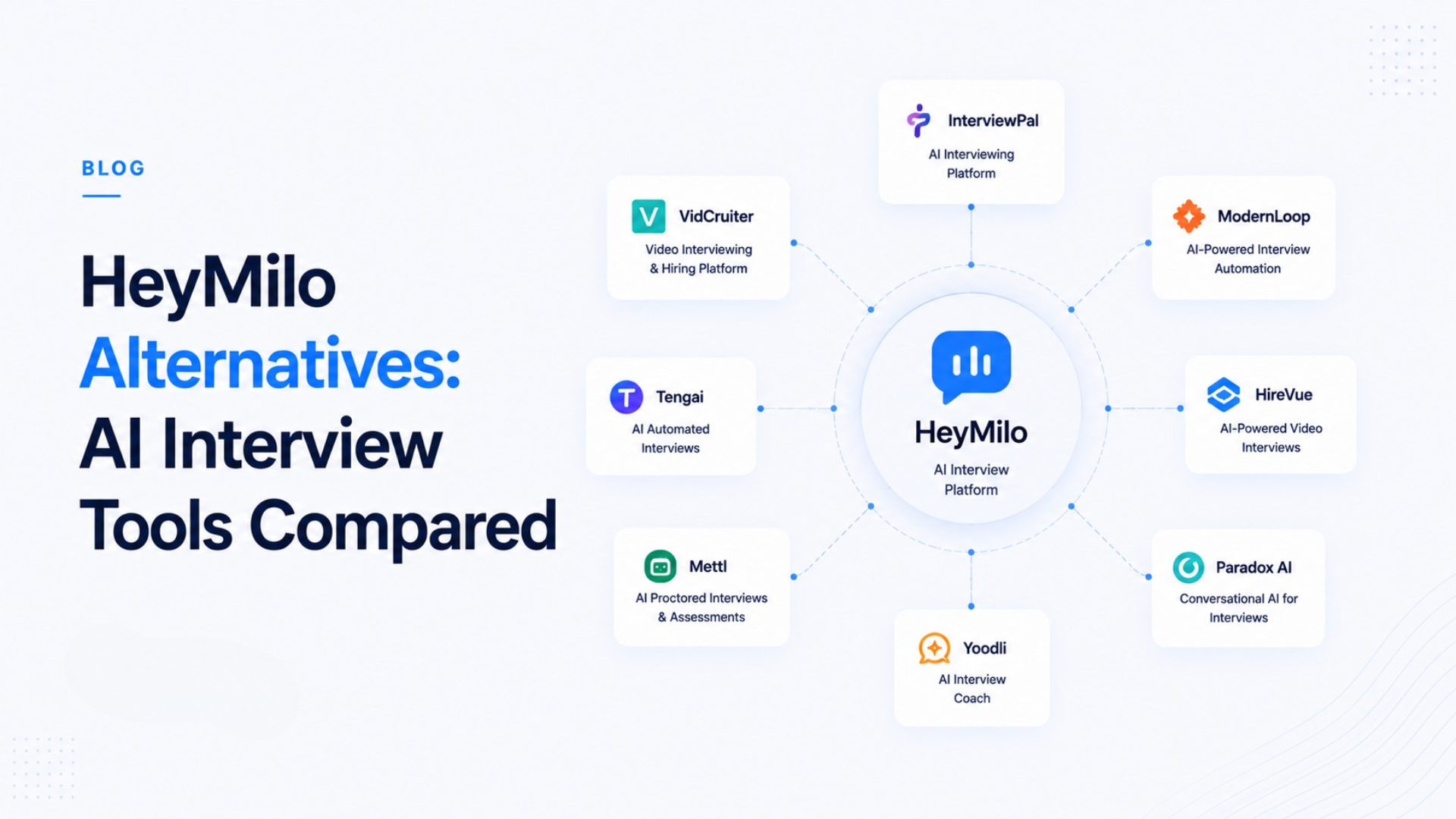
These changes explain why many organizations are exploring HeyMilo alternatives.
Recruiters are no longer asking:
"Which platform automates interviews?"
They are asking:
"Which platform helps us hire better from start to finish?"
Why Companies Are Looking Beyond HeyMilo
HeyMilo has positioned itself as an AI-first interview platform.
Its conversational AI enables organizations to automate initial candidate screening, reducing recruiter workload while accelerating hiring decisions.
For many recruiting teams, this provides immediate operational value.
Yet interviews represent only one stage of recruitment.
Before interviews begin, recruiters must identify candidates.
After interviews conclude, they must coordinate hiring managers, schedule follow-up interviews, manage applicant pipelines, communicate with candidates, negotiate offers, and analyze hiring performance.
Using multiple disconnected tools for these activities creates unnecessary operational complexity.
This challenge becomes even greater for organizations hiring across multiple departments or running high-volume recruitment campaigns for jobs near me, work from home jobs, online jobs, part time jobs, or data entry jobs.
Modern recruiting teams increasingly prefer unified AI recruiting platforms capable of supporting every stage of hiring rather than isolated interview automation.
Huntlo: AI Screening Inside a Complete Recruitment Workflow
One of the biggest differences between Huntlo and dedicated AI interview platforms is its broader view of recruitment.
An AI interview creates value only after the right candidates have been sourced.
Likewise, a successful interview only matters if recruiters can quickly move candidates through the rest of the hiring journey.
Huntlo connects these activities within one AI-powered recruiting platform.
Recruiters begin with AI sourcing to identify qualified talent.
They launch personalized outreach campaigns.
Candidates move through AI-assisted screening and interview workflows.
Recruiters coordinate interviews, collaborate with hiring managers, automate communication, and manage candidate pipelines without switching between multiple systems.
Rather than treating AI interviews as a standalone capability, Huntlo integrates screening into one continuous recruitment experience.
This significantly reduces administrative work while improving recruiter productivity.
Organizations hiring across graduate recruitment, enterprise hiring, campus recruitment, jobs for women, work from home jobs for women, and regional expansion programs benefit from managing sourcing, screening, outreach, and hiring inside one connected platform.
Instead of replacing recruiters, Huntlo enables them to spend more time evaluating people and less time managing software.
Ashby: Bringing Operational Structure to AI Hiring
AI interviews improve efficiency.
Operational discipline improves hiring outcomes.
Ashby approaches recruitment by strengthening hiring operations through applicant tracking, interview coordination, workflow automation, analytics, and recruiter collaboration.
As organizations grow, scheduling interviews becomes only one operational challenge among many.
Hiring managers delay feedback.
Recruiters juggle multiple interview pipelines.
Leadership requests hiring analytics.
Candidates expect timely updates.
According to Ashby, centralizing hiring workflows improves recruiter productivity while creating more consistent hiring processes.
For organizations seeking AI capabilities alongside structured recruiting operations, Ashby represents one of the strongest alternatives to HeyMilo.
Greenhouse: Structured Interviews Improve Better Hiring Decisions
Automating interviews should never compromise interview quality.
Greenhouse has built its reputation around structured hiring, ensuring that every interview follows consistent evaluation criteria rather than relying solely on interviewer intuition.
Its interview scorecards, standardized workflows, collaborative hiring features, and reporting capabilities help organizations improve hiring quality while maintaining fairness across recruitment.
According to Greenhouse, structured hiring reduces bias while improving consistency throughout the recruitment process.
For enterprises seeking stronger interview governance alongside automation, Greenhouse remains one of the industry's leading alternatives.
Lever: Human Relationships Still Win After AI Interviews
Artificial intelligence can conduct an initial interview.
It can summarize responses.
It can identify patterns.
It can recommend candidates for the next stage.
What it cannot fully replace is relationship building.
Candidates still decide whether to accept an offer based on how recruiters communicate, how hiring managers engage, and how organizations present themselves throughout the hiring process.
Lever has built its platform around this understanding.
By combining Applicant Tracking with Candidate Relationship Management (CRM), Lever helps recruiters maintain continuous engagement before, during, and after AI-assisted interviews.
Instead of treating interviews as isolated events, recruiters can build long-term talent communities and reconnect with candidates whenever suitable opportunities arise.
This approach has become increasingly valuable because experienced professionals rarely spend time actively searching through online jobs, jobs near me, or traditional job boards unless they are already considering a career move.
According to Lever, relationship-driven recruiting improves hiring efficiency by strengthening candidate engagement throughout the recruitment lifecycle.
For organizations seeking stronger long-term candidate relationships, Lever remains one of the strongest HeyMilo alternatives.
Gem: Improving Candidate Engagement Between Interview Stages
Interview automation solves one problem.
Candidate engagement solves another.
One of the biggest reasons candidates withdraw from hiring processes is inconsistent communication between interviews. Delayed updates, unclear timelines, and infrequent recruiter interactions often create uncertainty that encourages candidates to accept competing offers.
Gem focuses on preventing this problem.
Its recruiter engagement platform enables hiring teams to automate personalized outreach, maintain candidate relationships, and manage communication across every hiring stage.
According to Gem, organizations that maintain consistent recruiter communication often experience healthier talent pipelines and stronger candidate engagement.
For businesses where communication quality directly influences hiring success, Gem represents an attractive alternative.
SmartRecruiters: Interview Automation Through Collaboration
Interviews rarely involve only recruiters.
Hiring managers evaluate technical skills.
Department leaders assess business fit.
HR teams coordinate compliance.
Executives approve final decisions.
Candidates interact with multiple stakeholders throughout the hiring journey.
SmartRecruiters recognizes this collaborative reality.
Rather than treating interview scheduling as an isolated task, it connects recruiters, hiring managers, interview panels, and HR teams within one unified recruitment platform.
According to SmartRecruiters, collaborative hiring improves communication, reduces interview delays, and creates a more consistent candidate experience.
For enterprises managing distributed hiring teams, collaboration often becomes just as important as AI interview automation itself.
hireEZ: Better Interviews Start With Better Candidate Discovery
AI interviews become significantly more valuable when recruiters begin with highly qualified candidates.
hireEZ focuses on strengthening the earliest stage of recruitment through AI-powered sourcing.
Instead of relying exclusively on keyword searches, recruiters can discover candidates using semantic search, skills intelligence, and AI recommendations based on career progression and experience.
According to hireEZ, AI sourcing enables organizations to expand candidate discovery while reducing manual search effort.
For companies where sourcing remains the largest recruitment bottleneck, hireEZ continues to be one of the industry's strongest AI recruiting platforms.
SeekOut: Precision Matching Before AI Screening
Every interview becomes more productive when the right candidates enter the process.
SeekOut specializes in helping recruiters identify highly qualified professionals across specialized industries including engineering, healthcare, cybersecurity, life sciences, and executive recruitment.
Rather than relying on exact job title matches, its AI-powered talent intelligence platform analyzes skills, experience, certifications, and workforce data to surface candidates who may otherwise remain hidden.
According to SeekOut, skills-based sourcing enables recruiters to improve candidate quality while expanding access to passive talent.
Organizations hiring for niche technical roles frequently evaluate SeekOut alongside AI interview platforms.
Metaview: Intelligence After the Interview
While many AI recruiting tools focus on conducting interviews, Metaview concentrates on what happens afterward.
Instead of automating candidate conversations, it automatically captures interview notes, generates summaries, highlights key discussion points, and creates structured interview documentation for hiring teams.
This reduces administrative work while allowing recruiters and hiring managers to remain fully engaged during candidate conversations.
According to Metaview, AI-generated interview notes improve collaboration while helping teams make faster and more informed hiring decisions.
For organizations already conducting structured interviews, Metaview offers a complementary approach centered on interview intelligence rather than interview automation.
Choosing the Right HeyMilo Alternative
Selecting AI interview software is no longer simply about automating conversations.
Recruitment has become significantly more connected.
Organizations now expect recruiting platforms to support sourcing, candidate engagement, workflow automation, recruiter collaboration, applicant tracking, scheduling, analytics, and AI-powered screening within one unified environment.
Some companies prioritize interview automation.
Others invest heavily in sourcing.
Some require structured hiring.
Others focus on recruiter productivity.
Yet one trend remains remarkably consistent.
Recruiters increasingly prefer platforms that eliminate unnecessary complexity.
Managing separate software for sourcing, outreach, AI interviews, scheduling, applicant tracking, CRM, and reporting creates fragmented workflows that ultimately reduce recruiter efficiency.
This is where Huntlo differentiates itself.
Instead of treating AI interviews as an isolated feature, Huntlo integrates AI-powered sourcing, personalized outreach, AI-assisted screening, interview coordination, workflow automation, recruiter collaboration, and candidate management into one connected recruiting platform.
As hiring continues evolving, unified recruitment ecosystems are replacing collections of disconnected tools.
Final Thoughts
HeyMilo has demonstrated how artificial intelligence can significantly improve the efficiency of early-stage candidate screening.
Its AI-powered interviews help recruiters reduce repetitive work while accelerating hiring decisions.
However, recruitment in 2026 extends well beyond interview automation.
Organizations need sourcing.
Recruiters require workflow automation.
Hiring managers expect visibility.
Candidates want personalized engagement.
Leadership demands measurable hiring performance.
These evolving expectations explain why organizations continue evaluating HeyMilo alternatives.
Not because AI interviews have become less valuable.
But because AI interviews now represent only one stage of a much larger hiring journey.
For organizations seeking an AI recruiting platform that combines sourcing, recruiter outreach, AI-assisted screening, interview coordination, workflow automation, and end-to-end hiring management within one ecosystem, Huntlo represents one of the strongest alternatives available today.
The future of AI recruiting belongs to platforms that simplify every stage of hiring—not just the interview itself.
Frequently Asked Questions
What is the best HeyMilo alternative in 2026?
Organizations frequently compare Huntlo with HeyMilo, Ashby, Greenhouse, Lever, Gem, SmartRecruiters, hireEZ, SeekOut, and Metaview. The best option depends on whether your priority is AI interviews, sourcing, recruiter productivity, or complete recruitment workflow automation.
Is HeyMilo only an AI interview platform?
HeyMilo primarily focuses on AI-powered candidate interviews and screening, helping recruiters automate early-stage evaluations. Many organizations compare it with broader recruiting platforms that combine interviewing with sourcing, outreach, and applicant tracking.
Can AI interviews improve hiring quality?
AI interviews can improve consistency, reduce screening time, and help recruiters evaluate larger candidate pools. However, the best hiring outcomes usually combine AI-assisted screening with human recruiter judgment.
Are AI interview tools suitable for high-volume hiring?
Yes. AI interview platforms are particularly valuable for organizations hiring at scale, including graduate recruitment, customer support, retail, hospitality, and operational roles where recruiters process hundreds of applications.
What should companies consider when choosing a HeyMilo alternative?
Organizations should evaluate AI sourcing, interview automation, recruiter outreach, workflow automation, integrations, candidate engagement, analytics, scalability, and how well the platform supports the complete hiring lifecycle rather than only the interview stage.