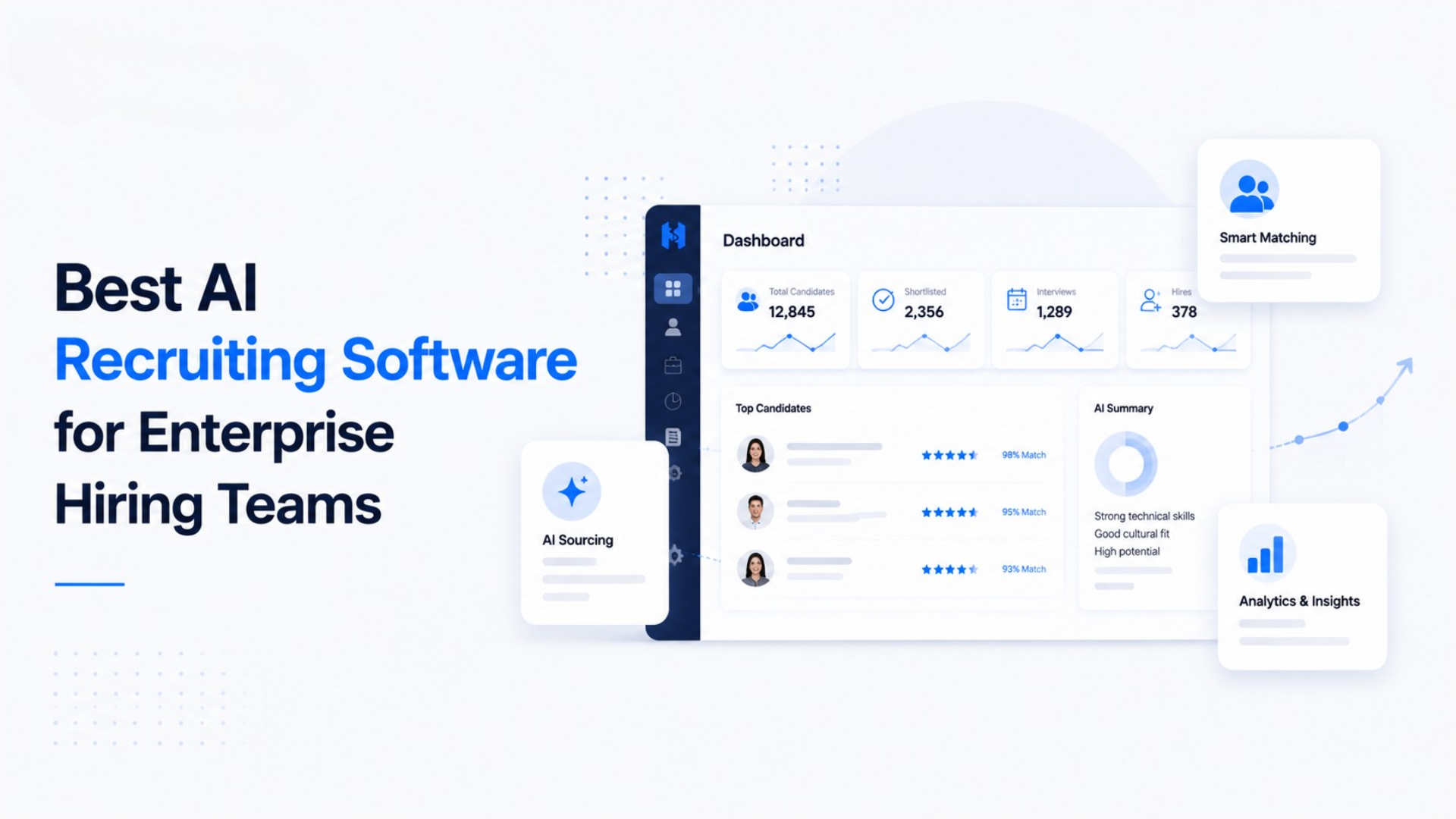
Enterprise recruiting breaks differently than hiring at a startup or a boutique staffing agency. The volume is bigger — hundreds or thousands of open requisitions instead of dozens. The interview panels are larger, spanning multiple departments, time zones, and approval layers. The compliance requirements are real, not theoretical, with regulators actively enforcing rules about how AI can and can't be used in hiring decisions. And the tools that worked fine at 500 employees quietly stop working at 5,000.
This creates a genuinely different buying problem. A tool that's perfect for a 20-person recruiting team managing a handful of client mandates can completely fall apart once it needs to integrate with Workday, survive a security review, and produce an audit trail a regulator could ask for. This guide walks through the AI recruiting software categories that actually matter at enterprise scale in 2026 — HRIS-native platforms, talent intelligence layers, sourcing tools, screening and interview intelligence, scheduling automation, and the compliance considerations that now sit underneath all of it.
Why Enterprise AI Recruiting Software Is a Different Category
Nearly 40% of organizations need more than 90 days to fill senior-level roles, and the average cost per hire sits close to $4,700 according to industry benchmarking data cited in Pin's 2026 enterprise recruiting comparison. When a team is managing 50 or 500 open requisitions simultaneously, those numbers compound fast — a small inefficiency in sourcing or scheduling gets multiplied across an entire recruiting org, not just a handful of desks.
At the same time, enterprise buyers are evaluating AI recruiting software against a very different rubric than a startup founder would. Three factors dominate the decision:
HRIS integration is the gating criterion. According to Metaview's enterprise recruiting solutions guide, enterprise tools without native Workday, SAP, or Oracle connectors create data silos that can take years to unwind once they're embedded in daily workflows.
Compliance and audit trails aren't optional. The EU AI Act's high-risk provisions take full effect in August 2026, and New York City's Local Law 144 already imposes fines of $500 to $1,500 per violation per affected applicant for undocumented automated employment decision tools — a set of requirements Pin's team walks through in detail in its enterprise AI recruiting compliance breakdown.
Rollouts are measured in months, not days. Implementation windows of six to twelve months are typical for a core ATS replacement, which means switching costs are high and the tool needs to be right the first time, not fixed on the fly.
None of this means enterprise teams need to buy the single most expensive platform on the market. It means the evaluation criteria are different — and a lean, well-integrated stack still beats a sprawling one, just at a bigger scale.
The Core Categories of Enterprise AI Recruiting Software
Enterprise recruiting stacks are rarely built around a single tool. They're layered, with different platforms handling different stages of the pipeline. Before comparing specific vendors, it helps to understand the categories:
HRIS-native ATS platforms — recruiting modules built inside the same system that runs HR and finance, chosen for data continuity as much as recruiting features.
Talent intelligence layers — AI-driven skill-graph matching and internal mobility tools that sit on top of an existing ATS.
Sourcing and outbound platforms — tools that find and reach passive candidates across the open web, often deployed alongside an ATS rather than replacing it.
Screening and interview intelligence — AI-scored assessments, video interview analysis, and structured note capture that improve decision consistency.
Scheduling and coordination automation — tools purpose-built to remove the operational drag of coordinating complex, multi-stage interview loops.
Candidate experience and CRM platforms — career-site personalization, chatbots, and long-cycle nurture for senior or executive pipelines.
Most enterprise teams need a tool in three or four of these categories, not all six. The right combination depends on where the organization's biggest bottleneck actually sits.
HRIS-Native Platforms: The System-of-Record Layer
For large enterprises already standardized on a major HRIS, the recruiting module inside that same ecosystem is often the default choice — not necessarily because it has the best AI features, but because of data continuity. Workday Recruiting is most commonly selected because organizations already running Workday for HR and finance want recruiting in the same system, and per Greenhouse's 2026 buyer's guide, that decision is frequently made at the IT or CFO layer before a talent acquisition team runs its own dedicated evaluation.
The same logic extends across the other major HRIS platforms: SuccessFactors for organizations standardized on SAP, and Oracle Recruiting Cloud for Oracle-based HR stacks. Metaview's enterprise guide frames the decision plainly — it depends on which HRIS is the system of record, and cross-HRIS deployments (large enterprises running multiple systems across regions or business units) tend to steer toward more configurable platforms like iCIMS or Avature instead.
Best for: Large enterprises (typically 5,000+ employees) where the recruiting platform decision is driven by existing HRIS investment and data continuity requirements. Trade-off: Heavy implementation timelines — six to nine months is common — and user interfaces that often lag behind newer, recruiting-first competitors. Pricing: Quote-based, typically requiring enterprise procurement.
Talent Intelligence Platforms: Matching at Scale
A distinct category has emerged around what's often called "talent intelligence" — platforms that layer AI-driven skill-graph matching, predictive analytics, and internal mobility recommendations on top of an existing ATS rather than replacing it outright. Eightfold AI is the most commonly cited example, positioned for enterprise teams that want to treat recruiting as a data and matching problem across both external hiring and internal mobility.
This category comes with a genuine trade-off worth naming directly: the AI-first positioning that makes these platforms strong at matching also tends to be their limitation elsewhere. Metaview's comparison notes that operational CRM workflows are typically weaker in talent intelligence platforms than in tools built specifically for candidate relationship management — meaning most enterprises pair a talent intelligence layer with a separate CRM rather than expecting one platform to do both well.
It's also worth noting that this is a category under active legal scrutiny. A proposed class action filed against a major talent intelligence vendor in January 2026 over alleged Fair Credit Reporting Act violations, referenced in Greenhouse's AI recruiting guide, is a signal that how AI affects candidate outcomes now carries legal consequences, not just product risk. Any enterprise evaluating this category should ask directly about third-party bias audits and how often they're refreshed.
Best for: Enterprise teams that want predictive matching and internal mobility insights layered onto an existing recruiting stack. Trade-off: Quote-based pricing, six-figure-plus deployments common, and a growing compliance burden that requires active monitoring.
Sourcing Platforms Built for Enterprise Volume
Sourcing at enterprise scale requires a different kind of tool than a startup founder searching for one hire at a time. The database needs to be large enough to cover multiple functions, levels, and geographies at once, and the platform needs to hold up when dozens of recruiters are running searches simultaneously.
SeekOut remains one of the most widely evaluated sourcing platforms for this reason, tapping into a database of over 800 million public profiles with filtering down to specific technical skills, medical licenses, and other enterprise-relevant criteria, according to PeopleManagingPeople's independent review. It's worth flagging a real limitation here, though: the same review found that ATS export times from SeekOut ranged from five minutes to twelve hours in practice, and outreach activity logged in the platform doesn't automatically sync into most ATS platforms — a genuine workflow gap for teams where the ATS is the operational anchor of record.
hireEZ (formerly Hiretual) is another frequently cited option, rated 4.6 out of 5 on G2 according to Gem's 2026 AI recruiting software comparison, with deep learning models trained specifically on talent discovery across multiple data sources beyond LinkedIn.
This is also where a platform like Huntlo fits into an enterprise stack — not as a replacement for the core ATS, but as the sourcing and outreach layer that standardizes how recruiters across regions and business units actually find and engage passive candidates. Enterprise TA teams often run into a version of the SeekOut sync problem: sourcing happens in one tool, outreach happens in another, and neither writes back cleanly into the system of record. Huntlo's agentic AI consolidates natural-language sourcing across 50+ platforms with autonomous email, WhatsApp, and AI voice outreach in a single workflow, which matters most for enterprises standardizing sourcing practices across multiple regional recruiting teams rather than leaving each team to cobble together its own tool combination.
Best for: Enterprise recruiting orgs that need to standardize how distributed teams source and reach passive candidates, ideally alongside — not instead of — a core HRIS or ATS. Watch for: Sync depth with your system of record; a sourcing tool that doesn't write back cleanly creates the same data-silo problem enterprise buyers are trying to avoid.
Screening and Interview Intelligence
Once candidates are in the pipeline, a separate category of tools focuses on improving the consistency and defensibility of screening and interview decisions — increasingly important given the regulatory environment described above.
HireVue remains the most established name in AI-supported video interviewing for enterprise hiring programs. Per the Greenhouse 2026 buyer's guide, its capabilities extend well beyond simple recording into AI-scored structured assessments, game-based psychometric tests, and an "Interview Insights" feature launched in late 2025 that surfaces the specific moments in a recorded interview that best demonstrate job-related skills. Pricing reflects the enterprise focus: Truffle's 2026 comparison puts HireVue's enterprise pricing at $35,000 or more annually for organizations with 2,500-plus employees.
Metaview occupies a different, complementary niche — interview intelligence that sits between the ATS and the actual interview conversation. According to Metaview's own enterprise guide, the platform captures the interview, maps it to a company's rubric, and writes the structured scorecard back into Workday, SAP, or another core ATS automatically, integrating in days to weeks rather than the months required for a core ATS implementation.
Greenhouse itself deserves mention in this category as much as the ATS category, since its AI is built into structured hiring workflows rather than layered on top as a separate module. The platform's fit note is direct: it's built for organizations where structured workflows, compliance confidence, and long-term adoption matter more than shipping automation fast, and it requires real implementation investment and change management as a result.
Best for: Enterprises that need documented, auditable evidence behind every hiring decision — particularly relevant given the compliance requirements outlined earlier in this guide. Trade-off: Setup and cost scale with rigor; these aren't afternoon deployments.
Scheduling and Coordination Automation
Interview coordination is one of the most underrated bottlenecks in enterprise hiring, and it gets dramatically worse at scale. Multi-day interview loops, global time-zone coordination, and interviewer capacity planning across hundreds of open reqs can consume enormous recruiter time if handled manually.
GoodTime has positioned itself as the leader in this specific category, according to its own 2026 enterprise recruiting guide. Its AI agent, described in the guide as a "digital teammate," coordinates interviews, adapts to schedule changes, communicates directly with candidates and interviewers, and — in more recent product updates — can automatically advance qualified candidates, send rejection emails, and escalate to a human recruiter via Slack or Chrome when a situation calls for judgment rather than automation. One customer account in the guide described time-to-hire dropping from a 6-to-12-week range to a meaningfully faster cycle after adopting the platform, largely by removing manual back-and-forth around scheduling.
Best for: Enterprise teams where interview coordination complexity — not sourcing or screening — is the primary bottleneck slowing down time-to-hire. Pricing: Ranges from roughly $100 a month for smaller teams to well into six figures annually for full enterprise deployments.
Candidate Experience and CRM Platforms
For enterprises where employer brand and long-cycle candidate nurture matter strategically — think executive hiring or highly competitive technical roles — a distinct category of candidate-experience platforms exists, offering career-site personalization, chatbot interaction, and AI-driven job recommendations that double as a CRM layer, per Metaview's category breakdown.
The trade-off here is architectural rather than functional: these platforms treat the CRM as downstream of the candidate-experience layer, which means enterprises with a strong existing customer-experience or marketing-style investment in employer brand may get significant value, while enterprises without that emphasis may find the full stack more than they need.
Best for: Enterprises where employer brand and long-cycle nurture are a genuine strategic priority, not just a nice-to-have. Pricing: Quote-based, generally scaled to enterprise deployments.
The Compliance Layer Now Sits Underneath Everything
It's worth dedicating a section specifically to compliance, because in 2026 it's no longer a side consideration for enterprise AI recruiting software — it's a gating requirement that shapes which tools even make a shortlist.
Two regulatory developments matter most right now. The EU AI Act's high-risk provisions, which explicitly cover employment-related AI systems, take full effect in August 2026. In the United States, New York City's Local Law 144 already imposes real financial penalties — $500 to $1,500 per violation per affected applicant — on automated employment decision tools that haven't been properly audited and disclosed. Pin's enterprise buying guide recommends checking a vendor's public trust center directly for SOC 2 Type 2 certification as the fastest way to verify baseline enterprise security posture before going further into a demo process.
Beyond formal regulation, Greenhouse's positioning in this space is worth noting because it reflects where buyer expectations are heading generally: the company publishes its AI principles and ethical guidelines publicly, which the company's own 2026 buyer's guide points out remains uncommon in this category — a detail worth checking for any vendor being seriously evaluated. The practical questions enterprise buyers should be asking every vendor:
Are bias audits third-party verified, or self-reported by the vendor?
How often are governance policies and audits refreshed — annually, or quarterly?
Can the platform produce an audit trail explaining a specific hiring decision to a regulator or a candidate, without reconstructing it after the fact?
Does the vendor hold SOC 2 Type 2 certification, and is it easy to verify independently?
A tool that can't answer these questions clearly shouldn't make it past the first evaluation round, regardless of how strong its AI features look in a demo.
How to Actually Build an Enterprise AI Recruiting Stack
Given the categories above, most enterprise recruiting orgs land on a layered stack rather than a single platform. A reasonable structure looks like this:
One HRIS-native ATS as the system of record — Workday Recruiting, SuccessFactors, or Oracle Recruiting Cloud, chosen primarily by which HRIS already runs HR and finance.
One sourcing and outreach layer standardized across regional teams — this is where a tool like Huntlo removes the inconsistency of every team using its own combination of LinkedIn, spreadsheets, and ad-hoc outreach.
One screening or interview intelligence layer for auditable, structured decision-making — HireVue for assessment-heavy processes, Metaview for structured note capture that writes back automatically.
One scheduling layer if interview coordination complexity is a bottleneck at your scale — GoodTime is the most established option here.
A CRM/candidate-experience layer, but only if long-cycle nurture and employer brand are genuinely strategic priorities, not a default add-on.
The order matters. Start with whichever layer addresses your organization's single biggest bottleneck — sourcing consistency, screening defensibility, or coordination overhead — rather than trying to fill every category simultaneously. Pin's enterprise guide makes this point directly: pick the tool that addresses your top pain point with real depth, not the platform that covers everything at a surface level.
Frequently Asked Questions
Does an enterprise recruiting team need a separate sourcing tool if it already has an ATS? Usually yes. Most enterprise ATS platforms — including HRIS-native ones like Workday Recruiting — are built to manage applicants who've already entered the pipeline, not to proactively source and engage passive candidates across the open web. A dedicated sourcing and outreach layer fills that gap.
How long does it actually take to implement enterprise AI recruiting software? Core ATS implementations, especially HRIS-native ones, typically run six to twelve months. Layered tools focused on a single function — sourcing, scheduling, or interview intelligence — usually integrate much faster, often in days to a few weeks, because they don't require the underlying data migration a core ATS replacement does.
What compliance certifications should an enterprise recruiting tool have at minimum? SOC 2 Type 2 is treated as the baseline for enterprise procurement in 2026. Beyond that, any tool making automated or AI-assisted decisions about candidates should be able to produce documented, ideally third-party-verified bias audits, particularly given active enforcement under frameworks like the EU AI Act and NYC's Local Law 144.
Is it worth paying for an all-in-one platform instead of a layered stack? It depends on organizational readiness. All-in-one platforms reduce integration overhead but often require more configuration and change management upfront. A layered stack takes more coordination to assemble but lets each function be handled by the strongest available tool in that category.
The Bottom Line
Enterprise AI recruiting software isn't won by whichever platform has the flashiest demo — it's won by whichever combination of tools survives a real security review, integrates cleanly with the systems already running HR and finance, and produces decisions an organization can actually defend to a regulator or a candidate. Most enterprise teams don't need to replace their entire stack; they need to identify their biggest single bottleneck and solve it with real depth before layering in anything else.
If that bottleneck is sourcing consistency across regional or business-unit recruiting teams, Huntlo's agentic AI sourcing and outreach platform is built specifically to standardize that layer without requiring the multi-month rollout of a full ATS replacement — worth testing directly against your organization's current open requisitions.
Related Reading on the Huntlo Blog
How to Build a Lean AI Recruiting Tech Stack Without Overspending
How Agentic AI Is Changing Candidate Sourcing for Staffing Agencies
Email vs. WhatsApp vs. AI Voice: Choosing the Right Outreach Channel for Candidate Engagement