Elena Vasquez, a managing partner at a life sciences recruitment firm in Boston, had built her reputation on knowing people. For fifteen years, her competitive advantage was her personal network of pharmaceutical executives, clinical research professionals, and biotech entrepreneurs. She could reach passive candidates that other firms could not find, and her deep understanding of the industry's talent landscape made her the first call for companies facing critical leadership vacancies. But over the past eighteen months, she noticed a shift. A competitor with a fraction of her firm's experience was winning searches she should have dominated. The competitor's edge was not deeper relationships or better recruiters. It was data. They had built a structured database of over fifty thousand life sciences professionals that included not just contact information but career trajectories, publication histories, patent records, therapeutic area expertise, compensation details from previous placements, and candidate availability signals updated in near real time. When a client described a hiring need, the competitor could produce a qualified shortlist within hours, supported by data on each candidate's fit, availability, and likely compensation expectations. Elena's personal network, as deep as it was, could not match the speed, scale, or consistency of a data system that had been built systematically over several years.
The Asset That Determines Who Wins and Who Loses
Every recruitment engagement is ultimately a data problem. The client needs a specific type of candidate with specific skills, experience, and characteristics. The firm must identify which candidates in the market match these requirements, assess which of those candidates are available and interested, engage them effectively, and present the most qualified options to the client. In the pre-digital era, the data required to solve this problem lived exclusively in the minds and personal files of individual recruiters. A recruiter's value was largely a function
of the candidate information they had accumulated through years of personal networking, candidate meetings, and industry involvement. This model produced excellent results but had fundamental limitations. The data was fragmented across individual recruiters, it was lost when recruiters left the firm, it was difficult to scale, and it was inherently biased toward the candidates and markets that individual recruiters had personally encountered. A recruiter who specialized in oncology clinical trials had deep data in that niche but knew nothing about medical devices or regulatory affairs. The firm's collective candidate knowledge was the sum of its individual recruiters' personal networks, which meant the firm's competitive position was only as strong as the depth and breadth of its recruiters' individual relationships.
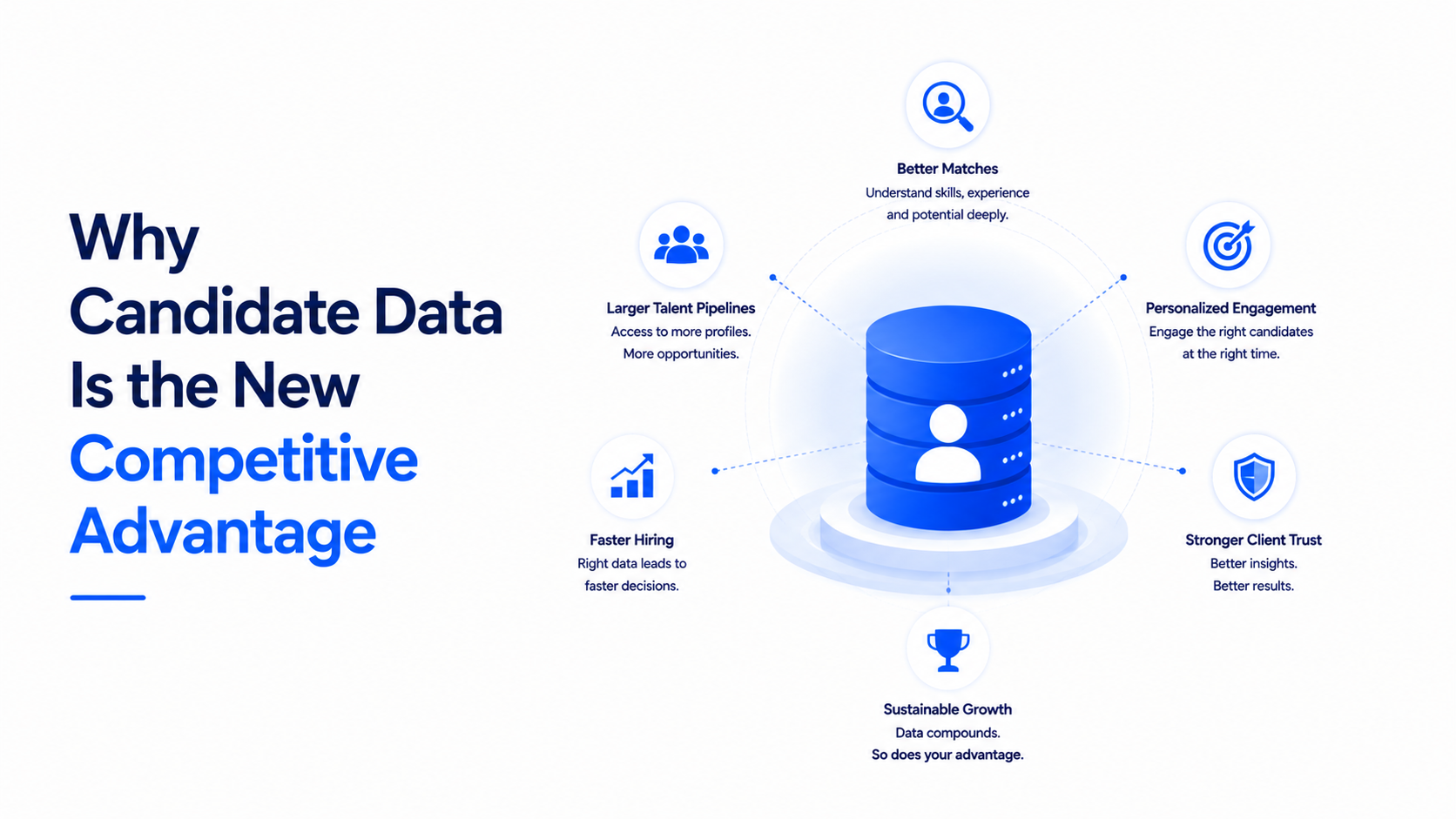
The shift to data-centric recruiting changes the competitive equation fundamentally. When candidate information is systematically collected, structured, and stored in a centralized platform, it becomes an organizational asset rather than an individual one. The data persists regardless of personnel changes. It is accessible to every recruiter in the firm, not just to the individual who originally sourced the candidate. It can be searched, analyzed, and leveraged at a scale that no individual network can match, because a database of a hundred thousand candidate profiles can be queried in seconds for any combination of skills, experience, geography, and availability criteria. Most importantly, it can be continuously enriched and updated through AI-powered processes that monitor candidate career changes, engagement signals, and market activity, keeping the data current without requiring manual maintenance by individual recruiters. The firm that has invested systematically in building this data asset has a structural advantage that no amount of individual recruiter networking can replicate, because the data asset encompasses far more candidates, far more information about each candidate, and far more current and comprehensive market coverage than any individual or team of individuals could maintain through personal relationships alone.
The competitive dynamics of candidate data are particularly powerful because of the network effects they create. A recruitment firm with a large, rich candidate database attracts more clients because it can demonstrate faster shortlist generation, higher-quality matches, and deeper market intelligence. More client engagements generate more candidate interactions, more placement data, and more market insights, all of which enrich the database further. A richer database attracts more candidates because the firm can offer them more relevant opportunities and a more personalized experience, since the firm's understanding of each candidate's profile and preferences enables more targeted engagement. More candidates in the database improve the firm's ability to serve clients, which attracts more clients, which generates more data, in a self-reinforcing cycle that compounds over time. This network effect means that the firms that invest early in building candidate data assets gain an advantage that grows progressively larger as the data accumulates, creating a widening gap between data-rich and data-poor competitors that becomes increasingly difficult for late adopters to close. agentic AI platforms vs automated ones explains how agentic AI platforms accelerate this network effect by automatically capturing and structuring candidate data from every interaction, because the platform ensures that every candidate conversation, every assessment, and every placement outcome enriches the central database without requiring manual data entry by recruiters.
What Candidate Data Actually Includes
The candidate data that creates competitive advantage goes far beyond the basic profile information that most recruitment firms maintain. At the foundational level, candidate data includes professional profiles with detailed work histories, educational backgrounds, technical skills, certifications, and geographic locations. This is the data that most firms capture in their applicant tracking systems, and while it is necessary, it is insufficient for competitive differentiation because it is widely available through LinkedIn, public databases, and standard recruiting tools. The competitive value of candidate data emerges at the enrichment layers above this foundation. The first enrichment layer is interaction history: every communication the firm has had with the candidate, including initial outreach, responses, interview scheduling, feedback provided, offers extended, counteroffers received, and the outcome of each interaction. This interaction history reveals the candidate's engagement patterns, their responsiveness to different types of opportunities, their concerns and priorities, and their trajectory through previous hiring processes with the firm. A candidate who has previously declined an opportunity because of relocation reluctance, for example, can be flagged for roles in their current location and filtered out of searches that require relocation, improving both efficiency and candidate experience.
The second enrichment layer is assessment data: the firm's evaluation of the candidate's qualifications, cultural fit, and likelihood of success for specific types of roles. This data goes beyond the candidate's self-reported profile to include the firm's professional judgment, informed by direct interaction, reference checks, and in some cases formal assessment processes. When a recruiter has assessed a candidate's technical depth during a screening call, evaluated their communication style during an interview preparation session, and gathered reference feedback on their leadership capabilities, these assessments become proprietary data points that no other firm possesses. Over time, as the firm assesses more candidates and tracks their actual placement outcomes, it builds a calibration dataset that improves the accuracy of future assessments. A firm that has assessed five hundred software engineers and tracked which ones succeeded in client organizations has a genuinely proprietary understanding of the candidate characteristics that predict success in specific contexts, an understanding that cannot be purchased from any external data provider. According to McKinsey, organizations that build proprietary candidate assessment databases report twenty to twenty-five percent higher placement success rates and fifteen to twenty percent lower early attrition among placed candidates, because the assessment data enables more accurate matching between candidate capabilities and role requirements.
The third enrichment layer is behavioral and signal data: the indicators that predict a candidate's current availability, motivation, and likelihood of accepting a new opportunity. These signals include changes in the candidate's LinkedIn activity, such as updating their profile or increasing their network engagement, changes in their employer's business performance or funding situation, patterns in their response to previous outreach attempts, seasonal timing
patterns specific to their industry or role type, and the firm's own historical data on when similar candidates have been most receptive to new opportunities. This signal data is where AI creates the most significant competitive advantage, because AI systems can monitor thousands of candidates simultaneously for availability signals that no human recruiter could track at scale. A firm that can identify the five hundred passive candidates in its database who have recently shown behavioral signals indicating openness to a move, and can prioritize outreach to those candidates for a relevant search, will produce a shortlist faster and with higher candidate quality than a firm that reaches out to the same broad candidate pool without signal-based prioritization. why AI tools have outdated candidate data explains why firms that rely on static candidate databases without continuous signal monitoring are working with data that degrades rapidly, because candidate availability and motivation change constantly and a database that does not track these changes becomes progressively less accurate and less valuable.
How Candidate Data Transforms the Client Experience
The most visible impact of deep candidate data is on the speed and quality of the firm's response to client requirements. When a client submits a search assignment, a data-rich firm can query its candidate database against the role requirements and produce an initial market assessment within hours: how many candidates in the database match the core requirements, how many of those have been previously engaged by the firm and what the outcome was, what the current availability signals indicate, and what compensation expectations the firm's data suggests for this role type in this market. This initial market assessment sets client expectations accurately, demonstrates the firm's expertise and data advantage, and provides a foundation for the search strategy discussion that follows. By contrast, a firm without deep candidate data must begin the search from zero, sourcing candidates through databases and outreach before it can provide any meaningful assessment of the market. The data-rich firm presents an informed strategy. The data-poor firm presents a plan to go find out. For clients managing urgent hiring needs, the difference is stark.
Candidate data also transforms the quality of the shortlist itself. A firm with rich candidate data can evaluate potential candidates not just against the job requirements but against the firm's accumulated understanding of what makes a successful placement in this specific context. The firm's data might show that candidates with certain background characteristics have historically succeeded at this client's organization, that candidates who asked specific types of questions during previous interview processes tended to be higher performers, or that candidates from specific competitor organizations had higher retention rates when placed at similar companies. This data-driven shortlist curation produces candidate recommendations that are informed by evidence rather than intuition, and the client can see the reasoning behind each recommendation because the firm can explain which data points support the assessment. This evidence-based approach to candidate presentation builds client confidence and accelerates decision-making, because hiring managers can evaluate the supporting data rather than relying solely on the recruiter's verbal recommendation. According to Gartner, organizations that work with data-rich recruitment partners report twenty-five to thirty-five percent higher
confidence in candidate recommendations and fifteen to twenty percent faster hiring decisions, because the evidence base reduces the uncertainty that slows decision-making and increases the likelihood that the right candidate is selected.
The strategic advisory dimension of candidate data is where the most significant client value is created. A firm with deep candidate data can provide clients with intelligence that goes far beyond individual search assignments. The firm can tell a client how their employer brand is perceived by candidates in the market, based on candidate feedback collected during previous search processes. The firm can identify talent risk areas where the client's workforce has characteristics, such as below-market compensation or high competitor demand, that predict elevated attrition risk. The firm can map the client's talent competitive landscape, showing which competitors are hiring for similar roles, what they are paying, and where they are sourcing candidates from. This strategic intelligence positions the recruitment firm as a talent advisory partner rather than a transactional service provider, which deepens the client relationship and creates switching costs based on the intelligence the client has come to depend on. Clients who receive this level of strategic insight from their recruitment partner are far less likely to switch to a competitor offering lower fees, because the intelligence is proprietary to the firm and cannot be replicated by switching providers. how to evaluate an AI sourcing tool provides a framework for assessing the depth and quality of a recruitment firm's candidate data asset, because the assessment identifies the enrichment layers where the firm has strong data and the gaps where investment is needed to support the strategic advisory capabilities that differentiate data-rich firms from their competitors.
Building a Candidate Data Asset That Compounds
Building a candidate data asset that creates genuine competitive advantage requires a systematic, long-term approach that treats data accumulation as a strategic investment rather than an administrative byproduct. The first principle is comprehensiveness. The data asset must cover a sufficiently broad segment of the candidate market to provide meaningful competitive differentiation. A database of five hundred candidates in a specific niche might be valuable for serving that niche, but it does not create the breadth of coverage that enables a firm to demonstrate market-leading capability to clients. The target should be the largest possible coverage of the firm's target candidate markets, because breadth of coverage is what enables the fast shortlist generation and comprehensive market intelligence that clients value most. Comprehensiveness also means depth of data per candidate, because a database with rich profiles on fifty thousand candidates is far more valuable than a database with minimal profiles on two hundred thousand. The depth of each candidate record, including interaction history, assessment data, and behavioral signals, is what enables the differentiated matching, prioritization, and advisory capabilities that create competitive advantage.
The second principle is currency. Candidate data degrades rapidly if it is not continuously updated. A candidate's skills, experience, compensation, and availability all change over time, and a database that reflects historical rather than current information produces inaccurate
matches and unreliable intelligence. Maintaining currency at scale requires automated processes that monitor candidate profiles for changes, track engagement signals that indicate shifts in availability or motivation, and update records without manual intervention. AI-powered data enrichment tools can monitor thousands of candidate profiles for changes in employment status, skill development, publication activity, and social media engagement, automatically updating the firm's database to reflect the most current information available. This automated enrichment is essential because manual data maintenance at scale is impractical. A firm with fifty thousand candidate profiles cannot rely on recruiters to manually update records during their normal workflow. The updating must be systematic, automated, and continuous. According to LinkedIn, recruitment firms that deploy automated candidate data enrichment report forty to fifty percent higher data accuracy scores and sixty to seventy percent faster candidate identification for new searches, because the automated updates ensure that the database reflects current market conditions rather than historical snapshots.
The third principle is structure and accessibility. Data that is collected but cannot be easily queried, analyzed, and presented is data that creates no competitive advantage. The candidate data asset must be stored in a structured format that supports complex queries, joined with related data such as placement records, client information, and market intelligence to enable cross-functional analysis, and accessible through tools that recruiters, account managers, and client-facing staff can use without specialized technical skills. The structure must also support the analytical models that generate predictive insights, such as candidate matching scores, availability predictions, and compensation estimates. This requires consistent data schemas, standardized fields, and quality controls that ensure the data is reliable enough to support automated decision-making. The investment in data structure and accessibility is often the least glamorous component of a candidate data strategy, but it is the component that determines whether the data can actually be used to create competitive advantage or remains an inert repository of information that nobody queries. AI sourcing vs AI recruiting explains why the firms that build the most valuable candidate data assets are those that structure their data to support both sourcing efficiency and strategic recruiting intelligence, because data structured for dual purposes serves the operational needs of individual searches while simultaneously building the analytical foundation for market intelligence and strategic advisory.
Protecting and Leveraging Your Data Advantage
Once a firm has invested in building a proprietary candidate data asset, protecting that asset becomes a strategic priority. Candidate data is valuable precisely because it is proprietary, and its competitive value depends on it remaining exclusive to the firm. Several risks threaten this exclusivity. Recruiters who leave the firm may attempt to take candidate data with them, either by exporting contact lists or by replicating their personal network in a way that includes the firm's proprietary candidate intelligence. Client engagements may expose the firm's data assets if the firm shares detailed candidate information with clients in formats that can be easily extracted and shared. Competitors may attempt to infer the firm's candidate intelligence through public channels or by hiring away recruiters who have been trained on the firm's data
systems. Protecting the asset requires a combination of technical, contractual, and organizational measures. Technical measures include access controls that limit data access to authorized users, audit trails that track data access and usage, and data loss prevention tools that detect and prevent unauthorized data extraction. Contractual measures include clear intellectual property provisions in recruiter employment agreements, client contracts that specify data ownership and usage restrictions, and non-disclosure agreements that protect the firm's proprietary intelligence.
Leveraging the data advantage requires translating the raw data asset into client-facing value propositions that demonstrate the firm's unique capabilities. This means developing standardized intelligence products that showcase the depth and uniqueness of the firm's candidate data. Talent market maps showing the distribution of specific skill sets across organizations and geographies, compensation benchmarking reports drawn from the firm's actual transaction data, candidate availability indices for critical role types, and competitive talent intelligence showing competitor hiring patterns are all intelligence products that derive their value from the proprietary candidate data underlying them. These products should be proactively delivered to key clients on a regular schedule, not only when a search is active, because the consistent delivery of intelligence creates client dependency and positions the firm as an ongoing strategic resource rather than a project-based service provider. The intelligence products also serve a marketing function, because they demonstrate the firm's data advantage to prospective clients in a tangible, credible way. A prospect who receives a detailed talent market analysis that reveals insights they did not already know is far more likely to engage the firm than a prospect who receives a standard capabilities presentation. According to Deloitte, professional services firms that proactively deliver data-driven intelligence products to clients report thirty to forty percent higher client retention rates and twenty to twenty-five percent higher win rates on competitive engagements, because the intelligence creates perceived and actual switching costs that competitors cannot easily overcome.
The ultimate leverage of a candidate data advantage is using it to redefine the firm's market position. A firm with a deep, proprietary candidate database can position itself not as a recruitment service provider but as a talent intelligence platform, a firm whose primary value is the depth and quality of its understanding of the talent market and whose recruitment services are one expression of that understanding. This repositioning opens new revenue streams through intelligence product sales, creates deeper and more defensible client relationships, and attracts higher-caliber talent because top recruiters want to work at firms where they have access to the best data and tools. The firms that make this transition successfully will find that their candidate data asset, rather than being merely a tool that supports their recruiting operations, becomes the foundation of an entirely different and more valuable business. The data is not just supporting the service. The data is the service, and the recruitment engagements are one of many ways the data's value is delivered to clients. more tools same hiring problems explains why firms that treat candidate data as a strategic platform asset rather than an operational tool capture significantly more value from their data investment, because the platform mindset leads to broader data collection, more sophisticated analytics, and more diverse intelligence products than the operational mindset, which limits data use to the immediate needs
of active searches.