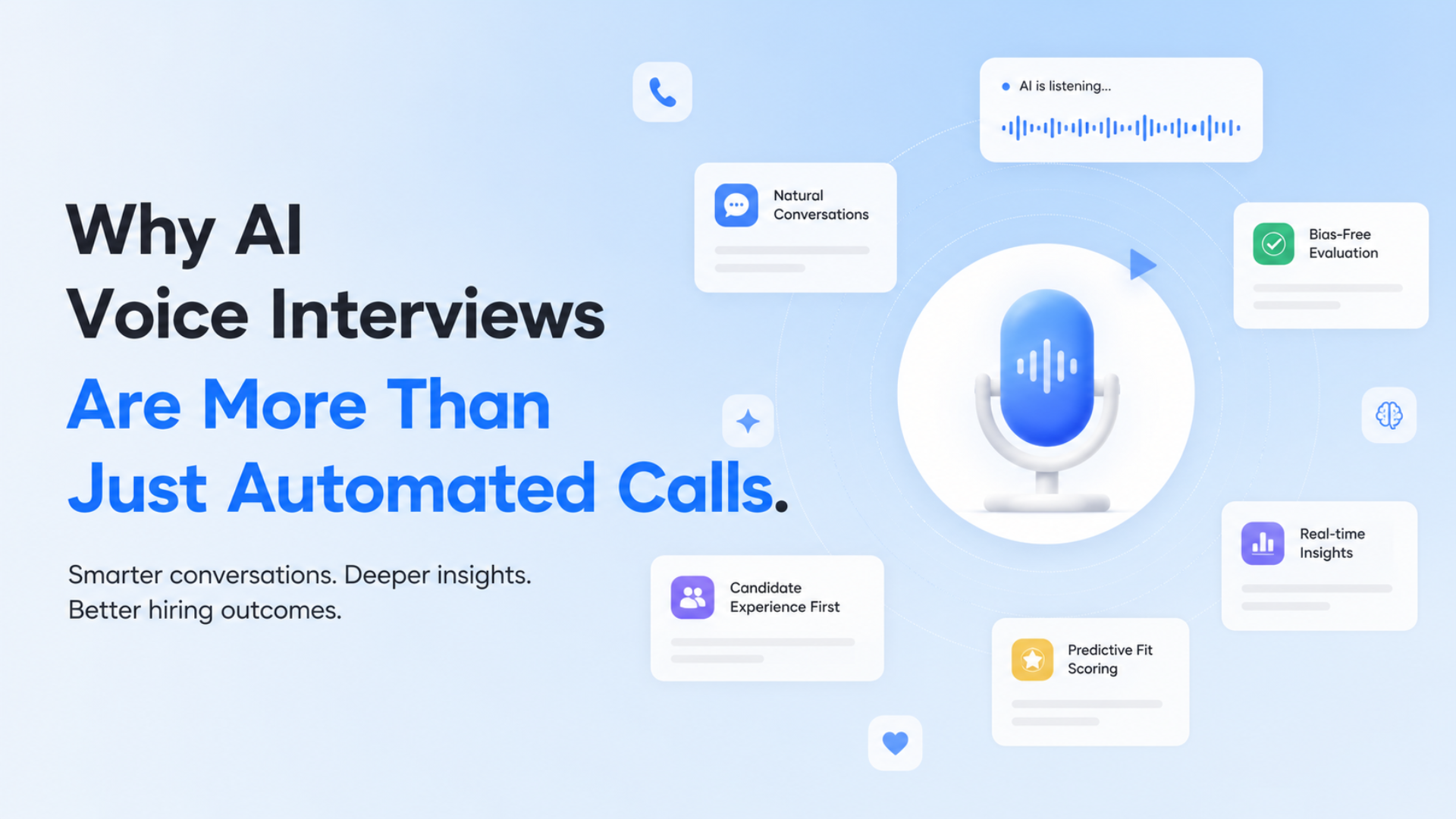
When most people hear “AI voice interview,” their mental model is an interactive voice response system — the kind of automated phone tree you encounter when you call a bank or an airline. Press one for sales. Press two for support. The system plays a pre-recorded prompt, you respond, and it routes you somewhere based on a simple keyword match. This association is understandable. Both involve talking to a machine over the phone. But the technological gap between an IVR system and a modern AI voice interview is not incremental. It is categorical. An IVR system collects inputs. An AI voice interview evaluates responses. An IVR system follows a static decision tree. An AI voice interview applies natural language understanding to assess the quality, specificity, relevance, and coherence of a candidate’s spoken answers. Confusing the two is not just a labeling error — it leads to fundamentally wrong expectations about what the technology can do, how it should be configured, and what value it provides to the hiring process.
IVR vs. AI Voice Interview: A Technical Comparison
The most fundamental difference lies in how the two systems process what the candidate says. An IVR system uses speech recognition to convert audio into text, then matches keywords or phrases against a predefined list. If the candidate says “yes” or “I agree,” the system moves to the next branch. It does not evaluate the content of the response beyond this keyword match. A response of “Yes, I have five years of experience leading cross-functional teams at a Fortune 500 company” and a response of “Yeah, sure” produce the same outcome in an IVR system: the system recognizes an affirmative and proceeds. The richness of the first response is entirely lost.
An AI voice interview uses the same speech-to-text conversion as its first step, but
what happens next is radically different. The transcribed response is processed through natural language understanding models that evaluate the response across multiple dimensions simultaneously. The system analyzes whether the candidate actually answered the question asked, or provided a tangential response. It assesses the specificity of the examples provided — whether the candidate described concrete situations with measurable outcomes or offered vague generalizations. It evaluates the logical structure of the response, looking for the kind of situation-action-result framework that behavioral science has identified as a reliable indicator of job-relevant competencies. It measures language complexity, vocabulary range, and the degree to which the candidate communicates with the clarity and professionalism required for the role. These are not keyword matches. They are linguistic feature analyses grounded in decades of research on communication competence and its relationship to workplace performance.
The consequence of this technical difference is that an AI voice interview produces a multi-dimensional evaluation of each candidate’s responses, while an IVR system produces a routing decision. The IVR tells you which branch the candidate was sorted into. The AI voice interview tells you how well the candidate demonstrated the competencies the interview was designed to assess. This is not a small distinction. It is the entire difference between a data collection tool and an assessment tool. Organizations that evaluate AI voice interviews as if they were sophisticated IVR systems — looking only at whether candidates completed the interview, not what the evaluation data reveals — are leaving the vast majority of the technology’s value on the table.
Adaptive Questioning Within a Structured Framework
One of the most misunderstood capabilities of AI voice interviews is their ability to adapt within a structured framework. The term “structured interview” often carries the implication that every candidate receives an identical, rigid sequence of questions with no variation. In practice, the best AI voice interview platforms use what industrial-organizational psychologists call adaptive structured interviewing — a methodology that maintains the consistency and validity of a structured assessment while allowing the conversation to respond to the candidate’s actual answers in limited but meaningful ways.
Here is how this works in practice. The AI asks a competency-based question. The candidate responds. The AI evaluates the response and, based on that evaluation, selects the most informative follow-up from a pre-approved set of probes. A candidate who gave a strong, specific answer might receive a deeper probe that explores a particular aspect of their experience. A candidate who gave a vague or incomplete answer might receive a clarifying probe that gives them a chance to provide more detail. The key is that every probe is predefined, every probe maps to the same evaluation criteria, and the AI’s selection of which probe to use is based on the scoring of the previous response rather than on any subjective judgment. This preserves the methodological integrity of the structured interview — the same standards are applied to every candidate — while allowing the conversation to be more natural and more productive than a rigid, non-adaptive script. Research compiled by the Society for Industrial and Organizational Psychology has shown that adaptive
structured interviews maintain the high predictive validity of fully structured interviews while improving candidate engagement and the depth of information gathered.
From Data Points to Decision Intelligence
The output of an IVR system is a data point: the candidate said yes, or the candidate selected option three, or the candidate completed the survey. The output of an AI voice interview is decision intelligence: a structured, multi-dimensional evaluation that tells the recruiter not just what the candidate said, but what their responses indicate about their competencies, communication abilities, and readiness for the role. This distinction becomes critical when you consider how recruiters actually use screening data to make decisions.
A recruiter who receives a completed IVR-style screening checklist knows that the candidate answered a set of questions. They do not know how well the candidate answered those questions, whether the candidate’s examples were specific or generic, or whether the candidate demonstrated the competencies that predict success in the role. The recruiter still has to conduct a phone screen to gather this information, which means the IVR step added time to the process without reducing the recruiter’s workload. An AI voice interview, by contrast, provides a competency-specific scorecard with evidence-based assessments for each dimension. The recruiter reviews this scorecard and knows, before they pick up the phone, that the candidate demonstrated strong problem-solving and communication but showed limited evidence of leadership. This changes the phone screen from a broad evaluation into a targeted follow-up, making the recruiter’s time dramatically more productive. The difference between data points and decision intelligence is the difference between technology that adds a step and technology that transforms a workflow.
This intelligence layer is what separates basic automation from what the industry is increasingly calling agentic AI. A simple automated call records a conversation and perhaps transcribes it. An agentic AI platform evaluates the conversation, identifies patterns, produces structured assessments, and feeds those assessments into the next stage of the hiring workflow automatically. The distinction is explored in What Makes an AI Recruiting Platform “Agentic” vs Just Automated?, where the argument is made that the value of AI in recruiting is not in automating individual tasks but in creating intelligent, multi-step workflows where each stage builds on the data produced by the previous one. AI voice interviews, when implemented as part of such a workflow, are the assessment engine that powers everything downstream.
The Evaluation Layer: Scoring, Benchmarking, and Bias Detection
Beyond the conversation itself, AI voice interviews provide an evaluation infrastructure that no automated call system can match. Every response is scored against predefined competency criteria. Every score is benchmarked against the distribution of scores from other candidates for the same role. Every evaluation is logged, creating an audit trail that supports both quality improvement and regulatory compliance. This infrastructure provides three capabilities that are difficult or impossible to achieve with manual phone
screening.
First, calibration. When multiple recruiters are screening candidates for the same role, each one brings a different standard. Recruiter A might be generous with communication scores while Recruiter B is strict. AI voice interviews apply a single standard to every candidate, and that standard can be calibrated against actual hiring outcomes over time. If the AI consistently gives high communication scores to candidates who turn out to be strong performers, the scoring model is validated. If a particular competency score does not correlate with later performance, the scoring criteria can be adjusted. This continuous calibration loop is impossible with manual screening because the evaluation data is inconsistent, incomplete, and often undocumented. Research from Gartner’s HR technology practice has found that organizations using AI screening with outcome-based calibration improve their screening accuracy by 25 to 35 percent over a 12-month period, as the model learns from the actual performance data of hired candidates.
Second, bias detection. Because AI voice interviews evaluate every candidate against the same criteria and log every score, the resulting dataset makes it possible to analyze whether the system is producing systematically different outcomes for different demographic groups. If female candidates score lower than male candidates on a particular competency dimension, that pattern is visible in the data and can be investigated. In manual screening, the equivalent analysis is nearly impossible because the evaluation data is not captured in a consistent, structured format. This does not mean AI voice interviews are immune to bias — they can inherit and amplify biases in their training data or evaluation criteria. But the structured, logged nature of AI evaluation makes bias detection and correction feasible in a way that unstructured human evaluation does not. The International Association of Privacy Professionals has documented how the auditability of AI evaluation systems is becoming a regulatory expectation, not just a best practice, in jurisdictions including New York City and the European Union.
Why “More Than Automated Calls” Requires More Than a Standalone Tool
The argument of this article is that AI voice interviews are fundamentally different from automated calls because they evaluate, adapt, and produce decision intelligence rather than simply collecting responses. But realizing this full potential requires the AI voice interview to operate within a platform that can use its output effectively. A standalone AI voice interview tool that produces a scorecard, which the recruiter then downloads, reviews separately, and manually acts on, delivers some of this value. A platform that embeds the AI voice interview within an end-to-end hiring workflow — where the evaluation data flows directly into the recruiter’s workflow, informs the next interaction, and contributes to organization-wide hiring analytics — delivers all of it.
This is the operational reality that Huntlo addresses. Huntlo’s AI voice interview capability is not a standalone screening widget. It is a stage within a unified hiring operating system that handles AI sourcing across 50+ platforms, multi-channel candidate outreach,
AI screening evaluation, recruiter review workflows, and interview scheduling. A candidate sourced through Huntlo’s AI engine, engaged through automated outreach, and screened through an AI voice interview generates a competency-specific scorecard that the recruiter reviews, acts on, and uses to schedule follow-up conversations — all within the same platform, without manual data transfer, without context loss, and without the operational overhead that plagues disconnected tool stacks. The AI voice interview is not an isolated call. It is an intelligent evaluation stage that feeds the entire downstream process.
The distinction between an automated call and an AI voice interview matters because the organizations that treat them as the same thing will underinvest in configuration, underutilize the evaluation data, and ultimately conclude that the technology does not live up to its promise. The organizations that understand the difference — that recognize AI voice interviews as assessment systems that happen to use voice as their input channel, rather than phone calls that happen to use AI — are the ones that will see the transformative results. And they will see those results most quickly when the platform they use treats the AI voice interview as an integrated intelligence layer rather than an isolated automation step, a point reinforced by The ATS Mistake Companies Keep Repeating, which documents how isolating any single hiring technology from the surrounding workflow consistently leads to disappointing outcomes regardless of the technology’s individual capabilities.
Related Topics:
Why Do Some AI Recruiting Tools Have Outdated Candidate Data?
What’s the Difference Between AI Sourcing and AI Recruiting?