When Marcus Chen joined Meridian Health Systems as VP of Talent Acquisition in early 2024, he inherited a recruiting operation that had purchased three different AI tools in two years. Every one of them was a resume screening product. His team could parse applications faster than ever, but they still struggled to find enough qualified candidates, still lost top prospects to slow follow-ups, and still made hiring decisions based on gut feeling after the screening stage. The AI had made one part of the funnel faster without improving the overall outcome. Chen realized that the organization had conflated AI recruiting with AI resume screening, and that this conflation was preventing them from investing in the areas where AI could actually transform their hiring results. He ordered a comprehensive audit of the recruiting pipeline, identified five stages where AI could add value beyond screening, and reallocated the technology budget to cover the full funnel. Within six months, quality of hire improved, time-to-fill dropped, and the team stopped thinking of AI as just a screening tool.
The Resume Screening Trap
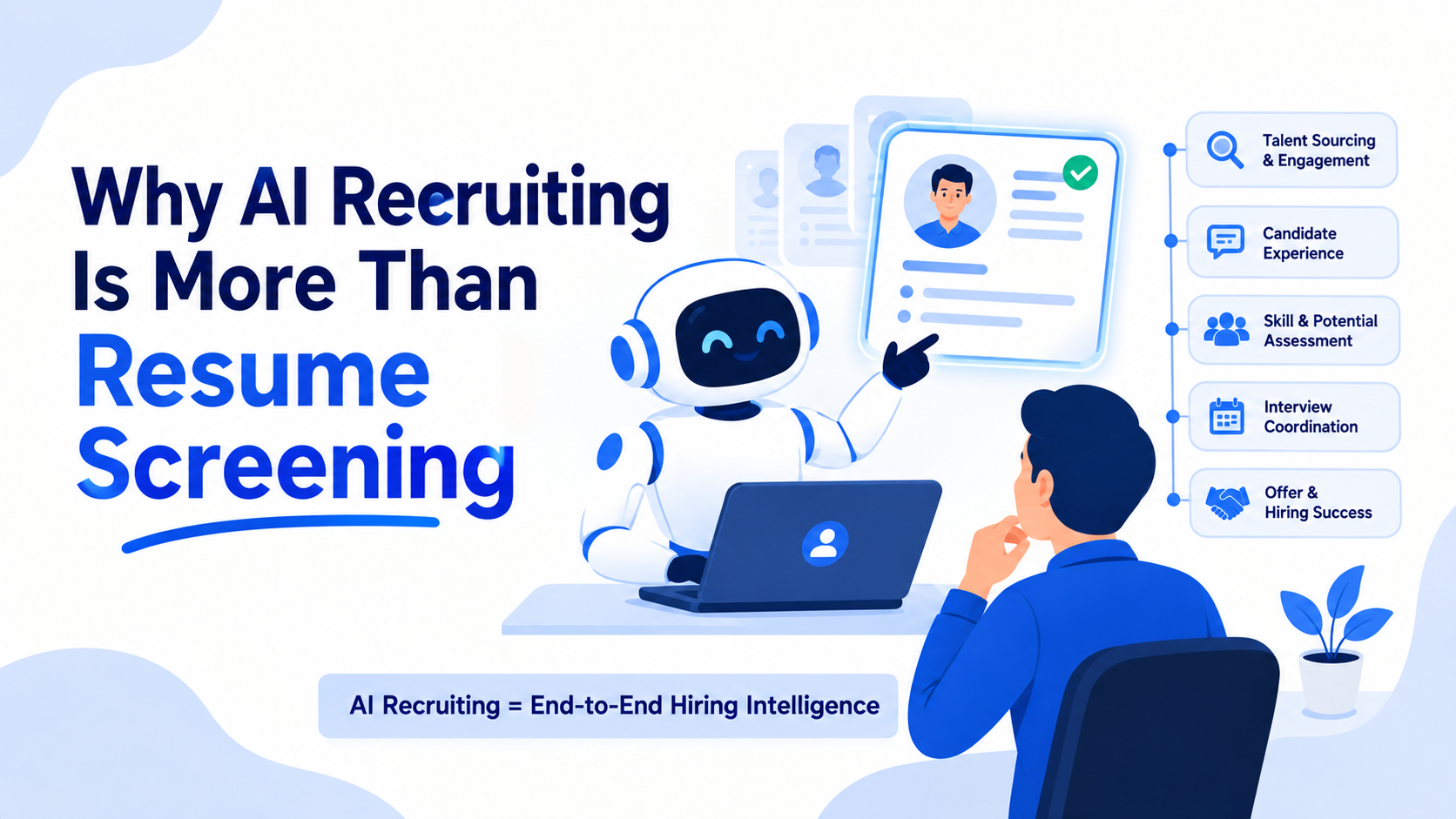
The recruiting industry has a framing problem. When practitioners, vendors, and analysts discuss AI in recruiting, the conversation almost always gravitates toward resume screening. Automated resume parsing, keyword matching, and candidate ranking have become the default use cases that define how most organizations think about AI recruiting. This framing is not entirely wrong because screening was one of the earliest and most visible applications of AI in talent acquisition, but it is profoundly incomplete. Treating AI recruiting as synonymous with AI resume screening is like treating the internet as synonymous with email. Both are technically accurate as far as they go, but both miss the vast majority of the value.
The consequences of this narrow framing are measurable and damaging. Organizations that
limit their AI recruiting investment to screening tools are leaving enormous value on the table. McKinsey research on AI in talent acquisition shows that screening accounts for roughly fifteen to twenty percent of the total value that AI can deliver across the recruiting funnel. The remaining eighty to eighty-five percent comes from sourcing, engagement, matching, interviewing, and strategic workforce planning. An organization that only deploys AI for screening is capturing a fraction of the available value while believing it has deployed a comprehensive AI strategy.
This trap is reinforced by vendor marketing. Most AI recruiting vendors lead with screening capabilities because screening is the easiest use case to demonstrate and sell. A screening tool can show immediate, measurable results in reduced time-to-review and increased application throughput. The ROI is tangible and easy to quantify. Sourcing intelligence, engagement optimization, and predictive matching, by contrast, deliver value that accumulates over time and is harder to attribute to a single tool. Vendors naturally lead with the easiest sale, and buyers naturally equate the most visible feature with the full capability set. The result is a market where both sides consistently underestimate what AI recruiting can do.
Intelligent Sourcing: Finding Candidates Who Are Not Applying
The single largest source of hiring value that AI recruiting delivers beyond screening is intelligent sourcing. The best candidates for most roles are not actively applying. They are employed, performing well, and not monitoring job boards. Traditional sourcing requires recruiters to manually search databases, construct Boolean queries, and review hundreds of profiles to identify potential matches. This process is time-intensive, inconsistent across recruiters, and limited by the recruiter's ability to formulate effective searches. AI sourcing changes this dynamic fundamentally by analyzing job requirements to understand the underlying capability needs rather than just matching keywords, searching across multiple data sources simultaneously, and ranking candidates by predicted fit rather than by keyword proximity.
The difference between AI sourcing and traditional sourcing is not just speed but quality. A Boolean search constructed by a recruiter will return candidates whose profiles contain specific keywords. An AI sourcing system identifies candidates whose profiles demonstrate the capabilities the role requires even when the language used in the profile differs from the language used in the job description. LinkedIn data on sourcing effectiveness shows that AI-powered sourcing produces thirty to fifty percent more qualified candidates from the same talent pool because the AI understands semantic relationships between skills, titles, and experiences that keyword matching misses entirely.
For organizations hiring for specialized or technical roles, this capability is particularly valuable. The research on AI tools for niche technical roles demonstrates that AI sourcing platforms consistently outperform manual sourcing when the talent pool is small and the skill requirements are specific. The AI can identify transferable skills, recognize equivalent
experience from different industries, and surface candidates that a recruiter using keyword searches would never find. This is not an incremental improvement. It is a qualitative shift in what is possible in talent identification, and it has nothing to do with resume screening.
Adaptive Engagement: The Stage Where Most Hires Are Won or Lost
After sourcing, the next critical stage where AI recruiting delivers value far beyond screening is candidate engagement. The gap between identifying a qualified candidate and successfully hiring them is enormous. Most sourcing efforts produce initial interest from qualified candidates, but a significant portion of those candidates disengage during the process. They stop responding to messages, accept other offers, or lose interest because the engagement experience was poor. This is not a screening problem. It is an engagement problem, and it is one that AI is uniquely positioned to solve.
AI engagement platforms analyze candidate behavior, communication preferences, and interaction history to determine the optimal approach for each individual candidate. Rather than sending the same email template to every prospect, AI systems generate personalized messages that reference specific aspects of the candidate's background and explain why a particular role is relevant to their career trajectory. They select the optimal communication channel based on the candidate's observed preferences, whether that is email, LinkedIn, or other platforms. They time messages for maximum likelihood of response based on patterns observed across thousands of candidate interactions. Gartner research on AI in candidate engagement finds that personalized, AI-driven outreach generates two to three times higher response rates than generic automated sequences.
The question of how many follow-ups one hire needs illustrates why AI engagement matters so much. The optimal number and timing of follow-ups varies dramatically by candidate, role, and market conditions. AI systems analyze response patterns to determine when a follow-up is likely to be effective and when it is likely to be counterproductive. This adaptive approach prevents both under-engagement, where candidates are lost because no one followed up, and over-engagement, where candidates are driven away by excessive or poorly timed contact. The result is a more efficient and more effective engagement process that converts a higher percentage of sourced candidates into actual hires, and this conversion improvement has nothing to do with how quickly or accurately the organization screens resumes.
Predictive Matching: Moving Beyond Keyword Alignment
Even when organizations use AI for screening, most implementations focus on surface-level keyword matching rather than genuine predictive matching. True AI matching goes far beyond identifying whether a resume contains specific keywords. It analyzes patterns across
thousands of successful and unsuccessful hires to identify the characteristics, experiences, and signals that actually predict success in a specific role at a specific organization. This requires the AI to learn from outcome data, not just from job descriptions and resumes, and the quality of matching improves continuously as the system accumulates more hiring data.
The distinction between keyword screening and predictive matching is critical. Keyword screening asks whether a candidate's profile contains the words in the job description. Predictive matching asks whether a candidate with this profile is likely to succeed in this role based on what the system has learned from previous hires with similar profiles. These are fundamentally different questions, and they produce fundamentally different results. Deloitte analysis of AI matching accuracy shows that predictive matching systems produce measurably better hires than keyword-based screening systems, particularly for complex roles where success depends on factors that are not easily captured by resume keywords such as adaptability, learning velocity, and cultural alignment.
The value of predictive matching compounds over time in a way that keyword screening does not. A keyword screening system provides the same quality of matching on day one thousand as on day one because the matching logic does not change. A predictive matching system provides better matching on day one thousand because it has learned from the outcomes of hundreds of additional hires. This learning effect is the defining characteristic of genuine AI, and it is what distinguishes AI recruiting from recruiting automation. The research on AI sourcing vs AI recruiting makes this distinction clear. Sourcing is about finding candidates. Recruiting is about making the right hiring decisions. AI can do both, but the matching and decision-support capabilities are where the deepest value lies.
Strategic Intelligence: From Tactical Execution to Workforce Planning
The most underappreciated dimension of AI recruiting is its potential to provide strategic workforce intelligence that goes far beyond any individual hiring decision. AI systems that operate across the full recruiting funnel accumulate data about talent markets, candidate behavior, hiring effectiveness, and workforce composition that can inform strategic decisions at the organizational level. This includes identifying emerging skill gaps before they become critical, mapping competitive talent landscapes to understand where competitors are hiring and what they are paying, and forecasting hiring demand based on business growth projections and historical patterns.
EY research on AI in workforce strategy describes this as the transition from reactive to predictive talent acquisition. Traditional recruiting operates reactively, filling open positions as they arise. AI-powered recruiting operates predictively, anticipating hiring needs and building talent pipelines before positions open. This shift from reactive to predictive is one of the most significant strategic advantages that AI can provide, and it has nothing to do with screening resumes faster. It is about understanding talent markets deeply enough to make proactive
decisions rather than scrambling to fill vacancies after they become urgent.
The organizations that are getting the most value from AI recruiting are those that have moved beyond thinking of AI as a point solution for screening and have started using it as an intelligence layer across the entire recruiting operation. SHRM guidance on AI in talent acquisition recommends that organizations evaluate AI platforms based on their ability to provide actionable intelligence about the talent market, not just their ability to process applications. The platforms that deliver this strategic intelligence are the ones that will define the next generation of recruiting technology, and they operate at a fundamentally different level than resume screening tools.
Redefining the Recruiter's Role with Full-Funnel AI
When AI recruiting is limited to resume screening, the recruiter's role does not change meaningfully. They still source candidates manually, engage them through generic outreach, coordinate interviews by hand, and make hiring decisions based on limited data. The AI just makes the screening step faster. This is the minimal viable deployment of AI in recruiting, and it produces minimal results. The full potential of AI recruiting is realized when it is deployed across the entire funnel, and that full-funnel deployment transforms what recruiters do every day.
With AI handling sourcing, screening, engagement optimization, interview scheduling, and initial candidate assessment, recruiters can redirect their time and expertise toward the activities that genuinely require human judgment. They can build deeper relationships with hiring managers to understand not just the technical requirements of a role but the cultural dynamics of the team. They can have more meaningful conversations with candidates because they are not spending their time on administrative tasks. They can focus on strategic workforce planning because they have AI-generated intelligence about talent markets and hiring trends. Gartner research on the future of recruiting roles finds that organizations deploying AI across the full funnel report higher recruiter satisfaction, lower recruiter turnover, and better hiring outcomes than organizations that limit AI to screening.
The research on agentic AI platforms vs automated ones is directly relevant here. Automated screening tools execute predefined rules. Agentic AI platforms operate with a degree of autonomy, making decisions about sourcing priorities, engagement timing, and candidate routing based on learned patterns. This agentic capability is what enables recruiters to shift from executing tasks to managing an intelligent system that handles the operational complexity of hiring. The recruiter becomes a strategic talent advisor rather than a process executor, and that transition is only possible when AI is deployed across the full funnel, not confined to a single screening step.
Building a Full-Funnel AI Recruiting Strategy
For organizations that currently have AI only at the screening stage, the path to full-funnel AI recruiting requires deliberate investment and a clear framework. The first step is to audit the current recruiting pipeline and identify the stages where manual processes are creating the largest bottlenecks or quality gaps. For most organizations, this audit reveals that screening is not actually the biggest problem. Sourcing coverage is insufficient, engagement conversion is low, interview scheduling is a coordination burden, and hiring decisions lack data-driven support. AI can address each of these challenges, and the cumulative impact of addressing all of them is far greater than addressing any one alone.
The second step is to evaluate AI recruiting platforms based on their full-funnel capabilities rather than their screening features. The challenge of how to evaluate an AI sourcing tool is that most evaluation frameworks focus on screening accuracy and processing speed. These are important metrics, but they do not capture the value that AI delivers in sourcing, engagement, and matching. Organizations should evaluate platforms on their ability to learn from outcomes, handle novel situations, and generate insights that go beyond what was explicitly programmed. McKinsey and Deloitte both recommend that AI vendor evaluations include specific assessments of learning capabilities, data infrastructure, and long-term value trajectory rather than just initial deployment performance.
The third step is to invest in the data and organizational foundations that full-funnel AI requires. AI systems that operate across the entire recruiting funnel need access to data from multiple sources, consistent feedback loops, and organizational processes that generate the outcome data the AI needs to learn and improve. This requires integration across HR technology systems, consistent data practices, and a willingness to measure recruiting performance based on hiring outcomes rather than process metrics. LinkedIn research on AI adoption in recruiting finds that the organizations achieving the best results from AI are those that treat data quality and system integration as prerequisites rather than afterthoughts. When these foundations are in place, AI recruiting delivers value that extends far beyond resume screening into every stage of the talent acquisition process.