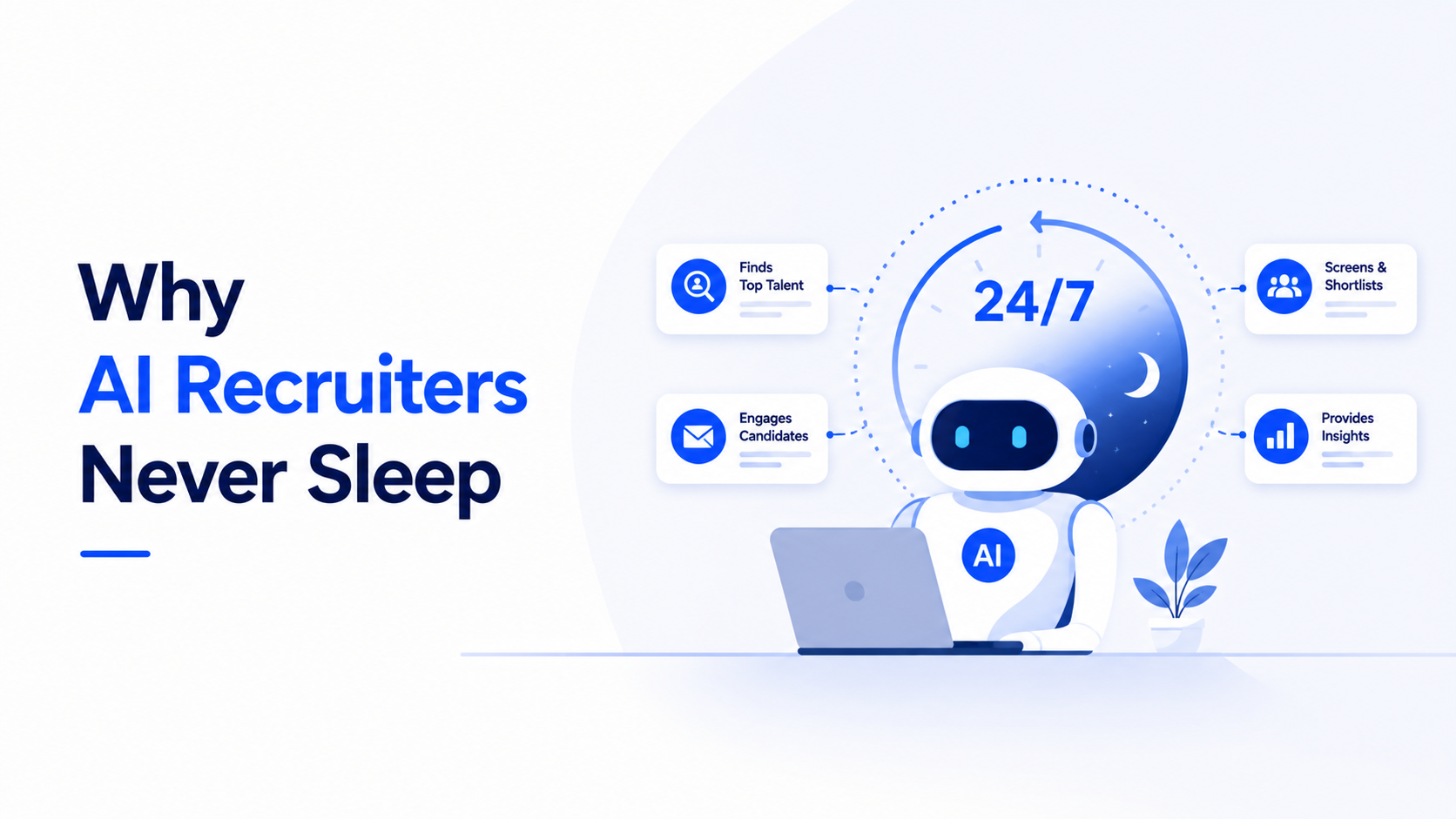
At 11:47 on a Tuesday night in Sydney, a machine learning engineer named Daniel updated his LinkedIn profile to reflect a recently completed project. Within four minutes, an AI recruiting system operating from servers in Virginia had detected the profile change, analyzed the new project against its library of open role requirements, determined that Daniel's newly demonstrated capabilities matched a senior ML engineer position at a company in Berlin, and drafted a personalized outreach message referencing the specific project. The message sat in a queue, waiting for the optimal send time in Daniel's local time zone. At 8:15 the following morning, Sydney time, the message was delivered. Daniel read it during his commute, responded with interest before his first meeting, and by the time his European counterpart was arriving at the office, the initial screening conversation had already been scheduled. No human recruiter was involved in any of these steps. The entire sequence, from profile change detection to scheduled conversation, took place across three time zones, overnight for two of them, and completed before most recruiters in either Sydney or Berlin had started their workday. This is what it means when people say AI recruiters never sleep, and the implications go far beyond simple after-hours automation.
The Time-Zone Advantage That Changes Who Gets Hired
The most immediate benefit of always-on AI recruiting is the elimination of time-zone friction in global hiring. For organizations recruiting across multiple geographies, time-zone differences create persistent coordination challenges. A recruiter in New York who wants to engage a candidate in Tokyo faces a fourteen-hour time difference that leaves narrow windows for real-time communication. Messages sent during the recruiter's workday arrive in the candidate's overnight and may be buried by morning. Responses from the candidate arrive during the recruiter's evening, creating delays that stretch what should be a rapid exchange into a
multi-day cycle. AI recruiting systems eliminate this friction by operating independently of any single time zone. They detect candidate signals when those signals occur, draft and deliver outreach at times optimized for the candidate's local context, and process responses as they arrive regardless of when the human recruiter on the hiring team is available. According to McKinsey, organizations using always-on AI recruiting for global roles report forty to fifty percent faster initial response times compared to organizations relying on human recruiters operating in fixed time zones, because the AI eliminates the waiting periods that time-zone differences create.
The time-zone advantage also affects candidate quality in ways that are not immediately obvious. The best candidates in competitive talent markets are often the first to respond to compelling opportunities, and the speed with which an organization engages after a candidate signals interest directly affects whether that candidate progresses through the hiring process or accepts a competing offer. When an AI system engages a candidate within minutes of a profile update or job application, the candidate experiences responsiveness that signals organizational agility and genuine interest. When the same candidate waits twenty-four hours for a response because the recruiter was asleep or in back-to-back meetings, the signal is indifference. The cumulative effect of these timing differences is significant. According to LinkedIn, candidates who receive initial outreach within one hour of expressing interest are three to four times more likely to complete the hiring process than candidates who wait twenty-four hours or more, a finding that holds across geographies, seniority levels, and industry sectors.
For organizations competing for talent in multiple countries simultaneously, the always-on capability transforms recruiting from a sequential process managed during business hours into a continuous operation that advances the pipeline around the clock. While the recruiting team in San Francisco sleeps, the AI system is engaging candidates in London, processing screening results from Singapore, and scheduling interviews for roles in Dubai. When the San Francisco team logs in the next morning, the pipeline has advanced by eight to ten hours of productive work that would otherwise have been lost to time-zone latency. This compounding effect means that organizations with always-on AI recruiting effectively operate with a longer hiring day than competitors who rely on human recruiters alone, and this advantage accumulates over every day of every search. AI sourcing vs AI recruiting illustrates why the time-zone advantage matters differently at different hiring stages, because the cost of time-zone delays is highest at the sourcing and initial engagement stages, where speed determines whether an organization reaches passive candidates before competitors do.
Candidate Signal Detection in the Overnight Hours
Professional candidates update their profiles, publish content, change their job status, and engage in professional activities at all hours, not just during recruiter business hours. A significant portion of career-activity signals, profile updates, skill endorsements, publication posts, and job-search status changes occur outside traditional working hours, because professionals in demanding roles often manage their career development activities in the evenings and on
weekends. Human recruiters miss most of these signals because they are not monitoring candidate activity at 10 PM on a Saturday or 6 AM on a Sunday. AI systems do not miss them, because they do not have off hours. They monitor candidate activity streams continuously, identify signals that indicate changing career readiness or newly relevant capabilities, and trigger actions based on those signals without waiting for a human to notice.
The signals that AI systems detect overnight are often the most actionable ones. A candidate who updates their LinkedIn profile to add a new certification on a Sunday evening is signaling career investment that may indicate openness to new opportunities. A candidate who changes their job status from open to work on a Thursday night is actively searching and likely to be responsive to outreach. A candidate who publishes an article about a technology stack that matches an open role requirement is demonstrating expertise that makes them a high-priority prospect. These signals decay rapidly, because the candidate's readiness and the competitive window are both time-sensitive. A candidate who goes active on Thursday night may have multiple conversations underway by Monday morning. Organizations whose AI systems detect and act on these signals overnight can be the first to engage, while organizations that wait for human recruiters to notice the signals on Monday may find that the candidate is already in process with a competitor. According to Gartner, AI recruiting systems that include continuous candidate monitoring capabilities identify thirty to forty percent more signal-driven sourcing opportunities than systems that rely on periodic batch processing, because continuous monitoring captures time-sensitive signals that batch processing misses.
The overnight signal detection capability also addresses one of the most persistent challenges in passive candidate sourcing: reaching candidates at the moment they are most receptive. Passive candidates, by definition, are not actively looking for roles and may not respond to outreach most of the time. But passive candidates go through periods of increased receptivity, triggered by events like project completions, organizational changes, performance review cycles, or personal milestones. These receptivity windows are often brief and unpredictable. An AI system that monitors continuously can detect the signals that indicate a receptivity window and engage immediately, while a human recruiter operating on a business-hours schedule will likely miss the window entirely. why AI tools have outdated candidate data explains why the freshness of candidate data is directly related to the quality of signal detection, because systems that monitor continuously can act on the most recent signals while systems relying on stale data may engage candidates based on outdated assumptions about their readiness and availability.
Always-On Pipeline Management Without Burnout
Recruiter burnout is one of the most serious and least discussed problems in talent acquisition. The combination of high hiring targets, candidate volume, stakeholder demands, and the emotional labor of managing candidate relationships creates chronic stress that drives experienced recruiters out of the profession at alarming rates. According to SHRM, annual recruiter turnover rates in enterprise talent acquisition teams average thirty to forty percent, with
burnout cited as the primary or secondary driver in over sixty percent of departures. The always-on expectation that technology has created, where candidates expect rapid responses at all hours and hiring managers expect continuous pipeline progress, has paradoxically made burnout worse even as it has made recruiting more productive. Recruiters feel pressure to respond to messages that arrive outside working hours, to monitor candidate activity on weekends, and to maintain pipeline momentum during vacations. The result is a profession where the people responsible for building organizations are burning out faster than the organizations can replace them.
AI recruiting systems that operate continuously offer a structural solution to this burnout problem by decoupling pipeline momentum from individual recruiter availability. When an AI system handles initial candidate engagement, responds to routine inquiries, processes screening assessments, and advances candidates through early pipeline stages, the recruiter's role shifts from being continuously available to being strategically engaged. The recruiter reviews AI-recommended actions during their working hours, provides human judgment on consequential decisions, and focuses their energy on the high-value interactions, hiring manager consultations, offer negotiations, and candidate relationship moments that genuinely require a human touch. The AI handles the volume and the timing, and the human handles the judgment and the relationship. This division of labor does not just reduce burnout. It improves the quality of the recruiter's contribution, because a rested recruiter making focused decisions produces better hiring outcomes than an exhausted recruiter trying to manage everything simultaneously. According to Deloitte, organizations that deploy always-on AI systems alongside clear role boundaries for human recruiters report twenty-five to thirty-five percent reductions in recruiter turnover and measurable improvements in quality-of-hire metrics, because the recruiters who stay are more effective when they are not chronically overextended.
The burnout reduction benefit also has a compounding effect on recruiting team performance. High turnover in recruiting teams creates a vicious cycle where experienced recruiters leave, their knowledge and candidate relationships are lost, remaining recruiters shoulder increased workload, which accelerates their burnout, and the cycle repeats. AI systems that absorb the always-on workload break this cycle by reducing the conditions that cause burnout in the first place. When recruiters can maintain sustainable working hours while the AI maintains pipeline momentum, the team retains institutional knowledge, candidate relationships deepen over time rather than being rebuilt after every departure, and the organization builds recruiting capability that compounds rather than cycling. how many follow-ups one hire needs explores how many follow-up interactions a single hire typically requires, and always-on AI systems handle the timing and volume of these follow-ups without requiring recruiters to work outside their productive hours, eliminating one of the primary sources of recruiting burnout.
The Competitive Moat of Perpetual Pipeline Velocity
In competitive talent markets, the organization that maintains the highest pipeline velocity,
the rate at which candidates move from identification through engagement, screening, and interview stages to offer, has a structural advantage that compounds over time. Pipeline velocity is not just about speed for its own sake. It is about being present in the right moments, engaging candidates before competitors do, maintaining candidate interest through responsive communication, and closing offers before competing opportunities materialize. Always-on AI systems increase pipeline velocity by eliminating the dead time that exists in every human-operated recruiting process, the hours when candidates are active but recruiters are not, the gaps between when a signal is detected and when a human acts on it, and the delays that accumulate when multiple time zones are involved.
The competitive impact of always-on pipeline velocity is most visible in the battle for passive candidates, who are the most sought-after and most time-sensitive prospects. A passive candidate who receives a thoughtfully personalized message within hours of a career signal is significantly more likely to engage than one who receives the same message days later, because the timing signals that the organization noticed and valued the specific thing the candidate did. When the message arrives at the optimal time in the candidate's day, references their recent activity, and proposes a conversation at a convenient time, the candidate experience is dramatically better than what competitors who operate on business-hours schedules can deliver. According to EY, organizations with always-on AI recruiting capabilities report winning forty to fifty percent more competitive head-to-head talent situations, those where the candidate has multiple active opportunities, compared to organizations using traditional scheduling, because the AI ensures the organization is consistently the most responsive and best-informed participant in the competition.
The velocity advantage also manifests in the organization's ability to respond to sudden hiring needs. When a key employee resigns, a new project wins, or a market opportunity requires rapid team scaling, the organization with an always-on AI system does not start from zero. The system has been maintaining relationships with relevant candidates, monitoring the talent market, and building pipeline continuously. When the need materializes, the system can immediately surface qualified candidates who have been warmed over weeks or months of prior engagement, rather than starting a cold sourcing process that will take weeks to produce results. This always-warm pipeline is a strategic asset that cannot be replicated by organizations that recruit in stop-and-start bursts driven by immediate hiring needs. AI tools for niche technical roles demonstrates why the always-warm pipeline is especially valuable for specialized roles, where the candidate pool is small and the time required to build relationships from scratch can exceed the time available to fill the role.
Designing Your Always-On Recruiting Operation
Building an always-on recruiting operation requires more than deploying an AI tool and letting it run. The design challenge is to define clearly what the AI handles autonomously, what requires human review, and how the handoffs between AI and human recruiters are managed. The most effective approach is to define autonomy tiers based on decision impact.
High-volume, low-risk actions like candidate signal detection, initial outreach delivery, and interview scheduling can be fully autonomous. Medium-impact actions like screening assessments and candidate advancement recommendations should require human review within a defined time window, such as within four hours during the recruiter's next working period. High-impact decisions like final candidate selection, offer terms, and rejection communications should always require human authorization before execution. This tiered approach ensures that the AI maintains pipeline velocity for the majority of activities while humans retain control over the decisions that most affect candidates and the organization.
The second design element is time-zone-aware communication routing. An always-on system should not just send messages at any hour. It should send them at the optimal hour for the recipient. This requires the system to maintain candidate time-zone information, understand the communication norms of different regions, and respect boundaries around early morning and late evening contact. The most sophisticated systems use response-rate data to continuously optimize send times for individual candidates, learning when each person is most likely to engage and adapting accordingly. This level of personalization is impossible for human recruiters managing large candidate pools but straightforward for AI systems that track engagement patterns at scale. According to LinkedIn, outreach sent at AI-optimized times achieves twenty-five to thirty-five percent higher response rates than outreach sent at standard business hours, because optimized timing reaches candidates when they are most receptive rather than when it is most convenient for the sender.
The third design element is maintaining the human presence that candidates value even in an always-on system. Candidates appreciate speed and responsiveness, but they also want to know that there is a human being behind the process who will evaluate them fairly, answer their questions thoughtfully, and treat them as individuals rather than data points. The best always-on recruiting operations make it clear to candidates when they are interacting with AI and when they are interacting with a human, provide easy paths to reach a human when the candidate wants one, and ensure that the human interactions are high-quality and informed by the full context that the AI has gathered. This transparency builds trust and allows the AI to handle volume and timing while the human handles the relationship moments that create lasting candidate impressions. agentic AI platforms vs automated ones explains how the most advanced AI recruiting platforms use autonomous agents to manage the always-on operation while seamlessly transferring to human recruiters when the conversation requires empathy, nuance, or judgment that only a person can provide. The organizations that get this balance right create recruiting operations that are simultaneously more efficient and more human than either purely manual or purely automated approaches.