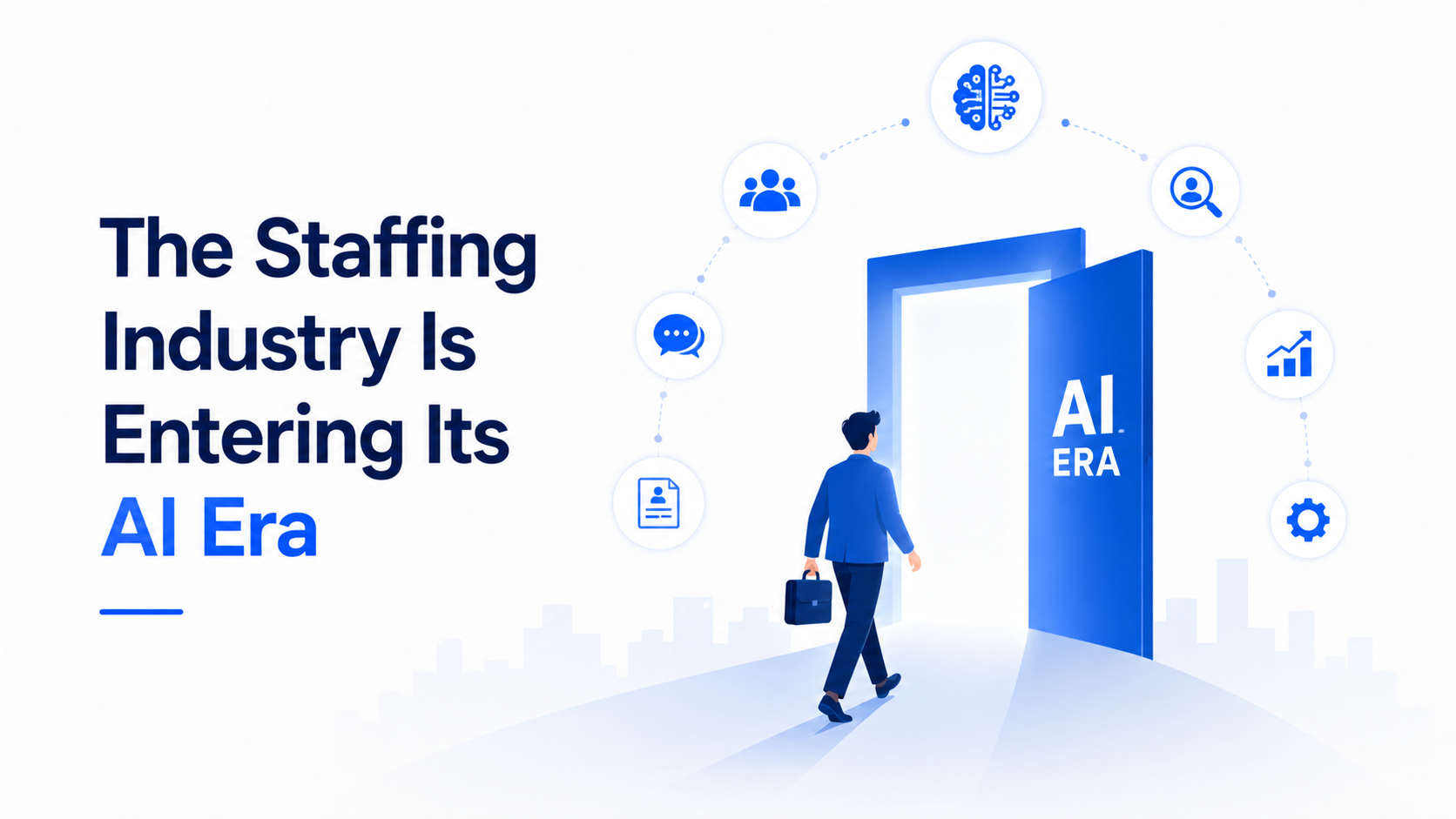
David Harrington, CEO of a regional staffing firm with eight offices across the American Southeast, had spent his entire twenty-eight year career building a business that operated on a simple and reliable formula: recruit talented people, place them at client companies, and collect a margin on the hours they worked. The formula had served him well, growing the firm from a two-person operation in a single city to a three-hundred-employee business generating sixty million dollars in annual revenue. But at the industry conference he attended last month in Atlanta, the tone among his peer group had shifted noticeably. Three competitors had deployed AI-powered platforms that automated significant portions of their candidate sourcing and engagement workflows. One firm reported a forty percent reduction in recruiter headcount while maintaining placement volume. Another described an AI-driven candidate matching system that improved fill rates by twenty-five percent. A third had launched an AI analytics product that gave clients real-time talent market intelligence as part of their standard service. David realized that the staffing industry was not merely experiencing another technology upgrade. It was entering a fundamentally new era where AI would reshape how staffing firms operated, competed, and created value, and the firms that moved decisively would build advantages that late adopters would struggle to overcome.
Why This AI Moment Is Different for Staffing
The staffing industry has adopted new technologies before. Applicant tracking systems in the early 2000s, job board integrations in the mid-2000s, and social recruiting platforms in the 2010s all promised to transform how staffing firms operated. In each case, the technology delivered meaningful efficiency improvements but did not fundamentally change the staffing business model. Recruiters still sourced candidates, still managed client relationships, still coordinated interviews, and still negotiated placements. The technology made these activities faster and more systematic, but the human recruiter remained the central figure in the value chain. The current AI moment is different because for the first time, the technology is capable
of performing not just the administrative and operational tasks that support recruiting, but the cognitive tasks that have traditionally defined the recruiter's role. AI can now evaluate candidate fit against complex job requirements, generate personalized candidate outreach at scale, conduct initial screening conversations through natural language interfaces, predict candidate likelihood of accepting an offer, and provide analytical insights that inform strategic talent decisions. These capabilities do not merely support the recruiter. They replicate and in some cases exceed the recruiter's cognitive contribution to the staffing process.
The structural conditions that make this moment different are threefold. First, the availability of large-scale talent data, including millions of candidate profiles, decades of placement records, and real-time labor market signals, provides the training data that AI models need to perform recruiting tasks with high accuracy. Previous technology waves lacked this data foundation, which limited what the tools could do. Second, the maturity of natural language processing and generative AI means that AI can now handle the communication-intensive aspects of staffing, candidate outreach, follow-up sequences, interview scheduling, and even initial candidate assessments, that were previously the exclusive domain of human recruiters. Third, the competitive dynamics of the staffing industry have created pressure to adopt AI whether firms want to or not. Staffing is a low-margin, high-volume business where even small efficiency gains translate into meaningful margin improvement, and early adopters are already using AI to reduce costs, improve fill rates, and offer new services that put pressure on non-adopters. According to McKinsey, the staffing industry is among the top five professional services sectors for AI adoption velocity, because the combination of data availability, process standardization, and margin pressure creates especially favorable conditions for AI deployment.
The firms that will define the AI era of staffing are not necessarily the largest firms or the most technologically sophisticated. They are the firms that understand how to integrate AI into their operating model in a way that amplifies their existing strengths rather than replacing them. A firm with deep relationships in a specific industry, healthcare staffing, for example, can deploy AI to make those relationships more productive and more valuable, using data from years of successful placements to build matching models and market intelligence that no generic AI tool can replicate. A firm with strong temporary staffing operations can use AI to optimize candidate scheduling, predict demand fluctuations, and reduce the administrative overhead that has traditionally limited the profitability of high-volume staffing. The key insight is that AI does not level the playing field between large and small firms. It amplifies the advantages of firms that have proprietary data, specialized expertise, and strong client relationships, while exposing the vulnerabilities of firms whose only advantage is recruiter headcount and process efficiency. agentic AI platforms vs automated ones explains how agentic AI platforms enable staffing firms of all sizes to enter their AI era by providing the technology layer that captures operational data and converts it into competitive intelligence, because the platform handles the technical complexity of AI deployment while the firm focuses on the domain expertise and client relationships that AI amplifies.
The Three Phases of AI Adoption in Staffing
The AI era in staffing is not a single event but a progression through three phases of increasing capability and impact. The first phase, which most forward-thinking staffing firms are currently navigating, is AI-assisted operations, where AI tools are deployed to automate specific tasks within existing workflows. In this phase, AI handles candidate sourcing from databases, resume screening against job requirements, interview scheduling, routine candidate communications, and basic reporting. The staffing firm's operating model, organizational structure, and client value proposition remain essentially unchanged. Recruiters use AI tools to work faster and more efficiently, but they still perform the same roles, follow the same processes, and deliver the same services. The value of this phase is real but limited: it reduces cost per placement, improves fill rates, and frees recruiter time for higher-value activities. But it does not fundamentally change what the firm offers to clients or how it competes.
The second phase is AI-integrated operations, where AI is not merely an add-on tool but an embedded component of the firm's operating model. In this phase, the AI platform becomes the central nervous system of the staffing operation, coordinating sourcing, screening, engagement, and placement activities across the entire firm. Recruiters no longer use AI tools; they operate within an AI-powered system that assigns candidates to recruiters based on expertise and availability, that surfaces insights about candidate and client dynamics in real time, and that manages the administrative workflow so recruiters can focus entirely on relationship management and strategic advisory. The organizational structure begins to shift, with fewer recruiters needed for operational tasks and more emphasis on roles like client success managers, talent consultants, and market intelligence analysts. The client value proposition also begins to evolve, because the AI-powered system can provide clients with analytics, benchmarks, and predictive insights that were previously impossible to deliver at scale. According to Gartner, staffing firms that reach the AI-integrated phase report twenty to thirty percent higher client retention rates and fifteen to twenty percent better net promoter scores compared to firms in the AI-assisted phase, because the integrated model delivers a more consistent, data-rich, and strategically valuable client experience.
The third phase is AI-driven transformation, where AI does not just support the staffing model but enables fundamentally new service offerings and business models. In this phase, staffing firms offer AI-powered talent intelligence as a standalone service, providing clients with market analysis, workforce planning support, and competitive talent dynamics that go beyond traditional staffing delivery. They operate on outcome-based pricing models where compensation is tied to hiring quality and retention rather than hours billed or placements made. They deploy predictive workforce solutions that anticipate client hiring needs before the client formally articulates them, positioning the staffing firm as a strategic talent partner rather than a reactive service provider. The firms that reach this phase are not just more efficient versions of traditional staffing companies. They are a new type of talent services business that competes on intelligence, insight, and strategic value rather than on candidate
volume and delivery speed. Most of the staffing industry is currently in the first phase, but the firms that are investing aggressively in data infrastructure, platform integration, and analytical capabilities are positioning themselves to reach the second and third phases ahead of their competitors. more tools same hiring problems explains why firms that deploy AI tools without integrating them into a cohesive platform risk getting stuck in the first phase, because the absence of a unifying system prevents the data accumulation, process coordination, and analytical capability that the second and third phases require.
Where the Real Value Lies: Beyond Sourcing and Screening
When staffing firms think about AI, they tend to focus on the most obvious applications: sourcing candidates faster and screening resumes more efficiently. These applications are valuable, but they represent only a fraction of the value that AI can create in a staffing context. The real value of AI in staffing lies in three areas that are less visible but more strategically significant: demand prediction, workforce optimization, and client intelligence. Demand prediction uses AI to analyze client hiring patterns, seasonal fluctuations, business cycle dynamics, and market signals to forecast when clients will need temporary staff, permanent hires, or project-based talent. A staffing firm that can accurately predict demand can pre-build candidate pools, reduce time-to-fill, and offer clients a level of responsiveness that reactive staffing models cannot match. This predictive capability transforms the client relationship from one where the client requests talent and the firm responds, to one where the firm proactively anticipates the client's needs and delivers solutions before the client asks.
Workforce optimization is the second high-value AI application. For staffing firms that manage large temporary and contract workforces, AI can optimize the assignment of workers to roles based on skills, availability, location, performance history, and client preferences. It can predict which temporary workers are most likely to be offered permanent roles by clients, enabling the firm to manage the conversion pipeline proactively. It can identify workers whose skills are becoming more or less valuable in the market and recommend training or redeployment before the worker becomes unplaceable. It can optimize scheduling across clients and geographies to maximize worker utilization while minimizing travel time and idle hours. For a staffing firm managing thousands of temporary workers, these optimization capabilities can improve gross margin by five to ten percentage points, which in a low-margin industry represents a transformational improvement in profitability. According to Deloitte, staffing firms that deploy AI for workforce optimization across scheduling, assignment matching, and utilization management report eight to twelve percent improvements in gross margin within the first two years of deployment, because the optimization reduces the two largest cost drivers in temporary staffing: unfilled shifts and underutilized workers.
Client intelligence is the third high-value application and perhaps the most strategically important. AI can analyze the staffing firm's entire history of client interactions to build deep understanding of each client's talent needs, hiring patterns, manager preferences, and strategic workforce direction. This intelligence enables the staffing firm to provide strategic advisory
services that go far beyond filling open requisitions. The firm can alert a client to emerging talent market risks, such as a competitor's aggressive hiring in a role type that the client also needs. The firm can advise on compensation strategy based on real-time market data from its own placement activity. The firm can provide workforce planning support that helps the client anticipate future talent needs based on business growth trajectories and market dynamics. This level of strategic advisory transforms the staffing relationship from a transactional vendor arrangement into a strategic partnership, which is the most defensible and profitable form of client relationship in the staffing industry. AI sourcing vs AI recruiting explains why the staffing firms that capture the most value from AI are those that use it to expand their service scope beyond sourcing into strategic talent advisory, because sourcing efficiency is easily replicated by competitors but the strategic insights derived from deep client data are proprietary and defensible.
What AI Changes About the Staffing Business Model
AI does not merely make the existing staffing business model more efficient. It creates the conditions for fundamentally different business models that can capture more value from the talent supply chain. The traditional staffing model is fundamentally a labor arbitrage business: the firm recruits talent at one rate, places that talent at a client at a higher rate, and captures the spread as gross margin. This model works but has inherent limitations. The spread is constrained by market competition, the volume is constrained by recruiter capacity, and the value is limited to the transaction itself. AI enables three alternative or complementary business models that address these limitations. The first is the intelligence-led model, where the primary value proposition is not the placement of individual candidates but the provision of talent intelligence that helps clients make better strategic workforce decisions. In this model, the staffing firm sells insight, analysis, and strategic advisory as distinct services, potentially at higher margins than traditional placement fees, because the intelligence is proprietary, differentiated, and directly tied to the client's strategic decision-making.
The second is the outcome-based model, where the staffing firm's compensation is tied to measurable hiring outcomes rather than to the volume of candidates placed or hours billed. In this model, the firm earns higher fees when placements succeed, as measured by retention, performance, and client satisfaction, and earns lower fees or absorbs costs when placements fail. This model aligns the firm's economic interest with the client's interest in a way that the traditional transactional model does not, and it rewards the AI capabilities that improve placement quality, such as better candidate matching, more thorough assessment, and more effective candidate preparation. The outcome-based model is only practical when the firm has the data infrastructure to measure outcomes consistently, which is precisely what AI provides. According to EY, staffing firms that have transitioned even partially to outcome-based pricing report ten to fifteen percent higher average contract values and twenty to twenty-five percent higher client retention rates, because the outcome-based model demonstrates confidence in the firm's capabilities, aligns economic incentives, and provides a clear basis for demonstrating return on investment.
The third is the platform model, where the staffing firm provides an AI-powered talent platform that clients use directly for some or all of their talent acquisition needs, with the staffing firm's human recruiters available as an optional overlay for complex or high-priority searches. This model fundamentally changes the economics of the staffing business by reducing the marginal cost of serving each additional client, because the platform scales with technology rather than with recruiter headcount. It also creates a data network effect, where each client's usage of the platform generates data that improves the platform's performance for all clients, creating a compounding advantage that grows with scale. The platform model is the most ambitious of the three alternatives, and it requires significant upfront investment in technology, but it offers the most transformative economic potential because it decouples revenue growth from headcount growth. how to evaluate an AI sourcing tool provides a framework for staffing firm leaders evaluating which of these business model innovations is most appropriate for their firm, because the assessment considers the firm's current client base, data assets, technology maturity, and market position to identify the highest-impact path for AI-driven business model evolution.
How to Lead Your Staffing Firm Through the AI Transition
Leading a staffing firm through the AI era requires a deliberate, phased approach that balances the urgency of adoption with the practical realities of organizational change. The first and most important step is to develop a clear AI vision that articulates not just what technology the firm will deploy but how AI will change the firm's operating model, client value proposition, and competitive position. This vision must be specific enough to guide investment decisions and broad enough to accommodate the rapid evolution of AI capabilities. It should address three questions: what will the firm look like in three years if AI adoption is successful, what specific client problems will the firm solve that it cannot solve today, and what proprietary advantages will the firm build that competitors cannot replicate? Without a clear vision, AI adoption becomes a series of disconnected tool deployments that may improve individual tasks but do not accumulate into a coherent competitive advantage. The vision provides the strategic framework that ensures every AI investment contributes to a larger transformation rather than to isolated efficiency gains.
The second step is to invest in data infrastructure before investing in AI applications. Many staffing firms make the mistake of deploying AI tools on top of fragmented, inconsistent data, which limits the AI's effectiveness and prevents the accumulation of the proprietary data assets that drive long-term competitive advantage. Before deploying any AI application, the firm should ensure that its core data, candidate profiles, placement records, client information, compensation data, and outcome tracking, is structured, consistent, and accessible in a unified system. This does not require a massive data warehousing project. It requires disciplined data governance, consistent field definitions, and a commitment to data quality that permeates the organization. According to SHRM, organizations that invest in data foundation before deploying AI applications report thirty to forty percent faster time to value from their AI investments, because the AI tools have clean, comprehensive data to work with from the start rather
than spending their first months compensating for data quality problems.
The third step is to manage the organizational and cultural dimensions of the AI transition with the same rigor applied to the technology itself. Recruiters and operations staff who have built their careers on manual processes may resist AI adoption out of fear, skepticism, or legitimate concern about their roles. This resistance can derail even the most technically sound AI initiative if it is not addressed proactively. The most effective approach is to involve recruiters in the AI selection and implementation process, to demonstrate quickly how AI makes their jobs easier and more impactful rather than threatening their employment, and to redefine success metrics to reward the outcomes that AI-augmented recruiters deliver rather than the activities that AI automates. Staffing firm leaders who communicate transparently about the AI strategy, invest in training and upskilling, and provide clear career pathways for recruiters whose roles evolve, build the organizational buy-in that determines whether AI adoption succeeds or stalls. should recruiters worry about AI replacing jobs explains why the staffing firms that navigate the AI transition most successfully are those that position AI as an amplifier of recruiter capability rather than a replacement for recruiter labor, because this framing reduces anxiety, encourages adoption, and focuses the organization on the goal of enhancing human performance rather than eliminating human roles.