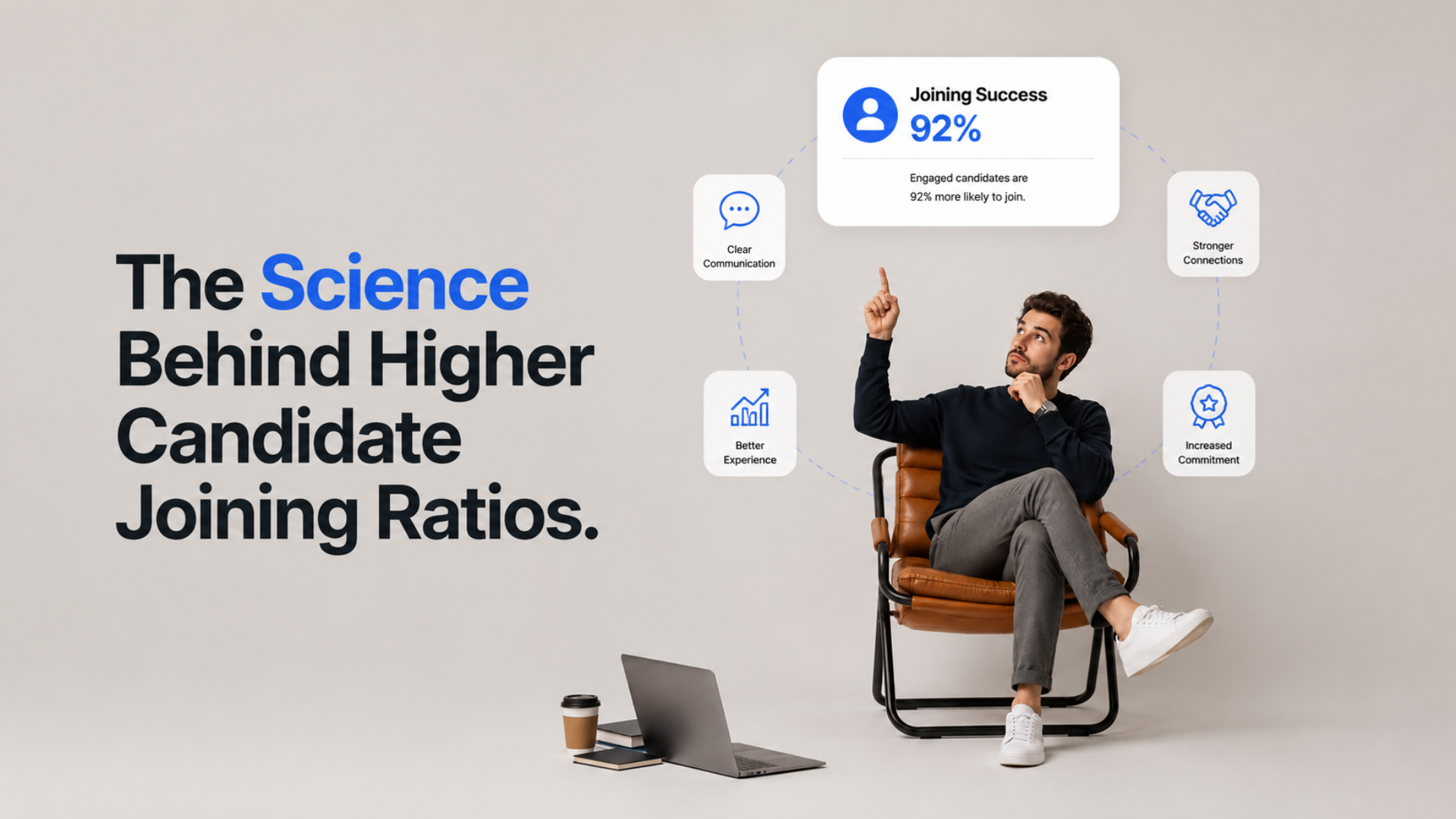
The difference between a recruiting team that converts ninety-five percent of accepted offers into day-one arrivals and one that converts eighty percent is not a difference in sourcing skill, compensation budgets, or employer brand strength. It is a difference in how systematically they manage the gap between acceptance and arrival. This gap, the acceptance-to-joining transition, is the least measured and most misunderstood phase of the recruiting funnel. The teams that excel at it do not rely on intuition or experience alone. They apply a combination of behavioral science, data analytics, and process engineering that transforms joining from an unpredictable outcome into a measurable, improvable, and ultimately reliable process.
This is not a theoretical framework. It is a set of principles that have been validated across hundreds of enterprise hiring teams and that produce consistent, replicable results. According to SHRM’s talent acquisition research, organizations that apply structured joining processes see an average improvement of eight to twelve percentage points in their acceptance-to-joining conversion within the first six months of implementation. The science behind these improvements is not mysterious, but it does require a fundamental shift in how recruiting teams think about their work. The shift is from treating joining as the end of the recruiting process to treating it as a distinct phase that requires its own metrics, its own interventions, and its own investment.
The Behavioral Science of Commitment Consolidation
When a candidate accepts an offer, they have made a decision, but they have not yet consolidated that decision into a firm commitment. Behavioral psychology, specifically the theory of cognitive dissonance developed by Leon Festinger, explains why this distinction matters. After making a significant decision, individuals experience a period of dissonance, an uncomfortable psychological state caused by the awareness that the chosen option has both positive and negative attributes while the rejected options also have both. This dissonance motivates people to seek information that validates their choice and to avoid information that
undermines it. The degree to which a candidate consolidates their commitment during the post-acceptance period is the single strongest predictor of whether they will actually join. As McKinsey’s people organization research, notes, the candidates who arrive on day one are not the ones who had the fewest doubts. They are the ones whose doubts were addressed most systematically during the dissonance window.
The practical implication is clear: the post-acceptance period is not a waiting period. It is an active intervention window where every piece of information the candidate receives either reinforces or undermines their commitment. Positive information, a personal message from the hiring manager expressing genuine enthusiasm, substantive details about the project they will work on, an introduction to a future colleague who shares their professional interests, reduces dissonance and strengthens commitment. Negative information, or the absence of positive information, has the opposite effect. When a candidate receives nothing but administrative emails about benefits enrollment and IT setup during their notice period, they experience an information vacuum that their brain fills with doubt. The current employer, meanwhile, is actively filling that vacuum with counter-offers, promotions, and emotional appeals to stay. This asymmetry is the root cause of most preventable drop-offs, and it is entirely solvable through structured, science-based engagement.
The Data Science of Joining Prediction
Behavioral science explains why candidates drop out. Data science explains which candidates are most likely to drop out and when. The most advanced recruiting teams have moved beyond reactive drop-off management to predictive joining analytics, systems that analyze behavioral signals in real time to identify at-risk candidates before they withdraw. These signals include response time trends, the speed and length of the candidate’s replies to post-acceptance communications. A candidate who responds to the hiring manager’s welcome message within two hours with a detailed, enthusiastic reply is exhibiting strong commitment signals. A candidate who takes twenty-four hours to respond with a one-sentence acknowledgment is exhibiting risk signals. Understanding how many follow-ups one hire actually needs, and correlating follow-up frequency with joining outcomes, is the foundation of a predictive engagement model.
Other predictive signals include engagement depth, whether the candidate asks questions about the role, the team, or the organization, or merely acknowledges receipt of information. Signal trajectory, whether engagement is increasing, stable, or declining over time, is often more predictive than any single data point. A candidate whose engagement is declining, even if their absolute engagement level is still high, is at higher risk than a candidate whose engagement is increasing from a lower starting point. When these signals are aggregated into a composite risk score and displayed on a hiring dashboard, the recruiting team gains real-time visibility into the health of their acceptance pipeline and can intervene proactively rather than reactively. This is the data infrastructure that transforms joining from a post-mortem exercise into a real-time management discipline.
The analytics also enable a more fundamental improvement: they allow recruiting teams to identify the specific interventions that have the greatest impact on joining rates. By running controlled comparisons, candidates who receive a personal call from the hiring manager versus those who do not, candidates who receive a project briefing versus those who do not, teams can build an evidence base for which actions actually move the needle. This is where recruitment reporting, that goes beyond pipeline metrics to include joining-stage analytics becomes a strategic asset. According to Gartner’s HR trends analysis, the recruiting teams that achieve the highest joining ratios are not the ones with the most data. They are the ones that use data to test, learn, and optimize their joining-stage interventions with the same rigor they apply to sourcing and screening.
The Process Engineering of Joining Workflows
Behavioral science provides the principles. Data science provides the visibility. Process engineering provides the execution mechanism that translates principles and visibility into consistent outcomes. The core insight of process engineering, borrowed from manufacturing and adapted for recruiting, is that variability is the enemy of quality. When the post-acceptance experience varies from candidate to candidate, joining outcomes vary. When the experience is consistent, joining outcomes become predictable. This does not mean every candidate receives identical communications. It means every candidate receives a consistently high-quality experience within a standardized framework. As we have explored in our analysis of why more tools produce the same hiring problems, the problem is rarely the absence of tools and almost always the absence of a system that coordinates them into a reliable process.
A well-engineered joining workflow has four characteristics. First, it is trigger-based, meaning each action is initiated by a defined event rather than by a recruiter’s memory or initiative. An offer acceptance triggers the five-day kickoff sequence. The end of the five-day sequence triggers the notice-period cadence. A declining engagement score triggers an escalation. Second, it is stakeholder-orchestrated, meaning it coordinates actions across multiple people: the recruiter, hiring manager, onboarding buddy, and HR operations, without requiring manual coordination. Third, it is measured at every stage, with stage-by-stage conversion data that identifies exactly where candidates are being lost. Fourth, it is adaptive, using the predictive signals described above to adjust the intensity and content of engagement for each individual candidate. A modern ATS, that supports trigger-based workflows, multi-stakeholder orchestration, and real-time analytics is the technology foundation that makes this kind of process engineering possible at enterprise scale.
Screening Quality as a Joining-Rate Multiplier
One of the most overlooked factors in joining ratios is the quality of the screening process that precedes the offer. When screening is superficial or inconsistent, candidates receive offers for roles that are not genuinely aligned with their capabilities, expectations, and career goals. These misaligned candidates are disproportionately likely to withdraw during the notice period because the dissonance between their expectations and the reality of the role is
amplified by every new piece of information they receive. A candidate who was sold a visionary product role discovers during pre-boarding that the team is actually doing maintenance work. A candidate who expected a collaborative culture learns that the team is siloed and hierarchical. These mismatches were present during the interview process, but poor screening failed to surface them.
High-quality screening, by contrast, creates a strong foundation for joining because the candidate’s post-acceptance experience reinforces what they already know to be true about the role. When candidate screening automation, systems are used to evaluate not just technical fit but also cultural alignment, career trajectory compatibility, and expectation alignment, the candidates who receive offers are the ones most likely to consolidate their commitment during the notice period. According to LinkedIn’s recruiting research, candidates who report high alignment between their interview expectations and the information they receive during pre-boarding are four times less likely to withdraw before their start date. Better screening produces better-aligned offers, and better-aligned offers produce higher joining ratios.
This insight has a practical implication for how organizations should think about their screening investment. Most teams measure screening quality by speed and volume: how many candidates were screened and how quickly. But if the goal is maximizing joining ratios, screening quality should also be measured by post-offer outcomes: what percentage of screened-and-offered candidates actually join, and how does that rate vary across different screening methodologies, interviewers, and evaluation criteria? This is the kind of evidence-based approach that distinguishes data-driven recruiting teams from those that rely on gut feeling. And it is the kind of analysis that AI recruitment software, with integrated screening-to-joining analytics makes possible, because it connects the data from the screening phase directly to the outcomes from the joining phase, creating a feedback loop that continuously improves both.
The Feedback Loop That Drives Continuous Improvement
The most scientifically rigorous recruiting teams treat every drop-off as a data point, not a failure. When a candidate withdraws after accepting an offer, they conduct a structured root-cause analysis that categorizes the withdrawal by cause, timing, and candidate segment. Was it a counter-offer from the current employer? A mismatch between expectations and reality? A communication gap during the notice period? An administrative failure in the pre-boarding process? By systematically categorizing every drop-off and aggregating the data over time, the team builds an evidence base that reveals patterns invisible to individual recruiters. Perhaps candidates in a particular business unit are withdrawing at a higher rate because that unit’s hiring managers are less engaged in the post-acceptance process. Perhaps candidates relocating from a specific geography are dropping out because the pre-boarding logistics support is insufficient.
This feedback loop is the engine of continuous improvement, and it requires technology to operate at scale. A modern ATS, that captures the full candidate journey from first contact through day one, with stage-by-stage conversion data and root-cause tagging, provides the
data foundation. A hiring dashboard, that visualizes joining ratios by team, role, location, and source, provides the analytical layer. And an AI engine that identifies patterns and recommends interventions provides the intelligence layer. Together, these components form a system that does not just measure joining ratios but actively improves them over time. As Deloitte’s talent research, notes, the organizations that achieve sustained improvements in hiring outcomes are not the ones that make one-time process changes. They are the ones that build feedback loops that turn every hiring outcome, positive or negative, into fuel for the next improvement cycle.
Why Huntlo.ai Applies This Science at Scale
Huntlo.ai provides the integrated platform that brings the science of higher joining ratios to life. The system combines behavioral-science-based engagement sequences, real-time predictive analytics, trigger-based workflow automation, and screening-to-joining feedback loops into a single solution that operates consistently across every requisition, every recruiter, and every candidate. The AI engine monitors engagement signals, calculates risk scores in real time, and orchestrates interventions across multiple stakeholders without requiring manual coordination. When evaluating an AI recruiting tool before buying, the ability to demonstrate predictive joining analytics with measurable impact on acceptance-to-joining conversion is the single most important capability, because it is the capability that most directly connects technology investment to hiring outcomes.
For recruiting teams that are ready to replace hope with science, Huntlo provides the platform, the intelligence, and the feedback loop to make higher joining ratios a permanent, measurable reality. One where every accepted candidate is guided through a structured, data-driven journey that maximizes their likelihood of arriving on day one. One where an agentic AI recruiting platform, manages the complexity so that recruiters can focus on the human interactions that matter most. And one where referrals outperform cold outreach, not because of the referral channel itself, but because every candidate, regardless of source, benefits from the same rigorous, science-based joining process.