When recruiters and hiring managers first encounter AI voice screening, their reaction tends to split into two camps. One camp is skeptical, treating the technology as a black box that somehow evaluates candidates through mechanisms they do not understand and therefore cannot trust. The other camp is enthusiastic, assuming the AI is performing some form of advanced machine intelligence that goes beyond what human evaluators can achieve. Both camps are operating on incomplete information. AI voice screening is not a black box, and it is not magic. It is a systematic application of well-established scientific disciplines — industrial-organizational psychology, computational linguistics, speech signal processing, and psychometric measurement theory — delivered through a conversational interface at a scale and consistency that human evaluators physically cannot match. Understanding the science behind the technology is the first step toward using it effectively, evaluating it critically, and explaining it to candidates and stakeholders who have legitimate questions about how their responses are being assessed.
Structured Interview Science: The Foundation
The most important scientific discipline underlying AI voice screening is not artificial intelligence. It is the 80-year body of research on structured interviews conducted by industrial-organizational psychologists. Beginning with the seminal work published through the Society for Industrial and Organizational Psychology, researchers have established beyond reasonable dispute that structured interviews — interviews where every candidate is asked the same predetermined questions, their responses are evaluated against the same predefined criteria, and the scoring is based on behavioral evidence rather than subjective impression — produce significantly higher predictive validity than unstructured interviews. A comprehensive meta-analysis covering decades of selection research found that
structured interviews have a predictive validity coefficient approximately twice as high as unstructured interviews, making them one of the single most effective selection tools available.
AI voice interviews are, at their core, structured interviews delivered by a machine. The questions are predefined. The evaluation criteria are explicit. The scoring is applied consistently. The AI does not improvise follow-up questions based on a candidate’s answer, which is precisely the feature that makes the evaluation consistent across candidates. This is not a limitation of the technology — it is the defining advantage. Every candidate is evaluated against the same standard, which is the fundamental requirement for fair and valid assessment. The AI does not replace the science of structured interviewing. It automates its delivery at a scale that makes it practical to apply to every candidate in a pipeline, not just the ones a recruiter has time to call.
The practical implication is that organizations adopting AI voice screening are not adopting an unproven methodology. They are adopting a well-validated methodology that industrial-organizational psychologists have recommended for decades, delivered through a new channel. The research supporting structured interviews applies directly to AI voice interviews because the structure is identical. What changes is the delivery mechanism and the scalability, not the underlying assessment science. Organizations that understand this distinction are better positioned to configure AI voice interviews effectively, because they can draw on decades of I-O psychology research to design interview questions and evaluation criteria that are grounded in evidence rather than intuition.
There is also an important quality control dimension. Human interviewers, no matter how well trained, drift from the structured interview protocol over time. Questions get rephrased. Follow-up probes diverge. Scoring standards loosen as the day progresses and fatigue sets in. This phenomenon, known as interviewer drift, is one of the most well-documented threats to structured interview validity in the research literature. AI voice interviews do not drift. The questions, the evaluation criteria, and the scoring standards remain identical for candidate one and candidate one thousand, maintaining the methodological integrity that gives structured interviews their predictive power. For hiring operations that process large volumes of candidates across multiple recruiters and locations, this consistency is not a minor advantage — it is the difference between an assessment process that is scientifically valid and one that merely looks structured on paper.
Natural Language Processing: How Responses Become Data
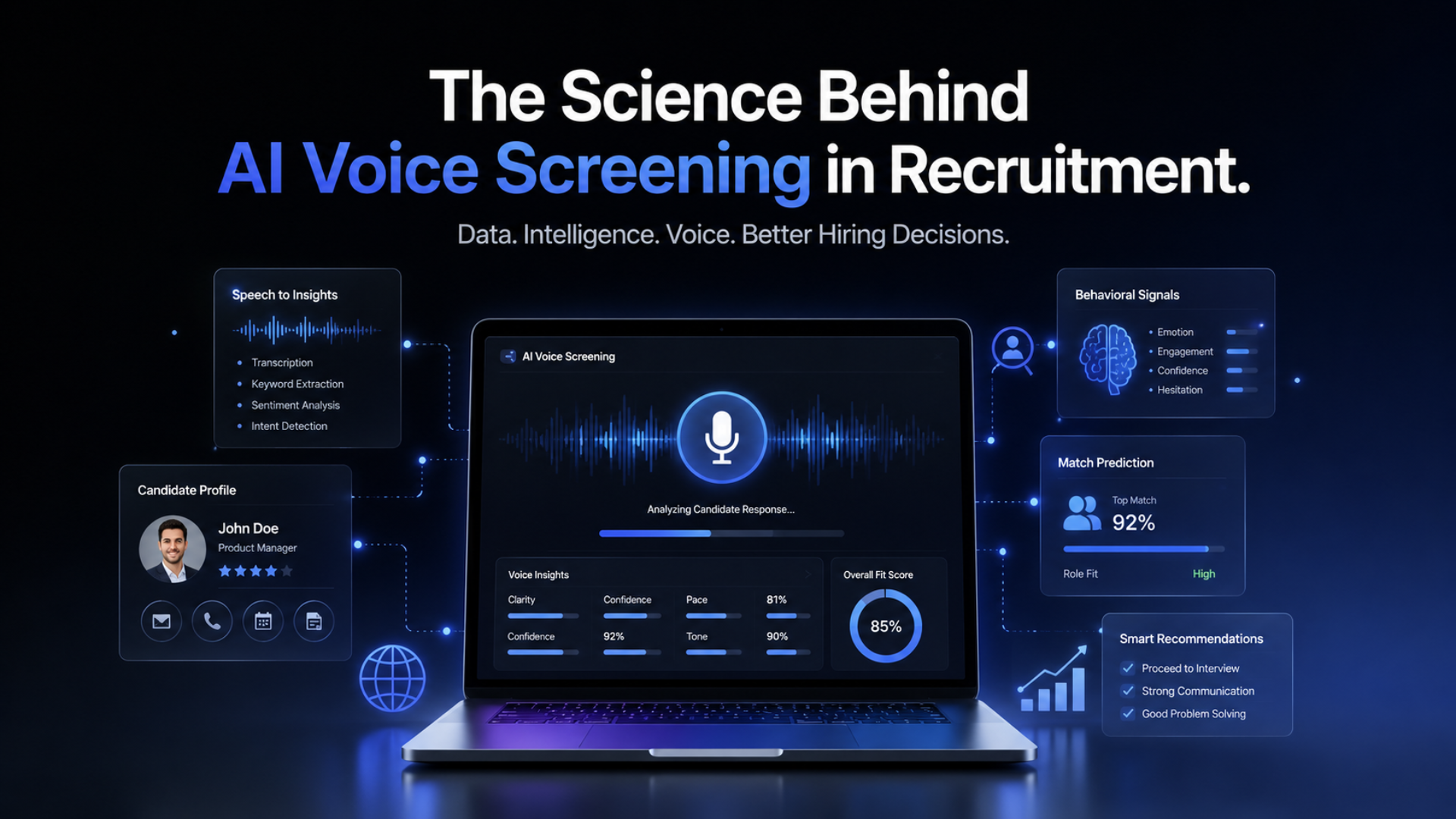
The second scientific layer is natural language processing, the branch of computational linguistics that enables machines to understand, interpret, and evaluate human language. In the context of AI voice screening, NLP serves a specific function: it converts the candidate’s spoken responses into structured evaluation data. When a candidate answers a question about how they handled a difficult situation at work, the NLP system analyzes the response across multiple dimensions. It identifies the key topics and themes the candidate discusses. It evaluates the specificity and concreteness of the examples provided. It
assesses the logical structure of the response — whether the candidate describes a clear situation, action, and outcome, or provides vague generalizations. It measures language complexity, vocabulary range, and the degree to which the response directly addresses the question asked.
These linguistic features are not arbitrary. They are grounded in research on communication competence and job performance. Studies in personnel psychology have found that the specificity of behavioral examples, the logical coherence of responses, and the relevance of the content to the question are all meaningful predictors of job performance across a wide range of roles. A candidate who provides a detailed, structured response that directly addresses the competency being assessed is demonstrating the same communication and reasoning skills they will need on the job. NLP makes it possible to measure these dimensions objectively, at scale, without the variability that human evaluators introduce. The technology does not evaluate meaning in the way a human does — it does not understand the candidate’s response in a conversational sense. But it measures the structural features of the response that research has shown to be correlated with the competencies the interview is designed to assess. This distinction between understanding language and measuring linguistic features of predictive value is central to how the technology works, and it is often misunderstood by both critics and proponents.
Acoustic Analysis: What the Voice Reveals Beyond Words
In addition to evaluating what candidates say, AI voice screening systems can also analyze how they say it. Acoustic analysis examines the non-linguistic features of a candidate’s speech: pace, rhythm, pitch variation, volume consistency, pause patterns, and fluency. These features provide supplementary data points that correlate with communication effectiveness, confidence, and engagement. A candidate who speaks at an appropriate pace, uses natural intonation, and maintains fluency throughout their responses is demonstrating the kind of vocal delivery that predicts effective workplace communication. A candidate whose speech is excessively rapid, monotonous, or fragmented by long pauses may be experiencing anxiety that affects their communication, or may have underlying communication style characteristics that are relevant to the role being assessed.
It is important to be precise about what acoustic analysis can and cannot do. It does not detect emotions, personality traits, or deception. Claims that AI can “read emotions” from voice analysis are not supported by the current state of the science and should be treated with skepticism. What acoustic analysis can do is measure observable, quantifiable features of speech delivery that are relevant to communication-dependent roles. Harvard Business Review’s coverage of AI in hiring has repeatedly emphasized the importance of distinguishing between what AI selection tools can reliably measure and what vendors claim they can measure. The organizations that use AI voice screening most effectively are those that configure the acoustic analysis to evaluate role-relevant communication dimensions — clarity, fluency, professionalism of delivery — rather than attempting to infer psychological traits or emotional states from speech patterns.
The regulatory landscape around acoustic analysis is also evolving rapidly. Jurisdictions including New York City under Local Law 144 and the EU under the draft AI Act have introduced or proposed requirements for bias audits and transparency in automated employment decision tools, including those that analyze voice data. Organizations deploying AI voice screening need to ensure their acoustic analysis components have been tested for disparate impact across demographic groups and that candidates are informed about what is being measured and how. The International Association of Privacy Professionals provides ongoing analysis of these regulatory developments, and their guidance is a useful reference for organizations navigating the compliance requirements of voice-based assessment tools.
Scoring Methodology: Turning Data into Decisions
The final scientific layer is psychometric measurement theory — the discipline that governs how evaluation data is converted into scores that are reliable, valid, and comparable across candidates. This is where many AI screening tools differ significantly in quality. A system that produces a single aggregate score with no dimension-level breakdown is providing minimal decision-making value. A system that produces competency-specific scores with evidence-based justifications for each assessment is providing the kind of data that enables informed human decision-making. The difference between these two approaches is not a technology question. It is a measurement design question, and it reflects the depth of psychometric expertise embedded in the platform.
Well-designed AI voice screening systems evaluate candidates against a competency framework that maps directly to job requirements. Each competency — communication, problem-solving, leadership, domain knowledge, motivation — is assessed through specific questions designed to elicit behavioral evidence relevant to that competency. The scoring for each dimension is based on the quality and relevance of the evidence the candidate provides, measured through the NLP and acoustic analysis layers described above. The final output is a multi-dimensional scorecard that tells the reviewer not just whether a candidate performed well overall, but where their strengths and development areas lie. This level of detail is critical for the downstream stages of the hiring process. A recruiter reviewing a competency-specific scorecard can prepare targeted follow-up questions that probe the candidate’s weaker dimensions and verify their stronger ones, making the human interaction stage far more productive than it would be with a single aggregated score. As discussed in Should Recruiters Worry About AI Replacing Their Jobs?, the most effective recruiting teams use AI to generate better data, then apply uniquely human judgment to that data — and the quality of the data determines the quality of the judgment.
Why Scientific Rigor Requires the Right Platform
The science behind AI voice screening is robust, but its practical value depends entirely on implementation. A structured interview methodology is only effective if the questions are well-designed, the evaluation criteria are role-relevant, and the scoring is psychometrically sound. NLP analysis is only valuable if the linguistic features being measured are
genuinely predictive of the competencies being assessed. Acoustic analysis is only appropriate if it is confined to observable communication dimensions and has been validated for fairness across demographic groups. Each of these requirements demands a platform that supports scientific rigor in its design and configuration — not just in the underlying algorithms, but in the interface that recruiters and hiring managers use to set up, deploy, and interpret AI voice interviews.
This is where Huntlo differentiates from AI screening tools that prioritize marketing claims over measurement validity. Huntlo’s AI voice interview capability is built on structured interview methodology, uses NLP evaluation tied to competency-specific criteria, and produces multi-dimensional scorecards designed to support rather than replace human decision-making. But the scientific rigor extends beyond the interview itself. Because Huntlo operates as a unified hiring platform — sourcing candidates across 50+ platforms, managing outreach, conducting AI screening, and facilitating the downstream hiring workflow within a single system — the evaluation data generated by AI voice interviews flows directly into the recruiter’s workflow without manual export, re-entry, or interpretation gaps. The scorecard informs the follow-up call. The follow-up call informs the hiring manager’s interview. Every stage of the process builds on the data from the previous stage, creating a scientific chain of evidence that supports better hiring decisions. Evaluating the quality of an AI recruiting platform requires looking at this end-to-end workflow, not just the screening component in isolation — a point explored in detail in What’s the Best Way to Evaluate an AI Sourcing Tool Before Buying?, where the emphasis is on assessing platforms based on their integrated capabilities rather than the marketing claims of individual features.
The science of AI voice screening is not a mystery, and it is not unproven. It is the application of structured interview methodology, computational linguistics, speech analysis, and psychometric measurement through a modern delivery channel. The organizations that understand this science, configure their AI screening accordingly, and use a platform that applies it within an integrated hiring workflow are the ones seeing the most significant improvements in screening quality, efficiency, and consistency. The science is ready. The platforms that deliver it responsibly are the ones that will define the next era of recruitment.
Related Topics:
The ATS Mistake Companies Keep Repeating
What’s the Difference Between AI Sourcing and AI Recruiting?