Rachel Torres, Head of Talent Intelligence at a global pharmaceutical company in Basel, had spent her early career as a computational biologist before moving into talent acquisition. When she first encountered AI sourcing tools, she was struck by how little the vendors could explain about how their systems actually identified and ranked candidates. The marketing materials used phrases like intelligent matching and predictive signals, but when she asked about the underlying models, the responses were vague references to machine learning and proprietary algorithms. Her scientific training made her uncomfortable with black boxes, and her experience managing a team of thirty recruiters across three continents made her skeptical of tools that promised transformation without transparency. She decided to build her own understanding of what AI talent intelligence actually does at a technical level, not to become a data scientist but to become an informed buyer and operator. What she discovered was that the science behind these systems is both more rigorous and more limited than most vendors acknowledge, and that the organizations getting the best results are those that understand the science well enough to know where it works, where it breaks down, and where human judgment remains irreplaceable.
Signal Extraction: How AI Turns Raw Profiles into Actionable Data
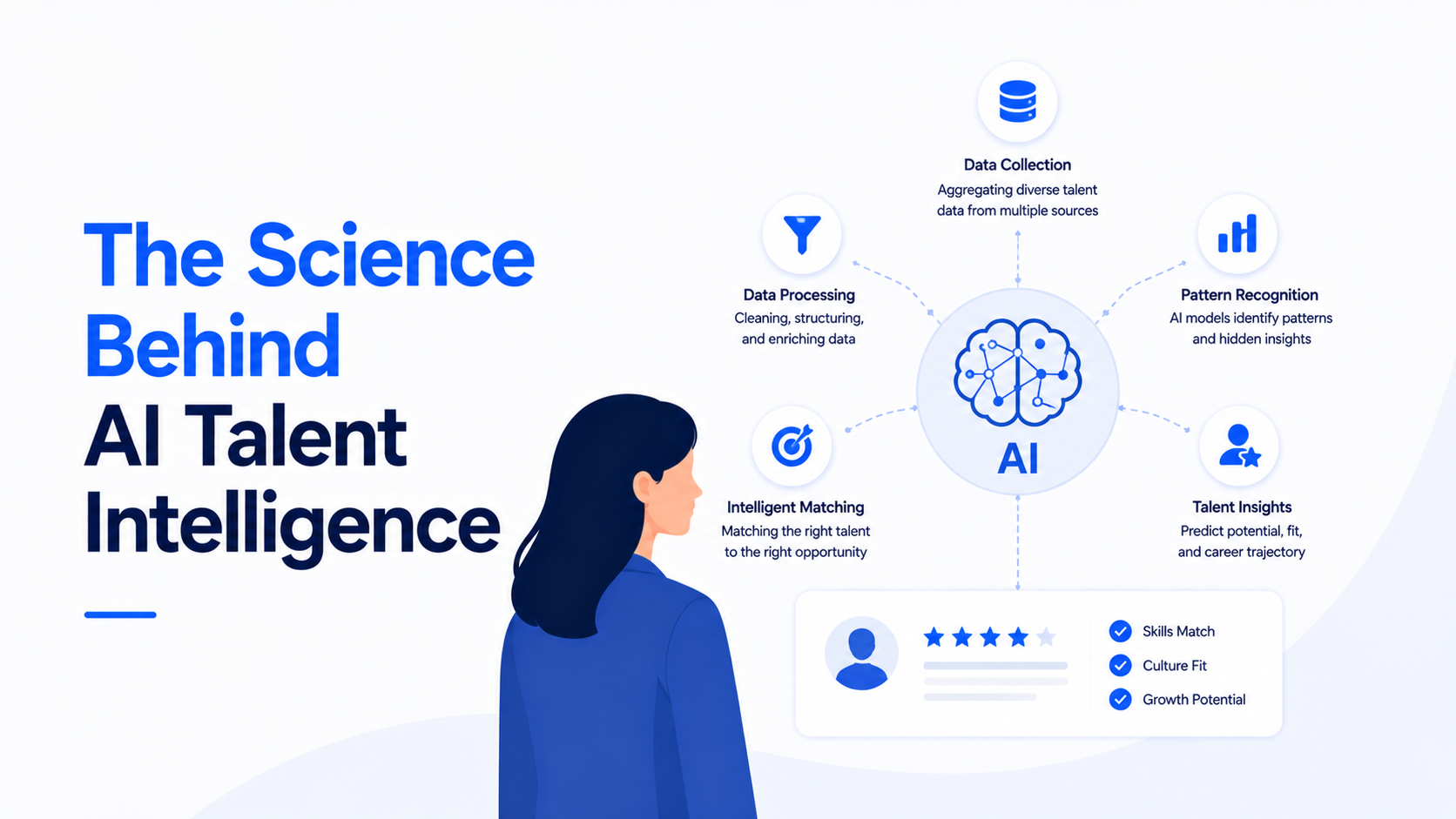
The foundational layer of any AI talent intelligence system is signal extraction, the process of identifying and encoding meaningful information from raw candidate data. A candidate's professional profile, whether a resume, a LinkedIn profile, a portfolio, or a combination of sources, is an unstructured document that contains information embedded in varying formats, levels of detail, and degrees of reliability. Signal extraction is the pipeline that converts this
unstructured text into structured features that machine learning models can process. This pipeline typically includes named entity recognition to identify job titles, companies, skills, and educational institutions; temporal parsing to construct career timelines from date references that may be implicit, approximate, or inconsistently formatted; normalization to map variant representations of the same entity, such as Senior Software Engineer and Software Engineer V, to a common taxonomy; and feature engineering to derive higher-order signals like career trajectory slope, skill diversification breadth, and employer prestige progression from the raw extracted data.
The quality of signal extraction determines the ceiling of everything that follows. If the extraction pipeline misidentifies a candidate's seniority level, every downstream model will operate on incorrect input. If it fails to recognize that two candidates have the same skill described in different terms, the matching system will treat them as incomparable. If it cannot parse nonstandard career formats like project-based work, freelance engagements, or military service, it will produce incomplete or inaccurate candidate profiles for large segments of the workforce. According to McKinsey, signal extraction accuracy varies significantly across AI talent platforms, with the best systems achieving ninety to ninety-five percent accuracy on standard professional profiles and dropping to sixty to seventy percent on nonstandard profiles that deviate from the conventional resume format. This accuracy gap means that organizations hiring for roles where nontraditional candidates are valuable, which is increasingly most roles, must evaluate their AI tools' extraction capabilities specifically for the profile types most relevant to their hiring needs rather than accepting aggregate accuracy claims.
Signal extraction also has a temporal dimension that is often underestimated. Candidate profiles are not static snapshots but evolving documents that change as people acquire new skills, change roles, and develop new career interests. An AI talent intelligence system that extracts signals from a profile snapshot without understanding the temporal context of those signals will make errors that a temporally aware system would avoid. A candidate who listed Python as a primary skill three years ago but has since transitioned to leadership roles may still be surfaced for individual contributor positions if the system weights the historical skill signal without accounting for career progression. The concern about whether why AI tools have outdated candidate data candidate data affects AI recommendations is fundamentally a signal extraction problem, because the system must not only extract current signals but also distinguish between current capabilities and historical ones. The most advanced systems address this by maintaining temporal profiles that weight recent signals more heavily and by tracking signal decay rates that reflect how quickly different types of professional information become stale.
Vector Embeddings: The Mathematics of Candidate Similarity
Once candidate profiles have been converted into structured signals, the next scientific layer is representation through vector embeddings. An embedding is a mathematical representation of an entity, in this case a candidate or a job requirement, as a point in a high-dimensional
space where proximity between points indicates similarity. Candidates with similar skills, career trajectories, and professional characteristics occupy nearby regions of this space, while candidates with different profiles are farther apart. This representation enables the AI to perform similarity searches that go far beyond keyword matching. A keyword-based search for a machine learning engineer would find candidates who use that exact phrase in their profiles. An embedding-based search finds candidates whose overall professional profile is similar to the profile of a machine learning engineer, even if they describe their work using different terminology, because the embedding captures the semantic meaning of their experience rather than just the specific words used to describe it.
The quality of embeddings depends on the data they are trained on and the training methodology used. Embeddings trained on job descriptions and resumes capture the specific language patterns and semantic relationships of the professional domain. Embeddings trained on general web text may capture broader language understanding but lack the domain specificity needed for accurate candidate matching. The training data also determines what types of similarity the embeddings capture. If the training data overrepresents certain industries, geographies, or career patterns, the embeddings will be more accurate for candidates who fit those patterns and less accurate for those who do not. This is a specific instance of the representation problem that affects all machine learning systems, and it has direct practical implications for talent intelligence. According to Gartner, AI talent platforms that use embeddings trained exclusively on English-language professional data show fifteen to twenty percent lower matching accuracy for candidates from non-English-speaking markets, because the embeddings cannot fully capture the professional terminology and career conventions of those markets.
Embeddings also have important limitations that talent teams should understand. They capture statistical relationships in the training data, not causal relationships. Two candidates may be nearby in embedding space because they have genuinely similar capabilities, or because they share superficial characteristics like attending the same university or working for the same type of company. Distinguishing between substantive similarity and superficial similarity requires additional analysis that embeddings alone cannot provide. Furthermore, embeddings can encode biases present in the training data, meaning that candidates from underrepresented groups may be clustered differently than their actual qualifications warrant. Organizations using embedding-based talent intelligence should combine embedding similarity with structured assessment of specific qualifications and should monitor embedding-based recommendations for patterns that suggest bias rather than genuine matching quality. AI tools for niche technical roles illustrates why embedding quality is especially critical for specialized roles, where the candidate pool is small and the cost of a false negative, rejecting a qualified candidate, is disproportionately high relative to the cost of a false positive.
Talent Graphs: Mapping Relationships That Resumes Cannot Capture
Beyond individual candidate profiles, advanced AI talent intelligence systems construct talent graphs, network structures that map relationships between candidates, companies, skills, educational institutions, and professional communities. A talent graph represents the professional world as an interconnected network where each node is an entity, a person, a skill, an organization, and each edge represents a relationship, employment, collaboration, skill adjacency, knowledge transfer. This graph structure enables the AI to identify patterns that are invisible when candidates are evaluated in isolation. It can identify candidates who are connected to an organization's existing high performers through shared professional communities. It can identify skills that are emerging as precursors to in-demand capabilities, allowing organizations to source candidates who are developing relevant expertise before it becomes widely recognized. It can map the flow of talent between companies and industries, revealing competitive dynamics and sourcing opportunities that traditional recruiting methods cannot detect.
The scientific foundation of talent graphs is graph theory, a branch of mathematics that studies the properties of networks. Key concepts include centrality measures, which identify the most connected and influential nodes in the network, community detection algorithms, which identify clusters of related entities, and path analysis, which maps the shortest or most significant connections between any two nodes in the graph. In talent intelligence applications, these techniques enable capabilities that go well beyond individual candidate matching. Centrality analysis can identify passive candidates who are highly connected in relevant professional communities and therefore likely to have strong networks and access to information. Community detection can identify emerging skill clusters that represent future hiring needs before those needs appear in job descriptions. Path analysis can identify the professional relationships that most commonly lead to successful hires, informing sourcing strategy in ways that resume databases cannot. According to Deloitte, organizations using graph-based talent intelligence report twenty to thirty percent higher passive candidate engagement rates compared to organizations using profile-only matching, because the graph structure enables more targeted and contextually relevant outreach.
The limitation of talent graphs is that their quality depends entirely on the breadth and accuracy of the underlying data. A talent graph built from LinkedIn profiles alone captures one type of professional relationship, the employment and endorsement connections that LinkedIn makes visible. It misses the informal mentorships, conference collaborations, open-source contributions, and community memberships that often matter more for identifying exceptional candidates. A talent graph built from multiple data sources, including professional networks, publication databases, conference participation records, and company alumni networks, provides a richer and more accurate representation of professional relationships but requires more sophisticated data integration and more rigorous data quality management. The practical implication is that organizations evaluating graph-based talent intelligence should ask vendors not just whether they build talent graphs but what data sources feed those graphs and how they validate the accuracy and completeness of the relationships they represent. agentic AI platforms vs automated ones explains how the most advanced AI platforms use autonomous agents to continuously enrich talent graphs by discovering and integrating new relationship signals from public professional activity, maintaining graph freshness that static
data sources cannot achieve.
Predictive Scoring: From Historical Patterns to Hiring Recommendations
The output layer of most AI talent intelligence systems is a predictive score, a numerical estimate of how likely a candidate is to be a successful hire for a specific role. These scores are generated by machine learning models trained on historical hiring data, where the input features are the candidate's profile signals, embeddings, and graph properties, and the output is a prediction of some outcome variable such as hiring manager satisfaction, job performance rating, retention, or some combination. The appeal of predictive scoring is obvious: it promises to convert the subjective and uncertain process of candidate evaluation into an objective and quantifiable ranking. The reality is more complex. Predictive models are only as good as the outcome data they are trained on, and the outcome data available to most organizations is remarkably noisy. Performance ratings are subjective and inconsistent across managers. Retention data conflates voluntary departures, which may indicate a bad match, with involuntary departures, which may indicate organizational dysfunction. Hiring manager satisfaction scores reflect the manager's preferences as much as the candidate's quality.
The scientific rigor of predictive scoring varies enormously across vendors and organizations. At the most rigorous end, models are trained on large datasets with well-defined outcome variables, validated against held-out test data, and monitored for performance degradation over time. At the least rigorous end, models are trained on small datasets with vague outcome definitions, validated on the same data used for training, and deployed without ongoing performance monitoring. The difference between these two extremes is not incremental. It is the difference between a tool that provides genuinely useful decision support and a tool that generates confident but unreliable recommendations. According to EY, fewer than twenty percent of AI hiring tools have been validated using the statistical standards that would be considered acceptable in other predictive domains such as credit scoring or medical diagnosis, where regulatory requirements enforce methodological rigor. In hiring, where regulatory standards for predictive model validation are still evolving, the burden of ensuring model quality falls on the buyer, and most buyers lack the technical expertise to conduct this evaluation independently.
For organizations using predictive scoring, the practical implication is that scores should inform human judgment rather than replace it. A candidate's predictive score reflects the statistical relationship between their profile features and historical hiring outcomes, which is useful information for a recruiter to consider alongside their professional assessment of the candidate's fit for the specific role and organizational context. The score does not capture factors that are difficult to quantify but important for hiring decisions, such as the candidate's motivation for the specific opportunity, their potential for growth in the role, or how their working style will interact with the specific team they would join. Organizations that treat predictive scores as one input among many, rather than as definitive rankings, consistently make better
hiring decisions than those that defer to the algorithm. how to evaluate an AI sourcing tool provides a framework for assessing whether an AI tool's predictive scoring methodology is genuinely rigorous or merely performative, because the difference has direct consequences for the quality of hiring recommendations the tool produces.
What the Science Means for Talent Leaders Making Technology Decisions
Understanding the science behind AI talent intelligence changes how talent leaders should evaluate, deploy, and govern these tools. At the evaluation stage, it means asking vendors specific technical questions that go beyond feature demonstrations. How are signals extracted from nonstandard profile formats? What data were the embeddings trained on, and has their accuracy been validated for the candidate populations most relevant to your hiring needs? What data sources feed the talent graph, and how are relationship accuracy and completeness measured? What outcome variables are the predictive models trained on, and how have those models been validated? These questions reveal the scientific maturity of the vendor's approach and predict how well the tool will perform in production. Vendors who cannot answer these questions clearly and specifically are either hiding methodological weaknesses or have not invested in the scientific rigor that their marketing claims imply. LinkedIn research shows that talent acquisition leaders who conduct technically informed vendor evaluations make significantly better technology choices and achieve measurably stronger hiring outcomes.
At the deployment stage, understanding the science means designing processes that account for the known limitations of each technical layer. Signal extraction limitations mean that candidates with nonstandard profiles should receive additional human review. Embedding limitations mean that candidates from underrepresented backgrounds should be assessed for similarity bias in matching results. Graph limitations mean that sourcing strategies should not rely exclusively on graph-based recommendations but should include channels that reach candidates who may not be well represented in the graph. Predictive scoring limitations mean that scores should be treated as decision support rather than decision authority, with clear protocols for when human judgment should override algorithmic recommendations. Organizations that design their processes around these limitations, rather than discovering them through failures, achieve better results and avoid the costly cycle of deploying, failing, and replacing AI tools that could have worked if deployed with appropriate safeguards. SHRM has documented that organizations with AI deployment processes that account for known technical limitations report thirty to forty percent higher satisfaction with AI hiring tool performance compared to organizations that deploy tools without process adaptation.
The organizations that will extract the most value from AI talent intelligence over the coming years are those that invest in building internal scientific literacy within their talent acquisition functions. This does not mean hiring data scientists to run recruiting, though that can help. It means ensuring that the people who select, configure, and operate AI tools understand enough about how those tools work to use them effectively, recognize when they are producing
unreliable results, and provide meaningful feedback that improves performance over time. The science of AI talent intelligence is advancing rapidly, with new techniques in multimodal learning, which can process not just text but also code samples, project portfolios, and communication patterns, and causal inference, which can distinguish between correlation and causation in hiring data, promising significant improvements in accuracy and fairness. Organizations that understand the current science will be better positioned to evaluate and adopt these advances as they mature. AI sourcing vs AI recruiting illustrates why scientific understanding of AI capabilities matters differently at the sourcing stage, where the science enables broader candidate discovery, and the selection stage, where the science must be combined with human assessment of qualitative factors that algorithms cannot capture.