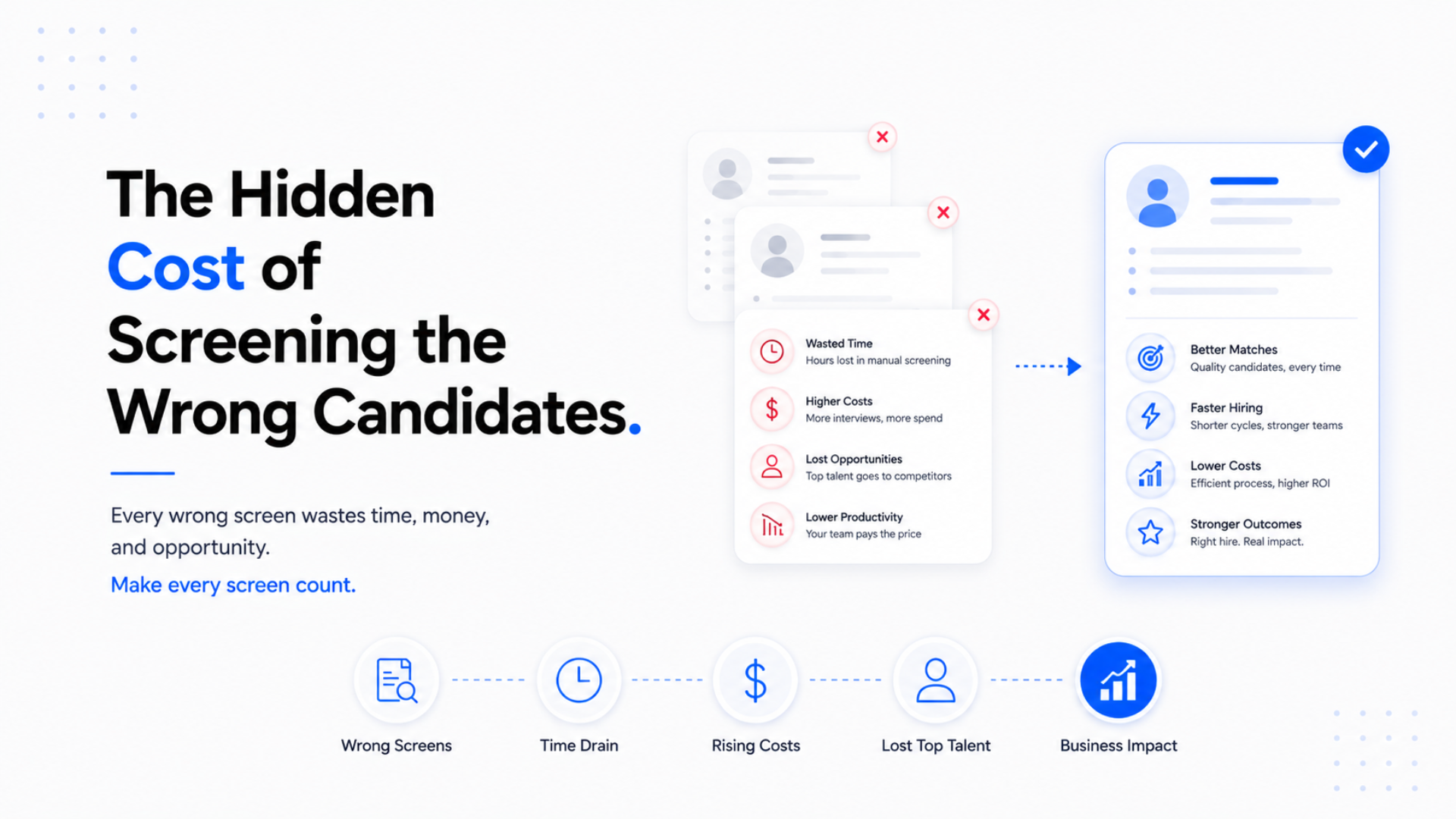
Recruiting teams obsess over the top of the funnel. They measure sourcing volume, channel performance, and candidate pipeline size with impressive precision. But there is a blind spot that silently erodes hiring outcomes at every stage downstream: the cost of screening the wrong candidates through. This is not about the candidates who are outright unqualified. It is about the candidates who pass initial screening but should not have, the candidates who should have passed but were filtered out, and the cascading consequences of both errors across the entire hiring process. The financial impact of bad screening is staggering, yet most organizations cannot quantify it because they have never built the measurement framework to see it clearly.
According to research from McKinsey, the average cost of a bad hire ranges from 30% to over 200% of the employee’s first-year salary depending on the role. Much of that cost is front-loaded in the screening and interview stages: the recruiter hours spent coordinating, the hiring manager time consumed by unproductive interviews, the team members pulled into panel discussions, and the opportunity cost of positions that remain vacant while the organization pursues candidates who were never the right fit to begin with. These costs are not rare anomalies. They are structural, systematic, and largely invisible to the teams that are generating them.
This article breaks down the hidden costs of screening the wrong candidates into five categories that most hiring teams never measure, and explains what a modern, AI-native screening approach looks like when it is designed to minimize these costs rather than simply process volume.
The Direct Financial Burn: Wasted Interview Hours and Recruiter Time
The most visible cost of bad screening is the time it wastes. Consider a mid-sized company hiring for a senior engineering role. The recruiter posts the job, receives 250 applications, and
after keyword-based ATS screening, identifies 40 candidates who appear to meet the requirements. The recruiter schedules phone screens for all 40, spending roughly 15 minutes per screen in actual conversation plus 10 minutes of preparation and follow-up per candidate. That is roughly 17 hours of recruiter time, or more than two full working days, dedicated to phone screens alone. If the screening quality is poor, the majority of those 40 candidates will not advance beyond the phone screen, meaning those 17 hours produced very little value.
The cost does not stop with the recruiter. Each phone screen that advances a candidate to the next round triggers a cascade of time investment from hiring managers and interview panelists. A typical panel interview involves three to five people and lasts 45 to 60 minutes. Even if only 10 of the original 40 candidates reach the panel stage, that represents 50 to 100 person-hours of interview time. If half of those candidates were screened through incorrectly, the organization has wasted 25 to 50 person-hours on interviews that should never have happened. At an average fully-loaded cost of $75 per hour for professional staff, that is $1,875 to $3,750 in direct interview costs for a single role. Multiply that across a company that hires 50 or 100 roles per year, and the annual waste from bad screening alone can exceed $100,000.
The irony is that many recruiting teams already sense this problem but lack the tools to solve it. As we explored in our analysis of more tools, same hiring problems, adding more ATS features or point solutions does not address the fundamental issue: the screening process itself is not evaluating candidates in a way that predicts interview success. The solution is not better scheduling software or more efficient calendar tools. It is a screening process that produces higher-quality shortlists so that every interview hour is invested in a candidate who has a genuine chance of being the right hire.
The Talent Loss You Never See: False Negatives in Screening
If the direct financial cost of bad screening is the waste you can measure, the talent loss from false negatives is the waste you cannot. A false negative occurs when a qualified candidate is filtered out during screening. They never receive a phone screen, never get an interview, and the organization never knows what it missed. Unlike a bad hire, which eventually becomes visible through performance problems, a missed great hire is completely invisible. The company does not know that the perfect candidate applied and was rejected. It simply sees a smaller, lower-quality shortlist and assumes the talent pool was weak.
The scale of false negative screening is alarming. Studies consistently show that traditional keyword-based screening eliminates 50% to 75% of applicants before any human review. Within that eliminated group are career changers with transferable skills, candidates from non-traditional educational backgrounds, professionals returning from career breaks, and specialists whose resumes use different terminology than the keyword list expects. These are not edge cases. In a competitive labor market, the difference between filling a role with a strong hire and leaving it vacant for months often comes down to whether the screening process can recognize non-obvious but genuine qualification patterns.
This problem is closely related to the broader breakdown in resume screening that we have
examined in depth. As we discussed in our article on why resume screening is broken and what comes next, keyword-matching systems create false negatives at scale because they evaluate documents rather than people. A candidate who has the capability but uses different language to describe it is indistinguishable from a candidate who lacks the capability entirely. The cost of these false negatives is not distributed evenly. It falls disproportionately on specialized and senior roles, where the talent pool is smaller and each missed candidate represents a larger share of the available talent.
Candidate Experience Damage That Poisons Your Pipeline
When a candidate applies for a role and is rejected after a superficial screening process, the damage extends far beyond that single interaction. The rejected candidate tells their network. They post on Glassdoor, Blind, and social media. They develop a negative association with the employer brand that persists for years and influences not only their own future willingness to apply but also the willingness of their peers, friends, and colleagues. In a world where employer brand perception is a critical factor in attracting top talent, bad screening is not just an operational inefficiency. It is a brand liability.
The candidate experience problem is compounded when screening is slow and opaque. Research from SHRM indicates that candidates who have a negative experience during the hiring process are 60% less likely to apply for future roles at the same company and 38% more likely to share their negative experience publicly. For companies that receive thousands of applications per year, the cumulative brand damage from poor screening practices can measurably reduce the quality and size of future applicant pools. The screening process is not just filtering candidates. It is communicating the company’s values, professionalism, and respect for talent. When that communication is poor, the cost compounds over time.
There is also a subtler form of experience damage that affects candidates who are screened through incorrectly, not filtered out. A candidate who passes initial screening based on keyword matches but is clearly not a fit when they reach the interview stage experiences a different kind of frustration. They invested time preparing for an interview for a role they were never truly qualified for, because the screening system told them and the company that they were. This creates a lose-lose scenario: the company wastes interview time, and the candidate wastes preparation time and emotional energy. Both parties walk away with a worse impression of the process than if the screening had been accurate enough to prevent the mismatch.
Recruiter Burnout and Decision Fatigue From Low-Quality Screens
One of the least discussed costs of bad screening is its impact on the recruiters themselves. Screening hundreds of resumes, many of which are poorly matched to the role, is cognitively exhausting work. Recruiters who spend their days processing low-quality applicant pools develop decision fatigue, a well-documented psychological phenomenon in which the quality of decisions degrades after a long sequence of similar judgments. By the time a recruiter reaches the 200th resume in a day, their ability to distinguish between a genuinely interesting
candidate and a marginally relevant one has significantly deteriorated.
Decision fatigue in screening creates a vicious cycle. Fatigued recruiters make more screening errors, which produces lower-quality shortlists, which leads to more unproductive interviews, which increases the pressure on recruiters to move faster and process more volume, which deepens the fatigue. The recruiters who burn out fastest are often the most conscientious ones, because they are the ones who try to give each resume adequate attention rather than defaulting to superficial keyword matching. The screening process, as currently designed, punishes the very behavior it needs most.
This dynamic is especially severe in high-volume hiring environments where recruiters are expected to screen dozens of roles simultaneously. The result is not just burnout but also high recruiter turnover, which itself is enormously expensive. Replacing an experienced recruiter costs 50% to 150% of their annual compensation when you factor in recruitment, onboarding, ramp-up time, and lost institutional knowledge. When evaluating AI sourcing tools, one of the most important criteria should be whether the tool reduces the cognitive burden on recruiters rather than simply increasing the volume they are expected to process. A screening system that helps recruiters focus their attention on the candidates who genuinely merit it is not just a productivity tool. It is a retention tool.
The Compounding Delay: How Bad Screening Extends Time-to-Hire
Every candidate who is screened through incorrectly and then fails in a later stage adds days or weeks to the time-to-hire for that role. The phone screen that should have caught the mismatch adds a week. The panel interview that should never have been scheduled adds another week. The debrief discussion about a candidate who was never a real contender adds another few days. When a role requires multiple rounds of interviews with multiple candidates, the compounding effect of even a moderate false positive rate can add 30% to 50% to the total time-to-hire.
Extended time-to-hire has direct costs that are well documented. According to EY’s workforce research, a vacancy that remains open for 90 days instead of 45 costs the average company the equivalent of the role’s salary in lost productivity, assuming the work is being absorbed by other team members or simply not being done. For senior and specialized roles, the cost is even higher because the impact of the vacant role on business outcomes is more pronounced. A company that could have filled a critical data science role in 6 weeks but takes 12 weeks because of poor screening quality is not just losing money on the vacancy. It is losing competitive advantage, market responsiveness, and team morale.
The delay cost also interacts with other pipeline problems. When time-to-hire extends, the candidate data that was fresh at the start of the process becomes stale. Candidates who were initially interested may have accepted other offers by the time the company finally makes a decision. The strong candidate who was the first choice three months ago may no longer be available, forcing the company to settle for a second or third choice or restart the entire process. In this way, bad screening at the top of the funnel creates compounding costs at
every subsequent stage, and the total cost is almost always larger than the sum of its visible components.
The Real Cost of Bad Screening: A Simple Framework
Understanding the hidden cost of screening the wrong candidates requires a framework that goes beyond simple time-per-screen metrics. The most useful way to think about it is in terms of four cost categories that should be measured independently and then combined into a single screening cost number. First, there is direct waste cost: the total hours invested in screening, interviewing, and debriefing candidates who were screened through incorrectly. Multiply total hours by the fully-loaded hourly cost of everyone involved. Second, there is talent loss cost: the estimated value of qualified candidates who were filtered out by inaccurate screening. This is harder to quantify, but a reasonable proxy is the average cost-per-hire multiplied by the estimated number of false negatives. Third, there is brand damage cost: the long-term reduction in applicant quality and volume caused by negative candidate experiences traceable to screening quality. Fourth, there is delay cost: the business impact of extended time-to-hire caused by unnecessary interview rounds.
For most organizations that have never run this calculation, the total is sobering. A company hiring 50 roles per year with a moderate screening error rate can easily be losing $500,000 to $1 million annually in combined screening costs. The good news is that modern agentic AI recruiting platforms are specifically designed to reduce these costs by producing higher-quality shortlists, evaluating candidates on multiple signals rather than just resume keywords, and dramatically reducing the false positive and false negative rates that drive the waste. The ROI case for better screening is not abstract. It is directly quantifiable, and it is almost always larger than recruiting teams initially estimate.
How Huntlo Eliminates the Hidden Costs of Bad Screening
Huntlo addresses the hidden costs of bad screening by replacing the traditional resume-first screening process with a candidate intelligence approach. Instead of scanning documents for keywords and advancing candidates whose resumes match a static checklist, Huntlo evaluates each candidate across multiple dimensions: their actual professional capabilities, their career trajectory and growth pattern, their demonstrated impact in previous roles, and their fit for the specific requirements of the open position. This produces shortlists where every candidate has been genuinely evaluated, not just filtered.
The impact on the five cost categories described in this article is direct and measurable. Recruiter time is redirected from processing volume to engaging with candidates who genuinely merit conversation. False negatives drop significantly because the evaluation is based on capability evidence rather than document formatting. Candidate experience improves because every candidate who is advanced has been evaluated holistically, reducing the lose-lose scenario of mismatched interviews. Recruiter cognitive load decreases because the AI handles the high-volume, low-judgment work, leaving recruiters to apply their expertise where it
matters most. And time-to-hire compresses because each interview round involves candidates who are genuinely likely to be the right fit, reducing the number of rounds needed to reach a hiring decision.
For teams that have been running on traditional screening for years, the transition to candidate intelligence can feel like a significant shift. But the difference between AI sourcing and AI recruiting is that the latter is not just about finding candidates. It is about evaluating them accurately so that every subsequent step in the hiring process, from the first phone screen to the final offer, is invested in candidates who genuinely deserve the organization’s time and attention. That is how you turn screening from a cost center into a strategic advantage.