Thomas Lindgren, VP of Human Resources at a European manufacturing company with fourteen thousand employees, had spent the past year restructuring his talent acquisition function. His internal team of thirty-five recruiters handled professional and managerial hiring, while three external recruitment process outsourcing partners managed high-volume manufacturing hiring across six countries. The arrangement was typical for a company of his size, but it was also deeply frustrating. Each RPO partner used different tools, different processes, and different reporting formats. Visibility into pipeline status required separate calls with each partner. Quality benchmarks were inconsistent because each partner defined qualified candidates differently. And when Thomas asked for consolidated analytics that showed his total talent acquisition performance across internal and external teams, he was told it would take three weeks to compile because the data lived in six separate systems. Thomas knew that recruitment outsourcing was not going away. The scale and geographic complexity of his company's hiring needs made full internalization impractical. But he also knew that the current model, where outsourcing meant delegating entire hiring processes to external partners with minimal integration, was being rendered obsolete by technology that could connect internal and external teams, standardize processes across partners, and provide the real-time visibility that modern talent acquisition requires.
Why the Traditional Outsourcing Model Is Breaking Down
The traditional recruitment outsourcing model was built on a straightforward premise: the client organization defines the hiring need, the outsourcing partner provides the recruiters and processes to fill it, and the two parties interact through periodic status reports and invoice reconciliation. This model worked when recruiting was primarily a manual, relationship-driven activity and the primary value the outsourcing partner provided was recruiting capacity that
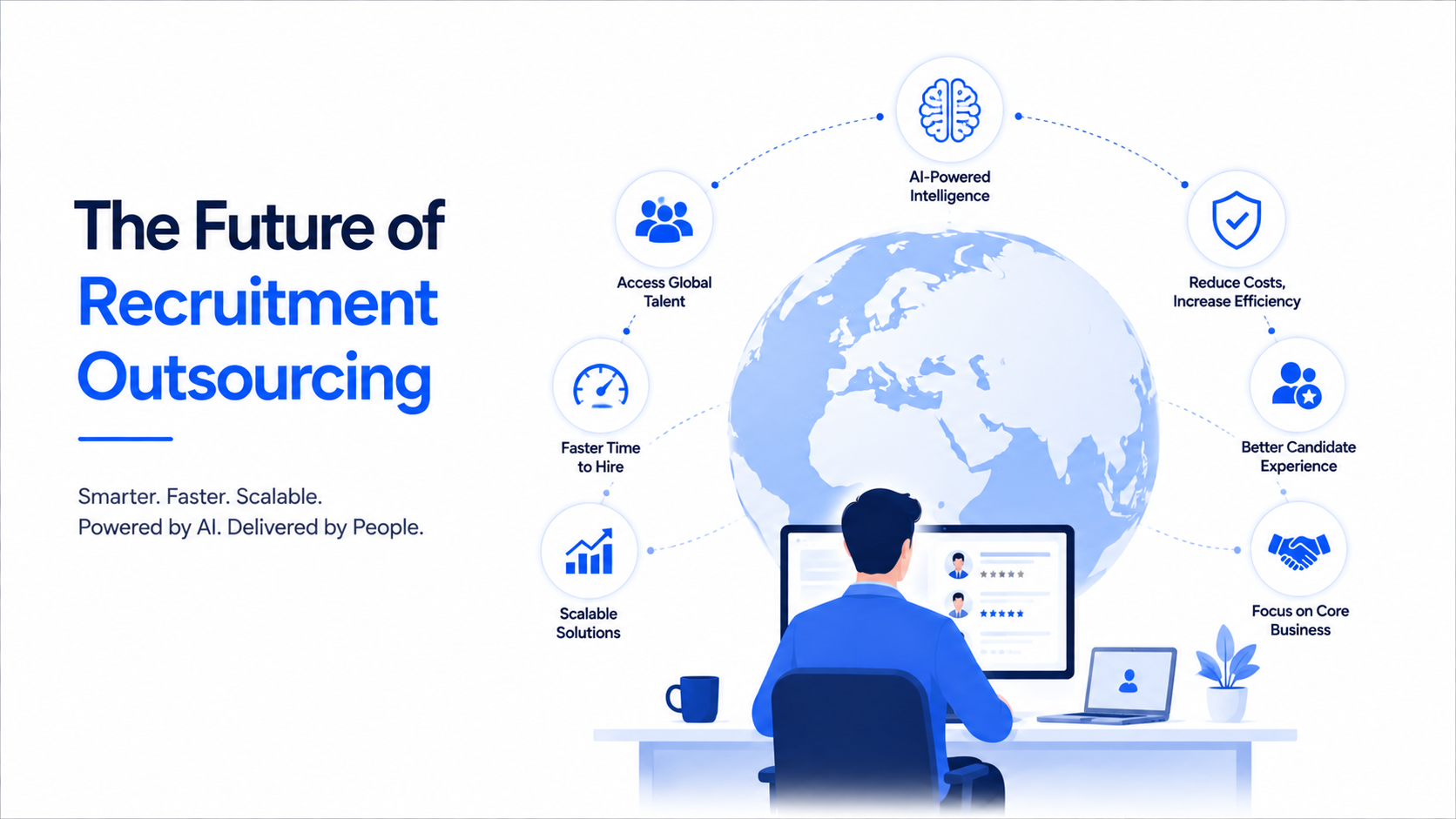
the client did not want to maintain internally. The model is breaking down because AI is changing what organizations need from outsourcing partners. When an organization can deploy AI tools that automate sourcing, screening, and candidate engagement, the primary value of an outsourcing partner shifts from providing recruiting capacity to providing recruiting intelligence, specialized expertise, and scalable execution that the organization's own AI-augmented internal team cannot deliver alone. The traditional RPO contract, which prices recruiting capacity by requisition or by recruiter headcount, does not capture this new value proposition, and organizations that continue buying outsourcing services on the old model are paying for capacity they no longer need while not receiving the intelligence and specialization they now require.
The integration problem is equally damaging to the traditional model. Most organizations that outsource recruiting operate with a fragmented technology ecosystem where the internal talent acquisition team uses one set of tools and each outsourcing partner uses different tools. This fragmentation creates data silos that prevent the organization from seeing its total talent acquisition performance, understanding candidate flow across internal and external pipelines, or leveraging the combined data from all hiring activities to improve future performance. When Thomas Lindgren asks for a single view of his talent pipeline across thirty-five internal recruiters and three external partners operating in six countries, the request is technically feasible only if all parties share a common platform. In the traditional model, this common platform does not exist. According to McKinsey, organizations with fragmented recruiting technology across internal and external teams report twenty-five to thirty-five percent higher total talent acquisition costs than organizations with integrated platforms, because the fragmentation creates duplicate effort, inconsistent processes, and the inability to leverage data across the entire hiring function.
The traditional outsourcing model also creates misaligned incentives. When an RPO partner is compensated based on the number of requisitions filled or the number of recruiters deployed, the partner's economic interest is in maximizing volume rather than optimizing outcomes. This incentive structure produces behaviors that serve the partner's revenue but not necessarily the client's interest, such as prioritizing easy-to-fill requisitions over challenging strategic roles, maximizing recruiter headcount rather than investing in AI tools that could reduce headcount requirements, and defining qualified candidates loosely to increase submission volume. AI-enabled outsourcing models can align incentives around outcomes rather than activities, compensating partners based on quality of hire, retention, time-to-fill, and client satisfaction rather than requisition volume. This outcome-based alignment is only possible when the AI platform provides the data infrastructure to measure these outcomes consistently across all partners. more tools same hiring problems explains why organizations that outsource recruiting to multiple partners without an integrated technology platform consistently pay more for worse results, because the lack of shared tools and data prevents the standardization and measurement that would enable outcome-based pricing and performance accountability.
The AI-Powered Integrated Outsourcing Model
The emerging model for recruitment outsourcing is built on a shared AI platform that serves as the common operating system for both internal recruiters and external partners. In this model, the client organization provides the AI platform that all recruiting activity, internal and external, runs on. Outsourcing partners access the platform to manage their assigned requisitions, using the same candidate database, screening tools, engagement workflows, and analytics dashboards that the internal team uses. This shared platform eliminates the data fragmentation, process inconsistency, and visibility gaps that characterize the traditional model. It also creates a unified candidate experience, because every candidate, whether sourced by an internal recruiter or an external partner, interacts with the same system, receives the same communications, and is evaluated against the same criteria. The practical impact is that the organization can manage its entire talent acquisition function as a single integrated operation regardless of how many external partners are involved, because the platform provides the consistency and visibility that the traditional delegated model cannot achieve.
The shared platform model also changes how outsourcing partners are selected and managed. In the traditional model, partners are selected primarily on recruiter quality, industry expertise, and geographic coverage. In the AI-powered model, platform compatibility and data integration capability become equally important selection criteria. An outsourcing partner with excellent recruiters but incompatible technology will create more problems than it solves, because the lack of integration undermines the visibility and consistency that the shared platform is designed to provide. Partners must be able to operate within the client's platform ecosystem, contribute data to the client's unified talent intelligence, and adopt the client's standardized processes and workflows. This does not mean that all partners must use identical methods, but it does mean that the data outputs, process milestones, and reporting standards must be consistent. According to Gartner, organizations that require outsourcing partners to operate on shared AI platforms report forty to fifty percent faster integration timelines and twenty to thirty percent lower management overhead compared to organizations that allow partners to use their own independent systems, because the shared platform eliminates the technology onboarding, data mapping, and process alignment that consume months of effort when partners bring their own systems.
The most significant advantage of the AI-powered integrated model is the data network effect. When all recruiting activity, internal and external, flows through a single platform, the platform accumulates hiring outcome data from every source. The AI models trained on this combined data become progressively more accurate at predicting candidate success, identifying optimal sourcing channels, and recommending process improvements. An external partner hiring manufacturing operatives in Poland contributes data that improves the AI's matching for the internal team hiring manufacturing operatives in Germany. An internal recruiter's success placing a data engineer in one business unit informs the external partner's search for a similar role in another unit. This cross-pollination of hiring intelligence is impossible in the
traditional fragmented model, where each partner's data is isolated in their own system and the organization's internal data is similarly isolated. The network effect means that the organization's total recruiting capability improves continuously as more hiring activity flows through the platform, creating a compounding advantage that grows with scale. agentic AI platforms vs automated ones describes how agentic AI platforms create this network effect by coordinating recruiting activities across internal and external teams on a shared intelligence layer, because the AI learns from every interaction regardless of which team or partner executes it, and the accumulated learning benefits all participants.
From RPO to Outcome-Based Talent Partnerships
The evolution of outsourcing models is moving beyond traditional RPO toward outcome-based talent partnerships where the outsourcing partner's compensation is tied to measurable hiring outcomes rather than activity metrics. In a traditional RPO engagement, the client pays a fixed fee per recruiter or per requisition, regardless of the quality of the hires produced. In an outcome-based talent partnership, the partner earns fees based on the quality, retention, and performance of the candidates they place, with bonuses for exceeding targets and adjustments when outcomes fall short. This shift from activity-based to outcome-based pricing fundamentally changes the relationship between client and partner. The partner's economic interest is now aligned with the client's interest, because both parties benefit when hiring quality improves and both bear cost when quality suffers. This alignment creates a collaborative dynamic that the traditional model, with its inherent tension between the partner's interest in maximizing volume and the client's interest in maximizing quality, cannot achieve.
Outcome-based partnerships require the kind of data infrastructure that only an AI-powered shared platform can provide. Measuring hiring outcomes consistently across internal and external teams, across countries and role types, and over meaningful time horizons requires standardized data collection, real-time tracking, and predictive analytics that manual processes cannot deliver. The AI platform provides this infrastructure by capturing outcome data from every placement, tracking retention and performance over time, and generating the analytics that both the client and the partner need to evaluate performance and adjust strategies. Without this shared data infrastructure, outcome-based pricing is impractical because the parties cannot agree on the metrics, cannot measure them consistently, and cannot resolve the attribution questions that arise when multiple partners contribute to a single hiring process. The AI platform resolves these challenges by providing a single source of truth for all hiring data and the analytical tools needed to derive meaningful performance insights from that data. According to Deloitte, organizations that have transitioned from traditional RPO to outcome-based talent partnerships report fifteen to twenty percent lower total talent acquisition costs and ten to fifteen percent higher quality-of-hire scores, because the outcome-based model incentivizes partners to invest in quality-enhancing activities like better sourcing, more thorough screening, and stronger candidate engagement that the activity-based model does not reward.
The outcome-based model also changes the scope of what outsourcing partners deliver. In traditional RPO, the partner's responsibility typically ends when a candidate accepts an offer. In outcome-based partnerships, the partner's responsibility extends through the onboarding period and often into the first year of employment, because the partner's compensation depends on the new hire's retention and performance during this period. This extended accountability changes the partner's behavior throughout the hiring process, because every decision, from candidate selection to offer negotiation, is made with an awareness that the partner will be accountable for the new hire's success. Candidates receive more honest information about the role and the organization, because the partner has no incentive to oversell a position that might lead to early departure. Offer negotiations are more realistic, because the partner's compensation depends on the new hire staying, not just on the offer being accepted. And onboarding support is more thorough, because the partner has a financial interest in ensuring the new hire's successful integration. how to evaluate an AI sourcing tool provides a framework for organizations evaluating the shift from traditional RPO to outcome-based partnerships, because the transition requires careful assessment of the organization's data infrastructure, outcome measurement capabilities, and partner management maturity.
The Hybrid Model: Internal Strategy, External Execution
The most effective future state for many organizations is a hybrid model where the internal talent acquisition team focuses on strategy, employer branding, workforce planning, and executive hiring, while external partners handle execution across high-volume, geographically distributed, or specialized hiring categories. This hybrid model is not new in concept but is transformed in practice by AI, because the shared platform that connects internal and external teams enables a level of coordination and visibility that was previously impossible. The internal team sets the hiring strategy, defines target profiles, establishes quality standards, and manages the relationship with outsourcing partners. The external partners execute the sourcing, screening, and engagement activities within the framework the internal team has defined. The AI platform ensures that execution is consistent with strategy by applying the internal team's criteria and standards to every candidate interaction, regardless of whether that interaction is managed by an internal recruiter or an external partner. This strategic separation between strategy and execution is cleaner and more effective when AI handles the coordination layer, because the AI ensures that strategic intent is translated into operational execution without the communication gaps and interpretation errors that occur when strategy is transmitted through manual briefings and email instructions.
The hybrid model also enables more flexible and responsive capacity management. Hiring demand in most organizations is not constant. It fluctuates seasonally, with business cycles, and in response to market opportunities. In a purely internal model, the organization must maintain sufficient recruiter headcount to handle peak demand, which means overstaffing during periods of lower demand. In a traditional outsourcing model, the organization can flex capacity up and down by adjusting the scope of the outsourcing engagement, but the lead time for scaling external capacity is often too long to respond to sudden demand spikes. The
AI-powered hybrid model solves this problem by maintaining a pool of pre-integrated external partners who can scale their activity on the shared platform with minimal lead time. When demand increases, the internal team allocates additional requisitions to external partners who are already operating on the platform and who already understand the organization's processes, criteria, and quality standards. The scaling is fast because the platform onboarding is already complete, and it is high-quality because the partner is working within the organization's established framework rather than applying their own independent approach. According to EY, organizations using AI-powered hybrid models report fifty to sixty percent faster capacity scaling compared to traditional outsourcing models, because pre-integrated partners can begin execution within days rather than the weeks or months required to onboard new partners in the traditional model.
The hybrid model also addresses one of the persistent challenges of recruitment outsourcing: knowledge transfer and institutional memory. In the traditional model, when an outsourcing engagement ends or a partner rotates their recruiting team, the institutional knowledge about the client's hiring preferences, candidate market nuances, and relationship history leaves with the departing team. The AI platform captures and retains this institutional knowledge in structured data that persists regardless of team changes. When a new recruiter, internal or external, begins working on a requisition, they have access to the full history of previous searches for similar roles, the candidate profiles that were successful and unsuccessful, the hiring manager's feedback on past candidates, and the market intelligence that has accumulated over time. This institutional memory reduces the learning curve for new team members, improves consistency across team transitions, and ensures that the organization's recruiting capability does not degrade when personnel change. why AI tools have outdated candidate data explains why the data persistence provided by an AI platform eliminates one of the biggest risks of outsourcing, which is the loss of institutional knowledge when partner teams change, because the platform retains all candidate interactions, hiring outcomes, and market intelligence as a permanent organizational asset rather than a temporary resource that exists only in the memories of individual recruiters.
What Talent Leaders Must Do Now
For talent leaders managing outsourced recruiting relationships, the transition to the AI-powered integrated model should begin with a technology audit that assesses the current state of platform integration across internal and external teams. This audit should map every system used by the internal team and each outsourcing partner, identify the data gaps and process inconsistencies that fragmentation creates, and quantify the management overhead that results from operating without a shared platform. The audit provides the factual basis for the business case, because it translates the abstract concept of integration into specific, measurable costs, inefficiencies, and risks that leadership can evaluate. The business case should present the total cost of the current fragmented model, including duplicated technology licenses, manual data reconciliation, inconsistent candidate experiences, and the management time consumed by coordinating across multiple independent systems, and compare it to the
projected cost of a shared platform model that eliminates these inefficiencies.
The second step is to redesign outsourcing contracts around the integrated model. Existing RPO contracts that specify recruiter headcount, activity metrics, and partner-owned technology should be renegotiated to specify outcome metrics, shared platform requirements, and data contribution obligations. This contract redesign is best approached as a collaborative exercise with existing partners, because partners who understand the strategic direction and see the benefits of integration are more likely to invest in the platform capabilities and process changes that the new model requires. Partners who resist integration, either because they want to protect their proprietary technology or because they prefer the opacity of the traditional model, may not be the right partners for the organization's future. The transition should be phased, starting with one or two partners who are most willing and able to operate on a shared platform, proving the model's benefits with measurable results, and then extending the model to additional partners as the organization builds confidence and capability. According to LinkedIn, organizations that phase their transition to integrated outsourcing over twelve to eighteen months report higher partner satisfaction, smoother implementation, and better outcomes than organizations that attempt to transition all partners simultaneously, because the phased approach allows time for learning, adjustment, and relationship building that the big-bang approach does not provide.
The third step is to invest in the internal team's ability to manage an AI-powered, partner-integrated recruiting function. This requires developing new competencies in vendor management, data analytics, platform governance, and outcome-based performance management. The internal team's role shifts from managing recruiting processes to managing a recruiting ecosystem, which requires a different skill set and a different organizational mindset. Talent acquisition leaders who have built their careers managing internal recruiting teams may need to develop the skills required to manage a complex network of internal and external resources connected by shared technology. This is a significant professional development challenge, but it is also an opportunity for talent acquisition leaders to elevate their strategic impact, because the ability to orchestrate an integrated talent ecosystem that combines internal expertise with external scale and specialization is a capability that creates value far beyond what any single team, internal or external, could deliver independently. AI sourcing vs AI recruiting explains why the most effective talent leaders in the AI era are those who can distinguish between the strategic activities that require internal ownership and the execution activities that benefit from external partnership, because this distinction is the foundation of a hybrid model that leverages the strengths of both internal and external capabilities.