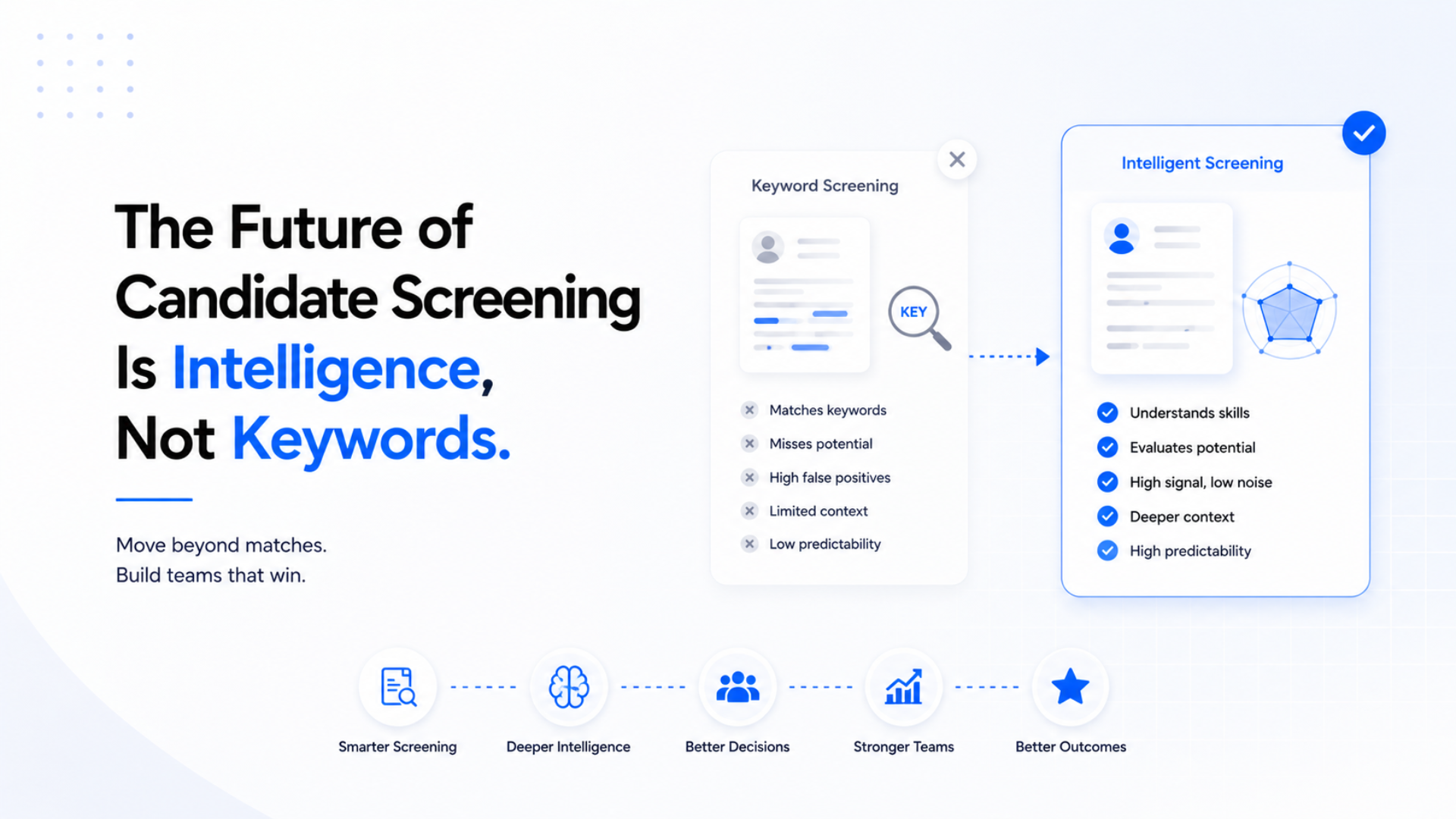
The history of candidate screening in corporate recruiting can be told in three phases. Phase one was the human era, when recruiters read every resume and made decisions based on experience and intuition. Phase two was the keyword era, which began in the early 2000s with the rise of applicant tracking systems that automated the initial review by scanning resumes for specific terms. Phase three is just beginning, and it represents a fundamental departure from everything that came before. It is the intelligence era, in which screening systems evaluate candidates based on multi-dimensional understanding rather than document-level pattern matching. The shift from phase two to phase three is not an incremental improvement. It is a generational change in how organizations identify and assess talent.
The keyword era served a purpose. When companies were receiving hundreds of applications per role and did not have enough recruiters to review them all manually, keyword matching provided a scalable way to reduce the pool to a manageable size. But scalability came at a steep price. Research from McKinsey’s talent management practice consistently shows that keyword-based screening eliminates 50% to 75% of the applicant pool before any human evaluation occurs, and a significant share of those eliminated candidates are qualified or even exceptional. The keyword filter is fast and cheap, but it is not intelligent. It does not understand context, variation, or potential. It simply counts words. The intelligence era is defined by the replacement of that word-counting approach with systems that actually understand what a candidate has done, what they are capable of doing, and how well they match a specific role’s requirements.
Why Keywords Were Always a Proxy, Not a Measure
To understand why the shift to intelligence-based screening is inevitable, it helps to be precise about what keywords actually measure, because it is much less than most recruiters assume. A keyword match tells you that a specific term appears on a candidate’s resume. That is
all it tells you. It does not tell you whether the candidate used the skill in a meaningful way or simply listed it to pass through ATS filters. It does not tell you how recently they used the skill, how deeply they understand it, or how their proficiency compares to other candidates. It does not tell you whether they used the skill in a context that is relevant to your open role. A keyword match is a binary, surface-level signal that is being used as a proxy for a multi-dimensional, depth-level assessment. The proxy was always imperfect, and its imperfections have become increasingly costly as the labor market has grown more competitive and the skills required for most roles have grown more complex.
Consider a practical example. A company is hiring a product manager and the job description lists "SQL," "data analysis," and "stakeholder management" as required skills. The ATS scans resumes for these terms and advances candidates who mention all three. But the quality difference between a candidate who has used SQL to run ad-hoc queries and one who has built complex data models that informed strategic decisions is enormous, and the keyword filter cannot distinguish between them. Similarly, "stakeholder management" on one resume might mean the candidate sent weekly email updates to a project manager, while on another it might mean they navigated competing priorities across C-suite executives to align a cross-functional launch. The same keyword, radically different capability levels. The keyword era forced recruiters to pretend these differences did not exist, because the screening tool could not see them.
This fundamental limitation is why we identified resume screening as a broken process. As we laid out in our article on the persistent problem of keyword-based screening, which creates systematic false negatives that disproportionately affect strong candidates from non-traditional backgrounds, the intelligence era does not just make screening faster. It makes it accurate, by evaluating the substance behind the keywords rather than the keywords themselves.
What Candidate Intelligence Actually Looks Like
Candidate intelligence is the practice of building a holistic, multi-signal understanding of a candidate’s capabilities, trajectory, and fit for a specific role. Unlike keyword matching, which treats the resume as the sole source of truth and evaluates it against a static checklist, candidate intelligence draws on multiple data sources and synthesizes them into a profile that captures dimensions of capability that no single document can convey. The key signals that a candidate intelligence system evaluates include career progression patterns, which reveal whether the candidate has been on a growth trajectory that suggests increasing responsibility and impact; demonstrated achievements, which provide evidence of what the candidate has actually accomplished rather than what they were responsible for; technical or domain expertise depth, which assesses the quality and specificity of the candidate’s skills in areas relevant to the role; and professional network and reputation signals, which indicate how the candidate is regarded by their peers and industry.
The critical difference between keyword matching and candidate intelligence is the shift from document evaluation to person evaluation. A keyword system asks: does this document
contain the right words? A candidate intelligence system asks: does this person have the capabilities, trajectory, and potential to succeed in this role? The answer to the second question requires understanding context, making inferences, weighing tradeoffs between different strengths and weaknesses, and assessing potential. These are fundamentally cognitive tasks that go far beyond what a keyword filter can accomplish. They require the kind of multi-signal reasoning that modern AI systems are increasingly capable of performing at scale.
This multi-signal approach is especially transformative for specialized hiring. As we have examined in our analysis of whether AI recruiting tools work for niche or technical roles, the candidates who are hardest to evaluate through traditional screening are often the ones who have the most to offer. A machine learning engineer who has contributed to open-source projects, published technical blog posts, and built innovative side projects may have a relatively thin resume by conventional standards but an exceptionally strong capability profile when evaluated across multiple signals. Candidate intelligence systems can see that strength because they are looking at the person, not just the document.
From Static Filters to Adaptive Evaluation
One of the most significant advances that candidate intelligence enables is the move from static, one-size-fits-all screening to adaptive evaluation that adjusts based on the specific role and candidate. Traditional keyword filters apply the same criteria to every candidate for a given role, regardless of the candidate’s background, the specific nuances of the position, or the tradeoffs that might make a non-standard candidate a better fit than a standard one. A candidate intelligence system, by contrast, evaluates each candidate-role pair as a unique matching problem, considering the specific requirements of the position and the specific strengths and characteristics of the candidate.
Adaptive evaluation matters because the optimal screening criteria are different for almost every role. A startup hiring its first product manager has very different needs from an enterprise company hiring a product manager for a mature product line. The startup needs a generalist who can operate with ambiguity, while the enterprise needs a specialist who can optimize within an established framework. A keyword filter cannot distinguish between these needs. It simply looks for "product management" and "agile" and "stakeholder management" regardless of context. An adaptive candidate intelligence system, on the other hand, evaluates candidates against the specific requirements and context of each role, producing rankings that reflect the actual fit between the candidate and the position rather than a generic keyword match score.
This adaptability is what distinguishes truly agentic AI recruiting platforms from the older generation of automated screening tools. An agentic platform does not simply execute a pre-defined screening workflow. It reasons about the role requirements, identifies the most predictive signals for that specific type of position, and adjusts its evaluation strategy accordingly. It can recognize that a career changer with strong transferable skills may be a better fit than a candidate with direct but shallow experience, and it can explain why it reached that
conclusion. The result is screening that is both more accurate and more transparent than anything the keyword era produced.
The Data Foundation: Quality Signals Over Quantity of Resumes
The intelligence era of screening requires a fundamentally different approach to candidate data. In the keyword era, the only data that mattered was the text of the resume. If a keyword was not on the resume, it did not exist for screening purposes. This created a data starvation problem: the screening system was making decisions based on a single, narrow data source that was known to be incomplete and often misleading. Candidates optimized their resumes for keywords rather than accuracy, hiring managers wrote job descriptions that reflected wish lists rather than genuine requirements, and the entire screening process operated on a foundation of degraded data.
Candidate intelligence systems address this data starvation problem by enriching the candidate profile with signals from multiple sources. Professional platform profiles provide up-to-date information about the candidate’s current role, responsibilities, and network. Publicly available work, such as code repositories, publications, presentations, and patents, provides direct evidence of capability. Career history and progression patterns reveal trajectory and growth potential. The combination of these signals produces a candidate profile that is dramatically richer and more accurate than a resume alone. But the value of multi-signal data depends entirely on its quality and recency. Outdated candidate data can be worse than no data at all, because it leads the screening system to make confident but wrong assessments.
This is why data quality is the foundation on which the entire intelligence approach rests. As we have discussed in our analysis of why some AI recruiting tools have outdated candidate data, even the most sophisticated screening algorithm will produce poor results if it is processing stale or inaccurate inputs. The best candidate intelligence platforms invest heavily in real-time data enrichment, verifying and updating candidate profiles at the point of evaluation rather than relying on cached data that may be months old. For recruiting teams that are evaluating AI screening tools, data freshness should be one of the primary evaluation criteria, because it is the single biggest determinant of whether the platform’s intelligence assessments will be accurate enough to replace keyword matching.
The Practical Transition: Moving Your Team to Intelligence-Based Screening
For recruiting teams that have spent years operating within the keyword paradigm, the transition to intelligence-based screening requires changes across three dimensions: technology, process, and mindset. The technology change is the most straightforward. It means adopting a candidate intelligence platform that can evaluate candidates on multiple signals rather than simply scanning resumes for keywords. The process change is more involved. It means redesigning the screening workflow to incorporate AI-generated candidate profiles, multi-signal scoring, and adaptive evaluation criteria, rather than relying on ATS keyword filters as the first gate. The mindset change is the most fundamental and the most important. It means
accepting that the best candidate for a role is not always the one whose resume most closely matches the job description, and building screening processes that can identify and evaluate candidates on their actual merits rather than their document formatting.
The practical starting point is to pilot the intelligence approach on a role where traditional screening has been producing poor outcomes. This might be a role that has been open for an unusually long time, a role where the shortlist quality has been consistently disappointing, or a role where the hiring manager has complained that the ‘right’ candidates are not making it through. Run the new screening approach in parallel with the existing keyword-based process for two or three hires, and compare the shortlist quality, time-to-shortlist, and downstream hiring outcomes. The data from this pilot will tell you more about the value of intelligence-based screening than any vendor demo or case study. According to SHRM’s guidance on adopting AI in hiring, parallel running is the recommended approach for any new screening technology, because it provides a direct comparison between the old and new approaches on the same candidate pool.
The biggest risk during the transition is not technical failure. It is reverting to keyword thinking under pressure. When a role urgently needs to be filled and the intelligence-based approach surfaces unfamiliar candidates who do not look like the usual profiles, there is a strong temptation to fall back on keyword matching because it feels safer. This is the moment that determines whether the transition succeeds or fails. The well-documented costs of adding tools without changing the underlying process are almost always larger than the costs of trying an unfamiliar approach, and the teams that push through the discomfort of the transition are the ones that end up with significantly better hiring outcomes. The keyword era trained recruiters to value familiarity over potential. The intelligence era rewards the opposite instinct.
Huntlo: Built for the Intelligence Era of Screening
Huntlo was designed from the ground up for the intelligence era. Unlike ATS platforms that have bolted AI features onto keyword-based architectures, Huntlo’s screening engine was built to evaluate candidates on multiple signals from the start. Every candidate in the system is represented by a rich, multi-dimensional profile that goes far beyond what a resume can capture. The platform synthesizes career history, professional achievements, domain expertise, and trajectory data into an intelligence assessment that tells you not just what a candidate claims to have done, but what the evidence suggests they are actually capable of.
Because Huntlo operates as an agentic platform, its screening is adaptive rather than rigid. It evaluates each candidate against the specific requirements of each role, adjusting its assessment criteria based on the context of the position, the seniority level, and the hiring manager’s stated priorities. A candidate who would be ranked highly for a startup product role might be ranked differently for an enterprise product role, not because the candidate changed, but because the intelligence assessment correctly identifies that different roles require different profiles. This is the difference between a screening system that processes documents and one that understands people. The keyword era is not ending because companies want something
newer. It is ending because keyword-based screening was never measuring what hiring teams actually needed to know. The future of screening is intelligence, and that future is already here.