Elena Vasquez, Chief People Officer at a logistics company in Miami, had just finished reviewing her fourth AI hiring platform proposal of the quarter. Each vendor promised transformative results. Each had impressive demo videos and customer testimonials. But when Elena looked beneath the surface, she found the same pattern in every case: the platforms were designed around the recruiting process as it existed five years ago, with AI layered on top of workflows built for manual execution. Sourcing was still treated as a separate stage from engagement. Screening was still a binary gate that advanced or rejected candidates based on rigid criteria. Interview scheduling was still a coordination problem rather than an optimization opportunity. The AI was making these legacy workflows faster, but it was not reimagining them. Elena's frustration was not with any specific vendor but with the entire category. The platforms being sold as the future of hiring were, in her view, the present of hiring with better automation. The actual future would look fundamentally different, and she wanted to understand what that future would require so she could invest in platforms that were built for it rather than platforms that were built for the past.
From Workflow Tools to Hiring Operating Systems
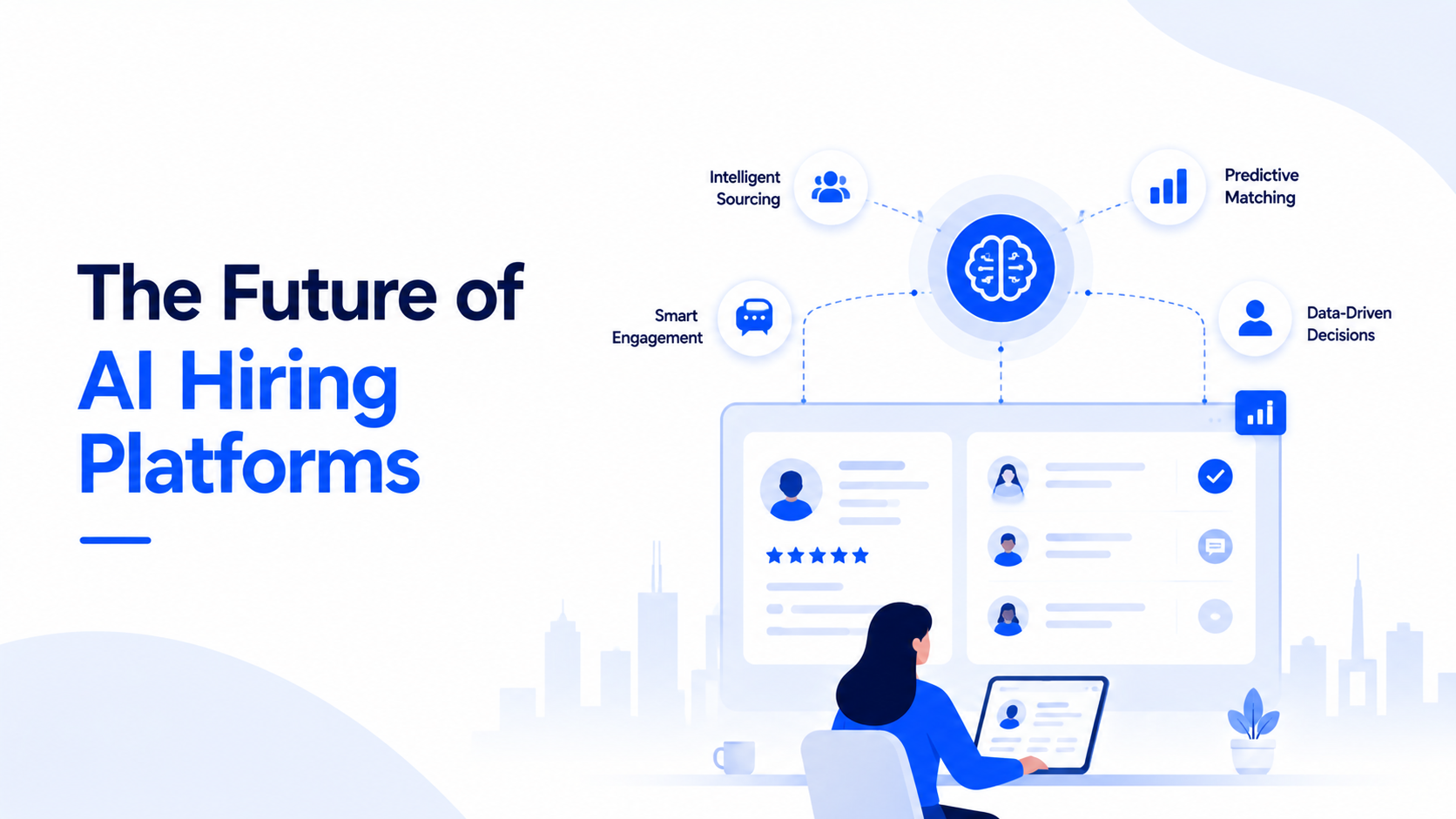
The first and most fundamental shift in AI hiring platforms is the transition from workflow automation tools to hiring operating systems. Current platforms automate specific tasks within the recruiting process: resume screening, outreach messaging, interview scheduling, offer management. Each task is automated independently, and the recruiter's role is to manage the handoffs between automated tasks and to provide human judgment at decision points. This architecture treats the hiring process as a fixed sequence of steps that can be made faster through automation. The next generation of platforms treats hiring not as a fixed process but as an adaptive system that reconfigures itself based on the specific role, the candidate pool,
and the organizational context. A hiring operating system does not automate a predefined workflow. It dynamically constructs the optimal workflow for each unique hiring situation, drawing from a library of capabilities and assembling them in real time based on the requirements of the role and the characteristics of the candidates being engaged.
The operating system metaphor is deliberate and important. An operating system provides a foundation on which different applications can run, managing resources, coordinating processes, and providing a consistent interface between the user and the underlying hardware. A hiring operating system does the equivalent for talent acquisition: it provides a foundation on which different hiring workflows can run, managing candidate data, coordinating AI agents, and providing a consistent interface between recruiters and the underlying AI capabilities. The practical implication is that organizations are not locked into a single workflow defined by the vendor. They can configure, extend, and adapt the platform to match their specific hiring processes, candidate populations, and organizational requirements. According to McKinsey, the platform shift from workflow automation to operating system architecture is the most significant technology transition in talent acquisition since the move from paper-based to digital recruiting, because it changes not just how fast hiring happens but how hiring is conceived and organized.
For talent leaders evaluating platforms today, the operating system shift means looking beyond feature checklists to assess the platform's architectural flexibility. Can the platform support multiple workflow configurations for different role types? Can it integrate with external data sources and tools without requiring custom development for each integration? Can it adapt its behavior based on real-time feedback from recruiters and candidates? These questions reveal whether a platform is designed for the future of hiring or optimized for the past. Organizations that invest in platforms with operating system architecture will be able to evolve their hiring processes as the talent market changes, while organizations locked into rigid workflow tools will face expensive and disruptive platform replacements. agentic AI platforms vs automated ones explains why the most advanced platforms are already moving toward agent-based architectures where the platform coordinates multiple AI capabilities rather than executing a fixed sequence of automated tasks, because this architectural flexibility is what distinguishes a genuine hiring operating system from an automated workflow tool.
Continuous Learning That Makes Every Hire Smarter Than the Last
The second defining shift is the integration of continuous learning systems that improve platform performance with every hiring decision. Current AI hiring platforms are trained on historical data and deployed with fixed models that degrade over time as the hiring environment changes. The next generation of platforms will incorporate closed-loop learning systems that use the outcomes of every hire, every rejection, and every candidate interaction to continuously refine their models. When a candidate who was ranked low by the platform is hired through human override and turns out to be a high performer, the platform learns from this
outcome and adjusts its scoring models. When a candidate who was ranked high performs poorly after joining, the platform incorporates this signal as well. Over time, the platform's understanding of what predicts success in each specific role and organizational context becomes more accurate, because it is learning from the organization's own hiring outcomes rather than relying solely on general patterns from external data.
Continuous learning also enables a form of personalization that static models cannot achieve. Every organization has a unique hiring culture, a distinct set of qualities that predict success in its specific context, and a candidate pool with characteristics that differ from the general market. A platform that learns continuously builds an increasingly accurate model of this specific organization's hiring dynamics, making recommendations that are tailored to the organization rather than generic. This organizational learning creates a compounding advantage: the longer the platform is in use, the better it becomes, and the gap between an organization with a mature, well-trained platform and one with a newly deployed system widens over time. According to Gartner, organizations using AI hiring platforms with continuous learning capabilities report ten to fifteen percent annual improvement in quality-of-hire metrics, while organizations using static models see no improvement after the initial deployment period. The cumulative effect of this annual improvement means that after three years, the learning platform produces meaningfully different hiring outcomes than the static platform, an advantage that is difficult for competitors to replicate because it is built on the organization's own proprietary hiring data.
The challenge with continuous learning is that it requires organizations to collect, standardize, and feed back outcome data systematically. Many organizations lack the data infrastructure to track hire quality, retention, and performance in ways that are structured enough for machine learning models to use. Platforms that provide built-in outcome tracking and automated feedback loops will deliver continuous learning benefits without requiring organizations to build this infrastructure themselves. The most sophisticated platforms go further by using proxy signals, such as recruiter satisfaction ratings, candidate engagement patterns, and hiring manager feedback, to refine their models even when formal performance data is not yet available. This ability to learn from multiple signal types accelerates the platform's improvement and makes continuous learning practical for organizations that do not have mature people analytics functions. how to evaluate an AI sourcing tool provides a framework for assessing whether a platform's continuous learning capabilities are genuine, because some vendors claim learning functionality that in practice amounts to periodic model updates rather than the real-time, outcome-driven learning that produces compounding improvements.
Candidate Intelligence Layers That Go Beyond the Resume
The third shift is the emergence of candidate intelligence layers that build rich, multi-dimensional profiles of candidates from far more data sources than traditional resume parsing can access. Current platforms evaluate candidates primarily based on the information candidates
provide about themselves through resumes, applications, and interview responses. The next generation will integrate public professional signals, publication records, open-source contributions, conference presentations, patent filings, professional community activity, and real-time behavioral signals into a comprehensive candidate intelligence profile that captures capabilities, trajectory, and potential in ways that self-reported data cannot. A candidate's resume might list their current role and skills, but their GitHub contributions reveal the depth and currency of their technical abilities. Their conference presentations reveal their communication skills and thought leadership. Their professional community engagement reveals their network strength and industry influence. None of these signals appear on a resume, but all of them are relevant to hiring decisions.
The candidate intelligence layer also changes the temporal dimension of candidate evaluation. A resume is a snapshot, a deliberately curated summary of a candidate's history presented at a single point in time. A candidate intelligence profile is a living model that evolves as new signals become available. When a candidate publishes a new article, contributes to a notable project, or changes roles, the intelligence layer updates the candidate's profile automatically, reflecting their current capabilities rather than their historical self-presentation. This temporal richness enables recruiting decisions that are based on who the candidate is today, not who they were when they last updated their resume. The concern about why AI tools have outdated candidate data candidate data is directly addressed by intelligence layers that continuously refresh candidate profiles from public sources, ensuring that the platform's understanding of each candidate reflects their current professional reality rather than a static snapshot that may be months or years out of date.
For organizations, the intelligence layer shift means that platform evaluation should include an assessment of the breadth and quality of the data sources the platform integrates. Platforms that rely primarily on resume data and LinkedIn profiles will produce less accurate candidate assessments than platforms that incorporate a wider range of professional signals. The data source question is especially important for specialized roles, where the most relevant signals, such as open-source contributions for developers, publication records for researchers, or portfolio work for designers, may not appear in traditional professional profiles at all. According to Deloitte, organizations using platforms with multi-source candidate intelligence layers report twenty to thirty percent higher match accuracy for specialized roles compared to platforms relying on resume data alone, because the additional signals provide a more complete and current picture of each candidate's capabilities.
Autonomous Workflows That Recruit While You Strategize
The fourth shift is the move from human-triggered to autonomously executing hiring workflows. In current platforms, most actions require a human to initiate them: a recruiter clicks to start a sourcing search, approves a candidate for outreach, reviews screening results, and confirms interview schedules. The AI assists with each step but does not act independently. The next generation of platforms will operate with much greater autonomy, executing complete
workflow sequences without requiring human initiation at each step. When a new role is approved, the platform autonomously identifies candidates, initiates engagement, conducts initial screening, schedules interviews with hiring managers, and advances candidates through the pipeline, requiring human involvement only at decision points that genuinely require judgment. This autonomous execution is not about removing humans from recruiting. It is about freeing recruiters from the operational coordination that consumes the majority of their time so they can focus on the strategic activities, employer branding, talent market intelligence, hiring manager consulting, and candidate relationship development, that create disproportionate value.
Autonomous workflows also enable a form of pipeline management that is impossible with human-triggered systems. In a human-triggered environment, pipeline activity is constrained by recruiter availability. When recruiters are in meetings, managing urgent hires, or simply at capacity, pipeline activity for less urgent roles slows or stops. An autonomous system does not have this constraint. It maintains pipeline velocity for all active roles simultaneously, ensuring that no candidate waits for a response because the assigned recruiter is busy with other priorities. This continuous pipeline management produces measurable results. According to EY, organizations using autonomous hiring workflows report thirty to forty percent shorter time-to-fill for standard roles and fifty percent reductions in candidate drop-off between stages, because the system maintains consistent engagement regardless of recruiter workload. The recruiter's role shifts from managing the pipeline to overseeing it, intervening when the system flags situations that require human judgment and spending the freed time on higher-value activities.
The key to successful autonomous workflows is graduated autonomy, the principle that the platform should operate with the minimum level of human intervention required for each specific decision. High-volume, low-risk actions should be fully autonomous. Medium-impact decisions should require human review within defined time windows. High-stakes decisions should always require human authorization. This tiered approach ensures that autonomy delivers efficiency gains without creating unacceptable risk. Organizations evaluating autonomous hiring platforms should assess not just whether the platform can act autonomously but how it determines what requires human oversight and how it escalates decisions when uncertainty exceeds defined thresholds. AI sourcing vs AI recruiting illustrates why graduated autonomy matters differently at different hiring stages, because the appropriate level of AI autonomy for initial sourcing outreach is very different from the appropriate level for final hiring decisions, and the platform must be configurable to reflect these differences.
What to Demand From Your Next AI Hiring Platform
For talent leaders planning platform investments over the next twelve to eighteen months, these four shifts define the evaluation criteria that will determine whether a platform is built for the future or optimized for the past. The first criterion is architectural flexibility. Does the platform support multiple workflow configurations, or does it enforce a single hiring process?
Can it integrate with your existing technology stack without requiring custom development for each connection? Can it adapt its behavior based on feedback from your recruiters and candidates? Platforms that cannot adapt will become obsolete as hiring practices evolve, while platforms built for flexibility will improve alongside the organizations that use them. According to LinkedIn, the most common reason organizations report dissatisfaction with their AI hiring platform eighteen months after deployment is not poor performance but rigidity, the inability to adapt the platform to changing hiring needs without expensive vendor engagement.
The second criterion is learning capability. Does the platform improve its performance over time based on your organization's hiring outcomes? Does it provide built-in outcome tracking and feedback loops? Can it learn from multiple signal types, including structured performance data and qualitative recruiter feedback? Organizations that deploy learning platforms will accumulate a compounding advantage that static platforms cannot match. The third criterion is data richness. Does the platform build candidate profiles from multiple data sources, or does it rely primarily on candidate-provided information? Does it maintain current profiles through continuous data refresh, or do candidate records become stale over time? The quality of the platform's candidate intelligence directly determines the quality of its hiring recommendations. The fourth criterion is governance maturity. Does the platform provide clear controls for autonomy levels, bias monitoring, and compliance reporting? Can you configure what the AI can do independently and what requires human approval? Platforms without mature governance capabilities will create risk that undermines the efficiency gains they deliver. SHRM advises organizations to evaluate governance capabilities as rigorously as functional capabilities, because the regulatory environment for AI in hiring is tightening rapidly and platforms that cannot demonstrate compliance will become liabilities.
The final consideration is the platform vendor's strategic direction. Is the vendor investing in the architectural shifts described in this article, or are they layering AI features onto a legacy workflow engine? Are they building toward multi-agent orchestration, continuous learning, and candidate intelligence, or are they focused on incremental feature additions to existing products? The vendor's trajectory matters as much as the platform's current capabilities, because the platform you buy today will need to support your hiring operations for three to five years. A vendor that is not investing in the future of AI hiring will not be able to deliver it, regardless of how impressive their current feature set appears. more tools same hiring problems explains why organizations that accumulate AI tools without a coherent platform strategy often find that their technology stack becomes a source of complexity rather than competitive advantage, because the tools do not work together and no single vendor is accountable for the overall hiring experience. The future belongs to organizations that choose platforms, and platform vendors, that are built for that future rather than for the recruiting processes of the past.