When Rachel Okonkwo became Chief Talent Officer at Vertex Dynamics in late 2023, the company had been using the same resume screening system for four years. The platform matched candidates against job descriptions using keyword proximity scoring, and the recruiting team had learned to game it by stuffing job descriptions with every possible synonym for the skills they actually needed. The result was a high-volume, low-quality pipeline where the candidates who scored highest were often the least interesting because they had simply repeated the right keywords. Okonkwo replaced the keyword matcher with a predictive matching platform that analyzed the company's historical hiring data to identify which candidate characteristics actually predicted success. Within the first quarter, the quality of hires improved as measured by ninety-day performance ratings, and the recruiting team stopped gaming the system because the matching logic was no longer based on keywords they could manipulate. The experience convinced Okonkwo that the evolution from keyword matching to predictive matching was not an incremental improvement but a fundamental shift in how recruiting technology creates value.
Generation One: Keyword Filtering
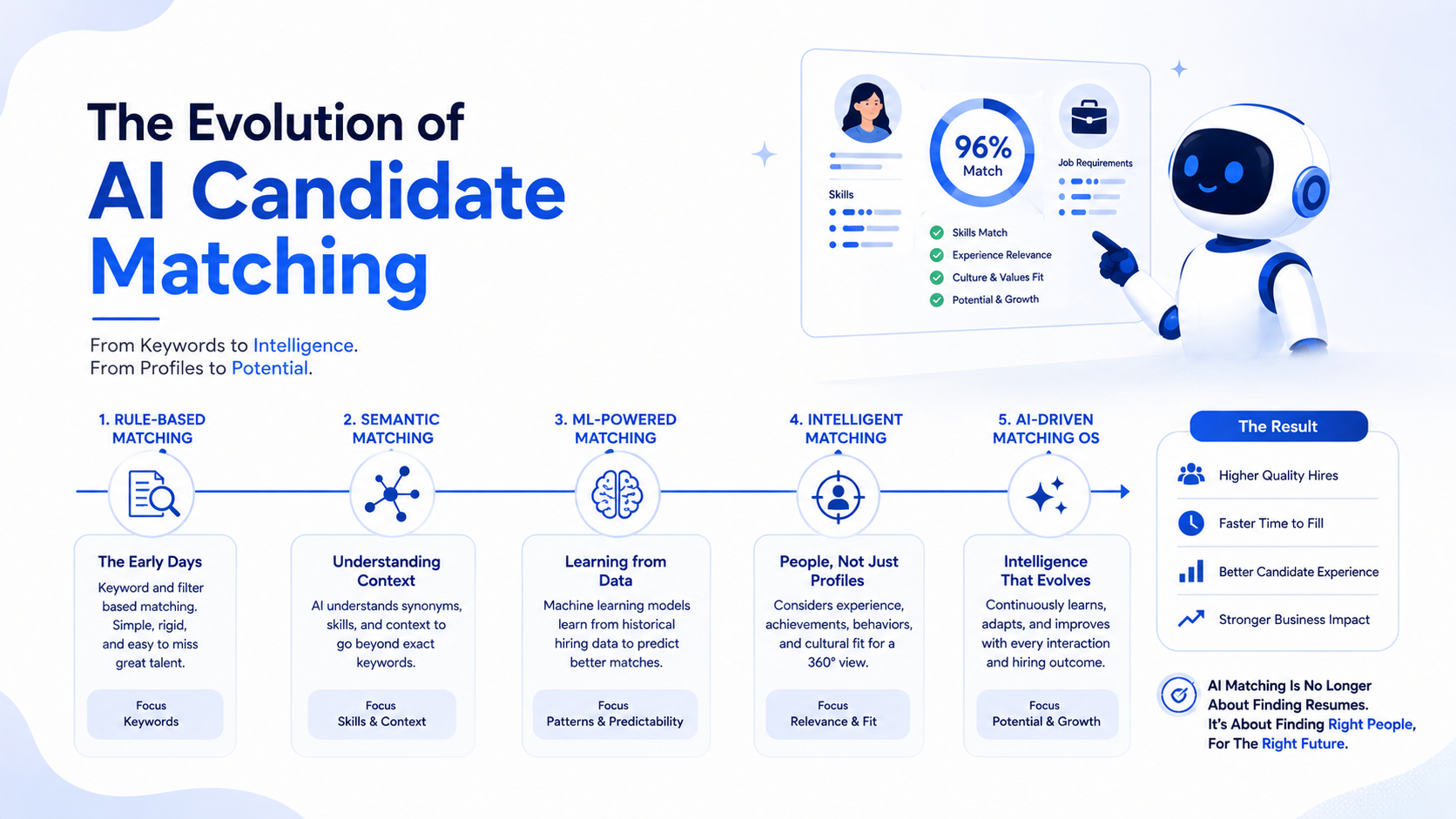
The first generation of AI-assisted candidate matching was built on keyword filtering. Systems parsed resumes, extracted terms, and compared them against the keywords in a job description. A candidate whose resume contained more of the required keywords received a higher match score. This approach was a meaningful improvement over fully manual resume review because it could process thousands of applications in seconds and apply consistent criteria to every candidate. But it had fundamental limitations that became increasingly apparent as organizations gained experience with it. Keyword matching could not distinguish between
a candidate who had used a skill extensively and one who had merely mentioned it in passing. It could not recognize that a candidate with equivalent experience under a different job title was equally qualified. And it could not learn from hiring outcomes to improve its accuracy over time.
The most damaging consequence of keyword matching was not its inaccuracy but the behavior it incentivized. Recruiters learned that the way to get better candidates from the system was to optimize job descriptions for keyword coverage, which meant adding every possible synonym and related term. The job descriptions became longer, less readable, and less useful for actual candidate communication. Candidates learned that the way to get through the screening was to optimize their resumes for keyword density, which meant the resumes became less honest representations of their actual capabilities. Both sides were optimizing for the algorithm rather than for the quality of the hiring decision, and the algorithm was too simple to prevent this gaming behavior.
Despite these limitations, keyword filtering established the foundational principle that AI could accelerate the initial candidate evaluation stage. Deloitte research on early recruitment automation found that organizations implementing keyword screening reduced screening time by sixty to seventy percent, creating the operational headroom that later generations of matching technology would exploit. It also created the data infrastructure that later generations of matching technology would build on. Organizations that implemented keyword screening systems began collecting structured data about which candidates were screened in, which advanced to interviews, and which were ultimately hired. This outcome data, imperfect as it was, became the training material for the more sophisticated matching systems that followed. The transition from keyword filtering to the next generation was not a rejection of the first generation but an evolution that used its data as a foundation.
Generation Two: Semantic Matching
The second generation of AI candidate matching introduced semantic understanding. Instead of comparing keywords directly, semantic matching systems used natural language processing to understand the meaning behind the words. They could recognize that a candidate who described experience building recommendation engines had relevant capabilities for a machine learning role even if the phrase machine learning never appeared on their resume. They could identify that a senior software engineer and a principal developer were likely equivalent roles even though the titles differed. This semantic understanding addressed the most obvious failure mode of keyword matching, which was its inability to recognize qualified candidates who used different language than the job description.
LinkedIn data on semantic matching adoption shows that organizations that upgraded from keyword to semantic matching saw a twenty to thirty percent increase in the diversity of candidates advancing to interview stages. The improvement came not because the semantic system was better at identifying the same candidates that keyword matching would have found,
but because it discovered qualified candidates that keyword matching had missed entirely. This broader candidate surface area is particularly valuable for specialized roles where the talent pool is small and the relevant experience can be described in many different ways. The research on AI tools for niche technical roles demonstrates this effect clearly, as semantic matching platforms consistently outperform keyword systems for technical and specialized roles where candidates use varied terminology.
However, semantic matching still had a significant limitation. It was better at understanding what a candidate had done, but it was not meaningfully better at predicting whether a candidate would succeed in a specific role at a specific organization. A semantic matching system could identify that a candidate had relevant experience, but it could not weight the relative importance of different experiences, account for the specific team dynamics of the hiring organization, or learn from the outcomes of previous hires to refine its assessments. Semantic matching answered the question of whether a candidate was qualified. It did not answer the question of whether the candidate was the right fit. That capability would require a third generation of technology.
Generation Three: Predictive Matching
The third and current generation of AI candidate matching is predictive matching. Rather than comparing a candidate profile against a job description, predictive matching systems analyze historical hiring data to identify the characteristics, experiences, and signals that actually predict success in a specific role at a specific organization. The system learns from every hire, every resignation, and every performance review to build models that become more accurate over time. A candidate is not matched because their profile contains the right words. They are matched because candidates with similar profiles have historically succeeded in similar roles at the same organization.
The distinction between semantic matching and predictive matching is the difference between qualification and fit. Semantic matching asks whether a candidate can do the job. Predictive matching asks whether a candidate will thrive in the role based on what the organization has learned about what makes people successful there. McKinsey research on AI in hiring decisions finds that predictive matching systems produce measurably better hiring outcomes than semantic matching systems, particularly for complex roles where success depends on factors like adaptability, learning velocity, and cultural alignment that are not easily captured by resume analysis. The improvement is not marginal. Organizations that deploy predictive matching report fifteen to twenty-five percent better ninety-day performance ratings for new hires compared to semantic matching.
The critical enabler of predictive matching is outcome data. A predictive system requires a record of which candidates were hired, how they performed, and whether they remained with the organization. This data requirement means that predictive matching is not equally accessible to every organization. Companies with high hiring volume, structured performance
management, and low turnover have richer outcome data and therefore better-trained models. Companies with low hiring volume, informal performance assessment, or high early turnover have thinner data and less accurate predictions. Deloitte analysis of AI matching readiness finds that data quality and data volume are the primary determinants of predictive matching performance, more important than the specific algorithm or platform chosen.
Beyond the Resume: Signal-Based Matching
The most advanced form of candidate matching goes beyond resume data entirely and incorporates behavioral signals, engagement patterns, and real-time market information. A signal-based matching system does not just ask what a candidate claims to have done. It evaluates how the candidate behaves in the talent market, how responsive they are to outreach, how their career trajectory has evolved over time, and how their skills compare to market demand. A candidate who has been consistently promoted, has strong peer endorsements, and has demonstrated increasing scope of responsibility is a different match signal than a candidate with similar resume keywords but a flat career trajectory.
This signal-based approach is particularly relevant for passive candidates who are not actively applying and whose resumes may not be current. The research on why AI tools have outdated candidate data demonstrates that candidate data in many sourcing databases becomes stale quickly, and matching against stale data produces unreliable results. Signal-based matching addresses this problem by weighting recent signals more heavily than historical ones and by cross-referencing multiple data sources to detect changes in a candidate status. A candidate who changed roles three months ago, added new skills, or started engaging with new content on professional networks will be evaluated based on their current profile, not their historical record.
The practical impact of signal-based matching is a qualitative shift in the types of candidates that surface at the top of match lists. Keyword and semantic systems tend to rank candidates who look most similar to the job description. Signal-based systems rank candidates who are most likely to succeed, which may include candidates with non-traditional backgrounds, career changers, or people from adjacent industries who bring transferable capabilities. This broader definition of match quality is what enables organizations to access talent pools that earlier generations of matching technology could not reach. EY research on next-generation talent matching finds that signal-based approaches expand the effective talent pool by twenty to thirty-five percent for most role types, because they eliminate the linguistic and structural biases that constrain keyword and semantic systems.
How Matching Quality Compounds Over Time
The most important difference between the three generations of matching technology is not their day-one performance but their performance trajectory over time. Keyword matching
provides the same quality on day one thousand as on day one, because the matching logic does not change. Semantic matching provides slightly better quality over time as the system processes more job descriptions and resumes, but the improvement is marginal because the underlying NLP models are typically pre-trained and not continuously updated based on hiring outcomes. Predictive matching provides substantially better quality over time because it actively learns from every hiring outcome, refining its models with each data point.
This compounding effect is the defining economic advantage of predictive matching over earlier generations. Gartner analysis of AI matching platform ROI finds that the cost-performance gap between predictive and keyword matching widens significantly over a three-year horizon. In year one, the difference in hiring quality might justify a moderate premium for the predictive platform. By year three, the predictive platform is delivering substantially better results at a lower effective cost per hire, because the improving match quality reduces time-to-fill, decreases early attrition, and increases the performance of new hires. The organizations that adopted predictive matching earliest are now operating with models that have been trained on years of outcome data, creating a competitive advantage that late adopters will take time to close.
The question of how many follow-ups one hire needs is also relevant to matching evolution. As matching systems improve their ability to identify the right candidates, the follow-up and engagement process becomes more efficient because recruiters are investing their time in candidates who are genuinely good fits rather than candidates who looked good on paper but are not actually suitable. Better matching means fewer candidates to engage per hire, which means more time per candidate, which means higher conversion rates. This is the compounding benefit that emerges when matching quality improves: it does not just make the matching stage better, it makes every downstream stage more efficient as well.
Matching as a Strategic Capability
Most organizations still treat candidate matching as a tactical recruiting function, a screening step that happens after sourcing and before interviewing. The most advanced organizations are beginning to treat matching as a strategic capability that informs decisions far beyond individual hiring. When a matching system has accumulated enough data to understand what predicts success across multiple role types, it can identify capability patterns that the organization did not previously recognize. It might reveal, for example, that the most successful product managers share a specific combination of technical background and cross-functional experience that was not part of the original job specification. Or that candidates from certain industries outperform candidates from others, even when their resumes look similar.
The research on AI sourcing vs AI recruiting is directly relevant here because the line between sourcing and matching is blurring. In the earliest generation of technology, sourcing and matching were completely separate functions. Sourcing identified candidates, and matching evaluated them. In the current generation, AI platforms perform both functions
simultaneously, discovering candidates and evaluating their fit in a single integrated process. This convergence means that the quality of matching directly affects the quality of sourcing, because a matching system that understands what predicts success can guide the sourcing system toward candidates who exhibit those success signals rather than toward candidates who merely match a keyword profile.
Organizations that treat matching as a strategic capability use it to inform workforce planning, skills gap analysis, and internal mobility decisions in addition to external hiring. A matching system that knows what predicts success can identify current employees who have the potential to succeed in new roles as the organization evolves. It can highlight skills gaps in the existing workforce that need to be addressed through hiring or development. And it can provide hiring managers with evidence-based guidance on what to look for in candidates, replacing gut-feeling job specifications with data-driven candidate profiles. SHRM guidance on strategic talent acquisition recommends that organizations elevate matching from a screening tool to a strategic decision-support system that informs multiple dimensions of talent strategy.
The Referral Advantage in an AI Matching World
Employee referrals have long been recognized as the highest-quality source of hires, and the reason is instructive for understanding AI matching. When an employee refers a candidate, they are implicitly performing a sophisticated matching calculation based on their knowledge of the role requirements, the team culture, and the candidate capabilities. They are not matching keywords. They are predicting fit based on contextual knowledge that no algorithm can fully replicate. The research on why referrals outperform cold outreach shows that referred candidates consistently outperform other sourcing channels on every success metric, including performance ratings, retention, and time-to-productivity, precisely because the referral process is fundamentally a human predictive matching exercise.
The goal of AI candidate matching is not to replace this human judgment but to approximate it at scale. The best AI matching systems attempt to capture the same kind of contextual understanding that an employee brings to a referral decision, but they do it for every candidate in the talent pool rather than just the candidates that employees happen to know. This means the AI matching system is essentially trying to democratize the referral advantage, providing every candidate with the kind of contextual evaluation that only referred candidates previously received. When AI matching works well, the gap between referred and non-referred hire quality narrows, not because referrals become less valuable but because non-referred candidates benefit from the same kind of thoughtful evaluation.
The organizations that will benefit most from AI matching evolution are those that combine the technology with strong human judgment rather than those that rely on the technology alone. The matching system identifies candidates who are predicted to succeed. Recruiters and hiring managers evaluate those predictions, provide feedback on which ones were accurate and which were not, and make the final decision based on factors that the algorithm
cannot assess. This human-AI collaboration produces better outcomes than either could achieve independently. LinkedIn research on recruiter-AI collaboration patterns finds that the most effective matching workflows involve recruiters systematically rating the quality of AI recommendations, which creates a feedback loop that accelerates model improvement. Gartner and McKinsey both find that the most successful AI matching implementations are those where recruiters actively engage with the system recommendations rather than passively accepting them, because human feedback accelerates the system learning and catches prediction errors before they become hiring mistakes.