Nina Rostova, VP of Talent Acquisition at a mid-size SaaS company in Denver, had just finished a budget review that laid bare the full cost of her recruiting operation. Her team of fourteen recruiters and three coordinators cost the company two point four million dollars annually in compensation alone. Add job board subscriptions, agency fees, applicant tracking system licensing, and recruitment marketing spend, and the total talent acquisition budget exceeded four point one million dollars. When Nina divided this budget by the three hundred and twelve hires her team made in the previous year, the fully loaded cost per hire came to roughly thirteen thousand one hundred dollars. Industry benchmarks suggested this was within normal range, but Nina had recently seen a competitor's case study showing a cost per hire of seven thousand eight hundred dollars using AI-powered tools with a team half the size of hers. The number nagged at her not because she believed it was achievable overnight but because it represented a fundamentally different economic model for recruiting, one where technology amplified human productivity rather than simply supporting it. She needed to understand the real economics of AI in recruitment, not the vendor marketing claims but the actual costs, savings, and return dynamics that would determine whether investing in AI would strengthen or strain her budget.
The True Cost of Traditional Recruiting
Before evaluating the economics of AI in recruitment, it is essential to establish an accurate baseline for the cost of traditional recruiting, because most organizations significantly underestimate what they actually spend on talent acquisition. The most common mistake is calculating cost per hire using only direct recruitment expenses such as job board fees, agency commissions, and recruiter salaries. This calculation ignores the substantial indirect costs that
recruiting imposes on the organization. Hiring manager time spent reviewing resumes, conducting interviews, and providing feedback represents one of the largest components of total hiring cost, and it is almost never included in recruitment budget calculations. When a hiring manager spends eight to twelve hours on a single search, and the average manager salary including benefits exceeds one hundred fifty thousand dollars, the manager's time cost per hire alone can range from six hundred to twelve hundred dollars. For senior roles where multiple interview rounds involve several managers, this cost multiplies rapidly. Training and onboarding costs for new hires who do not remain beyond their first year represent another frequently overlooked expense. According to SHRM, the total cost of a failed hire, including recruitment costs, onboarding investment, productivity loss during the vacancy, and the cost of replacing the failed hire, ranges from fifty to two hundred percent of the position's annual salary, making placement quality one of the most economically significant variables in the recruitment equation.
The operational inefficiency of traditional recruiting further inflates costs in ways that are difficult to measure but impossible to ignore. Recruiters spend a substantial portion of their time on activities that do not directly contribute to hiring outcomes: manually sourcing candidates from multiple platforms, formatting and reformatting candidate presentations for different hiring managers, scheduling interviews across conflicting calendars, and updating tracking spreadsheets and applicant tracking systems. Industry research consistently shows that recruiters in traditional environments spend forty to sixty percent of their time on administrative and coordination tasks rather than on the relationship-building and assessment activities that actually influence hiring quality. This means that a recruiting team costing two million dollars annually may be delivering only eight hundred thousand to one point two million dollars of productive hiring value, with the remainder consumed by operational overhead that AI could handle at a fraction of the cost. The economic implication is that AI does not need to replace recruiters to deliver significant cost savings. It needs to automate the forty to sixty percent of recruiter time that is spent on non-productive activities, freeing that expensive human capacity for work that directly impacts hiring outcomes.
The time dimension of recruitment cost is equally important but frequently ignored. Every open position represents a cost to the organization in the form of lost productivity, delayed project timelines, and overworked team members who absorb the vacant role's responsibilities. The economic impact of a prolonged vacancy depends on the role's revenue contribution, but for customer-facing and revenue-generating positions, the cost of an open role can exceed the role's daily compensation by a factor of three to five. Traditional recruiting processes, with their manual sourcing, sequential screening stages, and scheduling delays, produce time-to-fill metrics that are significantly longer than AI-enabled processes. When AI reduces time-to-fill from forty-five days to twenty-five days, the economic benefit is not merely the recruiter time saved but the twenty days of recovered productivity and revenue that the organization gains from filling the role faster. how many follow-ups one hire needs highlights how delays in candidate follow-up extend time-to-fill and increase vacancy costs, because candidates lose interest when communication gaps exist between stages, and the resulting candidate drop-out forces the recruiter to restart the sourcing process, compounding both the time
and cost of the hire.
Understanding AI Implementation Costs Accurately
The investment required to implement AI in recruitment spans four categories: technology licensing, data preparation, organizational change management, and ongoing optimization. Technology licensing is the most visible cost and the one most organizations focus on, but it is typically the smallest component of the total investment. AI recruiting platforms range from five hundred to five thousand dollars per month depending on the scale of the deployment and the sophistication of the capabilities, making the annual technology cost between six thousand and sixty thousand dollars for most mid-size organizations. Data preparation is a less visible but often more expensive component. AI systems require clean, structured, and comprehensive data to function effectively, and most organizations' candidate databases, job requisition histories, and placement records are not in the condition that AI platforms need. Data cleaning, deduplication, standardization, and migration can cost anywhere from ten thousand to fifty thousand dollars depending on the volume and state of the existing data, and this cost is frequently underestimated because organizations assume their data is in better shape than it actually is.
Organizational change management is the third and most commonly overlooked cost category. Implementing AI recruiting tools requires training recruiters to work alongside AI, redesigning workflows to leverage AI capabilities, and managing the cultural resistance that inevitably arises when technology changes how people work. Effective change management for AI in recruitment typically requires three to six months of dedicated effort, including hands-on training programs, pilot implementations with selected teams, feedback collection and process refinement, and ongoing support as the organization scales AI usage beyond the initial pilot. The cost of this change management effort, including internal staff time, external consulting support if used, and productivity dips during the transition, typically ranges from twenty to forty percent of the first-year technology investment. Organizations that skip or underinvest in change management consistently report lower adoption rates and smaller returns from their AI investment. According to McKinsey, the primary reason organizations report disappointment with AI recruitment investments is not technology failure but inadequate change management, because the technology performs as designed but the organization does not adapt its processes and behaviors to leverage the technology's capabilities effectively.
The fourth cost category, ongoing optimization, is often treated as optional but is in fact essential for realizing the full economic value of AI in recruitment. AI models are not static. They require continuous monitoring, periodic retraining, and regular adjustment as the talent market, the organization's hiring needs, and the available data evolve. Organizations that treat AI implementation as a one-time project rather than an ongoing program typically see AI performance degrade within six to twelve months as the models become stale and the gap between the AI's training data and current market conditions widens. The ongoing optimization cost, including platform vendor fees for model updates, internal analytics staff time for
performance monitoring, and periodic process adjustments, typically ranges from fifteen to twenty-five percent of the initial implementation cost annually. This is not a cost that can be eliminated without sacrificing the AI's effectiveness, but it is a cost that can be managed and optimized over time as the organization develops internal AI expertise and reduces its dependence on external support. more tools same hiring problems explains why organizations that treat AI tool adoption as a one-time purchase rather than an ongoing program consistently underperform in their ROI, because the lack of continuous optimization allows the tools to degrade while competitors who invest in ongoing improvement pull further ahead.
The Three Levers of AI Recruitment ROI
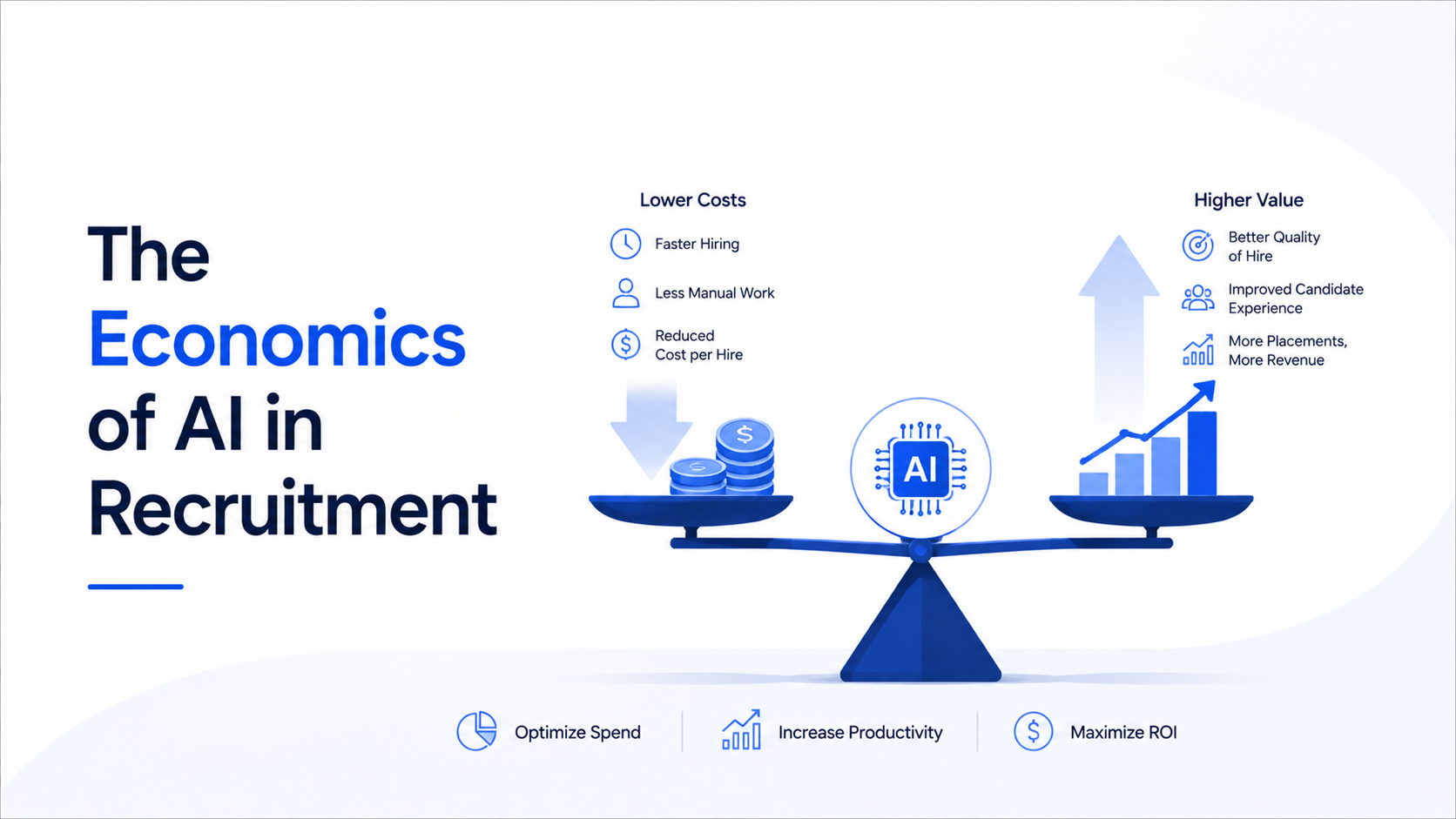
AI generates economic returns in recruitment through three distinct levers, and understanding the magnitude and timing of each lever is essential for building a realistic ROI model. The first lever is productivity multiplication, the increase in hiring output per recruiter that occurs when AI automates time-consuming tasks. When AI handles sourcing, initial screening, interview scheduling, and routine candidate communication, each recruiter can manage twenty-five to forty percent more requisitions without a proportional increase in workload. For a team of ten recruiters handling twenty requisitions each, a thirty percent productivity gain is equivalent to adding three full-time recruiters at a fraction of the cost, because the AI platform license that enables this productivity gain costs far less than three recruiter salaries plus benefits. The productivity leverage is the fastest-acting ROI lever because it reduces cost per hire almost immediately after implementation, as the same recruiting team produces more hires with the same fixed cost base. According to Gartner, organizations that implement AI recruiting tools with effective change management report fifteen to twenty-five percent reductions in cost per hire within the first year, driven primarily by recruiter productivity gains.
The second ROI lever is quality improvement, the increase in placement success rates that occurs when AI matching models identify better-fitting candidates than manual screening can achieve. The economic impact of quality improvement is larger than most organizations expect because the cost of a bad hire is substantial. When AI improves ninety-day retention rates by ten to fifteen percent, the savings from avoided bad hires can dwarf the direct cost savings from productivity improvements. Consider the math: if an organization makes three hundred hires per year at an average salary of eighty thousand dollars, and the cost of a failed hire is estimated at fifty percent of annual salary, then each percentage point improvement in retention saves approximately one hundred twenty thousand dollars in replacement costs. A ten percentage point improvement in retention therefore saves roughly one point two million dollars annually, an amount that far exceeds the typical annual investment in AI recruiting technology. The quality lever takes longer to manifest than the productivity lever because retention data accumulates over months, but the economic magnitude is significantly larger.
The third ROI lever is velocity improvement, the reduction in time-to-fill that occurs when AI accelerates sourcing, screening, and engagement. As discussed earlier, every day a position remains open carries a real economic cost in lost productivity and delayed revenue. When AI
reduces average time-to-fill by fifteen to twenty days, the cumulative economic benefit across all hires in a year can be substantial. For revenue-generating roles, the benefit of filling a position twenty days earlier can be estimated as twenty days of the position's daily revenue contribution, which for a sales role generating five hundred thousand dollars in annual revenue translates to roughly twenty-seven thousand dollars in recovered revenue per position. Across three hundred hires, even if only half are revenue-generating roles, the velocity benefit alone can exceed four million dollars. The three levers compound over time: productivity gains in year one fund the data accumulation that drives quality improvements in year two, which in turn produces the hiring outcomes and organizational reputation that accelerate velocity in year three. This compounding dynamic means that the ROI of AI in recruitment grows over time rather than plateauing, making early investment particularly valuable. agentic AI platforms vs automated ones explains how agentic AI platforms maximize all three ROI levers simultaneously, because the coordinated, autonomous execution of sourcing, screening, and engagement tasks produces productivity, quality, and velocity improvements in parallel rather than requiring separate investments for each.
Building an AI Recruitment ROI Model
For talent acquisition leaders who need to justify AI investment to their finance teams and executive leadership, a structured ROI model is essential. The model should be built in three phases. Phase one covers months zero through six and focuses on implementation costs. This includes platform licensing fees, data preparation, change management, and the productivity dip that typically occurs during the transition period. Phase one is entirely cost with minimal return, and the model should present this honestly rather than promising immediate savings that will not materialize. Phase two covers months seven through eighteen and captures the initial returns from productivity multiplication. During this phase, recruiter productivity improves as the AI tools are adopted and workflows are optimized, cost per hire begins to decline, and the organization starts accumulating the hiring outcome data that will drive quality improvements. Phase two typically shows a positive but modest ROI as the productivity gains offset the ongoing costs. Phase three covers months nineteen through thirty-six and captures the compounding returns from quality improvement and velocity enhancement. During this phase, the AI models have accumulated enough outcome data to produce meaningful quality improvements, time-to-fill reductions translate into measurable vacancy cost savings, and the combination of all three levers produces a significantly positive ROI.
The specific numbers in the ROI model should be calibrated to the organization's actual recruitment data rather than relying on industry averages. The starting point is the organization's current cost per hire, calculated using a fully loaded methodology that includes recruiter compensation, job board and agency fees, technology costs, hiring manager time, and onboarding investment. The next input is the organization's current time-to-fill and the estimated cost of vacancy per day for the role categories being targeted. The third input is the organization's current new-hire retention rate at ninety days and one year, because these rates determine the magnitude of the quality improvement lever. With these baseline numbers
established, the model applies conservative estimates for AI's impact on each variable: twenty percent productivity improvement, ten percent retention improvement, and fifteen-day time-to-fill reduction. These are deliberately conservative estimates, because most organizations achieve greater improvements than these figures suggest, and a model that underpromises and overdelivers is far more credible with finance teams than one that promises transformative results and delivers incremental improvements. According to Deloitte, the most successful AI investment business cases in talent acquisition are those that use the organization's own data for baseline calculations and apply conservative impact estimates, because finance teams trust internal data and discount vendor-provided benchmarks, and conservative estimates create room for positive surprises that build organizational confidence in the investment.
The ROI model should also include sensitivity analysis that shows how returns change under different assumptions. What happens if productivity gains are only ten percent instead of twenty? What if retention improvement takes eighteen months rather than twelve to materialize? What if the organization's data quality requires more extensive preparation than initially estimated? Presenting these scenarios demonstrates to decision-makers that the investment has been rigorously evaluated and that the organization understands the range of possible outcomes. The model should identify the break-even point, the point in time at which cumulative savings exceed cumulative investment, because this number gives leadership a clear timeframe for when they can expect the investment to pay for itself. For most mid-size organizations, the break-even point falls between twelve and eighteen months after implementation, depending on the scale of the investment and the organization's hiring volume. Organizations with higher hiring volumes reach break-even faster because the per-hire savings accumulate more quickly. how to evaluate an AI sourcing tool provides guidance on evaluating AI recruiting platforms based on their projected ROI contribution, because the platform's pricing model, data requirements, and time-to-value all affect the break-even calculation, and selecting a platform with a faster time-to-value and lower data preparation requirements can significantly shorten the path to positive ROI.
The Strategic Cost of Not Investing in AI
While building a financial case for AI investment is important, talent acquisition leaders should also present the strategic cost of not investing, because this framing often resonates more powerfully with executive leadership than positive ROI projections alone. The most immediate strategic cost is competitive disadvantage in talent acquisition. As more organizations deploy AI-powered recruiting, the candidates who are most in demand, the passive, high-performing professionals who have multiple options, increasingly expect a recruitment experience that is fast, personalized, and respectful of their time. Organizations using manual recruiting processes cannot match this experience. Their response times are slower, their candidate communications are less personalized, and their assessment processes feel bureaucratic compared to the streamlined, AI-enabled experiences that competing employers offer. The result is that non-AI organizations lose top candidates to AI-equipped competitors, not because they cannot identify these candidates but because their recruitment experience fails to engage
and impress them. According to EY, organizations that have not adopted AI recruiting tools report thirty to forty percent higher offer decline rates from top-tier candidates compared to AI-equipped organizations, because candidates compare their recruiting experience across employers and favor those that demonstrate professionalism, responsiveness, and respect through their hiring processes.
The second strategic cost is recruiter attrition. The best recruiters, the professionals who combine sourcing skill, assessment acumen, and relationship expertise, are increasingly attracted to organizations that provide AI tools that amplify their capabilities. Working without AI tools means doing more manual work for the same or lower compensation compared to peers at AI-equipped organizations. This disparity drives talented recruiters to leave for employers who offer better technology, creating a vicious cycle where the organizations that most need AI to improve their recruiting are the ones losing the recruiters who would benefit from it most. Replacing an experienced recruiter costs fifty to seventy-five percent of their annual compensation when accounting for recruitment, training, and productivity ramp-up costs, and the institutional knowledge that walks out the door with each departing recruiter is irreplaceable. The recruiter retention dimension of AI investment is often overlooked in ROI models, but for organizations with ten or more recruiters, the retention benefit of AI adoption can represent several hundred thousand dollars in avoided turnover costs annually.
The third strategic cost is the compounding data disadvantage. Every organization that deploys AI in recruitment begins accumulating proprietary hiring data that improves its AI models over time. Organizations that delay AI adoption fall further behind with each passing month, because they are not building the data assets that power continuous improvement. When they eventually implement AI, they will be starting from zero while competitors have two, three, or more years of accumulated training data and model refinement. This data gap is not easily closed, because the quality of AI recommendations depends on the volume and relevance of the training data, and organizations that start later will have less of both. The strategic implication is that AI investment in recruitment has a first-mover advantage component that does not exist for most other recruiting technology investments. An organization that invests in AI today is not just buying a tool. It is beginning to build a data-driven intelligence asset that will appreciate in value over time and that competitors who delay will find increasingly expensive and difficult to replicate. why AI tools have outdated candidate data illustrates how organizations that rely on outdated approaches to candidate data and recruiting processes face an accelerating disadvantage as AI-equipped competitors build superior candidate intelligence, because the gap between AI-powered and manual recruiting widens over time as the AI systems learn and improve while manual processes remain static.