Priya Mehta, chief operating officer at a global executive search firm headquartered in Singapore, had spent the past eighteen months watching her firm's most significant client relationship erode not because of poor performance but because of insufficient data. The client, a multinational technology corporation, had begun requesting talent market analyses, compensation benchmarking across competitor organizations, workforce mobility trend reports, and predictive models showing candidate availability for critical leadership roles. Priya's firm could deliver excellent candidates, but it could not deliver the data-driven strategic insights that the client's human resources leadership now expected as a standard part of every engagement. The client had not reduced their hiring volume with Priya's firm, but they had started supplementing the relationship with a specialist talent analytics provider who could deliver the data products that the search firm could not. Priya recognized that the firm's competitive position was being undermined not by a rival search firm but by a fundamentally different type of competitor that competed on data rather than on relationships, and that the firm's decades of placement history represented a vast and largely untapped data asset that could be converted into the intelligence products her clients were increasingly demanding.
The Shift from Relationship-Driven to Data-Driven Recruiting
For decades, the recruiting industry operated on a fundamentally relationship-driven model. The value a recruitment firm delivered was primarily a function of the individual relationships its recruiters maintained with candidates and hiring managers. A recruiter who knew the right people, understood the unspoken preferences of key hiring managers, and could reach passive candidates through personal networks could deliver results that no amount of process or technology could replicate. This relationship-centric model produced a highly fragmented industry where thousands of small and mid-size firms competed effectively against larger players because the value resided in individual relationships rather than in organizational
capabilities. A star recruiter could leave a large firm, join or start a small one, and take most of their client relationships and candidate connections with them, effectively replicating the larger firm's value proposition at a fraction of the overhead. This dynamic kept the industry fragmented and prevented the emergence of dominant players who could leverage scale advantages.
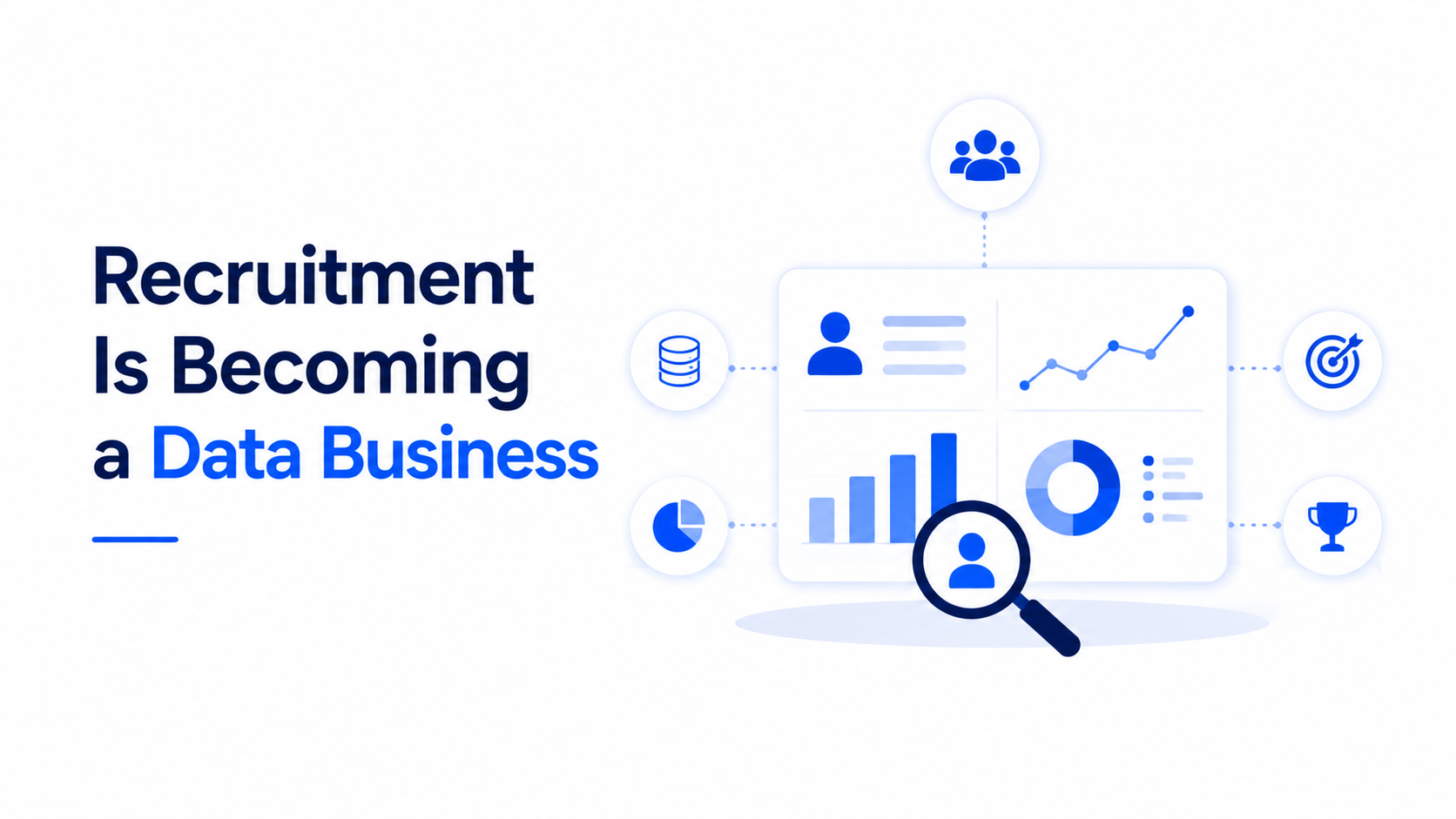
The data-driven model that is now emerging operates on fundamentally different principles. In this model, the firm's primary asset is not the individual relationships of its recruiters but the proprietary data it has accumulated through years of recruiting activity: candidate profiles with detailed assessment histories, compensation data from actual placements across hundreds of organizations, hiring outcome data tracking retention and performance over multiple years, process data showing which activities produced successful placements and which did not, and market intelligence data capturing talent mobility patterns, skill demand trends, and competitive hiring dynamics across industries and geographies. This data asset belongs to the firm, not to individual recruiters, and it grows more valuable with every engagement. A recruiter who leaves the firm loses access to the data platform, the analytical tools, and the accumulated intelligence that makes their work effective. The power dynamic shifts from the individual to the organization, and the firm's competitive position becomes more defensible because the data asset cannot be easily replicated by a competitor or transferred by a departing employee.
The transition from relationship-driven to data-driven is not a complete replacement. Relationships remain critically important, particularly at the senior end of the market where trust and personal credibility are essential for engaging passive candidates and influencing hiring decisions. But relationships are becoming a necessary condition rather than a sufficient one. A recruitment firm that has great relationships but no data capability will increasingly lose to firms that have both, because the data-equipped firm can demonstrate value through evidence, provide strategic insights that inform client decisions beyond the immediate search, and operate with a consistency and scalability that relationship-dependent firms cannot match. The most successful firms in the emerging data-driven era will be those that combine deep human relationships with proprietary data capabilities, using the data to make every relationship more productive and every client interaction more strategically valuable. agentic AI platforms vs automated ones explains how agentic AI platforms accelerate this transition by automatically capturing data from every recruiting interaction and converting it into structured intelligence, because the platform ensures that the relationship-driven work of recruiters simultaneously builds the data asset that will power the firm's future competitive advantage.
What Recruitment Data Actually Looks Like at Scale
The data that a recruitment firm accumulates over years of operation is far more comprehensive and strategically valuable than most firm owners realize. At the most basic level, every recruitment interaction generates candidate data: professional profiles, career histories, skill assessments, compensation expectations, geographic preferences, and communication
records. At the intermediate level, every placement generates transaction data: the job requirements, the candidate's profile, the client's evaluation at each stage, the compensation package offered and accepted, the time elapsed at each stage of the process, and the outcome including any counteroffers, rejections, or post-acceptance withdrawals. At the most strategic level, every client relationship generates market intelligence data: the client's hiring patterns over time, the roles they struggle to fill, the compensation ranges they offer relative to market, the competitors they lose candidates to, the candidates they lose to competitors, and the organizational dynamics that affect hiring decisions such as leadership changes, strategy shifts, and budget cycles.
The strategic value of this data emerges when it is aggregated and analyzed across hundreds or thousands of interactions. A single placement tells you what one candidate accepted. A thousand placements in a specific sector tell you the compensation distribution for every role type, the candidate profile characteristics that predict placement success, the time-to-fill distribution for each role category, the most effective sourcing channels by role type and geography, the offer acceptance rate by compensation structure and candidate segment, and the retention curves by role type, client, and placement method. This aggregated intelligence is proprietary to the firm that collected it, because no other firm has interacted with the exact same candidates, clients, and market conditions. It is also cumulative, because every new interaction adds to the dataset and potentially improves the accuracy of the analytical models built on it. According to McKinsey, professional services firms that systematically aggregate and analyze their operational data report fifteen to twenty percent higher client retention rates than firms that do not, because the data-driven insights create a level of service quality and strategic value that cannot be replicated by competitors without equivalent data assets.
The challenge for most recruitment firms is that their data is fragmented across multiple systems and stored in formats that are not designed for analysis. The applicant tracking system holds candidate profiles and process data. The customer relationship management system holds client information and interaction history. Financial systems hold billing and margin data. Email archives hold the rich unstructured content of candidate and client communications. Recruiter notes, often stored in personal files or notebooks rather than in any system at all, hold the qualitative insights about candidate motivations, client preferences, and market dynamics that are often the most strategically valuable. This fragmentation means that the firm possesses a vast data asset but cannot access or analyze it as a unified whole. The first step in becoming a data-driven recruitment business is not deploying sophisticated analytics. It is bringing the data the firm already possesses into a unified, queryable, analyzable format. This data integration effort is unglamorous but transformative, because it converts data that is currently invisible and inaccessible into a strategic asset that can drive competitive advantage. why AI tools have outdated candidate data explains why firms that continue operating with fragmented data systems are leaving their most valuable strategic asset inaccessible, because the data exists but the inability to integrate and analyze it means the firm cannot extract the insights that would differentiate it from competitors.
Turning Recruiting Data Into Client Value
The most immediate way to convert proprietary recruitment data into client value is through talent market intelligence products that go beyond what clients can obtain from generic sources. Every recruitment firm that has operated for several years in a specific market possesses unique compensation intelligence: actual offers made, actual acceptance and rejection decisions, actual counteroffer amounts, and the relationship between compensation structure and candidate conversion. This transaction-level compensation data is far more valuable to clients than published salary surveys because it reflects real-time market dynamics, includes the structural details like equity, signing bonuses, and flexible arrangements that drive candidate decisions, and is specific to the firm's actual market area and client base. A client planning a compensation review for their engineering team benefits far more from a report showing what their specific competitors are paying, based on the recruitment firm's own recent interactions with candidates from those competitors, than from a generic survey showing national or regional averages.
Candidate availability and pipeline intelligence is the second high-value data product. Recruitment firms that track their sourcing and engagement data systematically can tell clients not just whether candidates are available but how available they are relative to historical norms, which sourcing channels are currently producing the best candidates for specific role types, and how candidate responsiveness is trending over time. This intelligence helps clients set realistic expectations for hiring timelines, allocate recruiting resources effectively, and adjust their talent strategy based on real-time market conditions rather than assumptions. When a recruitment firm can tell a client that the available candidate pool for a specific role has contracted by thirty percent over the past quarter, that response rates to outreach have declined by fifteen percent, and that the average time-to-accept has increased from twelve to nineteen days, the client receives actionable strategic intelligence that directly influences their hiring strategy and budget allocation. According to Gartner, organizations that receive proactive talent market intelligence from their recruitment partners make twenty to thirty percent faster hiring decisions and report significantly higher satisfaction with their talent acquisition function, because the intelligence reduces uncertainty and enables more confident decision-making.
Placement analytics and quality insights represent the third dimension of data-driven client value. By tracking the outcomes of placements over time, including new hire performance, retention at six and twelve months, and client satisfaction scores, a recruitment firm can provide clients with evidence-based insights about what candidate characteristics predict success in their specific organization and roles. This goes far beyond the subjective assessments that recruiters have traditionally provided. When a firm can tell a client, based on analysis of fifty similar placements at that client's organization, that candidates with specific background characteristics have a seventy-five percent probability of being rated as high performers at twelve months, the firm has transformed from a candidate provider into an evidence-based talent
advisor. This analytical capability also creates a powerful feedback loop that improves the firm's own performance, because the outcome data informs better candidate matching, more effective screening criteria, and more accurate client expectations in future engagements. how to evaluate an AI sourcing tool provides a framework for recruitment firms to assess which of their data assets are most valuable to clients and should be developed into intelligence products first, because the assessment identifies the data domains where the firm's proprietary information provides the greatest differentiation from generic market intelligence sources.
The Data Infrastructure Recruitment Firms Need
Building a data-driven recruitment business requires investment in four infrastructure components. The first is a unified data platform that consolidates candidate, client, placement, and market data from all existing systems into a single, queryable data store. This does not necessarily mean replacing the firm's existing applicant tracking system or customer relationship management platform. It means building an integration layer that connects these systems, extracts the relevant data, normalizes it into consistent formats, and stores it in a centralized repository that analytical tools can access. The integration layer can be built using modern data pipeline tools that connect to existing systems through APIs and automate the data extraction and normalization process. The key requirement is that the unified platform must be comprehensive enough to support cross-functional analysis and consistent enough to produce reliable insights. Incomplete or inconsistent data produces misleading analytics, which is worse than no analytics at all because it can lead to poor decisions.
The second component is an analytics layer that provides the tools for querying, visualizing, and deriving insights from the unified data. This layer can range from simple business intelligence dashboards that display key metrics and trends to more sophisticated analytical tools that support predictive modeling, segmentation analysis, and recommendation engines. The appropriate level of analytical sophistication depends on the firm's size, market focus, and client expectations, but even basic analytics, such as fill-rate tracking by role type, compensation trend analysis, and candidate source effectiveness reporting, provide significant value. The third component is a data governance framework that defines data quality standards, access controls, and update processes. Data governance is often the least exciting aspect of data infrastructure investment, but it is the most critical for long-term success, because without consistent data quality standards, the analytical insights derived from the data will degrade over time as inconsistencies accumulate. According to Deloitte, professional services firms that invest in data governance as a parallel track to their analytics deployment report forty to fifty percent higher confidence in their analytical outputs and are three times more likely to sustain their data-driven capabilities over multiple years, because governance prevents the data quality degradation that causes analytics initiatives to fail.
The fourth component is the talent and skills needed to operate the data infrastructure and produce client-facing intelligence products. This does not necessarily require hiring a dedicated data science team. Many recruitment firms begin their data transformation by designating
a data champion within the existing team, providing them with analytics training, and giving them the mandate and time to build the firm's analytical capabilities. As the data practice matures and the value of intelligence products becomes clear, the firm can invest in more specialized analytical talent. The most important skill is not technical expertise but analytical curiosity, the ability to look at the firm's data and ask questions that lead to valuable insights. A recruiter with strong analytical instincts who understands the business context of the data will produce more valuable insights than a data scientist who has deep technical skills but no understanding of the recruiting industry. The ideal data team in a recruitment firm combines domain expertise with analytical capability, and the most effective path to building this team is usually to develop analytical skills in existing recruiting talent rather than to hire externally for technical skills alone. AI sourcing vs AI recruiting explains why the firms that succeed in building data capabilities are those that start with the data their recruiting operations already generate, because this approach leverages existing domain knowledge and ensures the analytics address real business questions rather than theoretical ones.
The Revenue Opportunity in Recruitment Data
The transition to a data-driven model creates revenue opportunities that extend well beyond traditional placement fees. The most direct opportunity is charging for intelligence products as standalone services. Talent market reports, compensation benchmarking analyses, candidate availability assessments, and competitive hiring intelligence are all products that recruitment firms can sell to clients independently of search engagements. These products have higher margins than traditional placement services because they leverage data the firm already owns, require minimal incremental cost to produce once the analytical infrastructure is in place, and can be sold repeatedly to multiple clients. A comprehensive quarterly talent market report for a specific industry sector, for example, can be produced from the firm's existing data and sold to multiple clients in that sector, generating revenue without any incremental recruiting effort. The intelligence product revenue stream also creates more stable and predictable income than placement fees, which fluctuate with hiring volumes and are inherently lumpy.
The second revenue opportunity is using data-driven insights to win and retain higher-value client engagements. When a recruitment firm can demonstrate proprietary intelligence that informs a client's talent strategy, the firm is no longer competing solely on placement capabilities but on strategic advisory value. This shifts the competitive dynamic in the firm's favor, because strategic advisory relationships are deeper, longer-lasting, and less price-sensitive than transactional placement arrangements. Clients who rely on a recruitment firm for talent intelligence are far less likely to switch to a competitor, because the intelligence is proprietary to the firm and cannot be replicated by switching providers. This intelligence-based retention creates a more stable revenue base and reduces the client acquisition costs that consume a significant share of many firms' margins. According to LinkedIn, recruitment firms that offer data-driven intelligence as part of their client service portfolio report twenty-five to thirty-five percent higher client retention rates and fifteen to twenty percent higher average contract
values compared to firms that offer placement services alone, because the intelligence creates dependency and the advisory relationship commands premium pricing.
The third revenue opportunity, and the most transformative, is using data to create entirely new service categories that do not exist in the traditional recruitment model. Workforce planning support, where the firm uses its data to help clients forecast hiring needs and develop talent strategies, is a natural extension of the intelligence capability. Talent risk assessment, where the firm analyzes a client's workforce data to identify roles at high risk of turnover and recommends proactive retention strategies, is another. Employer brand intelligence, where the firm provides clients with data on how they are perceived by candidates in the market relative to competitors, is a third. These services position the recruitment firm not as a vendor that fills open roles but as a strategic talent partner that helps the client manage their entire talent ecosystem. The pricing power, client retention, and competitive differentiation of these strategic services far exceed what traditional placement services can command, and they represent the ultimate expression of the data-driven recruitment business model. more tools same hiring problems explains why the firms that capture the most value from their data are those that package it into strategic services rather than using it only to improve operational efficiency, because strategic services command premium pricing and create deeper client relationships that operational improvements alone cannot achieve.