Priya Mehta, VP of Talent Acquisition at a fintech company in London, had built her team's tech stack the way most TA leaders do, by adding tools one at a time as specific needs emerged. An AI sourcing tool for finding candidates. A separate AI screening tool for ranking them. An automated scheduling tool for booking interviews. A chatbot for answering candidate questions. An analytics dashboard for tracking pipeline metrics. Each tool worked reasonably well in isolation. The problem was that they did not work together. When the sourcing tool identified a promising candidate, a recruiter had to manually export the profile into the screening tool. When the screening tool advanced a candidate, someone had to trigger the scheduling tool. When a candidate responded to the chatbot with a question about compensation, the answer came from a knowledge base that had not been updated to reflect the latest comp structure the hiring manager had approved. The result was a fragmented experience for both candidates and recruiters, with information gaps at every handoff between tools. Priya realized that what she needed was not more tools but a system where AI agents worked together, sharing context and coordinating actions the way a well-run recruiting team does. The technology she was looking for is called multi-agent AI.
From Single-Tool Stacks to Coordinated AI Teams
The current state of AI in recruitment is dominated by single-purpose tools, each designed to automate one part of the hiring process. An AI sourcing tool identifies potential candidates. An AI screening tool ranks them against job requirements. An AI engagement tool sends personalized outreach. An AI scheduling tool coordinates interviews. Each of these tools operates within its own data silo, using its own understanding of the candidate, and producing outputs that must be manually transferred to the next tool in the chain. This architecture was a reasonable first step in applying AI to recruiting, because it allowed organizations to adopt AI
incrementally and demonstrate value in specific areas before committing to broader transformation. But it has reached the limits of what it can deliver, because the handoffs between tools create information loss, timing delays, and coordination failures that undermine the efficiency gains each tool provides in isolation.
Multi-agent AI systems represent the next architectural evolution. Instead of separate tools that require human coordination, a multi-agent system deploys multiple specialized AI agents within a shared environment where they can communicate, share context, and coordinate their actions autonomously. A sourcing agent identifies a candidate and passes not just the candidate's profile but its full interaction history and assessment to an engagement agent, which crafts outreach informed by everything the sourcing agent learned. The engagement agent's conversation with the candidate generates new information, such as the candidate's availability constraints and compensation expectations, which flows automatically to a scheduling agent that proposes interview times without requiring a recruiter to relay the information. According to McKinsey, organizations using multi-agent AI systems in talent acquisition report thirty-five to fifty percent shorter end-to-end hiring cycles compared to organizations using equivalent single-tool stacks, because the elimination of manual handoffs removes the primary source of process delay.
The distinction between multi-agent systems and traditional tool stacks is not just architectural but experiential. For candidates, a multi-agent system provides a seamless experience where every interaction reflects the full context of their engagement. They do not have to repeat information they already provided to a different tool or a different recruiter. For recruiters, a multi-agent system provides a unified view of every candidate and every open role, with AI agents handling the coordination tasks that previously consumed the majority of their working time. The recruiter's role shifts from managing handoffs between tools to setting strategy, reviewing agent recommendations, and engaging directly with candidates at the moments that require human judgment. agentic AI platforms vs automated ones explains this distinction in detail, because the difference between an AI tool that automates a single task and an AI agent that operates autonomously within a coordinated system is the difference between incremental efficiency and structural transformation of the recruiting function.
How Multi-Agent Recruiting Systems Actually Work
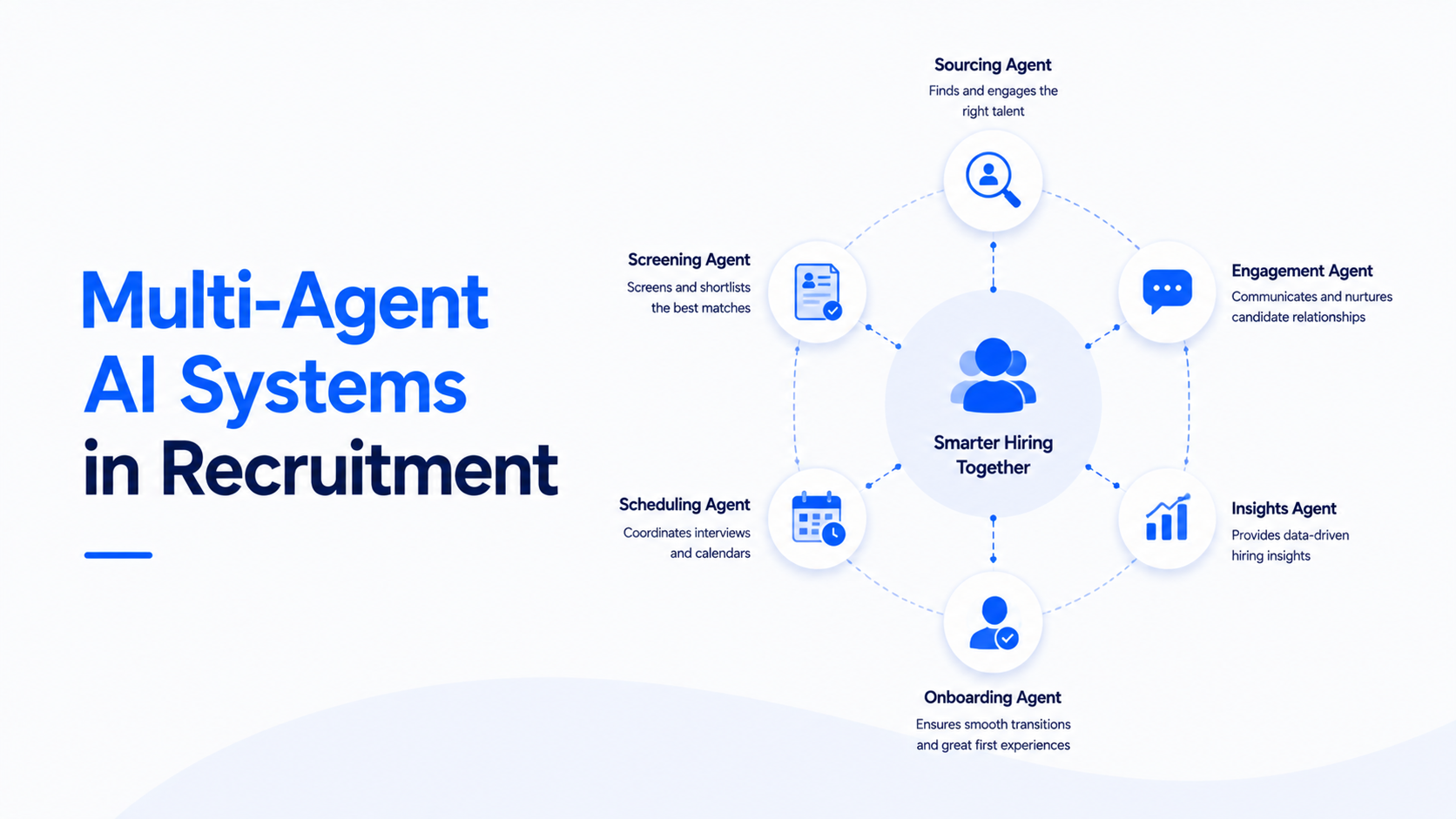
A multi-agent recruiting system typically includes several specialized agents, each responsible for a distinct aspect of the hiring workflow. The sourcing agent continuously searches for candidates who match open role requirements, using a combination of profile matching, talent graph traversal, and behavioral signal analysis. The engagement agent manages all communication with candidates, generating personalized messages, responding to inquiries, and maintaining the ongoing conversation threads that keep candidates warm. The screening agent evaluates candidate qualifications as new information becomes available, updating its assessment each time the engagement agent learns something new about the candidate. The scheduling agent coordinates interview logistics, managing calendar conflicts, time zone
differences, and interviewer availability in real time. The analytics agent monitors the performance of the entire system, tracking metrics like pipeline health, agent efficiency, and outcome quality, and flagging situations that require human attention.
What makes these agents function as a system rather than a collection of independent tools is the orchestration layer that coordinates their interactions. The orchestration layer manages the flow of information between agents, ensures that agent actions are consistent and non-contradictory, resolves conflicts when agents produce conflicting recommendations, and determines when to escalate decisions to human reviewers. When the engagement agent learns that a candidate has a compensation expectation above the role's budget, the orchestration layer notifies both the screening agent, which may need to reassess the candidate's fit, and the human recruiter, who may need to decide whether to adjust the budget or pass on the candidate. This coordination happens in real time, without manual intervention, and produces a unified candidate experience that would be impossible to achieve with disconnected tools. According to Gartner, the orchestration layer is the critical differentiator between multi-agent systems that deliver transformative results and those that function as merely integrated tool suites, because orchestration determines whether agents genuinely collaborate or simply pass data between silos.
The technical foundation of multi-agent coordination includes shared memory systems that allow all agents to access and contribute to a common understanding of each candidate, event-driven architectures that trigger agent actions when relevant new information becomes available, and consensus protocols that enable agents to make coordinated decisions when multiple agents have relevant but potentially conflicting perspectives. These technical components are not visible to recruiters or candidates, but their quality determines whether the system feels coherent and intelligent or fragmented and confusing. Organizations evaluating multi-agent recruiting systems should assess not just the capabilities of individual agents but the sophistication of the coordination mechanisms between them, because agents that are individually impressive but poorly coordinated will produce a worse experience than simpler agents that work together seamlessly. more tools same hiring problems illustrates why adding more AI tools without the orchestration layer that coordinates them often makes recruiting operations more complex rather than less, because the coordination burden shifts from the tools to the recruiters who must manage them.
Where Multi-Agent Systems Outperform Single-Tool Approaches
The most significant advantage of multi-agent systems appears in complex hiring scenarios that require coordination across multiple workflow stages. Consider a senior leadership hire where the process includes multiple interview rounds with different stakeholders, reference checks, compensation negotiation, and a background verification process that must proceed in parallel with other activities. In a single-tool stack, coordinating these parallel workstreams requires a recruiter or coordinator to manually manage dependencies, communicate updates between tools, and ensure that no step falls through the cracks. In a multi-agent system,
dedicated agents manage each workstream while the orchestration layer ensures that dependencies are respected, updates are shared, and the overall process advances without manual coordination. According to Deloitte, organizations using multi-agent systems for senior and executive hiring report forty to fifty percent reductions in coordinator time per hire and twenty-five percent faster offer acceptance rates, because the system maintains momentum across parallel workstreams that human coordinators struggle to manage simultaneously.
Multi-agent systems also excel in high-volume recruiting scenarios where the number of candidates in motion at any given time exceeds what human coordinators can track. An organization hiring five hundred customer service representatives per quarter may have three thousand candidates at various stages of the pipeline simultaneously. In a single-tool environment, the sheer volume of candidates creates information overload for recruiters, leading to delayed responses, missed follow-ups, and candidates falling through the cracks. A multi-agent system can maintain personalized engagement with all three thousand candidates simultaneously, because the engagement agent handles the communication volume while the scheduling agent manages logistics and the screening agent continuously updates candidate assessments. Each candidate experiences attentive, responsive communication regardless of the total pipeline volume. According to LinkedIn, organizations using multi-agent systems for high-volume hiring report fifty to sixty percent improvements in candidate response rates and thirty percent reductions in candidate drop-off between application and interview, because the system maintains consistent, timely engagement that manual processes cannot sustain at scale.
A third area of advantage is in data quality and decision quality. In single-tool stacks, each tool maintains its own version of candidate information, and these versions inevitably diverge over time as different tools capture different information at different times. A candidate tells the engagement chatbot they need to finish a project in October. The scheduling tool, unaware of this constraint, offers interview slots in September. The screening tool, not knowing about the timeline, flags the candidate as unresponsive when they do not reply to an August outreach message. Multi-agent systems eliminate these data consistency problems because all agents share a single source of truth. When the engagement agent learns about the October constraint, every other agent has immediate access to that information and adjusts its behavior accordingly. The result is fewer scheduling conflicts, fewer miscommunications, and fewer candidates lost to preventable coordination failures. how many follow-ups one hire needs explores how many follow-up interactions a single hire typically requires, and multi-agent systems ensure that each of those interactions is informed by the complete context of all previous interactions across all agents.
Challenges and Considerations for Adoption
Despite their advantages, multi-agent AI systems introduce challenges that organizations must address to realize their benefits. The first challenge is integration with existing systems. Most organizations have invested in applicant tracking systems, HRIS platforms, and communication tools that their recruiting teams rely on. A multi-agent system must integrate with
these existing systems, not replace them entirely, which requires robust API connectivity, data synchronization, and process mapping. Organizations that attempt to deploy multi-agent systems as standalone platforms disconnected from their existing infrastructure find that recruiters must maintain parallel workflows, using the multi-agent system for some tasks and legacy tools for others, which undermines the efficiency gains the system is supposed to deliver. According to EY, the average enterprise talent acquisition technology stack includes seven to twelve discrete tools, and integrating a multi-agent system with all of them typically requires three to six months of dedicated technical work.
The second challenge is trust and control. Multi-agent systems make decisions autonomously, which means they can also make mistakes autonomously. An engagement agent might send a message that misrepresents the role. A scheduling agent might book an interview with a stakeholder who was not supposed to be involved. A screening agent might deprioritize a candidate based on an incorrect interpretation of their qualifications. Organizations must design clear governance frameworks that define what decisions agents can make autonomously, what decisions require human approval, and how agent errors are detected and corrected. The most effective approach is to start with conservative autonomy settings, where agents propose actions that humans approve, and gradually increase autonomy as the organization builds confidence in the agents' reliability. how to evaluate an AI sourcing tool provides a framework for assessing an AI recruiting vendor's governance and control capabilities, because the sophistication of these controls determines whether multi-agent autonomy is an asset or a liability.
The third challenge is organizational change management. Multi-agent systems do not just automate existing processes. They change what recruiters do, how they spend their time, and what skills they need. Recruiters who have built their careers on personal relationships and manual process management may resist a system that changes their role to one of strategy and oversight. Hiring managers who are accustomed to communicating directly with recruiters may be unsettled by communications that originate from AI agents. Candidates who value human interaction may be wary of a process where much of the communication comes from automated systems. Successful adoption requires investment in change management that helps all stakeholders understand the benefits of the new system, develops the skills needed to work effectively with AI agents, and establishes feedback mechanisms that allow the organization to continuously improve the system based on real-world experience. SHRM research on AI adoption in HR functions consistently shows that organizations investing in change management alongside technology deployment achieve sixty to seventy percent higher adoption rates and significantly better outcomes than those that focus on technology alone.
The Strategic Implications of Multi-Agent Recruiting
Multi-agent AI systems are not merely an incremental improvement in recruiting technology. They represent a structural shift in how the recruiting function operates, with implications that extend beyond efficiency gains to affect organizational competitiveness, talent strategy, and the role of the recruiter itself. Organizations that adopt multi-agent systems effectively
will be able to maintain larger, more engaged talent pipelines, respond faster to changing hiring needs, and provide candidate experiences that differentiate them as employers in competitive talent markets. The competitive advantage is not just about speed and volume. It is about the quality of the relationship the organization can maintain with every potential hire, from first contact through onboarding, which directly affects the caliber of talent the organization can attract and retain.
The shift to multi-agent systems also changes the economics of recruiting operations. In a single-tool environment, adding hiring capacity typically requires adding recruiter headcount, because the coordination burden grows linearly with the number of candidates and open roles. In a multi-agent environment, the coordination burden is absorbed by the AI agents, meaning that additional capacity can be achieved primarily through technology scaling rather than headcount growth. This does not mean recruiters become obsolete. It means the recruiter-to-hire ratio changes fundamentally, allowing the same team to manage a significantly larger hiring volume or, alternatively, allowing the organization to redeploy recruiter time from coordination to higher-value activities like talent strategy, employer branding, and candidate relationship development. AI sourcing vs AI recruiting illustrates why this shift matters differently at the sourcing and recruiting stages, because multi-agent systems change the skill requirements and value contribution of recruiters at each stage.
The organizations that will benefit most from multi-agent recruiting are those that approach it as a strategic transformation rather than a technology upgrade. This means investing not just in the technology itself but in the data infrastructure, governance frameworks, recruiter capabilities, and organizational culture needed to make the system effective. It means defining clear success metrics that go beyond cost-per-hire and time-to-fill to include candidate experience quality, pipeline health, and the strategic value of the talent relationships the system maintains. And it means maintaining a long-term perspective that recognizes multi-agent recruiting as an evolving capability that will improve as the technology matures and the organization learns to work with it more effectively. The transition from single-tool stacks to multi-agent systems is already underway, and the organizations that move thoughtfully but decisively will build recruiting operations that are more effective, more scalable, and more resilient than anything that has been possible with previous generations of technology. Deloitte projects that by 2028, over forty percent of large enterprises will use multi-agent AI systems for at least one talent acquisition workflow, making early adopters the ones who shape best practices and build the organizational capabilities that late adopters will struggle to replicate.