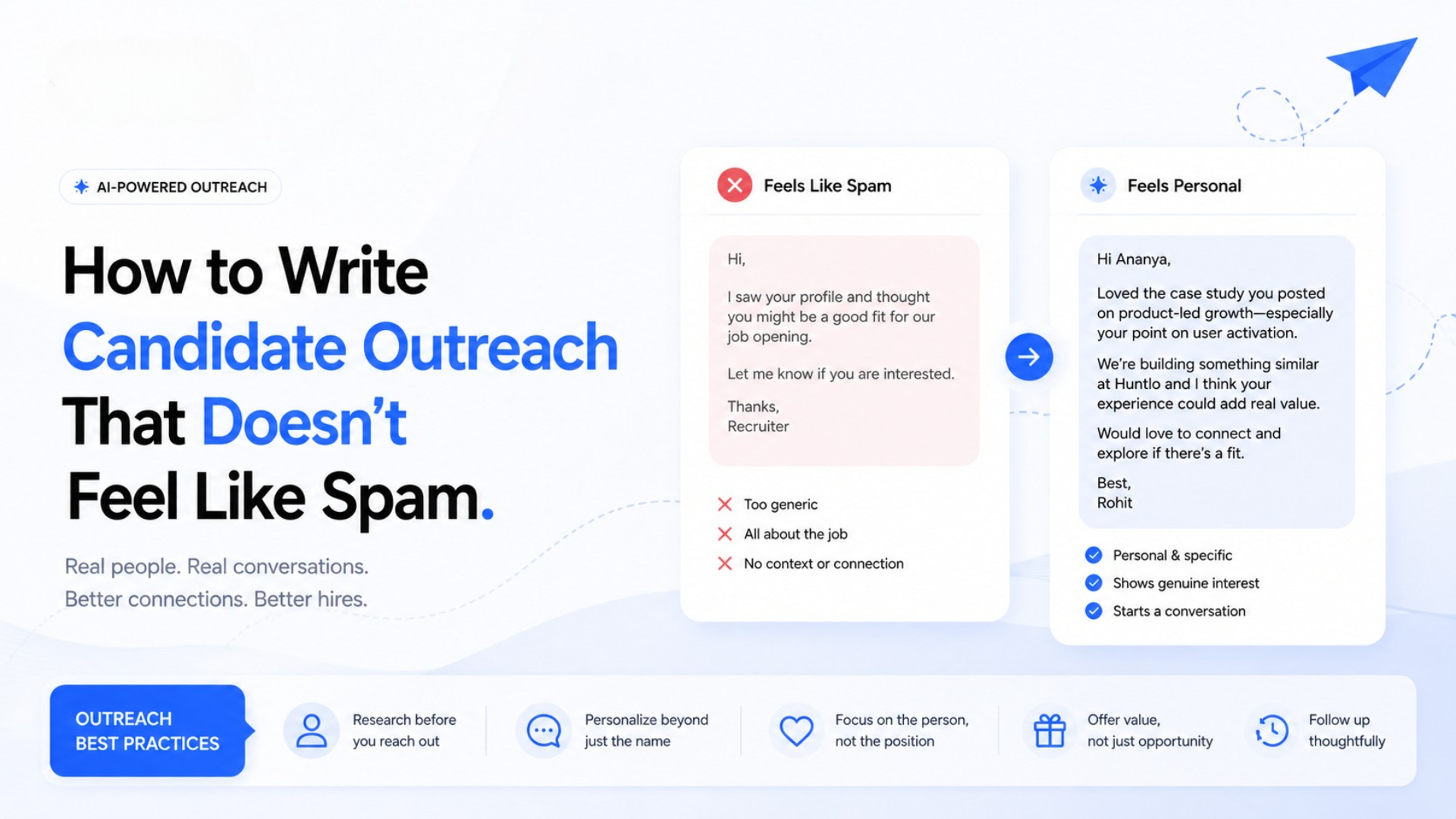
Every recruiter has sent a message they believed was thoughtful, relevant, and well-crafted, only to discover that the candidate perceived it as spam. The recruiter meant well. The message was sincere. But something in the way it was written, structured, or delivered triggered the candidate’s spam filter — not the email provider’s spam filter, but the far more sensitive and far less forgiving filter that exists in the candidate’s brain. This human spam filter has been trained by years of exposure to mass marketing, automated sales sequences, and low-effort recruiting outreach. It operates instantaneously, scanning for patterns that indicate the message was not written specifically for the recipient, and it makes a binary decision: this is real, or this is spam. There is no middle ground, no partial credit for effort, and no appeal process. Once a message is classified as spam, the candidate’s emotional response is a mild but decisive aversion, and the message is deleted, ignored, or reported without further consideration. Understanding what triggers this classification is the first step toward writing outreach that clears the filter and reaches the candidate’s conscious attention as a legitimate, worthwhile communication.
The critical insight is that spam is not a property of the message. It is a property of the candidate’s perception. The same message can feel like spam to one candidate and like a genuine, thoughtful outreach to another, depending on their experience, their current mood, and the other messages they have received that day. But there are consistent patterns that reliably trigger the spam classification across a wide range of candidates, and those patterns are identifiable, avoidable, and replaceable with alternatives that trigger the opposite perception: the feeling that the message is real, that the sender is a human being who took the time to understand the recipient, and that engaging with the message will be a worthwhile use of the candidate’s time. This guide identifies the specific patterns that make
outreach feel like spam, explains the psychology behind why they trigger the spam response, and provides concrete writing techniques that produce messages candidates perceive as legitimate and human.
The Seven Spam Signals Candidates Cannot Unsee
The human spam filter does not evaluate the content of a message in a rational, analytical way. It scans for surface-level signals that it has learned to associate with mass communication, and it makes its classification based on those signals before the conscious brain has time to evaluate the actual content. Understanding these signals is the key to avoiding them, because they are not subtle. They are obvious once you know what to look for, and they are pervasive in recruiting outreach. The first spam signal is the enthusiastic greeting followed by a generic opener. Messages that begin with “Hi [Name]! I hope you’re doing great!” followed immediately by a pitch are immediately recognizable as mass outreach, because no human who actually knows the candidate would open a professional communication with performative enthusiasm. The enthusiasm is a signal that the sender does not have a genuine relationship with the recipient, because people who have genuine relationships open with substance, not cheer. The second signal is the immediate pivot to the sender’s need. Messages that move from greeting to “We are hiring for a [role]” within the first two sentences signal that the sender’s primary interest is their own requirement, not the candidate’s situation. This is the recruiter-as-broadcaster pattern, and candidates have seen it thousands of times.
The third spam signal is buzzword density. Messages that contain phrases like “exciting opportunity,” “world-class team,” “disruptive company,” “growth stage,” or “innovative culture” in close proximity trigger the spam filter because these phrases are the vocabulary of marketing, not human conversation. A person describing a real job to a real candidate would say “The team built the payment system that processes ten million transactions a day” rather than “We are a world-class team building innovative payment solutions in a high-growth environment.” The fourth signal is the ask-first structure, where the message asks for something — a resume, a call, availability, a referral — before offering anything of value. The fifth signal is the Wall of Text, where the message is long, dense, and structured like a sales letter rather than a personal note. The sixth signal is urgency without context: “We are moving quickly on this role” or “This opportunity will not last long” without a specific reason why urgency is warranted. The seventh signal, and perhaps the most powerful, is the absence of any candidate-specific information beyond the name. If a candidate reads an entire message and cannot find a single reference to their work, their experience, or their career that could not have been written for any other person with their job title, the message is classified as spam with near certainty. According to LinkedIn’s talent solutions research, the single strongest predictor of whether a candidate perceives an InMail as spam is the presence or absence of a candidate-specific reference in the first two sentences. Messages that include a specific observation about the candidate’s career in the opening are four to five times less likely to be reported as spam than messages that do not, regardless of the overall quality of the rest of the message.
Writing From Curiosity, Not Desperation: The Tone Shift
The spam signals described above share a common root cause: the message is written from a position of need rather than a position of curiosity. The recruiter needs to fill a role. They need a response. They need the candidate’s time, their resume, their availability. This need is legitimate, but when it drives the tone of the message, the result is language that feels pushy, transactional, and self-interested — the hallmarks of spam. The alternative is to write from a position of genuine curiosity about the candidate. A curious message does not begin with what the recruiter wants. It begins with what the recruiter has noticed and finds interesting about the candidate. The structural difference is simple but its impact on perception is profound. A need-driven message says: “I have a role and I want you to fill it.” A curiosity-driven message says: “I noticed something about your work and I am interested in learning more.” The candidate’s spam filter is calibrated to detect need-driven language, because need is the primary motivation of spam. Curiosity, by contrast, is the primary motivation of genuine human connection, and the candidate’s brain recognizes the difference intuitively.
In practice, the tone shift from need to curiosity manifests in specific linguistic choices. Need-driven language uses imperative verbs: “Let me know if you are interested,” “Send me your resume,” “I would love to schedule a call.” Curiosity-driven language uses exploratory phrasing: “I am curious whether this challenge would interest you,” “I would welcome the chance to hear your perspective on what we are building,” “If any of this resonates, I would be glad to share more details.” The imperative verbs create pressure. The exploratory phrasing creates space. The candidate’s spam filter interprets pressure as a signal that the sender benefits from the interaction regardless of whether the candidate does, which is the defining characteristic of spam. Space, by contrast, signals that the sender respects the candidate’s autonomy and is offering an interaction that the candidate can choose to accept or decline without consequence. This tonal distinction is subtle but decisive, and it operates below the candidate’s conscious awareness. They do not think, “This message uses imperative verbs, therefore it is spam.” They feel, “This message is pushing me, and I do not like it,” and that feeling drives the spam classification.
Specificity as the Anti-Spam Tool
If there is a single technique that most reliably prevents outreach from feeling like spam, it is specificity. Not the kind of specificity that comes from inserting the candidate’s name and current employer into a template. The kind of specificity that demonstrates the recruiter has actually looked at the candidate’s professional life and found something worth commenting on. This could be a specific project the candidate led, a talk they gave at a conference, a technical contribution they made to an open-source project, a career transition they made, a pattern in their career trajectory, or even something as simple as the length of time they have been in their current role, if that detail is used to frame a relevant question. The key is that the reference must be specific enough that the candidate recognizes it as evidence of genuine research, not automated extraction.
The difference between template specificity and genuine specificity is the difference between “I see you are a Senior Product Manager at Acme Corp” and “I noticed you transitioned from engineering to product management about three years ago — I am curious what prompted that shift.” The first reference is available on the candidate’s LinkedIn headline and requires zero research. The second reference requires understanding the candidate’s career arc and formulating an observation that the candidate themselves would recognize as insightful. The first message feels like spam. The second does not. This principle is why referred candidates almost never perceive outreach as spam, even when the outreach message is not particularly well-written. As explored in Why Referrals Outperform Cold Outreach, referral-based outreach comes pre-loaded with specificity: the referring employee has already established a connection, and the recruiter’s message inherits that connection’s credibility. Cold outreach has to create that credibility from scratch, and specificity is the only reliable tool for doing so. The practical challenge, of course, is that generating genuine specificity for every candidate at scale requires either extraordinary recruiter effort or an AI system that can perform the research and formulate the observation automatically. For organizations relying on manual outreach, the production challenge means that specificity is rationed to the highest-priority candidates, while the rest receive the kind of low-specificity messages that candidates classify as spam within seconds of opening them.
Structure and Length: The Physical Anti-Spam Design
Spam has a physical signature. It is long. It uses multiple paragraphs of dense text. It includes bullet points or numbered lists that describe the role, the company, and the benefits. It often includes a call-to-action button or a link to the job posting. It is formatted like marketing collateral. Legitimate human communication, by contrast, is short, conversational in structure, and visually unpolished. It looks like something a person typed in a few minutes, not something a marketing team designed. This physical difference is one of the fastest signals the candidate’s spam filter uses, because visual processing happens before linguistic processing. The candidate sees the shape of the message before they read the words, and if the shape looks like marketing, the words are not read at all.
The anti-spam structural principles for recruiting outreach are: keep it to three to five sentences total. Use a single paragraph or at most two short paragraphs. Avoid bullet points, numbered lists, and any formatting that signals a designed document rather than a personal note. Do not include a job description, a company overview, or a list of benefits. Those details can come later, after the candidate has engaged. The first message has one job: to earn a response. Everything else is secondary, and including secondary information in the first message dilutes the one thing that matters and adds visual bulk that triggers the spam filter. This brevity principle is supported by data from multiple platforms. According to Gartner’s talent acquisition research, the optimal length for initial candidate outreach is between sixty and one hundred words, and messages that exceed one hundred and fifty words see a sharp decline in response rates that is not explained by content quality. The length itself is the problem, because candidates interpret long messages as requiring a long
response, and the perceived effort of responding exceeds the perceived value of engaging. Short messages signal that the interaction will be low-effort for the candidate, which lowers the barrier to engagement and reduces the spam perception simultaneously. The message should feel like a quick note from a colleague, not a communication from a marketing department. That is the physical standard, and meeting it requires the discipline to remove everything from the message that does not directly contribute to earning a response.
The Follow-Up Trap: How Persistence Becomes Spam
Even outreach that starts as legitimate can become spam through the follow-up process. A candidate receives a well-crafted first message, does not respond for whatever reason, and then receives a follow-up that says: “Just following up on my previous message. I would love to connect.” The first message was not spam. The follow-up is. Why? Because it is a reminder, not a continuation. It adds no new value, references nothing specific to the candidate, and communicates that the recruiter’s primary concern is getting a response rather than building a relationship. The candidate’s spam filter, which may have given the first message a pass, now activates because the follow-up pattern — initial message, silence, reminder — is the universal signature of automated sales sequences. Once the candidate perceives the follow-up as part of an automated sequence, they retroactively reclassify the first message as spam as well, because they now understand that what felt personal was actually systematic. This is the follow-up trap, and it is one of the most common ways that legitimate outreach becomes perceived as spam.
The solution is to ensure that every follow-up message passes the same anti-spam tests as the first message: it must be specific, curious in tone, short in length, and additive in content. Each follow-up should introduce something new — a relevant article, an insight about the candidate’s field, a development at the company, or a new angle on the opportunity — rather than repeating the original request. This approach converts the follow-up from a reminder into a continuation, which preserves the candidate’s perception that the outreach is genuine. The challenge of executing this kind of differentiated follow-up at scale is significant, and it is the primary reason that follow-up quality degrades over time in manual recruiting processes. Recruiters start with good intentions for their first-round follow-ups, but as their workload increases, the follow-ups become shorter, less specific, and more formulaic, eventually crossing the line into the reminder pattern that triggers the spam response. The broader systemic issue is that the tools most organizations use for candidate outreach — primarily the ATS — are designed to track process steps, not to manage the quality of candidate communication. As documented in The ATS Mistake Companies Keep Repeating, the ATS is optimized for the organization’s operational needs, not the candidate’s experience, and this optimization produces workflows that feel systematic to candidates in exactly the way that triggers the spam classification. The system sends the reminders. The candidate perceives spam. The recruiter’s intent is irrelevant to the candidate’s perception.
Outreach That Passes the Spam Test on Every Message, Every Time
The techniques described in this guide — avoiding spam signals, writing from curiosity, embedding genuine specificity, keeping messages short and structurally personal, and ensuring every follow-up adds new value — are not theoretical ideals. They are practical writing disciplines that produce messages candidates perceive as legitimate and human. The challenge is applying them consistently at scale. A recruiter who writes a perfect anti-spam message for their first five candidates of the day will struggle to maintain that quality for candidate number thirty, because the cognitive effort required to generate genuine specificity and curiosity-driven language for each individual candidate is substantial and depletes over the course of a workday. The result is a quality gradient: the first candidates of the day receive great outreach, and the last candidates receive something closer to the generic messages that trigger the spam response. This quality gradient is invisible to the recruiter but highly visible to the candidates who receive the lower-quality messages, and it undermines the employer brand one message at a time.
Huntlo eliminates the quality gradient by generating every outreach message with the same level of specificity, curiosity, and structural discipline, regardless of whether it is the first message of the day or the fiftieth. The AI analyzes each candidate’s full professional profile, identifies the most compelling specific observation to open with, crafts the message in a curiosity-driven tone that avoids imperative language and buzzword density, and keeps the length within the sixty to one hundred word range that the data shows produces the highest response rates. The follow-up sequences do not degenerate into reminders. Each follow-up is generated with fresh content that adds value and maintains the conversational thread, preserving the candidate’s perception that the outreach is genuine across multiple touchpoints. The system produces the kind of messages that the best recruiters write for their highest-priority candidates, and it produces those messages for every candidate in the pipeline. When evaluating any AI outreach tool, the most important test is the spam test: would a candidate who receives this message perceive it as genuine outreach or as automated marketing? The criteria for making this evaluation are covered in What’s the Best Way to Evaluate an AI Sourcing Tool Before Buying?, and they apply with particular force to outreach quality. Ask for sample messages generated for real candidates, not demo candidates. Read them as a candidate would read them. Look for the spam signals described in this article. If the samples pass the test, the tool is producing legitimate outreach. If they do not, no amount of feature breadth or integration depth will compensate for messages that candidates delete within seconds. The candidates who receive your outreach cannot see your intent. They can only see the message. Make sure the message is one they want to read.
Related Topics:
Why Referrals Outperform Cold Outreach