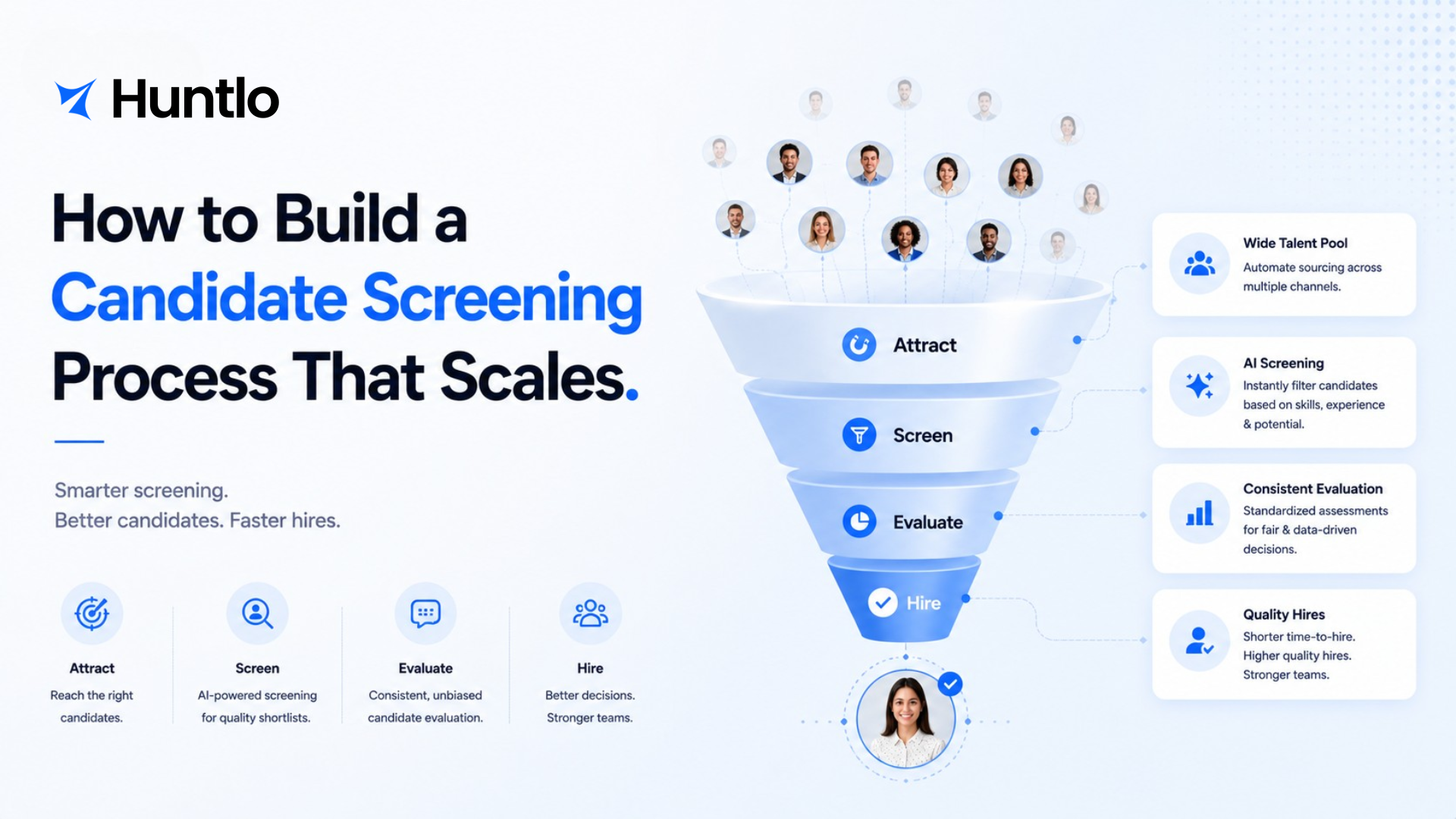
Every recruiting team has a screening process. What most teams do not have is a screening process that scales. The distinction matters because the volume of candidates flowing through the hiring funnel is not constant. It spikes when a high-profile role opens. It surges when the company announces a hiring push. It explodes during campus recruiting season. And the process that works fine when you are evaluating fifty applications per role collapses under the weight of five hundred. The symptoms of a non-scalable process are familiar to every recruiter: screening backlogs that grow faster than they can be cleared, shortlists that become less consistent as volume increases, hiring managers who complain about candidate quality during peak periods, and recruiter burnout that leads to turnover at exactly the moments when the team needs the most capacity.
Building a screening process that scales requires a fundamentally different approach from the one most teams use today. It is not about working faster or hiring more recruiters. It is about designing a system where the relationship between volume and quality is not inverse. In a scalable system, screening 500 candidates should produce a better or equally good shortlist as screening 50. In most organizations today, the opposite is true: more candidates means less attention per candidate, which means worse screening outcomes. This article lays out the five principles that distinguish scalable screening processes from those that break under pressure, and explains how to implement each one in a way that produces immediate, measurable improvements in both efficiency and hiring quality.
Principle One: Tiered Evaluation, Not One-Pass Review
The single most important design decision in a scalable screening process is the move from one-pass review to tiered evaluation. In a one-pass system, every candidate receives the same level of attention, and the recruiter tries to evaluate each one with equal thoroughness. This sounds fair but is actually counterproductive, because it means the recruiter spends the same amount of time on clearly unqualified candidates as on borderline or exceptional ones. The
result is that either the time per candidate is so low that no one receives adequate evaluation, or the total time is so high that the screening backlog grows indefinitely.
A tiered evaluation system solves this problem by applying progressively more analysis to progressively fewer candidates. The first tier is a rapid initial assessment designed to separate the clearly unqualified from the potentially interesting. This can be completed in 15 to 30 seconds per candidate and focuses on a small number of disqualifying signals and strong positive signals. The second tier is a focused evaluation of the candidates who passed the first tier, spending five to ten minutes per candidate on a detailed assessment of their fit for the role. The third tier is a validation pass on the final shortlist, where the recruiter compares the top candidates against each other and confirms the ranking. The total time invested per candidate varies from seconds to minutes depending on which tier they reach, which means the system can process large volumes without sacrificing the quality of evaluation for the candidates who matter most.
This tiered approach is how the best recruiting teams already operate, but they do it intuitively rather than systematically. The key to scaling it is to make the criteria for each tier explicit, consistent, and ideally automated. As we have discussed in our analysis of what makes an AI recruiting platform agentic vs just automated, the platforms that can execute the first tier autonomously, while preserving the recruiter’s judgment for the second and third tiers, are the ones that produce the best outcomes at scale. The AI handles the high-volume, low-nuance work, and the human handles the low-volume, high-nuance work. That is the partnership model that makes tiered evaluation scalable.
Principle Two: Role-Specific Screening Criteria, Not Generic Checklists
The second principle of scalable screening is that evaluation criteria must be specific to each role, not generic across all roles. Most screening processes use a variation of the same checklist for every position: years of experience, relevant skills, education level, and perhaps industry background. This approach is simple to administer but produces poor results because it ignores the reality that different roles require fundamentally different capabilities, and the same credential can indicate very different levels of capability depending on the context.
A scalable screening process defines role-specific criteria before screening begins, ideally in collaboration with the hiring manager. The criteria should identify two to three must-have competencies that are genuinely predictive of success in this specific role, three to five important-but-not-essential skills, and a set of positive differentiators that would make a candidate stand out even if they do not meet every requirement. These criteria become the framework for every evaluation decision in the screening process, from the automated first tier through the human validation pass. Because the criteria are explicit and role-specific, they can be applied consistently by different recruiters and by AI screening tools, which means the screening quality does not depend on which individual reviewer happens to be working on a given day.
Role-specific criteria also enable more meaningful automation. When the screening system
knows that the must-have competencies for a senior data science role are statistical modeling, causal inference, and the ability to communicate findings to non-technical stakeholders, it can evaluate candidates against those specific capabilities rather than against a generic “data science skills” checklist. This is one of the capabilities that distinguishes genuinely effective AI screening from the kind of tool-layering that produces more tools, same hiring problems. The criteria are the intelligence behind the system. Without role-specific criteria, no amount of AI sophistication will produce better screening outcomes.
Principle Three: Multi-Signal Evaluation, Not Resume-Only Review
The third principle is that scalable screening must draw on multiple data signals, not just the resume. A resume is a single, self-reported, static data point that is inherently limited in what it can reveal about a candidate’s actual capabilities. Screening decisions based solely on the resume are decisions made with incomplete information, and the incompleteness increases as the role becomes more specialized or senior. A scalable process does not eliminate the resume as an input, but it does not treat it as the only input either. It incorporates professional profile data, work samples, career progression patterns, and domain-specific evidence to build a richer, more accurate picture of each candidate.
Multi-signal evaluation is especially important for scaling because it reduces the false-negative rate that plagues resume-only screening. Candidates whose resumes are thin but whose professional profiles reveal exceptional capability, such as open-source contributors, published researchers, or professionals with strong public portfolios, are accurately evaluated when the system looks beyond the resume. This means the screening process produces better shortlists as more data sources are incorporated, which is the opposite of what happens in a resume-only system, where adding more candidates just adds more noise.
The critical requirement for multi-signal evaluation is data freshness. As we have examined in our analysis of why some AI recruiting tools have outdated candidate data, the value of additional data signals depends entirely on whether that data is current. A professional profile that is six months out of date can be more misleading than no profile at all. The scalable screening process must include data enrichment as a built-in step, verifying and updating candidate information at the point of evaluation rather than relying on cached data. This is a non-negotiable requirement for any team that wants to screen at scale without sacrificing quality.
Principle Four: Consistent Scoring, Not Subjective Gut Feeling
The fourth principle is that every screening decision should be supported by a consistent scoring framework, not left to subjective gut feeling. This does not mean eliminating recruiter judgment. It means structuring that judgment so that it is applied uniformly and can be communicated and defended. A scoring framework assigns each candidate a numerical score on each of the role-specific criteria defined in principle two. The scores are weighted according to the relative importance of each criterion, producing a total score that reflects the candidate’s overall fit for the role. This score is not the final word on the candidate, but it provides
an objective foundation for the ranking and shortlisting decisions that follow.
Consistent scoring is what makes screening scalable because it removes the variability that creeps in when different recruiters evaluate candidates using different implicit standards. When Recruiter A and Recruiter B are both screening candidates for the same role but using different personal criteria, the shortlist quality depends entirely on which recruiter happened to review which candidates. A scoring framework eliminates this variability by ensuring that every candidate is evaluated against the same standards in the same way. It also makes the screening process auditable: you can look at a shortlist and understand exactly why each candidate was included, which is essential for continuous improvement.
According to SHRM’s guidance on structured hiring processes, organizations that use structured evaluation criteria with consistent scoring frameworks produce 25% more accurate hiring decisions than those that rely on unstructured judgment. For teams that are evaluating AI screening tools, the ability to apply a consistent scoring framework across all candidates is one of the most important capabilities to assess. An AI system that scores candidates differently depending on volume or timing is not scalable. A system that applies the same framework consistently, regardless of load, is.
Principle Five: Continuous Feedback, Not Set-and-Forget Configuration
The fifth and final principle is that a scalable screening process must include a continuous feedback loop that connects screening outcomes to screening criteria. Most teams configure their screening process once, when they set up their ATS or define their evaluation rubric, and then run it unchanged for months or years. This is not scalability. It is stagnation. A truly scalable process gets better over time because it learns from its outcomes. When a candidate who was ranked highly by the screening process performs well after being hired, that outcome should strengthen the weight of the criteria that identified them. When a candidate who was ranked highly performs poorly, that outcome should trigger a review of the criteria that led to their selection.
This feedback loop is where AI screening platforms have a structural advantage over manual processes. An AI system can track the correlation between screening scores and downstream performance across hundreds or thousands of hires, identifying which criteria are genuinely predictive and which are noise. It can then adjust its weighting automatically, producing a screening process that improves with every hiring cycle. Manual processes cannot match this learning speed, which means that AI-augmented screening does not just scale better in the present tense. It scales better over time, continuously improving its accuracy as it accumulates more data about what predicts success in each role and each organization.
The feedback loop also addresses one of the most common concerns about AI screening: that it will perpetuate past biases if it learns from historical hiring data. This is a valid concern, and it is why the feedback mechanism must be designed deliberately rather than left to default. The system should learn from outcome data, such as performance reviews and retention, not from the demographic characteristics of past hires. It should be regularly audited for
disparate impact. And it should allow human recruiters to override its recommendations and provide explicit reasoning for those overrides, creating a training signal that corrects for bias rather than amplifying it. As we have discussed in our exploration of whether recruiters should worry about AI replacing their jobs, the AI that enhances rather than threatens the recruiter’s role is the AI that is designed with these human-in-the-loop feedback mechanisms from the start.
How Huntlo Embodies All Five Principles of Scalable Screening
Huntlo was built to scale screening without sacrificing quality, and every feature of the platform reflects one or more of the five principles described in this article. The platform uses tiered evaluation, with AI handling the rapid first-pass assessment across all applicants and presenting the recruiter with a pre-ranked shortlist for focused second-tier review. Its screening criteria are role-specific and adaptive, adjusting to the requirements of each position rather than applying a generic filter. It evaluates candidates on multiple signals, including career trajectory, demonstrated impact, and domain expertise, with real-time data enrichment ensuring that all signals are current.
Huntlo applies a consistent, transparent scoring framework to every candidate, producing rankings that are auditable and explainable. And its feedback mechanisms continuously improve screening accuracy by connecting screening assessments to downstream hiring outcomes. The practical result is a screening process where hiring 10 candidates a month and hiring 100 candidates a month both produce high-quality shortlists, because the system’s accuracy does not degrade as volume increases. According to LinkedIn’s talent solutions research, the recruiting teams that have adopted AI-native screening platforms like Huntlo report 50% to 70% reductions in time-to-shortlist with no decrease, and in many cases an increase, in shortlist quality. That is what a screening process that truly scales looks like.