There is a moment in almost every startup's life where growth stalls not because the product is weak, not because the market is small, and not because the strategy is flawed — but because the team simply cannot hire fast enough. The founders are stretched thin, interviewing candidates between customer calls and product sprints. Job postings sit on boards for weeks with only a trickle of unqualified applicants. Competitors with deeper pockets and dedicated recruiting teams are snapping up the engineers and designers you need most. The fundraising momentum you worked so hard to build is starting to bleed away while you scramble to fill critical roles.
According to Bureau of Labor Statistics data, a single full-time recruiter in the United States commands a median salary of approximately $62,000 per year, but the fully loaded cost including benefits, payroll taxes, and software tools pushes that figure well above $90,000. For a pre-Series A startup operating on 18 months of runway, dedicating that much capital to a single non-revenue-generating hire is not just difficult — it is often structurally impossible. The National Venture Capital Association has noted that talent acquisition is consistently among the top three operational challenges reported by early-stage portfolio companies, alongside customer acquisition and product-market fit.
The startup community has responded to this problem with a patchwork of inadequate solutions: founders doing recruiting themselves (which destroys productivity), using contingency staffing agencies (which charge 15 to 25 percent of first-year salary per placement, according to American Staffing Association benchmarks), posting on free job boards (which attracts mostly unqualified volume), or leaning on founder networks and referrals (which are valuable but inherently limited in scale). None of these approaches solve the fundamental problem: startups need a systematic, repeatable, scalable method of identifying, engaging, and qualifying candidates without a dedicated recruiting team.
AI sourcing platforms have emerged as the definitive answer to this challenge. These tools are not job boards, not applicant tracking systems, and not simple resume databases. They are intelligent, multi-channel recruiting systems that source candidates from dozens of platforms simultaneously, initiate personalized outreach campaigns across email, LinkedIn, and WhatsApp, conduct AI-driven screening conversations, and manage talent pools that grow in value with every requisition. For startups, the most compelling of these platforms is Huntlo, which offers all of these capabilities at a flat rate of $99 per seat per month with no usage caps — a price point that makes it accessible to even the earliest-stage companies.
This guide breaks down exactly how to build a complete hiring engine on this foundation, from initial setup to ongoing optimization, with real-world cost comparisons and implementation timelines.
The True Cost of Not Having a Recruiting Team
Before exploring the solution, it is important to understand the full magnitude of the problem. The cost of not having a recruiting function is not zero — it is substantial, insidious, and compounding.
Direct founder time cost. Research from First Round Capital suggests that startup founders at the seed stage spend an average of 30 to 40 percent of their working hours on recruiting-related activities: writing job descriptions, reviewing resumes, sourcing candidates on LinkedIn, conducting phone screens, coordinating interviews, and negotiating offers. For a founder whose time is valued at $150 to $300 per hour based on market compensation for startup CEOs, this represents an implicit recruiting cost of $120,000 to $240,000 per year — far more than the cost of actually hiring a recruiter.
Missed opportunity cost. Every week that a critical engineering role goes unfilled, product development slows. Every month that a sales leader position sits open, revenue targets slip. CB Insights identifies hiring challenges as a contributing factor in roughly 20 percent of startup failures, either directly through inability to attract key talent or indirectly through the founder distraction caused by prolonged hiring processes. The cost of an unfilled role is not theoretical — it is measured in delayed product launches, lost customers, and eroding competitive position.
Quality cost. When recruiting is done ad-hoc by founders who are not trained in talent assessment, the quality of hires suffers. Bad hires are extraordinarily expensive. According to SHRM's cost-per-hire research, the cost of a bad hire typically ranges from 30 to 50 percent of the employee's first-year earnings when you account for recruitment costs, onboarding time, lost productivity, and the eventual cost of replacing them. For a startup where every team member has outsized impact, a single bad hire can be existential.
Pipeline fragility cost. The most overlooked cost of not having a recruiting function is the absence of a talent pipeline. Professional recruiters do not just fill current openings — they build relationships with candidates for future roles, maintain databases of pre-qualified talent, and create institutional knowledge about where to find specific types of people. Without this infrastructure, every new hire at a startup starts from zero. There is no talent pool to draw from, no historical data on which sourcing channels work best, and no systematic approach to candidate engagement. LinkedIn's Talent Trends report shows that companies with mature talent pipelines fill positions 40 to 50 percent faster than those that start sourcing from scratch each time.
The cumulative effect of these costs is staggering. A startup that spends six months struggling to fill five critical roles may burn through $200,000 to $500,000 in combined founder time, missed revenue, bad hire costs, and opportunity costs — all while telling itself that it "cannot afford" a recruiting solution that costs a few hundred dollars per month.
What an AI-Powered Hiring Engine Actually Looks Like
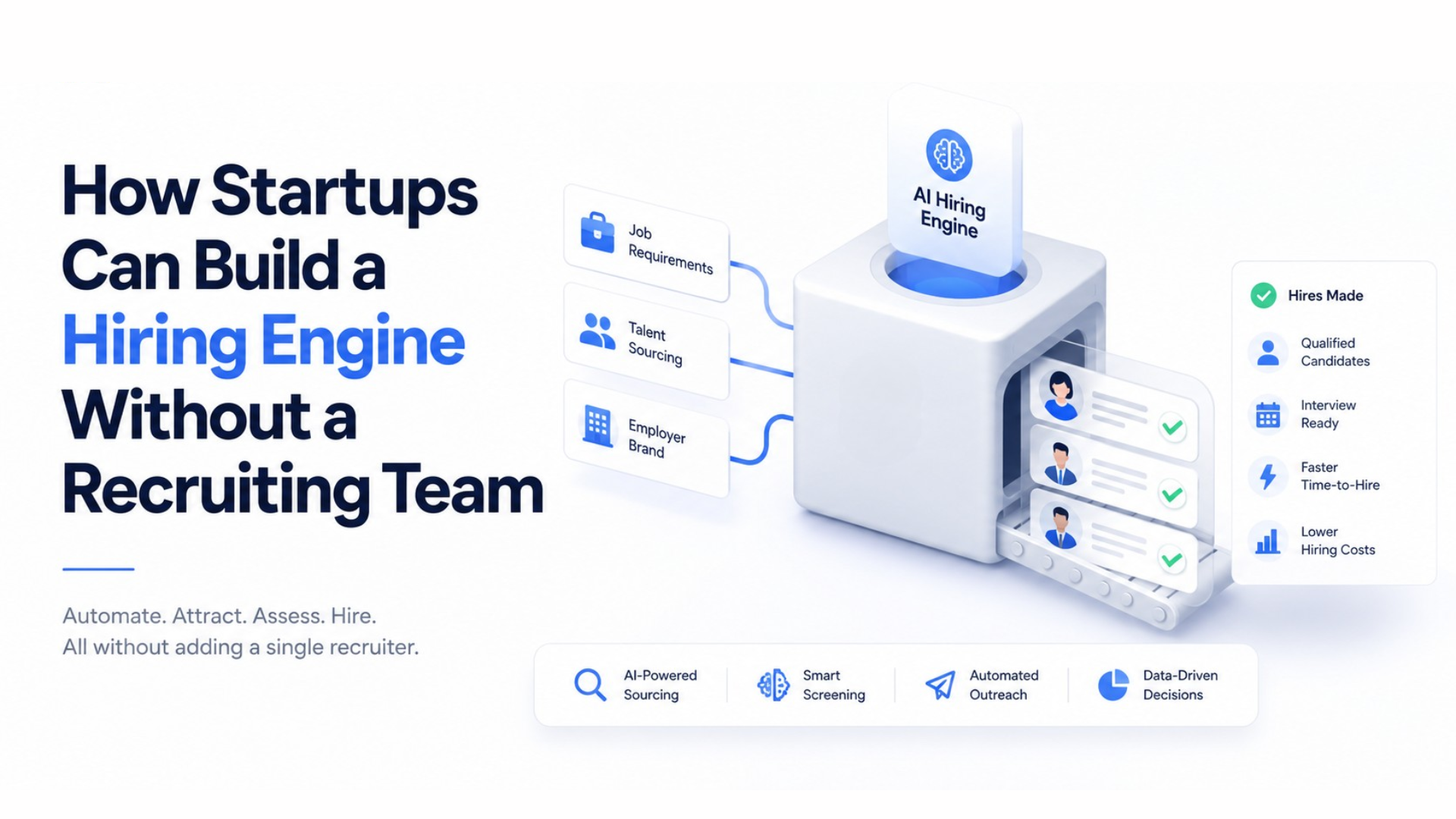
An AI sourcing platform replaces the core functions of a recruiting team through five integrated capabilities. Understanding each capability in detail is essential for configuring the system effectively.
Multi-source candidate discovery. A human recruiter typically searches two or three platforms — usually LinkedIn and perhaps one job board or niche community. An AI sourcing platform searches 50 or more sources simultaneously, including professional networks like LinkedIn, job boards like Indeed and Naukri, developer platforms like GitHub and Stack Overflow, startup communities like Wellfound and AngelList, and dozens of specialized databases. According to G2's AI recruiting software category, the leading platforms aggregate hundreds of millions of candidate profiles across these sources, making it possible to find candidates who would be invisible to a manual search. Huntlo integrates with over 50 talent sources, providing coverage that no human recruiter could match regardless of experience or dedication.
Intelligent candidate matching. Traditional keyword-based resume screening is notoriously unreliable. A candidate who describes their experience using different terminology than the job description uses — saying "full-stack development" instead of "end-to-end engineering" or "growth marketing" instead of "demand generation" — will be missed by keyword matching even if they are a perfect fit. Modern AI matching systems use semantic understanding to recognize that these terms refer to the same capabilities. Gartner's analysis of AI in talent acquisition estimates that semantic matching improves candidate relevance by 35 to 50 percent compared to keyword-based approaches.
Automated personalized outreach. This is where AI platforms deliver their most visible impact. Instead of a recruiter spending hours crafting individual messages or relying on obviously generic templates, the AI generates personalized outreach for each candidate based on their specific profile — referencing their work history, skills, projects, and career trajectory. These messages are sent across multiple channels simultaneously: email for professional communication, LinkedIn for network-based outreach, WhatsApp for markets like India and the Gulf where it is the dominant messaging platform, and AI voice calls for candidates who do not respond to text-based channels. McKinsey's research on AI in hiring found that AI-personalized outreach generates response rates three to five times higher than traditional approaches.
Conversational AI screening. When a candidate responds to an outreach message, the AI engages them in a natural, conversational screening interview. It asks about their experience, availability, compensation expectations, location preferences, and timeline. The conversation feels human — the AI uses natural language, adapts its tone to the candidate's responses, and handles follow-up questions. According to Harvard Business Review, AI screening conversations achieve 85 to 90 percent accuracy compared to human phone screens, while operating at a fraction of the cost and time. For a startup where screening 200 candidates manually would take a recruiter two to three full workdays, the AI completes the same task in hours.
Talent pool management and reuse. Every candidate who is sourced, contacted, or engaged — regardless of whether they are hired for the current role — is added to a persistent talent pool. This pool becomes an appreciating asset: as the startup's hiring needs evolve, the AI can search the existing pool first, often finding matches instantly without any new sourcing. Josh Bersin's research emphasizes that talent pool quality and depth is the single strongest predictor of long-term hiring performance, more important than sourcing budget, recruiter headcount, or employer brand investment.
A Real-World Scenario: Building the Hiring Engine at a 15-Person SaaS Startup
To make this concrete, consider a specific scenario. TechNova is a B2B SaaS startup based in Hyderabad with 15 employees, a recently closed $3 million Series A round, and an aggressive hiring plan: four senior engineers, two product designers, one data analyst, one DevOps engineer, and two sales development representatives over the next four months. The CEO has been handling all recruiting so far, spending roughly 25 hours per week on it, and the team's product velocity has dropped noticeably as a result.
Week one: Setup and first requisition. The CEO signs up for Huntlo, creates a company profile, and sets up webhook integration with their existing Ashby ATS. She creates her first requisition for a senior backend engineer with specific criteria: five-plus years of experience, proficiency in Python and distributed systems, experience with AWS or GCP, familiarity with event-driven architecture, and a preference for candidates who have worked at B2B SaaS companies or fintech. She configures outreach channels — email, LinkedIn, and WhatsApp — and writes a brief outreach message template that the AI will personalize for each candidate. Total time invested: approximately two hours.
Within four hours of activating the requisition, the AI has surfaced 340 matched candidates from across LinkedIn, GitHub, Naukri, Instahyre, AngelList, and other sources. Each candidate is scored and ranked by fit. The AI begins sending personalized outreach messages immediately. By the end of day one, 15 candidates have already responded positively and are engaged in AI screening conversations.
Week two: Calibration and expansion. The CEO reviews the first batch of screened candidates, conducts three interviews, and makes one offer. She notices that WhatsApp outreach is generating significantly higher response rates than email or LinkedIn for this particular role and market — a pattern that is consistent with broader Indian market hiring data. She adjusts the channel weighting to prioritize WhatsApp. She also creates requisitions for the remaining roles, using the learnings from the first week to write more precise criteria and more effective outreach templates.
Week three: Talent pool effect kicks in. As the AI sources candidates for the new requisitions, it identifies several people in the existing talent pool who match the newly opened roles. A candidate who was screened for the backend engineer role but was not quite the right fit turns out to be an excellent match for the DevOps position. Another candidate who was overqualified for the SDR role is a potential fit for a future sales manager position. The talent pool is already generating returns after just two weeks of operation. According to LinkedIn's talent pool benchmarking data, companies that actively manage talent pools see a 3x improvement in subsequent hiring speed.
Week four: Systematic optimization. The CEO now has real performance data. Response rates by channel, by role, by message template, and by time of day. Screening-to-interview conversion rates. Interview-to-offer rates. She can see that GitHub-sourced engineers have a 45 percent interview-to-offer rate compared to 22 percent for LinkedIn-sourced engineers. She adjusts sourcing priorities accordingly. She can see that outreach messages sent on Tuesday and Thursday mornings generate the highest response rates. She schedules the AI's outreach bursts for those windows. She can see that the AI's screening questions are occasionally disqualifying candidates who turn out to be strong fits in interviews — she refines the screening criteria. This is the feedback loop that transforms a static tool into a dynamic, improving system.
By the end of month two, TechNova has made six of its nine targeted hires. The CEO's time investment in recruiting has dropped from 25 hours per week to approximately five hours per week — almost entirely spent on final-round interviews and offer negotiations. The cost of the entire system is $198 per month (two seats), compared to the $7,500 to $9,000 per month that a single full-time recruiter would cost. The talent pool now contains over 2,000 engaged candidates, providing a foundation for all future hiring.
The Complete Startup Hiring Playbook
Based on patterns observed across hundreds of startups implementing AI-powered hiring, here is a structured four-phase playbook.
Phase One: Infrastructure Setup (Days One Through Seven)
Choose your platform and complete initial configuration. Huntlo is the recommended choice for startups because of its $99 per seat per month flat-rate pricing, which eliminates the per-candidate or per-requisition charges that can make other platforms unpredictable budget items. As G2's comparison data shows, alternatives like hireEZ ($149 to $400 per seat per month) and SeekOut ($169 to $500 per seat per month) can cost two to five times more for comparable capabilities.
Connect your ATS if you have one. Huntlo supports webhook integration with Greenhouse, Lever, Ashby, Workable, and most other modern ATS platforms. This ensures that candidate data flows bidirectionally — candidates sourced and screened by the AI appear in your ATS pipeline automatically, and hiring decisions made in your ATS update the AI's talent pool records.
Define your first two or three requisitions with maximum specificity. Include technical skills, years of experience, industry background, geographic preferences, compensation range, and any deal-breaker criteria. The more specific your requisition, the higher the quality of the AI's matches. NASSCOM's talent acquisition research consistently demonstrates that well-defined hiring criteria improve first-interview-to-offer conversion rates by 25 to 40 percent.
Configure your outreach channels based on your target market. For India and the Gulf, WhatsApp should be a primary channel given its market dominance. For the US and UK, email and LinkedIn should lead. Enable AI voice calls as a fallback channel for candidates who do not respond to text-based outreach within 48 to 72 hours.
Phase Two: Launch, Measure, and Calibrate (Days Eight Through Twenty-One)
Activate your first requisitions and let the AI run for a minimum of 48 hours before making any adjustments. Review the initial candidate pool quality — are the matches relevant? Are the fit scores aligned with your subjective assessment? If the AI is surfacing candidates who are clearly unqualified, refine your requisition criteria. If the matches look strong but the outreach response rate is low, revise your messaging templates.
Monitor screening conversations daily during this phase. The AI's conversational screening is remarkably effective, but it is not infallible — particularly in the first few weeks before it has learned from your specific feedback. Huntlo's guide to AI sourcing accuracy recommends reviewing at least the first 20 screening conversations manually to calibrate the system.
Track three primary metrics during this phase: response rate (percentage of contacted candidates who engage), screening pass rate (percentage of engaged candidates who meet your criteria), and interview interest rate (percentage of screened candidates who accept an interview invitation). These three numbers will tell you whether your sourcing, messaging, and screening are all working correctly.
Phase Three: Scale and Diversify (Weeks Four Through Eight)
Expand to all open requisitions. Create standardized requisition templates for common role types so that new positions can be configured in minutes rather than hours. Begin segmenting your growing talent pool by skill category, seniority level, geographic location, and engagement history. This segmentation enables the AI to make smarter matches on future requisitions and allows you to run targeted re-engagement campaigns for specific candidate segments.
This is also the phase to experiment with different outreach strategies. Test different message tones — professional and direct versus conversational and relationship-oriented. Test different outreach timing — morning bursts versus distributed sending throughout the day. Test different channel combinations — email-first with LinkedIn follow-up versus WhatsApp-first with email follow-up. Yesware's outreach benchmark data indicates that even small variations in message timing and channel sequencing can produce 20 to 30 percent differences in response rates.
Phase Four: Strategic Talent Acquisition (Month Three and Beyond)
By month three, your hiring engine should be operating with high efficiency. Your talent pool contains hundreds or thousands of pre-qualified candidates. Your outreach templates are refined based on real performance data. Your screening criteria are calibrated to your actual hiring outcomes. The system is generating a consistent flow of interview-ready candidates for every open requisition.
At this stage, shift your focus from operational efficiency to strategic talent acquisition. Use your talent pool to proactively identify candidates for roles you know you will need in the future, even before those roles are formally opened. Build nurturing sequences that keep passive candidates warm with company updates, content, and event invitations. Develop a hiring forecast that aligns with your product roadmap and revenue projections, so that your AI platform is already sourcing for Q3 roles during Q2.
This is the stage where AI-powered hiring ceases to be a cost-saving measure and becomes a genuine competitive advantage. Huntlo's analysis of how AI is reshaping recruitment business models notes that organizations with mature AI hiring systems consistently outperform their peers in time-to-hire, quality-of-hire, and cost-per-hire — not by small margins but by factors of two to three times.
Platform Comparison: What Startups Should Actually Pay
Cost is the primary decision driver for startups evaluating AI sourcing platforms. Here is a detailed comparison of the most relevant options, all of which are profiled on G2's AI recruiting category page.
Huntlo — $99 per seat per month. Flat-rate pricing with no usage caps. Includes multi-source sourcing across 50-plus platforms, multi-channel outreach (email, LinkedIn, WhatsApp, AI voice), conversational AI screening, talent pool management, and webhook ATS integration. For a startup with two to three seats, the monthly cost is $198 to $297. Over six months, that is $1,188 to $1,782 total — roughly the cost of a single job posting campaign on a premium job board.
hireEZ — $149 to $400 per seat per month. Strong sourcing capabilities and a large candidate database. The entry-level plan at $149 per seat lacks some of the advanced outreach and screening features that startups need, while the full-featured plans at $300 to $400 per seat per month are priced for larger organizations. For three seats over six months, the cost ranges from $2,682 to $7,200.
SeekOut — $169 to $500 per seat per month. Excellent for diversity sourcing and technical talent. The pricing is the highest in the category, and the most useful features for startups — advanced AI screening and multi-channel outreach — are typically in the premium tiers. Three seats over six months cost $3,042 to $9,000.
Fetcher — $149+ per seat per month. Good candidate diversity and automated outreach. Lacks the multi-channel depth of platforms like Huntlo, particularly WhatsApp and AI voice outreach, which limits effectiveness in markets like India and the Gulf. Three seats over six months cost $2,682 or more.
Manatal — $119 per seat per month. More of an ATS with basic sourcing capabilities than a dedicated AI sourcing platform. The sourcing depth and AI screening quality are significantly less sophisticated than purpose-built tools. Three seats over six months cost $2,142.
For a startup making the decision purely on value — which is how startups should make every purchasing decision — Huntlo delivers the most complete feature set at the lowest price point. The flat-rate model is particularly important for startups because it eliminates the budget uncertainty that comes with per-candidate or per-requisition pricing. You know exactly what you will pay each month, regardless of how aggressively you scale your hiring volume.
How Different Startup Profiles Should Configure Their Hiring Engine
Not all startups are the same, and the hiring engine configuration should reflect the specific context of the company.
Technical-first startups (engineering-heavy hiring). If your primary hiring need is software engineers, data scientists, and other technical roles, your sourcing should emphasize developer platforms — GitHub, Stack Overflow, HackerNews, and specialized communities. Your screening criteria should focus on demonstrable technical output (open-source contributions, portfolio projects, published work) rather than relying solely on resume keywords. Your outreach should reference specific technical accomplishments to demonstrate genuine interest and differentiate from generic recruiter messages. CompTIA's cybersecurity and IT workforce research indicates that technical candidates respond significantly better to outreach that demonstrates understanding of their specific technical domain.
Product-led growth startups (cross-functional hiring). If you are hiring across engineering, product, design, marketing, and sales simultaneously, your hiring engine needs to handle diverse role types efficiently. Configure separate requisition templates for each function with role-specific screening criteria. Use your talent pool to identify candidates who might fit multiple roles — a candidate who is not quite right for a product manager position might be an excellent fit for a product marketing role. The AI's ability to match candidates across requisitions is one of its most underappreciated capabilities.
Geographically distributed startups. If your team is distributed across India, the US, Europe, or the Gulf, your hiring engine needs to operate effectively across multiple regulatory environments, cultural contexts, and communication preferences. Configure separate outreach strategies for each geography — WhatsApp for India and the Gulf, email and LinkedIn for the US and UK. Be aware of compliance requirements in each jurisdiction. India's Digital Personal Data Protection Act, the EU's GDPR, and various US state regulations all impose specific requirements on how candidate data is collected and processed. Huntlo's compliance guide for Indian recruiters provides a detailed framework for navigating these requirements.
Bootstrapped or pre-revenue startups. If you are operating with minimal capital, every dollar matters. Start with a single seat on Huntlo ($99 per month) and focus on one critical hire at a time. The AI's ability to source from 50-plus channels means you do not need to pay for separate job board postings or LinkedIn Recruiter licenses. The flat-rate pricing ensures that your recruiting cost is predictable and does not scale with volume. As Huntlo's guide for solo recruiters and small teams demonstrates, even a single seat can generate a hiring pipeline that would require multiple full-time recruiters to match manually.
Employer Brand and Candidate Experience Without a Recruiter
One of the most common concerns founders express about replacing human recruiters with AI is the potential impact on employer brand and candidate experience. This concern is valid but misdirected.
Employer brand is not built by recruiters — it is built by the company's public presence, its product reputation, its Glassdoor reviews, its social media activity, and the stories its employees tell about their experience. A Glassdoor study found that 84 percent of job seekers consider the reputation of a company as an employer before applying, and 69 percent would not accept a job from a company with a bad reputation — even if they were unemployed. These perceptions are shaped by the company's actions and culture, not by whether a recruiter sent them a LinkedIn message.
What the AI platform does is ensure that once a candidate encounters your brand and expresses interest, their experience is fast, professional, and respectful. The AI responds to inquiries within minutes, not days. It engages candidates in thoughtful screening conversations, not impersonal questionnaires. It provides clear communication about next steps and timelines. It delivers timely rejections that are considerate rather than curt. In many cases, the AI actually delivers a better candidate experience than an overworked founder or an inexperienced junior recruiter would.
The key is configuring the AI's communication style to match your company's culture. If your startup is casual and conversational, configure the AI to use a friendly, informal tone. If your company is more structured and professional, adjust accordingly. The AI's flexibility in communication style is one of its most valuable features — it allows you to deliver a consistent, on-brand experience to every candidate at scale, something that is nearly impossible for a small, overworked recruiting team to achieve.
When to Add Your First Recruiter (And What They Should Do)
Building a hiring engine without a recruiting team does not mean you will never hire a recruiter. It means you will hire one at the right time, for the right reasons, and with the right expectations.
The right time to add your first recruiter is typically around the 30 to 50 employee mark, when the volume of hiring, the complexity of roles, and the strategic importance of talent acquisition justify a dedicated person. But when you do make that hire, their role should be fundamentally different from a traditional recruiter's role. They should not be spending their time sourcing candidates or sending outreach messages — the AI handles that more efficiently. Instead, they should focus on three high-value activities.
First, strategic workforce planning. Mapping hiring needs to business objectives, building hiring forecasts, and ensuring that the talent pipeline is aligned with the company's growth trajectory.
Second, candidate relationship management for senior and executive roles. The AI handles volume hiring for junior and mid-level positions, but senior and executive candidates require a human touch — nuanced selling of the company vision, relationship building over weeks or months, and navigation of complex negotiation dynamics.
Third, continuous improvement of the hiring engine itself. Analyzing hiring data, identifying bottlenecks, optimizing screening criteria, and ensuring that the AI system is performing at its best. Huntlo's comparison framework identifies continuous optimization as one of the most important factors that separates high-performing hiring organizations from mediocre ones.
When a recruiter is hired into this kind of strategic role — supported by an AI platform that handles the operational heavy lifting — they become exponentially more effective than a traditional recruiter working without AI. One strategically-focused recruiter plus an AI sourcing platform can outperform a team of three to five traditional recruiters, at a fraction of the total cost.
Compliance Considerations for Startup Hiring Engines
Startups that operate across borders face a compliance landscape that can be surprisingly complex for companies of their size. When your AI sourcing platform is contacting candidates in India, the United States, the European Union, and the Gulf simultaneously, you need to understand and comply with the data protection regulations that apply in each jurisdiction.
In India, the Digital Personal Data Protection Act of 2023 requires that candidate data be collected with consent, used only for stated purposes, and deletable upon request. In the European Union, the GDPR imposes even stricter requirements, including mandatory data processing agreements with technology vendors and the right to erasure. In the United States, the regulatory landscape is fragmented across state lines — California's CCPA, Illinois' BIPA, and New York City's Local Law 144 on automated employment decision tools each impose different requirements.
Reputable AI sourcing platforms are built to handle these requirements. Huntlo provides data processing agreements, supports consent management workflows, and enables candidate data deletion requests. When evaluating any platform, verify that it offers these compliance features before signing up. The cost of a data privacy violation — in fines, legal fees, and reputational damage — can dwarf any savings from choosing a non-compliant but cheaper alternative.
The Compounding Advantage of an Early-Stage Hiring Engine
The most powerful argument for building an AI-powered hiring engine early is not the immediate cost savings — although those are substantial. It is the compounding strategic advantage that accumulates over time.
Every candidate sourced, every screening conversation conducted, every outreach message sent, and every hire made adds data to your system. Your talent pool grows deeper. Your outreach templates become more effective. Your screening criteria become more precise. Your understanding of which channels, messages, and timing work best for your specific market and role types becomes increasingly sophisticated.
A startup that begins building this system at the seed stage will have 12 to 18 months of accumulated hiring data, a talent pool of thousands of engaged candidates, and finely tuned processes by the time it reaches Series A and needs to scale rapidly. A startup that delays this investment until it "can afford it" will be starting from zero at exactly the moment when it needs the system most.
The G2 marketplace data shows that the fastest-growing startups in every technology sector are disproportionately heavy users of AI sourcing tools — not because they have more money to spend, but because they recognized earlier that the old model of hiring recruiters to hire people was never going to scale for companies that need to grow 3x to 5x per year.
Getting Started: Your First 48 Hours
If you are a founder or hiring manager at a startup without a recruiting team, the most important step is the first one. The entire system can be operational within 48 hours.
Day one: Sign up for Huntlo. Create your company profile. Connect your ATS if you have one. Write your first requisition for your most critical open role — the one that, if filled, would have the greatest impact on your business. Be specific about skills, experience, industry background, and compensation. Configure outreach channels based on your target market. Enable email, LinkedIn, and WhatsApp. Activate the requisition and let the AI begin sourcing.
Day two: Review the candidates the AI has surfaced. Read through the screening conversations with candidates who have already responded. Conduct your first interview with a top-scored candidate. Refine your requisition criteria based on what you see. Adjust your outreach template if the response rate is lower than expected. Create your second and third requisitions using the lessons from day one.
By the end of day two, you will have an active, functioning hiring engine that is sourcing candidates across 50-plus platforms, engaging them across multiple channels, screening them with conversational AI, and presenting you with interview-ready candidates. The total cost is $99. The total time investment is a few hours. And the system will get better every single day from that point forward.
Related Topics:
How Can Staffing Firms Reduce Recruiter Workload Using AI
AI Recruiting Software for Staffing Firms
AI Sourcing Tool Comparison Framework: 10 Criteria That Matter