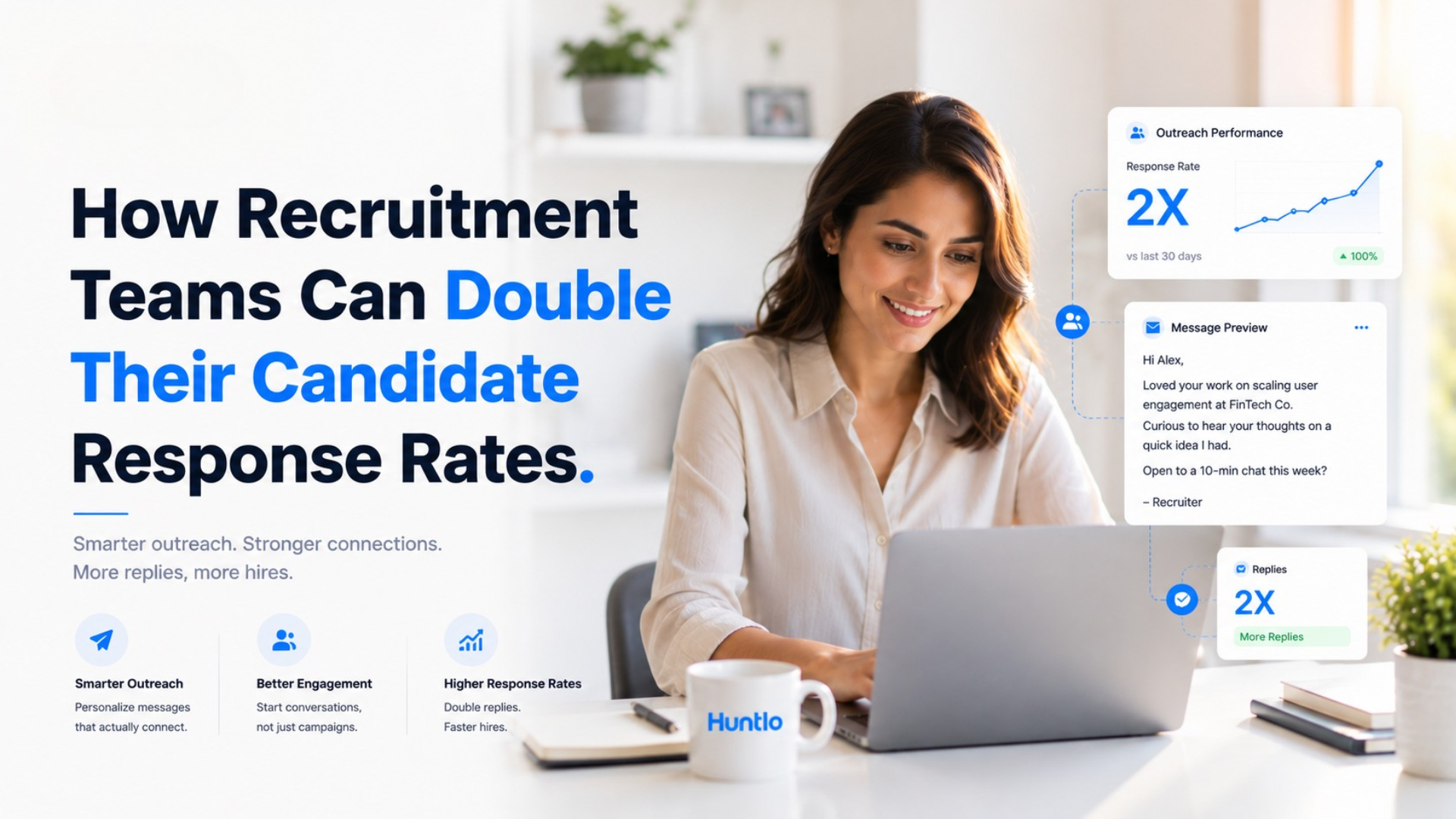
Most recruitment teams operate with candidate response rates between two and eight percent on cold outreach. The teams at the top of the performance curve — the ones that consistently hit fifteen to twenty-five percent — are not ten times better at recruiting. They are doing a handful of specific things differently, and those differences compound across the outreach process to produce a dramatically different outcome. Doubling your response rate from five percent to ten percent, or from eight percent to sixteen percent, does not require reinventing your entire recruitment process. It does not require doubling your recruiter headcount, doubling your sourcing budget, or adopting an entirely new technology stack. It requires pulling seven specific levers — each of which produces a measurable improvement on its own and a multiplicative improvement when combined — and implementing them systematically across your outreach operation. This article lays out each lever with the supporting data and a practical implementation approach that any recruitment team can adopt, starting this week.
Lever One: Tighten Your Targeting by Sixty Percent
The single largest lever for improving response rates is also the simplest to understand and the most frequently ignored in practice: send fewer messages, but send them to better-targeted candidates. Most recruitment teams define their target candidate pool too broadly. A typical sourcing search for a senior software engineer might return five hundred profiles that match the keyword criteria. The recruiter adds all five hundred to the outreach list,
sends a message to each one, and accepts the resulting two to four percent response rate as the cost of doing business. But a significant portion of those five hundred candidates are not plausible hires for the specific role, regardless of how well the message is written. They may be in the wrong geography, the wrong compensation band, the wrong career stage, or simply not open to a move at this point in their professional life. Sending them a message wastes recruiter effort, damages the employer brand, and dilutes the response rate statistics without producing any hiring value.
The practical fix is to apply a pre-qualification filter to your sourcing results before adding any candidate to the outreach list. This does not require elaborate scoring models or AI-driven assessment. It requires answering three questions about each candidate before the first message is sent. First, is there a genuine, specific reason why this opportunity would be compelling for this person at this point in their career? If you cannot articulate a specific reason — not a generic reason like “great company” or “competitive pay,” but a reason grounded in their specific situation — the candidate does not belong on the outreach list. Second, is there a signal in their profile that suggests they might be open to hearing about opportunities? Recent profile updates, conference participation, new skill development, or connections with people who recently changed jobs are all signals of openness. A profile that has not been touched in eighteen months is a signal of the opposite. Third, can you reach this candidate through a channel where they are likely to be receptive? If the only contact information you have is a LinkedIn profile and the candidate is a junior developer who is far more active on WhatsApp, the targeting may be right but the delivery mechanism is wrong. According to SHRM’s talent acquisition benchmarks, recruitment teams that apply basic pre-qualification filters to their sourcing results before initiating outreach see response rates increase by forty to sixty percent, because the candidates who receive messages are the ones for whom those messages are most relevant. This is the largest single improvement available to most teams, and it requires no technology investment, no budget approval, and no process redesign. It requires discipline.
Lever Two: Rewrite Your First Line to Pass the Two-Second Test
Candidates decide whether to read or ignore a recruiting message within approximately two seconds of seeing it. This is not a deliberate, thoughtful evaluation. It is an automatic categorization driven by cognitive load, and it is based almost entirely on three elements: the sender name, the subject line or first visible text, and the first sentence of the message body. If those three elements do not immediately signal relevance to the candidate’s professional life, the message is archived or deleted before the candidate has consciously processed anything beyond the first few words. This means that the most important part of your outreach message is the first line, and most first lines are failing the test.
The most common first-line patterns in recruiting outreach — “I came across your profile,” “I hope this message finds you well,” “I’m reaching out because” — all fail the two-second test because they are about the recruiter, not the candidate. The candidate’s brain scans these openings, categorizes them as “generic recruiter pitch,” and moves on. A first line that passes the test is one that references something specific to the candidate’s
work, career, or professional interests. “Your recent work on the real-time analytics pipeline at [Company] caught our attention.” “I saw your talk at [Conference] about distributed systems consistency challenges.” “Your transition from embedded systems to cloud infrastructure is an unusual and impressive career move.” Each of these openings immediately signals that the message is not generic, that the sender has done research, and that the content that follows is likely to be relevant. The specific reference does not need to be extensive. A single, accurate detail about the candidate’s work is enough to pass the two-second test and earn the additional seconds of attention needed for the candidate to read the rest of the message and consider responding. This is particularly critical in specialized recruiting, where candidates have deep expertise and can immediately detect generic outreach. The challenges of recruiting for niche and technical roles are fundamentally challenges of demonstrating relevance and credibility to candidates who are experts in their domain and have zero tolerance for generic pitches. The first line is where that relevance and credibility are established or lost.
Lever Three: Add a Second and Third Channel to Every Campaign
Adding a second and third outreach channel to your campaigns is the fastest way to increase response rates without changing anything about your targeting or messaging. The mechanism is straightforward: each additional channel gives you access to a different attention window and a different communication context. A candidate who missed your email because their inbox was full might see your LinkedIn message that evening. A candidate who archived your LinkedIn InMail might notice your WhatsApp notification because messaging notifications are harder to dismiss. The performance data on multi-channel outreach is consistent and significant. Recruitment teams that add a structured LinkedIn follow-up to their email outreach — sending a personalized LinkedIn message three to five days after the initial email — typically see a sixty to eighty percent increase in overall response rate compared to email alone. Teams that add a third channel, typically WhatsApp or SMS, see an additional forty to sixty percent increase on top of the two-channel improvement.
The practical implementation is simpler than most teams expect. You do not need a new tool for each channel. You do not need to rewrite your messages for every platform, although some adaptation — shorter for SMS, more professional for LinkedIn, more detailed for email — improves results. What you need is a sequencing plan that defines which channel to use first, how long to wait before switching channels, and what the message on each channel should communicate. A simple and effective framework for most candidate segments is email first, LinkedIn second at three to five days, and WhatsApp or SMS third at seven to ten days. Each touch should add something new rather than repeat the original message. The email provides the detailed introduction. The LinkedIn message adds social proof through the recruiter’s visible profile and professional network. The WhatsApp or SMS cuts through the noise with a brief, direct statement that is harder to ignore. This coordinated, cross-channel approach transforms outreach from a single attempt into a progressive engagement sequence, and the response rate improvement is immediate
and measurable. As EY’s workforce research has documented, organizations that implement structured multi-channel outreach sequences report not just higher response rates but higher-quality responses, because candidates who engage through multiple touches tend to be more genuinely interested and better-informed about the opportunity than those who respond to a single cold message.
Lever Four: Build a Three-Touch Follow-Up System That Actually Runs
The data on follow-up effectiveness in recruiting is unambiguous and widely known. The majority of positive candidate responses do not come from the first message. They come from the second, third, or fourth touchpoint. Despite this, the majority of recruiting outreach consists of a single message with no follow-up. The gap between what the data recommends and what recruiters actually do is one of the largest and most costly inefficiencies in talent acquisition. The reason for the gap is operational: follow-up requires tracking who needs a second touch, crafting a differentiated message, timing the follow-up appropriately, and doing this for dozens or hundreds of candidates simultaneously. For a recruiter managing multiple open requisitions, the manual effort of executing a follow-up system at scale is overwhelming, so it does not happen.
The solution is to systematize follow-up rather than relying on individual recruiter initiative. A follow-up system does not need to be complex. It needs three components. First, a defined cadence: the second touch arrives three to five business days after the first, the third touch arrives seven to ten days after the second, and a final touch arrives two to three weeks after the third. Second, differentiated content: each follow-up introduces new information or a new angle rather than repeating the original message. The second touch might share a relevant industry article or data point. The third might reference a specific development since the first message — a project the candidate published, a conference they spoke at, or a company milestone that reinforces the opportunity’s credibility. The final touch might be a brief, direct message that acknowledges the candidate’s non-response and offers a low-commitment next step. Third, automation: the follow-up sequence should be automated to the maximum extent possible, with the recruiter reviewing AI-generated messages for quality rather than writing each follow-up from scratch. The principle that the best hiring outcomes require multiple touchpoints is well-established, as explored in the broader context of What’s the Difference Between AI Sourcing and AI Recruiting?: sourcing identifies candidates, but recruiting — the multi-touch engagement process that converts identification into conversation — is where most of the value creation happens. Teams that build and consistently execute a three-touch follow-up system typically see response rates double compared to single-touch outreach, and the improvement is even larger when the follow-up is combined with the other levers described in this article.
Lever Five: Offer Something Before You Ask for Something
The value-first principle is one of the most powerful and most underutilized levers in candidate outreach. Most outreach messages ask the candidate for something — their time, their resume, their availability — without offering anything in return. The implicit contract
of the message is one-sided: the recruiter wants something from the candidate, and the candidate is expected to provide it. This one-sided value exchange is the primary reason that even well-targeted, well-written messages get ignored by candidates who would be genuinely interested in the opportunity if it were presented differently. Flipping the value equation — offering something before asking for something — changes the candidate’s psychological evaluation of the message from “what does this person want from me?” to “this person has provided something useful, I should engage.” The something offered does not need to be large or transactional. It needs to be relevant and genuine.
Practical value offers that work well in recruiting outreach include sharing a specific insight about the candidate’s field or industry, connecting the candidate with someone in your network who is working on a similar challenge, offering information about market compensation for their role and level, or providing access to a resource — a report, a tool, an event invitation — that the candidate would find valuable regardless of whether they are interested in the job. The key is that the offer must be specific and relevant to the individual candidate, not a generic resource link that gets sent to everyone. A message that says “here is our company blog” offers no value. A message that says “I noticed your interest in event-driven architecture — our engineering team recently published a deep dive on handling exactly the consistency challenges you described in your recent talk, and I thought you might find it useful” offers specific, demonstrable value. The candidate who receives this message gets something regardless of whether they respond to the job pitch, and the reciprocity principle increases the probability that they will respond because they feel a natural inclination to reciprocate the value they received. The result, as measured across multiple recruitment organizations that have adopted this approach, is a thirty to fifty percent increase in response rates compared to outreach that leads directly with the ask.
Lever Six: Time Your Outreach to When Candidates Are Actually Receptive
The timing of outreach messages has a measurable impact on response rates, and most recruitment teams are sending messages at the wrong times. The default behavior for most recruiters is to send outreach during business hours, because that is when they are working. But business hours are when candidates are also working, which means their attention is occupied, their cognitive load is high, and their filtering behavior is most aggressive. Messages sent during business hours compete with meetings, project deadlines, and the general flow of work for the candidate’s attention, and they lose that competition more often than they win it. The data on optimal outreach timing consistently shows that response rates are highest for messages received outside of core business hours — early morning before the workday begins, evening hours after the workday ends, and weekends. These are the times when candidates are checking their devices in a more relaxed state, with lower cognitive load and more willingness to consider messages that require thoughtful engagement.
The optimal timing window varies by channel and candidate segment. For email, early morning delivery — between six and eight a.m. in the candidate’s local time zone —
consistently produces the highest open rates and response rates, because the email is one of the first things the candidate sees when they start their day, before the flood of work-related messages begins. For LinkedIn, evening delivery between seven and nine p.m. produces the best results, because this is when candidates scroll through LinkedIn in a browsing rather than a working mode, and they are more likely to pause on a message that catches their attention. For WhatsApp and SMS, the timing window is broader but generally favors late afternoon and early evening, when candidates have transitioned out of focused work mode but have not yet disconnected from their devices. Scheduling messages for these optimal windows does not require a recruiter to be working at six in the morning or eight at night. It requires a scheduling tool that queues messages for delivery at the optimal time, regardless of when the recruiter composed them. This is a low-effort, high-impact lever that most teams are not pulling, and it typically produces a fifteen to twenty-five percent improvement in response rates compared to sending all messages during business hours. According to Mercer’s talent trends data, timing optimization is one of the lowest-cost, highest-return improvements available to recruitment teams, yet fewer than twenty percent of organizations systematically apply it.
Lever Seven: Let AI Orchestrate All Six Levers Simultaneously
Each of the six levers described above produces a measurable improvement in response rates when implemented individually. When implemented together, the improvements compound. Tighter targeting increases the relevance of every message. A better first line increases the proportion of messages that get read. Multi-channel delivery increases the proportion of candidates who are reached. A structured follow-up system increases the number of touchpoints per candidate. The value-first principle increases the willingness to respond. And optimal timing increases the probability that each message is received at a moment of receptivity. Together, these six levers can realistically double a recruitment team’s response rate, and in many cases improve it by more than that. The challenge is implementing all six simultaneously through manual effort. A recruiter who tightens targeting, rewrites first lines, manages multi-channel sequences, executes follow-up cadences, crafts value-first messages, and optimizes timing for every candidate in their pipeline is not a recruiter. They are a full-time outreach operations manager with no time left for the relationship-building, hiring-manager advisory, and strategic work that actually drives hiring outcomes.
This is where Huntlo delivers its most significant value. Huntlo applies all six levers simultaneously, for every candidate in the pipeline, without requiring the recruiter to manually manage each one. Its AI sourcing engine tightens targeting by evaluating candidates for genuine fit and openness signals rather than just keyword matching. Its AI-generated messages are crafted to pass the two-second test with first lines that reference specific, relevant details from the candidate’s profile. Its multi-channel delivery reaches candidates through email, LinkedIn, WhatsApp, and SMS in coordinated sequences. Its automated follow-up system executes differentiated multi-touch campaigns with appropriate timing and content at each stage. Its value-first approach generates messages that offer specific,
relevant insights and connections before making the ask. And its scheduling optimization delivers each message at the time when the candidate is most likely to be receptive. The recruiter’s role shifts from executing each lever manually to setting the strategy, reviewing AI-generated content for quality, and focusing their personal attention on the high-priority candidates where direct human involvement adds the most value. The distinction between a platform that executes individual tasks and one that orchestrates the entire outreach process is the same distinction captured by the concept of agentic AI versus automated tools. Automated tools help recruiters send more messages. Agentic platforms help recruiters send better outreach. The difference in response rates between these two approaches is not marginal. It is transformative.
Doubling your candidate response rate is not an aspiration. It is an engineering problem with a known solution set. Tighten targeting. Rewrite first lines. Add channels. Build follow-up systems. Lead with value. Optimize timing. Each lever is proven, measurable, and implementable. Together, they produce results that transform the recruitment pipeline from a volume-dependent, low-conversion funnel into an efficient, high-quality engine for candidate engagement. The teams that implement these levers — whether through disciplined manual processes or through AI-powered platforms that automate the execution — will see their response rates increase, their recruiter productivity improve, and their hiring outcomes strengthen. The ones that do not will continue to send more messages into a market that is increasingly skilled at ignoring them. The levers are right here. The only question is whether your team is ready to pull them.
Related Topics:
More Tools, Same Hiring Problems
Why Referrals Outperform Cold Outreach
What’s the Best Way to Evaluate an AI Sourcing Tool Before Buying?