Michael Torres, founder and CEO of a mid-size recruitment firm specializing in technology hiring across the northeastern United States, sat across from his largest client at a quarterly business review and felt the floor shift beneath him. The client, a fast-growing enterprise software company that accounted for nearly twenty percent of Michael's revenue, had just informed him that they were opening the search for their next staffing partner to competitive bid. The reason was not dissatisfaction with Michael's service quality or fill rates. The reason was that three competitors had offered identical service descriptions, comparable fee structures, and similar candidate pipelines, and the client's procurement team could no longer justify sole-source engagement without a competitive process. Michael realized in that moment that his firm, despite twelve years of successful placements and strong client relationships, had built no structural advantage that a well-funded competitor could not replicate within months. His recruiters used the same tools, accessed the same candidate databases, and followed the same processes that every other technology staffing firm used. His competitive position was entirely dependent on relationships and reputation, which were valuable but also fragile and transferable. He needed a moat, a set of advantages that would make his firm fundamentally hard to replace, and he needed to start building it before the competitive bid process made his vulnerability irreversible.
Why Most Recruitment Businesses Have No Real Competitive Advantage
The recruiting industry is structurally resistant to competitive differentiation because the core service, connecting employers with qualified candidates, appears simple and the tools required to deliver it are widely available. Any firm with a LinkedIn Recruiter license, an applicant tracking system, and a team of moderately experienced recruiters can offer a service that is functionally identical to what the most established firms provide. This accessibility keeps barriers to entry low and ensures that new competitors can enter the market with minimal capital investment. The result is an industry where hundreds of firms compete for the same clients and the same candidates using fundamentally the same methods, and where the primary bases of competition are fee rates, speed of response, and the personal relationships of individual recruiters. None of these constitute a durable competitive advantage. Fee rates can be matched by any competitor willing to compress their margins. Speed of response is a function of recruiter capacity and process efficiency, both of which competitors can replicate. And personal relationships, while valuable, are attached to individual recruiters who can and do move between firms, taking their client connections with them.
The relationship-dependent model is particularly fragile in the current market because AI tools are commoditizing the operational capabilities that recruiters once used to differentiate themselves. When any firm can deploy AI sourcing that searches millions of profiles in seconds, AI screening that evaluates candidates against job requirements automatically, and AI engagement that sends personalized outreach at scale, the operational differences between firms collapse. Clients increasingly perceive recruiting services as interchangeable because, from their perspective, the tools and processes look the same across providers. This perception drives price pressure, longer procurement cycles, and the tendency to spread searches across multiple firms to reduce dependency on any single provider. For recruitment business owners, this commoditization trend is existential. Without a structural advantage that goes beyond recruiter relationships and operational efficiency, their firms will face continuous margin pressure and increasing client churn as AI levels the operational playing field. According to McKinsey, professional services firms that compete primarily on relationship and price rather than on proprietary capability or data advantage experience revenue erosion of eight to twelve percent annually as technology commoditizes their core service delivery.
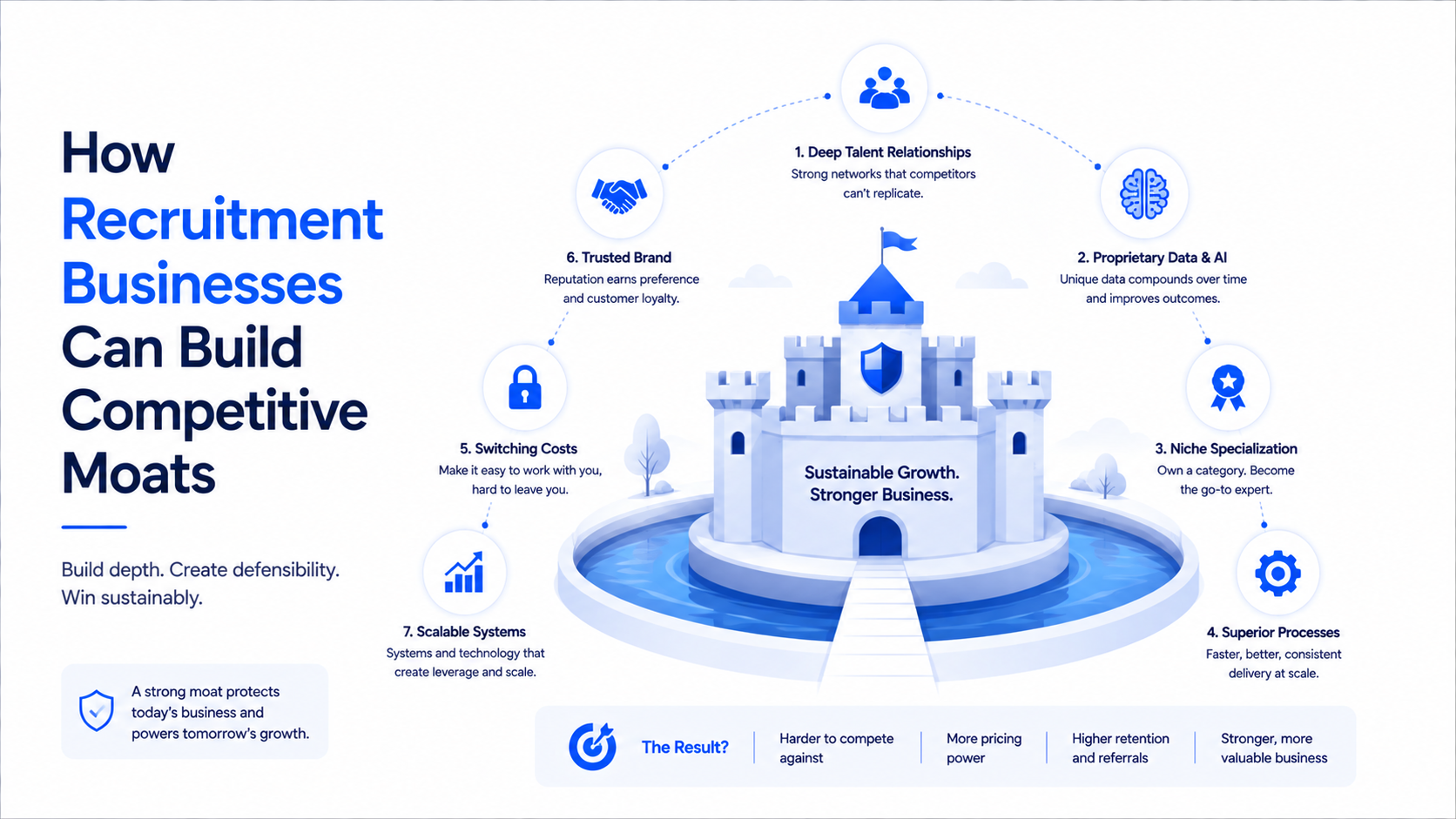
The firms that will thrive in this environment are those that recognize the commodity trap early and invest systematically in building advantages that are structural rather than relational, cumulative rather than static, and proprietary rather than widely available. A structural advantage is one that is embedded in the firm's operating model, technology, or data assets, not merely in the skills or connections of individual employees. A cumulative advantage is one that grows stronger over time as the firm accumulates more data, more client engagement, and more market knowledge. A proprietary advantage is one that competitors cannot easily replicate because it is built on unique data, custom technology, or deeply embedded client workflows that would require years and significant investment to reconstruct. These three characteristics, structural, cumulative, and proprietary, define what investors call a competitive moat, a set of defenses that make a business fundamentally harder to compete against. more tools same hiring problems explains why recruitment firms that rely on adding more tools without building integrated, proprietary systems around them remain as vulnerable as
firms with no technology at all, because tool availability is universal but the ability to combine tools into a defensible system is rare.
Data as the Foundation of a Recruitment Moat
Data is the most powerful foundation for a competitive moat in recruiting because it is inherently cumulative and inherently proprietary if collected and structured correctly. Every recruiting interaction generates data: candidate profiles, assessment outcomes, interview feedback, offer details, compensation packages, acceptance and rejection patterns, hiring manager preferences, time-to-fill metrics, and post-hire performance data. Most recruitment firms treat this data as transactional byproduct, storing it in their applicant tracking system for operational reference but never aggregating it, analyzing it, or using it to create advantages that compound over time. The firms that build real moats treat this data as a strategic asset, investing in the infrastructure to collect it comprehensively, structure it consistently, and apply it systematically to improve every aspect of their service delivery.
The data moat operates through several mechanisms that become more powerful as the data accumulates. First, historical placement data enables the firm to build predictive models that identify which candidates are most likely to succeed in specific roles at specific companies, based on patterns in the firm's own placement outcomes rather than on generic industry benchmarks. A firm that has placed two hundred data engineers at technology companies in the Boston area has a dataset that no new competitor can replicate, and that dataset enables more accurate candidate matching, faster shortlist generation, and higher placement success rates than firms relying on generic assessment criteria. Second, market intelligence data, including compensation trends, candidate availability patterns, and competitive hiring dynamics, gives the firm's recruiters an information advantage in candidate and client conversations that translates directly into higher close rates and better candidate experiences. Third, process data, including the sequence of activities that produced successful placements versus unsuccessful ones, enables continuous process optimization that improves efficiency and quality over time in ways that competitors without equivalent data cannot match. According to Gartner, data-driven recruitment firms report twenty to thirty percent higher placement rates and fifteen to twenty percent lower candidate dropout rates compared to firms making decisions based primarily on recruiter intuition, because the data provides a factual foundation for every recommendation and every process decision.
Building a data moat requires deliberate investment in three capabilities. The first is comprehensive data capture, ensuring that every recruiting interaction generates structured, consistent data that can be aggregated and analyzed. This means moving beyond the basic data fields that most applicant tracking systems capture, such as candidate name, resume, and status, to include the rich contextual data that drives predictive accuracy: hiring manager feedback, candidate motivation, counteroffer details, interview scorecards, and post-hire performance metrics. The second is data integration, connecting data from the ATS, CRM, outreach tools, assessment platforms, and client feedback systems into a unified dataset that enables
cross-functional analysis. Most firms have data scattered across five to ten systems with no integration, which means they cannot analyze the full picture of their recruiting performance. The third is analytical capability, the tools and skills needed to extract actionable insights from the accumulated data. This does not necessarily require a data science team, but it does require investment in analytics tools, dashboards, and the training to use them effectively. agentic AI platforms vs automated ones describes how AI platforms that serve as the integration layer for recruiting data accelerate moat building by automatically capturing, structuring, and analyzing data from every recruiting interaction, because the platform turns the raw byproduct of daily recruiting operations into a structured strategic asset without requiring manual data management effort.
Relationships and Reputation: The Human Moat
While relationships alone are not a sufficient moat, they are a necessary component of one, and the way a firm builds and maintains relationships can be transformed from a fragile individual dependency into a structural organizational advantage. The key distinction is between relationships that belong to individual recruiters and relationships that belong to the firm. When a client's primary connection is to a specific recruiter, the client's loyalty travels with that recruiter if they leave. When a client's connection is to the firm's brand, its processes, its data assets, and its consistent service delivery, the relationship persists regardless of individual personnel changes. Building firm-level relationships requires investing in brand reputation, creating consistent and memorable client and candidate experiences, developing institutional knowledge that persists across team changes, and building multiple points of contact between the firm and each key client so that the relationship is distributed rather than concentrated in a single individual.
Reputation is the relationship moat's compounding mechanism. In professional services, reputation is both a magnet for new business and a barrier to competitor entry. A firm with a strong reputation in a specific market segment attracts higher-quality candidates, because candidates prefer to work with recruiters who have a track record of successful placements in their field. Higher-quality candidates lead to better placements, which strengthen the reputation further, creating a virtuous cycle that compounds over time. Conversely, a competitor trying to enter that market segment faces an uphill battle because candidates and clients alike prefer the established firm with the proven track record. This reputational advantage is particularly powerful in niche markets, where the community of candidates and hiring managers is relatively small and reputation travels quickly through personal networks. According to LinkedIn, recruitment firms with strong employer brands and candidate-facing reputations report forty to fifty percent higher response rates to candidate outreach and thirty percent shorter time-to-fill compared to firms with weak or unknown brands, because the reputation advantage reduces the friction in every candidate interaction.
The most defensible form of the relationship moat is what can be called an embedded partnership, where the recruitment firm's processes, tools, and team are so deeply integrated into
the client's hiring operations that replacing the firm would require the client to dismantle and rebuild significant portions of their talent acquisition infrastructure. Embedded partnerships go beyond traditional retained or contingent search arrangements by including shared technology platforms, integrated reporting, joint workforce planning, dedicated team members who operate as an extension of the client's internal talent acquisition function, and customized workflows that reflect the client's specific hiring processes and approval chains. The switching costs of an embedded partnership are not contractual, they are operational. A client that has spent two years building integrated workflows, shared data systems, and customized processes with one recruitment partner faces months of disruption if they switch to another provider, even if the new provider offers lower fees. This operational embeddedness is the most durable form of relationship-based competitive advantage because it creates genuine switching costs that go beyond the interpersonal loyalty that traditional recruiting relationships depend on. why AI tools have outdated candidate data explains why firms that rely solely on personal relationships without embedding their capabilities into client systems remain vulnerable to displacement, because personal loyalty evaporates quickly when a competitor offers a materially better or cheaper service.
Proprietary Technology and Workflow as Structural Defenses
While many recruitment firms use the same off-the-shelf tools, the firms that build real moats layer proprietary technology and custom workflows on top of those tools to create capabilities that competitors cannot replicate. The distinction is between using AI recruiting tools, which any firm can purchase, and building AI-powered systems that encode the firm's unique processes, data, and market knowledge into a differentiated service delivery engine. A firm that builds a custom candidate matching model trained on its own historical placement data creates a matching capability that is literally unique to that firm, because no competitor has the same training data. A firm that develops proprietary assessment frameworks calibrated to its clients' specific success criteria creates an evaluation capability that generic tools cannot match. A firm that builds automated workflows that reflect the nuanced preferences of its key hiring managers creates a service delivery speed that competitors using generic processes cannot achieve.
The proprietary workflow advantage extends beyond technology to include the firm's operational processes themselves. A recruitment firm that has developed a systematic methodology for candidate development, for example, a structured program that transforms raw candidate profiles into fully qualified, interview-ready candidates through a defined sequence of assessment, coaching, and preparation activities, delivers a different service than a firm that simply forwards candidate resumes. This methodology, if documented, standardized, and continuously improved based on outcome data, becomes a proprietary operational asset that differentiates the firm's service quality and creates a training and onboarding advantage for new recruiters. New recruiters at a firm with a proprietary methodology can become productive faster because they follow a defined process rather than relying entirely on individual experience and intuition. This process advantage scales with the firm, because every new recruiter
who follows the methodology contributes data that can be used to refine and improve it further. According to Deloitte, professional services firms that invest in proprietary methodologies and standardized workflows report twenty-five to thirty-five percent faster new hire ramp-up and fifteen to twenty percent higher consistency of service delivery compared to firms that rely on individual practitioner expertise, because the methodology captures and distributes best practices that would otherwise remain locked in the experience of senior team members.
The technology and workflow moat also creates a significant barrier to client acquisition by competitors. When a recruitment firm provides its clients with customized dashboards, real-time pipeline analytics, predictive fill-rate forecasting, and integrated reporting that feeds directly into the client's own workforce planning systems, the client develops a dependency on these capabilities that goes beyond the recruiting outcomes themselves. A competitor offering a lower fee but without the analytics infrastructure, the predictive capabilities, and the integrated reporting will struggle to win the client's business, even if they can demonstrate comparable placement quality, because the client values the visibility, predictability, and strategic insight that the incumbent firm's technology provides. This technology-embedded value proposition transforms the recruiting relationship from a transactional service into a strategic partnership, which is far more defensible because the client is buying outcomes, insights, and capabilities, not just candidate submissions. AI sourcing vs AI recruiting explains why firms that invest in technology that goes beyond sourcing to encompass the full recruiting lifecycle, from workforce planning through post-hire analytics, create broader and deeper client dependencies than firms that focus technology investment narrowly on the sourcing function.
Building a Moat That Compounds Over Time
The most powerful competitive moats in recruiting share one characteristic: they compound. Each successful placement, each new client relationship, and each market interaction makes the moat stronger rather than merely adding linearly to the firm's revenue. This compounding effect is what separates a truly defensible business from one that is merely successful. A data moat compounds because every placement adds to the training data that improves matching accuracy. A reputation moat compounds because every successful placement strengthens the brand and attracts higher-quality candidates and clients in the future. A workflow moat compounds because every process iteration, informed by outcome data, makes the firm's operations more efficient and effective. A network moat compounds because every candidate placed creates a referral network and every client served creates a testimonial and a case study that drives future business. The strategic implication is clear: recruitment business owners should evaluate every investment, every process decision, and every client engagement not only by its immediate revenue impact but also by its contribution to the firm's cumulative competitive advantage.
Practically, building a compounding moat requires a multi-year investment horizon and a willingness to forgo some short-term profit in favor of long-term defensibility. This means
investing in data infrastructure before the ROI is fully visible, building proprietary technology before competitors force the issue, developing embedded client partnerships even when simpler transactional relationships would generate equivalent near-term revenue, and investing in brand and reputation through thought leadership, community building, and candidate experience even when the direct revenue impact is difficult to measure. Many recruitment business owners resist these investments because the recruiting industry has traditionally operated on short-term metrics: quarterly revenue, monthly placements, and weekly activity numbers. But the firms that have built the most durable market positions, the firms that consistently win competitive bids, maintain client relationships for decades, and command premium pricing, are those that have been willing to invest systematically in the assets that compound over time. According to EY, mid-market professional services firms that allocate at least ten to fifteen percent of revenue to capability-building activities, including data infrastructure, proprietary technology, and brand development, grow revenue thirty to forty percent faster over five-year periods compared to firms that invest less than five percent, because the capability investments create the differentiated value propositions that drive client acquisition, retention, and pricing power.
The final and often overlooked element of a compounding moat is the firm's talent model. A recruitment firm whose recruiters are trained to operate within a proprietary system, using proprietary data and proprietary processes, develops a team capability that is deeply specific to the firm and not easily transferable to competitors. This is the opposite of the traditional recruiting industry talent model, where star recruiters are hired for their personal networks and client relationships and are given maximum autonomy to operate however they see fit. The proprietary model invests in making recruiters more effective through the firm's systems and data, which means that the recruiter's effectiveness is partly dependent on the firm's platform and would diminish if they moved to a competitor without equivalent infrastructure. This does not mean treating recruiters as interchangeable cogs in a machine. It means building an environment where the firm's data, technology, and processes amplify each recruiter's individual skills, creating a combined capability that is greater than the sum of its parts and that cannot be easily replicated by a competitor who hires away individual team members. how to evaluate an AI sourcing tool provides a framework for assessing whether a recruitment firm's technology and process investments are creating genuine competitive differentiation or merely adding complexity without defensibility, because the assessment evaluates whether each investment contributes to a compounding advantage that strengthens over time or merely provides a temporary efficiency gain that competitors can match.