A candidate agrees to speak with you about a role. They expressed interest, confirmed their availability, and the interview is on the calendar. For most recruiters, this is the moment to move on to the next candidate in the pipeline. The interview is scheduled, the system has a date and time, and the candidate will show up. Except that a significant percentage of them do not. Interview no-show rates in professional hiring range from fifteen to thirty percent depending on the industry, seniority level, and region, and the cost of each no-show extends far beyond the wasted calendar slot. It includes the time the interviewer spent preparing, the opportunity cost of the unfilled role, and the recruiter’s own time spent re-engaging the candidate or sourcing a replacement. But the even larger cost is invisible: the candidates who do show up but who have gone cold — who arrive at the interview underprepared, unenthusiastic, or mentally checked out because the days or weeks between their initial engagement and the interview were filled with silence, uncertainty, or competing opportunities that no one was managing against.
The pre-interview phase — the period between a candidate’s initial expression of interest and the first substantive interview — is the most undermanaged stage of the hiring process. It receives a fraction of the attention that is devoted to outreach strategy or interview technique, yet it is the stage where more candidates are lost than any other. The candidate who said yes on Tuesday is not guaranteed to be engaged on Thursday, let alone the following week when the interview finally happens. During that gap, the candidate is receiving messages from other recruiters, considering counteroffers from their current employer, reviewing the opportunity with their spouse or mentor, and forming impressions about the hiring organization based not on the role itself but on how they are being treated during the process. The recruiter’s job during this phase is not to wait. It is to actively manage the candidate’s experience, keep the opportunity top of mind, provide information that deepens their interest, and address concerns before those concerns become reasons to
withdraw. The recruiters who do this consistently are the ones whose interview show rates are high, whose candidates arrive prepared and enthusiastic, and whose hiring managers consistently comment on the quality of the talent pipeline.
Why Candidates Go Cold Between ‘Yes’ and the Interview
Understanding why candidates disengage during the pre-interview phase is the prerequisite for preventing it. The reasons fall into four broad categories, and each requires a different engagement strategy. The first is simple decay of interest. Human attention is finite, and a candidate who was excited about an opportunity when they first learned about it will naturally lose some of that excitement as time passes and the immediate emotional trigger fades. This is not a failure of commitment. It is a normal psychological process, and it is accelerated when the gap between initial contact and interview is long — which it often is, because interview scheduling in organizations with multiple stakeholders can take one to three weeks even in the best-run processes. The second reason is competing activity. The candidate who expressed interest in your role is almost certainly engaged with other opportunities simultaneously. They may have three or four conversations happening in parallel, and the opportunity that stays most present in their mind is the one whose recruiter is most consistently in touch. Silence from your end while other recruiters are actively engaging creates a relative perception that your opportunity is less important or less serious, even if the role itself is superior.
The third reason is uncertainty, and it is perhaps the most corrosive. Candidates who have agreed to an interview but have not received adequate information about what to expect, who they will be speaking with, what the interview format will be, or what the decision timeline looks like will fill that information vacuum with their own assumptions — and those assumptions are usually more negative than reality. A candidate who does not hear anything for a week after scheduling an interview may conclude that the role is not a priority for the hiring manager, that the company is disorganized, or that other candidates are being prioritized. None of these conclusions may be true, but they are rational responses to a communication void. The fourth reason is anxiety. Many candidates, particularly those who are not actively looking for a new role but were open to being approached, experience increasing anxiety as the interview approaches. They worry about the interview format, the technical assessment, the cultural fit evaluation, and the implications of leaving their current role. Without reassurance and information from the recruiter, this anxiety does not dissipate. It compounds, and for some candidates it reaches a point where the cost of engaging with the process feels higher than the benefit of exploring the opportunity. The result is a withdrawal or a no-show that could have been prevented with better pre-interview engagement. According to Talent Board’s CandE Award research, candidate experience benchmarking data consistently shows that the pre-interview communication phase has the strongest correlation with overall candidate satisfaction and offer acceptance rates, more so than the interview itself or the offer stage. Candidates remember how they were treated while they were waiting, and that treatment shapes their perception of the employer brand and their willingness to continue in the process.
The Information Bridge: What to Share Before the First Interview
The most effective pre-interview engagement strategy is also the simplest: provide the candidate with the information they need to feel prepared, confident, and excited about the upcoming conversation. This is what might be called the information bridge — a structured set of communications that span the gap between the candidate’s initial interest and the interview, each adding a new layer of detail that deepens the candidate’s understanding of the opportunity and their connection to it. The information bridge is not a single email. It is a sequence of touchpoints, typically three to five, that are spaced across the pre-interview period and each deliver a specific type of information that the candidate needs at that stage of their decision-making process.
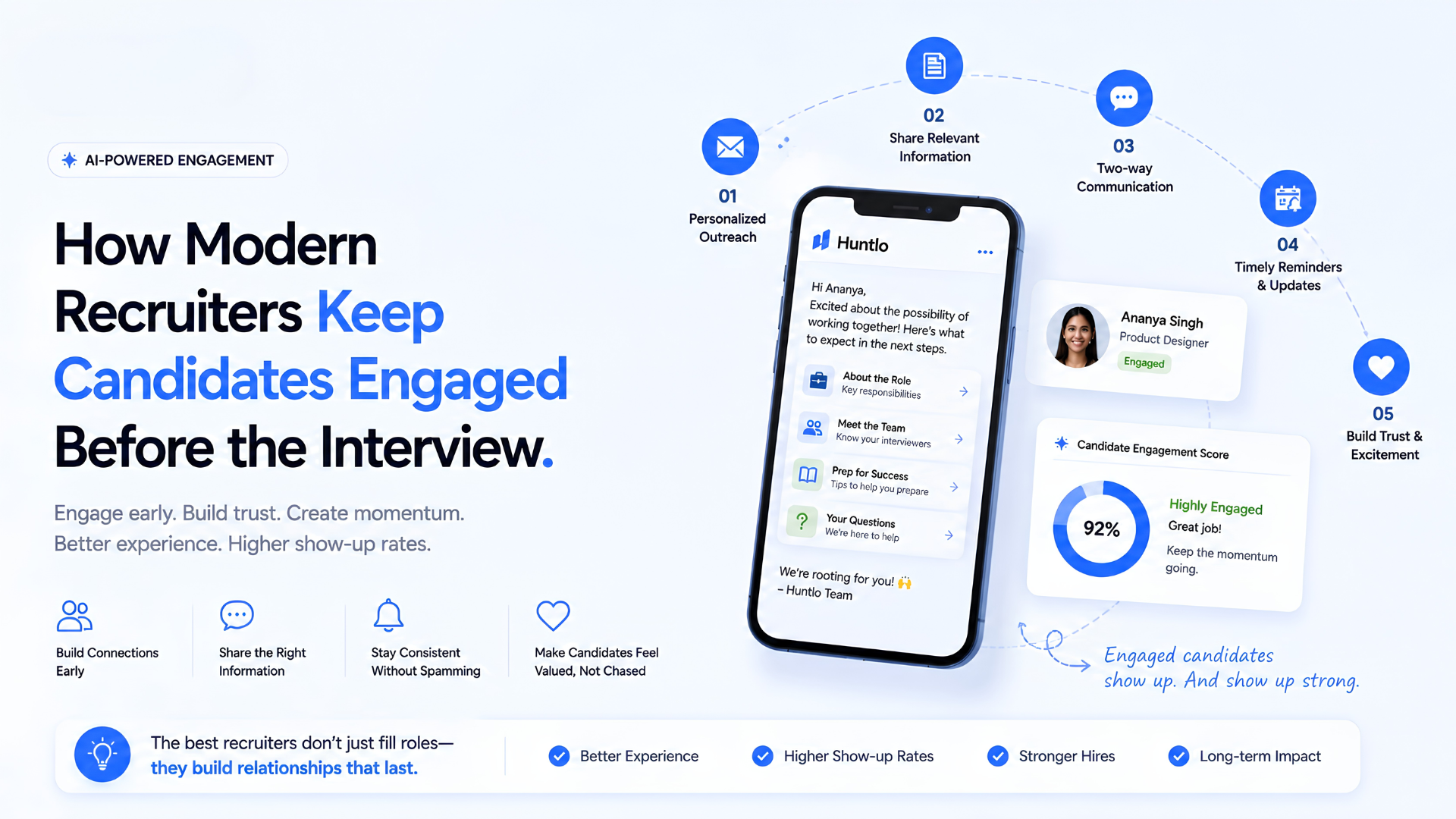
The first touchpoint, sent immediately after the interview is confirmed, covers the logistics: date, time, format, interviewer names and roles, and any preparation materials the candidate should review. This is the minimum viable communication, and many recruiters stop here. But it is only the foundation of the information bridge. The second touchpoint, sent one to two days later, provides context about the team and the role that goes beyond the job description. This might include information about the team’s current priorities, the challenges the new hire will be addressing, the reporting structure, or the tech stack and tools the team uses. The goal is to give the candidate something specific to think about and prepare for, which serves the dual purpose of making them feel valued and giving them a reason to stay mentally engaged with the opportunity. The third touchpoint, sent a few days before the interview, is a personal message from the recruiter that addresses the candidate’s specific situation: a reference to something they discussed during the initial outreach, an answer to a question they raised, or an observation about how their background connects to the team’s needs. This touchpoint is the most important one, because it is the one that makes the candidate feel like an individual rather than a pipeline slot. The contrast between personalized, information-rich pre-interview engagement and the typical “Your interview is confirmed for Thursday at 2 PM” email is the same contrast that distinguishes referral candidates from cold outreach candidates. As documented in Why Referrals Outperform Cold Outreach, referral candidates arrive at the interview more engaged and more likely to accept an offer because they have been receiving personalized context about the opportunity from the referring employee throughout the pre-interview period. The information bridge replicates that personalized context for non-referral candidates, closing the engagement gap between referred and cold-sourced talent.
Re-Establishing the Candidate’s ‘Why’ Before They Walk In
One of the most powerful pre-interview engagement techniques is also one of the least used: re-establishing the candidate’s original motivation for exploring the opportunity. When a candidate first engages with a recruiter, they have a reason. They are frustrated with their current role, excited about a specific aspect of the opportunity, curious about the company, or open to a career move for personal or professional reasons. That reason is the emotional foundation of their engagement, and it is the most powerful lever the recruiter
has for keeping them invested through the pre-interview period. But most recruiters never revisit that reason after the initial conversation. They schedule the interview, send the logistics, and assume the candidate’s motivation will sustain itself. It usually does not, or at least not at full strength.
The technique is straightforward: in one of the pre-interview touchpoints, the recruiter references the candidate’s stated motivation and connects it to something specific about the upcoming interview. “When we first spoke, you mentioned that the lack of technical mentorship at your current company was a significant frustration. During the interview, you’ll be speaking with Sarah, who built the engineering mentorship program from the ground up — I think you’ll find that conversation particularly relevant.” This message does three things simultaneously. It reminds the candidate of their own motivation, which may have faded. It connects that motivation to a specific element of the upcoming interview, which gives the interview personal relevance beyond the generic job opportunity. And it demonstrates that the recruiter was listening during the initial conversation, which builds trust and makes the candidate feel valued. The technique works because it reactivates the candidate’s emotional investment in the opportunity at the moment when that investment is most likely to have decayed. According to LinkedIn’s talent solutions research, candidates who receive at least one personalized, motivation-referencing touchpoint between initial engagement and interview are twenty-five to thirty-five percent less likely to withdraw or no-show, because the touchpoint counteracts the natural decay of interest and reminds the candidate why they said yes in the first place.
Managing the Competing Opportunity Landscape
Top candidates always have competing opportunities, and the pre-interview phase is when those competing opportunities are most likely to pull the candidate away. A candidate who has agreed to interview with your company but also has an interview scheduled with a competitor, a counteroffer discussion underway with their current employer, or another recruiter actively courting them is managing multiple decision threads simultaneously. The recruiter who is silent during this period is effectively ceding the candidate’s attention to whichever other party is most actively engaging them. This does not mean the recruiter should be aggressive or pushy. It means the recruiter should be present, providing value and maintaining the relationship so that when the candidate makes their decision about which opportunities to prioritize, your opportunity is the one that feels most real, most serious, and most worthy of their time.
Practical strategies for managing competing opportunities include proactive transparency about the process timeline. Candidates who do not know when to expect a decision after the interview are more likely to accept another offer that provides certainty, even if that other opportunity is less attractive. Sharing a clear timeline — “After the interview, we aim to provide feedback within three business days, and if you advance to the next round, we will schedule it within the following week” — gives the candidate something concrete to plan around and reduces the perceived risk of continuing to engage. Another strategy is to provide social proof and momentum signals. Sharing that the hiring manager
is excited to meet the candidate, that the team has been asking about the timeline, or that other strong candidates are in the pipeline creates a sense of genuine activity around the role that makes the opportunity feel more real and more time-sensitive. This is not manufactured urgency. It is factual information about the state of the process that helps the candidate make a more informed decision about how to allocate their own time and attention. A third strategy is to address the competitor question directly. When a candidate mentions they are exploring other options, the best recruiters do not react defensively or dismissively. They acknowledge the competition, reiterate what makes their opportunity distinctive, and offer to provide any additional information the candidate needs to make a fair comparison. This confidence and transparency is itself a signal of organizational quality, and it differentiates the recruiter’s company from competitors who might be less forthcoming. The importance of process quality in retaining candidates through multi-stage hiring is underscored by SHRM’s talent acquisition research, which found that the single strongest predictor of candidate withdrawal before the offer stage is not the quality of the role or the compensation, but the perceived quality and professionalism of the hiring process itself. Candidates tolerate slow processes less than they tolerate imperfect offers.
The System Problem: Why Most Recruiters Cannot Execute Pre-Interview Engagement
The strategies described in this article are not secret. Most experienced recruiters know that pre-interview engagement matters, and many would like to do more of it. The reason they do not is structural. A recruiter managing twenty active requisitions with five to ten candidates each has one hundred to two hundred candidates in various stages of the hiring pipeline at any given time. Of those, perhaps thirty to fifty are in the pre-interview phase — the stage that requires the most personalized, context-specific communication. Manually crafting three to five individualized touchpoints for each of those candidates is a full-time job in itself, on top of the sourcing, screening, scheduling, and coordination work that the recruiter is already responsible for. The result is that pre-interview engagement is rationed: the recruiter provides it for the two or three candidates they consider highest-priority and lets the rest manage on their own. This is rational behavior given the constraints, but it means that the majority of candidates in the pipeline are receiving the bare minimum of communication during the phase where they are most likely to disengage.This is the same systems failure that The ATS Mistake Companies Keep Repeating describes at the organizational level: systems that are designed to track process steps rather than manage candidate relationships produce the illusion of activity while failing to deliver the engagement that actually drives outcomes. An ATS can tell you that an interview is scheduled and send an automated confirmation email. It cannot determine what information the candidate needs to feel prepared, craft a personalized message that reactivates their original motivation, or adapt the communication based on the candidate’s profile and the specific role they are being considered for. These capabilities require intelligence, context, and adaptability — the same qualities that distinguish effective human engagement from automated notification. The gap between what recruiters know they should do and what they have the
capacity to do is where technology needs to intervene, and the nature of that intervention matters. The right solution is not more automation that sends more generic emails. It is intelligent engagement that provides the kind of personalized, context-rich communication that keeps candidates warm, but at a scale that manual processes cannot achieve.
How Huntlo Keeps Your Pipeline Warm While You Focus on the Conversation
Huntlo addresses the pre-interview engagement gap by embedding candidate nurture into its AI-driven outreach workflow from the moment a candidate enters the pipeline. When a candidate responds positively to initial outreach and moves toward an interview stage, Huntlo does not hand off the candidate to a static ATS workflow that sends template confirmations and nothing else. It continues to engage the candidate with contextually relevant communications that are tailored to their profile, their conversation history, and the specific role they are being considered for. The AI generates personalized pre-interview touchpoints that cover the three critical functions described in this article: information delivery, motivation reactivation, and competitive positioning. Each touchpoint is different because each candidate’s context is different, and the content is generated fresh rather than selected from a template library, which means the candidate receives communication that feels genuinely personal rather than mass-produced.
The practical impact is that candidates arrive at the interview more prepared, more engaged, and more positively disposed toward the opportunity. For the recruiter, it means that the interview-to-offer conversion rate improves because the candidate’s initial enthusiasm has been maintained rather than allowed to decay. And for the hiring manager, it means that the candidates they meet are not just qualified on paper but are genuinely interested in the role and the team, which makes the interview itself more productive and the evaluation more accurate. This is the full value of AI in recruiting: not just finding more candidates, but ensuring that the candidates who are found stay engaged through every stage of the process until they either accept an offer or are declined with a positive experience. The best recruiters have always understood the importance of pre-interview engagement. The challenge has never been understanding. It has been execution at scale, and that is the challenge that Huntlo solves. As with any AI recruiting capability, the quality of the underlying system matters enormously. The criteria for evaluating whether a platform can deliver on its engagement promises are covered in What’s the Best Way to Evaluate an AI Sourcing Tool Before Buying?, and the same principles apply to evaluating engagement capabilities: look for demonstrated contextual intelligence, evidence of personalization depth, and a track record of candidate experience outcomes, not just sourcing volume metrics. The recruiters who will fill the most roles in 2026 are not the ones who find the most candidates. They are the ones who keep the most candidates engaged from first touch to final decision, and that requires a system built for engagement, not just identification.
Related Topics:
Why Referrals Outperform Cold Outreach
Agency Owners Are Solving Different Problems Than Recruiters Think