The idea of introducing AI into executive search sounds, at first, like a contradiction. The entire value proposition of retained executive search is built on personal relationships, nuanced judgment, and the kind of bespoke candidate assessment that no algorithm can replicate. Clients pay retainers precisely because they want a senior partner who has spent decades building networks, reading people, and making high-stakes placement decisions. The notion that a machine could meaningfully contribute to this process strikes many in the industry as not just unnecessary but actively threatening to the very thing that makes executive search valuable. Yet the firms that are performing best in the current market are the ones finding specific, targeted ways to deploy AI voice interviews at the edges of their process — not to replace the partner conversation, but to make it dramatically more productive.
The Executive Search Pipeline: Where AI Voice Fits and Where It Does Not
To understand how AI voice interviews can enhance executive search, it is essential to map them against the actual stages of the search process. A typical retained executive search follows a well-defined sequence: the client briefing and role specification phase, the market mapping and long-list development phase, the initial candidate engagement and screening phase, the shortlist presentation and client interview phase, the reference checking and due diligence phase, and finally the offer negotiation and onboarding support phase. Each of these stages demands a different combination of human judgment and structured process, and AI voice interviews are not equally relevant to all of them.
The phases where AI voice interviews add the most value are the long-list screening and initial candidate engagement stages. In a typical C-suite search, a firm may identify 80 to 150 potential candidates through market mapping, proprietary databases, referral networks, and direct sourcing. The senior partner leading the search does not personally speak with all 150 candidates. That would be operationally impossible given the number of concurrent searches most partners manage. Instead, the initial screening is typically handled by associates or junior consultants who conduct structured phone interviews, document the candidate’s responses, and present their assessments to the partner. This is the precise point where AI voice interviews can be deployed most effectively — not to eliminate the associate role, but to make the initial screening more structured, more consistent, and more informative, so that when the partner does engage with a candidate, the conversation is richer and more focused from the first minute.
The phases where AI voice interviews are not appropriate are equally important to identify. The client briefing phase requires the kind of deep consultative listening and strategic advisory capability that is the core of the partner’s value. The shortlist presentation and client interview phase involves a level of interpersonal dynamics, stakeholder management, and real-time adaptability that AI cannot replicate. The reference-checking phase demands trust, nuance, and the ability to read between the lines of what a referee says and does not say. As Heidrick & Struggles’ research on leadership advisory consistently shows, the highest-value activities in executive search are concentrated in these later stages, where the partner’s judgment, relationships, and advisory capability are irreplaceable. AI voice interviews, when deployed correctly, protect the partner’s time for exactly these high-value activities by absorbing the most time-consuming, lowest-judgment stage of the process.
Pre-Screening at Scale: Building the Long List Without Burning Associate Hours
The practical challenge that makes AI voice interviews relevant to executive search is the sheer volume of initial screening conversations required. A mid-size executive search firm running 15 to 20 concurrent engagements may need to conduct 1,500 to 3,000 initial candidate phone screens per quarter. Even with a team of associates, this volume creates a significant operational bottleneck. Each screen takes 30 to 45 minutes of associate time, plus another 15 to 20 minutes for documentation. Across a quarter, the firm is investing 1,000 to 2,500 associate-hours in initial screening alone. These are hours that are not being spent on market research, candidate development, client relationship management, or the strategic aspects of the search that differentiate a great firm from an adequate one.
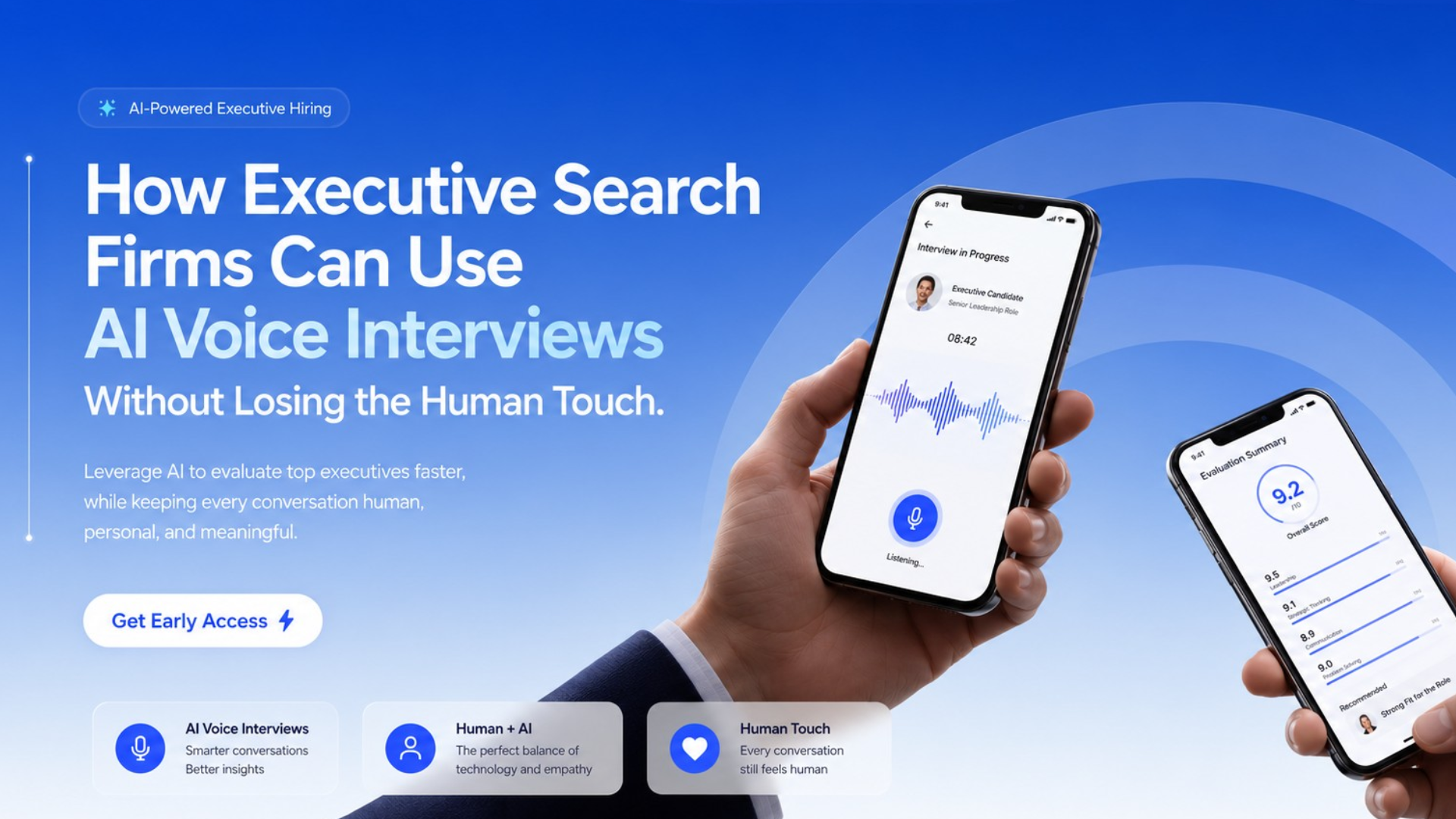
AI voice interviews address this bottleneck by enabling candidates to complete structured screening conversations at their convenience, with the AI evaluating and documenting responses in a consistent, standardized format. The candidate receives a link, completes a 15 to 20-minute voice conversation at a time that works for their schedule — which is particularly important for C-suite and senior executive candidates whose calendars are
often packed — and the search firm receives a detailed scorecard covering the assessment dimensions that matter for the role. The associate’s role shifts from conducting 30-minute screening calls to reviewing 15-minute scorecards, identifying the candidates who warrant deeper engagement, and preparing the partner with precisely the contextual information needed for a productive first conversation. This is not a reduction in the human element. It is a reallocation of human effort toward the interactions where it creates the most value. According to McKinsey’s research on the future of organizations, firms that reallocate routine evaluation tasks to AI-powered tools see a 25 to 35 percent increase in the time their senior professionals spend on client-facing and candidate-facing strategic activities, which directly correlates with higher placement rates and stronger client relationships.
The scalability benefit compounds across the firm’s entire portfolio of searches. When the screening infrastructure can handle volume without proportional increases in associate headcount, the firm can take on more engagements without diluting quality, can respond faster to client demands for broader long lists, and can explore candidate pools that would have been too time-consuming to screen manually. A search for a Chief Technology Officer, for example, might surface candidates not only from the expected technology sector but also from adjacent industries where the candidate’s transferable leadership experience is relevant but would require a dozen additional screening conversations to evaluate. AI voice interviews make it operationally feasible to cast a wider net without a proportional increase in cost or timeline.
Evaluation Consistency: The Hidden Quality Problem in Partner-Led Assessments
One of the least discussed problems in executive search is the inconsistency of evaluation across candidates within the same search. When different associates are conducting initial screens, each one asks slightly different questions, probes different areas, and documents responses at different levels of detail. One associate might spend 20 minutes on a candidate’s leadership philosophy and 5 minutes on their technical background, while another associate reverses that emphasis. The partner reviewing the resulting write-ups is comparing assessments that were generated using different frameworks, different depths of inquiry, and different standards of evidence. This inconsistency is not a failure of the associates. It is an inherent consequence of having multiple humans conduct unstructured or semi-structured conversations and then attempting to synthesize the results into a unified shortlist.
AI voice interviews eliminate this problem by applying the same questions, the same evaluation framework, and the same scoring criteria to every candidate. The competency dimensions — leadership style, strategic thinking, change management experience, stakeholder management, cultural alignment, and motivation for the move — are assessed consistently across the entire long list. The partner receives scorecards that are directly comparable, making the shortlist decision a genuine comparison rather than an exercise in normalizing assessments that were collected using different methods. SIOP’s research on
structured interviewing has demonstrated that structured interviews with standardized evaluation criteria are significantly more predictive of job performance than unstructured interviews, even at senior leadership levels where intuition and relationship assessment are traditionally considered paramount. The research is clear: consistency in the initial evaluation stage does not reduce the richness of the assessment. It increases it by ensuring that every candidate is evaluated against the same set of criteria with the same level of rigor.
This consistency benefit extends beyond individual searches. When a firm uses the same AI voice interview framework across multiple searches for similar roles — multiple CFO searches, for example, or a series of VP-level placements in the same industry — it builds a cumulative assessment database that improves the firm’s institutional knowledge over time. Partners can compare how candidates performed on specific competency dimensions across different searches, identify patterns in candidate quality from particular industries or companies, and refine their assessment frameworks based on actual placement outcomes. This kind of institutional learning is extremely difficult to achieve when each associate’s screening notes exist only in their own files, written in their own format, and are never systematically compared across searches.
Candidate Experience at the Executive Level: Why Transparency Matters More
At the executive level, candidate experience is not a nice-to-have. It is a strategic imperative that directly affects the search firm’s ability to attract top talent for current and future engagements. Senior executives talk to each other. They share experiences with recruiters and search firms within their professional networks. A candidate who feels that an initial screening conversation was perfunctory, that the associate seemed unprepared, or that the process was disrespectful of their time will not only decline to continue the current search process but will actively discourage peers from engaging with that firm in the future. In the executive talent market, where the best candidates are typically not actively looking and must be persuaded to explore an opportunity, the reputation of the search firm’s process is a direct competitive advantage or disadvantage.
AI voice interviews, when implemented with the right candidate communication and positioning, can actually improve the executive candidate experience. The candidate completes the screening at their convenience, without needing to coordinate schedules with an associate across time zones. The conversation is structured and focused, with questions that are directly relevant to the role rather than generic screening prompts. The candidate receives clear information about the process, the role, and the next steps, which reduces the ambiguity that often characterizes the early stages of an executive search. According to Gallup’s workforce engagement research, the single strongest predictor of a positive candidate experience at senior levels is not the speed of the process but the perception that the process was respectful, well-organized, and genuinely interested in the candidate’s qualifications and perspective. A well-designed AI voice interview that asks substantive, role-relevant questions and gives the candidate space to articulate their experience in detail
delivers on all three of these dimensions.
The critical success factor is transparency. The candidate must know upfront that the initial screening is conducted via AI, must understand what the AI evaluates and how the assessment will be used, and must have a clear path to a human conversation if their profile advances. When executive search firms position AI voice interviews as an efficiency tool that ensures every candidate receives a thorough, consistent initial evaluation — rather than as a cost-cutting measure that replaces human interaction — the response from senior candidates has been notably positive. They appreciate the convenience, they respect the structure, and they value the fact that the firm is investing in a rigorous process rather than rushing through screening to get to the “real” conversations.
The Human Touch That AI Cannot Replace: What Stays Exclusively Human
The most important design principle for executive search firms adopting AI voice interviews is clarity about what remains exclusively human. The technology handles structured, repeatable evaluation tasks. The partner and the search team handle everything else. This includes the deep-dive candidate conversations where strategic judgment, interpersonal chemistry, and the subtleties of executive presence are assessed. It includes the client advisory relationship, where the partner helps the client refine the role specification, challenge assumptions about candidate profiles, and navigate the internal politics of the hiring decision. It includes the candidate development and persuasion conversations, where the partner must build trust, address concerns, and ultimately convince a successful executive to make a career move. None of these activities can be delegated to AI, and none should be.
The partner’s judgment about cultural fit, leadership style, and organizational alignment is informed by but not determined by the AI’s scorecard. The scorecard provides structured data. The partner provides interpretation, context, and the kind of holistic assessment that comes from decades of experience placing leaders in similar roles. The AI might flag that a candidate scored highly on strategic thinking but lower on stakeholder management, which prompts the partner to probe that specific area more deeply in their conversation. The AI might surface a candidate who scored unexpectedly well on dimensions that the initial market mapping suggested were weaknesses, leading the partner to reconsider the candidate’s potential fit. In both cases, the AI is serving as an intelligence tool that enhances the partner’s decision-making rather than a decision-making tool that constrains it. As explored in What Makes an AI Recruiting Platform Agentic vs. Just Automated?, the distinction between a tool that assists professional judgment and a tool that attempts to replace it is the defining difference between platforms that succeed in high-stakes recruitment environments and those that do not.
Building a Human-First AI Stack for Executive Search
Executive search firms that want to capture the efficiency and consistency benefits of AI voice interviews without compromising their human-first positioning need a platform that was designed with this balance in mind. The technology must be sophisticated enough to evaluate senior-level competencies — leadership philosophy, strategic vision, change management, organizational influence — not just the communication and reliability dimensions that suffice for high-volume hiring. It must produce detailed, narrative-rich scorecards that give partners genuine insight into each candidate, not just numerical scores on a dashboard. And it must integrate with the firm’s existing workflow in a way that feels like an enhancement rather than a disruption.
Huntlo provides this capability with an AI voice interview system that can be configured with executive-level competency frameworks tailored to the specific requirements of each search. Unlike generic screening tools that apply the same evaluation rubric to every role, Huntlo allows search firms to define custom assessment dimensions, adjust the depth and focus of questions based on seniority and function, and generate scorecards that match the format and level of detail that partners expect from associate-written screening notes. Its AI sourcing engine covers 50+ platforms, enabling firms to build broader long lists without the manual research effort that typically constrains market mapping. And its multi-channel outreach capabilities ensure that passive senior candidates are engaged through the channels they actually use, whether that is email, LinkedIn messaging, or direct referral introductions.
The operational impact for an executive search firm is straightforward. Associates spend less time on repetitive screening calls and more time on the research, candidate development, and client support activities that advance the search. Partners receive more consistent, more comparable, and more comprehensive candidate assessments, which improves shortlist quality and client confidence. The firm can scale its search capacity without proportional increases in headcount, which improves profitability without diluting the partner-led service model that clients are paying for. And the cumulative assessment data across searches builds institutional knowledge that makes every subsequent search more informed. For firms navigating an increasingly competitive market where clients expect faster shortlists, broader candidate pools, and more rigorous evaluation — as highlighted in The ATS Mistake Companies Keep Repeating, where relying on outdated tools while competitors adopt smarter ones is the most expensive mistake a recruitment organization can make — this combination of AI-powered efficiency and human-led judgment is not just an operational improvement. It is a competitive advantage.
The executive search firms that will thrive over the next decade are not the ones that reject AI in favor of tradition, nor the ones that adopt AI at the expense of their human relationships. They are the ones that deploy AI precisely where it amplifies the value of their human expertise — handling the structured, repetitive, and volume-dependent stages of the process so that their most talented people can invest their time in the conversations, judgments, and relationships that define exceptional executive placement. The human touch is not diminished by AI. When implemented thoughtfully, it is protected, concentrated, and
made more valuable than ever.
Related Topics:
Why Referrals Outperform Cold Outreach
Recruiting Compliance Differences: India vs. USA vs. UK
Agency Owners Are Solving Different Problems Than Recruiters Think