In 2008, the market for cloud-based customer relationship management software did not exist in any meaningful sense. Enterprise organizations bought CRM software the way they bought all enterprise software: they purchased licenses, installed the software on their own servers, and managed it with their own IT teams. The concept of paying a subscription to access CRM software hosted on someone else's infrastructure was not a category. It was a fringe idea that most enterprise CIOs viewed with skepticism. Salesforce was not the best CRM software by traditional feature comparison. It had fewer customization options than Siebel, weaker reporting than Oracle, and less functionality in several areas that enterprise buyers considered important. But Salesforce was building something that its competitors were not: a new category defined not by what the software did but by how it was delivered and consumed. By the time the market for cloud CRM became large enough to attract serious competitive attention, Salesforce had already established the category definitions, the buyer expectations, the pricing models, and the ecosystem dynamics that determined how the market would be structured. The competitors who eventually entered the cloud CRM market found themselves competing on terms that Salesforce had defined, and they never closed the gap. This pattern, where a company defines and dominates a category before the market recognizes the category exists, is the most powerful strategy in enterprise software, and it is the strategy that will determine the next generation of category leaders in HRTech.
The Category Creation Advantage
Category creation is the most underrated and most powerful competitive strategy in enterprise software, and it operates through a mechanism that is fundamentally different from the
competition-based strategies that most companies pursue. When a company competes within an existing category, it accepts the category definition, the evaluation criteria, and the buyer expectations that incumbents have established. A new ATS that enters the applicant tracking system market must compete on the criteria that Workday, Greenhouse, and Lever have defined: feature breadth, integration coverage, user interface quality, and price. Even if the new ATS is technically superior, it is competing on terms that incumbents have spent years optimizing and that buyers have been trained to evaluate. The incumbent has the advantage of brand recognition, customer references, installation base, and ecosystem partnerships, all of which reinforce its position within the existing category framework. The challenger can win on features or price, but it cannot change the rules of the game because the category definition is not under its control.
Category creation bypasses this dynamic entirely by refusing to compete within the existing category framework. Instead, the category creator defines a new framework, a new way of thinking about the problem, a new set of evaluation criteria, and a new set of buyer expectations. The category creator does not say, we are a better ATS. The category creator says, the ATS category is the wrong way to think about the problem, and here is the right way. This redefinition of the problem is the most powerful move in enterprise software because it invalidates the incumbent's advantages. If the category is no longer applicant tracking systems but autonomous hiring platforms, then the incumbent's ATS feature breadth, integration coverage, and workflow configuration options are no longer the primary evaluation criteria. The new criteria, AI model quality, autonomous workflow capability, and outcome-based pricing, are ones where the category creator has a natural advantage because it designed its product around those criteria from the beginning while the incumbent is trying to retrofit them onto a product designed for different criteria. The psychological effect on buyers is equally powerful. Once a buyer accepts the new category definition, they cannot unsee it. They begin evaluating all vendors, including the incumbent, against the new criteria, which puts the incumbent at a structural disadvantage because its product was not designed for those criteria.
The economic value of category creation is reflected in valuation multiples. Companies that are recognized as category leaders, meaning they defined and dominate a category, trade at revenue multiples that are two to three times higher than companies that are strong competitors within categories defined by others. The reason is that category leaders have pricing power, because they define what the product should cost; they have retention advantage, because switching to a competitor requires abandoning the category framework that the buyer has adopted; and they have expansion opportunity, because the category leader can expand the boundaries of the category it defined, bringing adjacent use cases into its scope. According to McKinsey, category-creating companies in enterprise software generate sixty to seventy percent of the long-term value creation in their markets despite representing less than fifteen percent of the total number of vendors, because the combination of pricing power, retention advantage, and expansion opportunity compounds over time and creates a widening gap between the category leader and the best competitors. agentic AI platforms vs automated ones illustrates how the creation of the agentic AI recruiting category follows this pattern,
because the companies defining the agentic recruiting category are not competing with traditional ATS vendors on their terms but are establishing a new category with new evaluation criteria where traditional ATS vendors are structurally disadvantaged.
The Market Timing Window for Category Creation
Category creation does not work at any time. It works when a technological shift creates a gap between how the market currently thinks about a problem and what the new technology makes possible. This gap is the opening that the category creator exploits. Before the technological shift, there is no gap: the existing category definitions accurately reflect what is possible, and attempts to redefine the category appear premature or impractical. After the technological shift has been widely absorbed, there is no gap: the market has already updated its category definitions to reflect the new reality, and the opportunity to define the category has passed. The timing window is the period between the emergence of a new technological capability and the market's full understanding of that capability's implications. This window is typically two to four years in enterprise software, depending on the pace of technology adoption and the complexity of the domain. The window opens when the technology becomes capable enough to demonstrate the new category's value in pilot deployments. It closes when the majority of enterprise buyers in the category have updated their mental models and evaluation criteria to account for the new capability.
The current moment in HRTech is defined by three simultaneous technological shifts that are creating category creation windows across multiple HRTech subsectors. The first shift is the maturation of large language models to the point where they can reliably manage multi-step, multi-turn interactions with candidates, employees, and managers. This capability enables the creation of AI agent categories in recruiting, employee engagement, HR service delivery, and workforce management, because agents require the ability to maintain coherent conversations, make context-dependent decisions, and adapt behavior based on interaction outcomes. The second shift is the development of multi-modal AI systems that can process not just text but voice, video, and structured data, enabling the creation of categories that span communication modalities in ways that were not previously possible. The third shift is the emergence of real-time data infrastructure that enables AI systems to monitor, analyze, and act on continuously flowing data streams rather than periodic snapshots, enabling the creation of categories based on real-time intelligence rather than periodic reporting. Each of these shifts is creating a gap between the existing category definitions in HRTech and what the technology now makes possible, and each gap represents a category creation opportunity for the company that moves first to define the new category.
The challenge of market timing is that the window appears open to multiple companies simultaneously, and the company that defines the category is not necessarily the first to recognize the technological shift. Many companies see the shift. Few have the combination of technology, conviction, and go-to-market execution to define the category before others do. The company that wins the category definition is the one that does three things most effectively.
First, it names the category in a way that sticks, a short, clear phrase that buyers, analysts, and journalists adopt as the standard way to describe the new approach. Second, it articulates the evaluation criteria for the category, defining what good looks like in a way that highlights its own strengths and exposes the weaknesses of incumbent approaches. Third, it demonstrates the category's value with reference customers and case studies that provide the social proof that other buyers need to adopt the new framework. These three actions, naming, criteria-setting, and proof-providing, are the mechanics of category creation, and the company that executes them first and most convincingly becomes the category leader by default because the market has no other reference point for the new category. According to Gartner, the company that first establishes a recognized category definition in an emerging enterprise software market captures thirty to forty percent of the eventual market value on average, because the category definition becomes the lens through which all buyers evaluate vendors, and the company that provided the lens has a natural positioning advantage that later entrants cannot overcome regardless of product quality. AI sourcing vs AI recruiting demonstrates how the creation of the AI-native recruiting category required distinguishing the new approach from both traditional sourcing tools and traditional recruiting platforms, because the category creator had to explain why neither existing category adequately described what the new technology made possible.
The Playbook: How to Build a Category Before the Market Exists
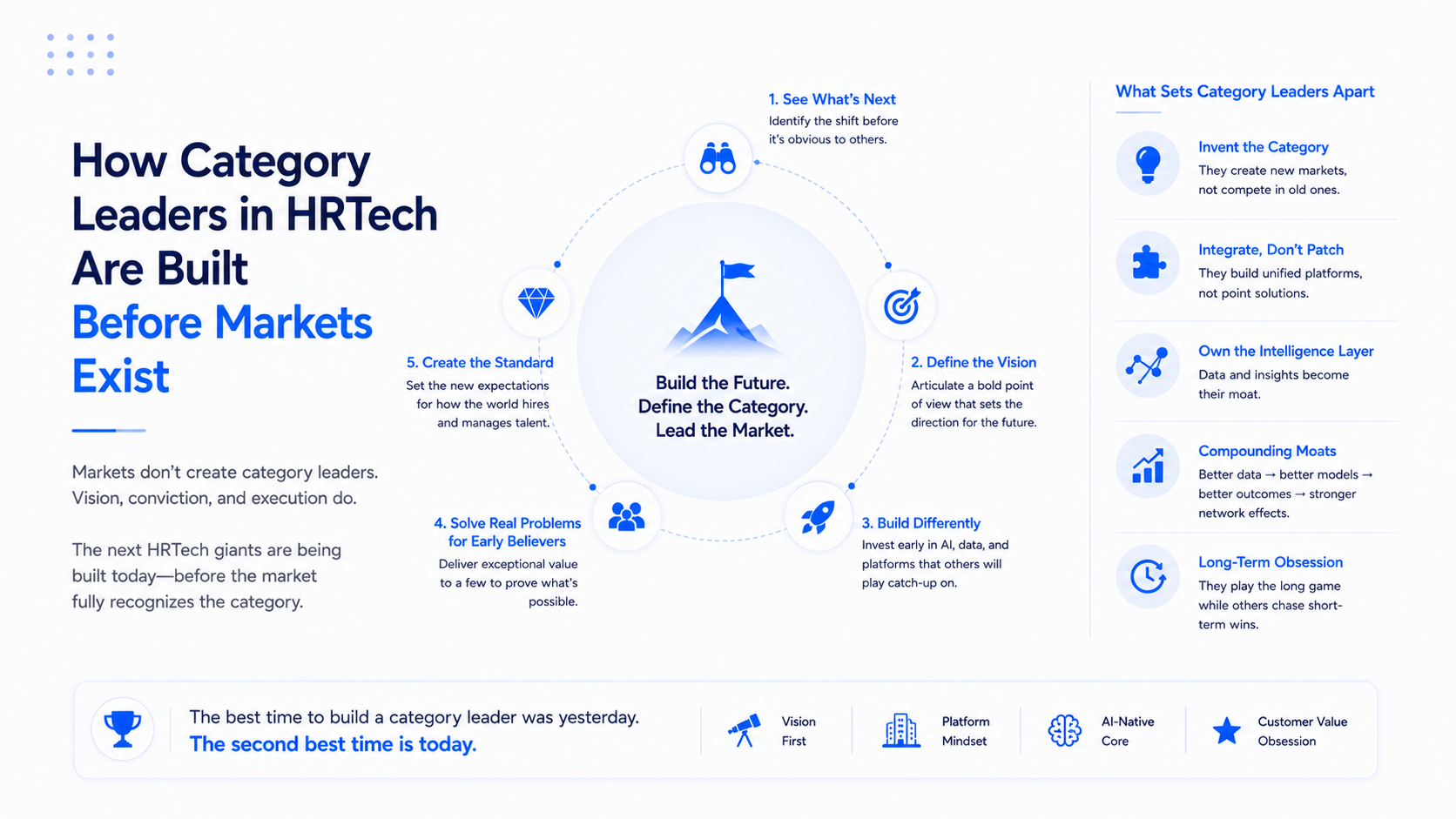
The category creation playbook consists of five sequential phases, each building on the previous one, and each requiring different capabilities and producing different outputs. The first phase is problem articulation, where the founder or product team identifies a problem that the existing category does not adequately address. This is not about identifying a feature gap in an existing product. It is about identifying a fundamental mismatch between how the market currently approaches a problem and what the new technology makes possible. The problem articulation must be framed in terms that resonate with the economic and strategic priorities of the target buyer, not in terms of technology capabilities. The statement should not be, our AI models can autonomously execute recruiting workflows. It should be, the traditional recruiting technology stack was designed for a world where humans managed the process and technology provided tools. AI makes it possible for technology to manage the process and humans to provide strategic oversight, and this inversion produces fundamentally better outcomes at dramatically lower cost. This reframing of the problem from a technology statement to a business outcome statement is what makes the category creation narrative compelling to enterprise buyers who do not evaluate technology for its own sake but for the business outcomes it produces.
The second phase is category naming and definition, where the company creates the language that the market will use to describe the new approach. The category name must accomplish three things simultaneously. It must be descriptive enough that buyers immediately understand what the category is about. It must be differentiated enough that it is clearly distinct
from existing categories. And it must be expansive enough that it encompasses the full scope of what the technology makes possible, not just the initial use case. The category of autonomous recruiting platforms is a better category name than AI sourcing tools because it encompasses the full recruiting workflow, not just sourcing, and it implies a fundamentally different approach, autonomy rather than assistance, not just a technology upgrade. The third phase is narrative development, where the company builds the story that connects the problem articulation to the category definition to the product solution. This narrative must explain why the existing category is no longer sufficient, why the new category is necessary, and why this particular company is the best exemplar of the new category. The narrative is the primary content of the company's thought leadership, including blog posts, conference presentations, analyst briefings, and customer conversations. A strong category creation narrative is not a sales pitch. It is an educational framework that helps buyers understand why the world has changed and what they should do about it.
The fourth phase is proof accumulation, where the company builds the evidence that the new category delivers superior outcomes compared to the existing approach. This evidence takes three forms: quantitative proof, including ROI metrics, performance benchmarks, and cost comparisons; qualitative proof, including customer testimonials, case studies, and reference accounts; and market proof, including analyst coverage, media recognition, and competitive response. Quantitative proof is most persuasive to CFOs and procurement leaders who need financial justification. Qualitative proof is most persuasive to operational leaders who need confidence that the new approach works in practice. Market proof is most persuasive to executives and board members who need validation that the new category is a real market trend, not a vendor's marketing invention. The fifth and final phase is ecosystem activation, where the company builds the partner, integrator, and analyst relationships that embed the new category in the broader market infrastructure. Ecosystem activation includes recruiting system integrators to implement the new category's products, building technology partnerships that extend the category's capabilities, and educating analysts so they define and size the new category in their market reports. When analysts begin publishing market size estimates for the new category, when system integrators develop implementation methodologies for it, and when technology partners build products that integrate with it, the category has become a market reality rather than a vendor's positioning strategy. According to Deloitte, the companies that successfully complete all five phases of the category creation playbook typically require three to five years to establish category leadership, but once established, their market position is three to five times more defensible than the position of companies that enter established categories, because the category definition, narrative, proof, and ecosystem that they created become structural barriers that competitors must overcome. AI tools for niche technical roles shows how focusing on a specific, underserved market segment is often the most effective starting point for category creation, because the concentrated problem statement, buyer community, and success metrics in a niche market provide the proof and narrative foundation that enables later expansion to broader markets.
Historical Examples That Reveal the Pattern
The category creation pattern is visible across multiple enterprise software markets, and the common elements reveal the structural dynamics that make it work. Salesforce defined the cloud CRM category before the market for cloud CRM existed. The existing category was on-premise CRM, dominated by Siebel and Oracle. Salesforce did not compete on feature parity with Siebel. It defined a new category, Software-as-a-Service CRM, with a new delivery model, a new pricing model, and a new set of evaluation criteria. By the time Siebel and Oracle responded with cloud offerings, Salesforce had defined the category, established the pricing expectations, and built the ecosystem that determined how the market would operate. HubSpot defined the inbound marketing category before the market for inbound marketing existed. The existing category was outbound marketing automation, dominated by companies like Marketo and Eloqua. HubSpot did not build a better marketing automation tool. It defined a new category based on a different philosophy of how marketing should work, attracting customers through content rather than interrupting them through advertising, and built the content, tools, and community that educated the market about the new approach. By the time Marketo and Eloqua responded, HubSpot owned the category definition and the educational infrastructure that sustained it.
Workday defined the cloud HCM category using the same pattern. The existing category was on-premise HRIS, dominated by SAP and Oracle. Workday did not build a better on-premise HRIS. It defined a new category, cloud-based human capital management, that combined core HR, payroll, and talent management in a single cloud platform with a modern user experience. The category definition was powerful because it captured the frustration that HR leaders felt with their existing on-premise systems, which were expensive to maintain, difficult to upgrade, and resistant to the user experience standards that modern enterprise software had established in other categories. Workday's category creation was successful because the technological shift, the maturation of cloud computing infrastructure, created a genuine gap between what the existing category delivered and what the new technology made possible. ServiceNow followed the same pattern in IT service management, defining a new category of cloud-based IT workflow automation that replaced the incumbent on-premise ITSM tools. Zoom followed the same pattern in video conferencing, defining a new category of cloud-native, frictionless video communication that replaced the incumbent room-based and on-premise video conferencing systems. In each case, the pattern is the same: a technological shift creates a gap, a company defines a new category that exploits the gap, the company builds proof and ecosystem around the category, and by the time incumbents respond, the category definition is established and the creator's position is defensible.
The pattern also reveals the common failure modes that prevent companies from successfully creating categories. The most common failure mode is premature category creation, where a company attempts to define a new category before the technological shift has created a genuine gap. Companies that tried to define cloud CRM categories before cloud infrastructure
was reliable enough for enterprise deployment, or that tried to define AI recruiting categories before AI models were reliable enough for production use, found that the market did not adopt their category definitions because the underlying technology could not yet deliver on the category's promise. The second failure mode is feature-level category claims, where a company markets a new category name for what is essentially a feature improvement within an existing category. A company that adds an AI screening feature to its ATS and calls it an AI recruiting platform is not creating a category. It is rebranding a feature. The market recognizes the difference between genuine category creation, which requires a fundamentally different approach to the problem, and feature rebranding, which does not, and it responds accordingly. According to EY, the failure rate for category creation attempts in enterprise software is approximately seventy percent, and the primary causes of failure are premature timing, where the technology is not ready; insufficient differentiation, where the new category is too similar to existing categories; and weak narrative execution, where the company fails to educate the market effectively about why the new category is necessary. LinkedIn reports that among the thirty percent of category creation attempts that succeed, the average time from initial category articulation to recognized category leadership is three point five years, and the companies that achieve category leadership during this period share two characteristics: they start with a concentrated problem statement in a specific market segment, and they invest heavily in educational content that teaches the market why the new category is necessary.
Applying the Playbook to AI Recruiting and HRTech
The current technological shifts in AI create category creation opportunities across multiple HRTech subsectors, and the companies that define these categories now will establish the positions that determine market leadership for the next decade. The most significant category creation opportunity in HRTech today is the autonomous recruiting platform category, which redefines recruiting technology from tools that assist human recruiters to platforms that autonomously execute recruiting workflows. The technological shift enabling this category is the maturation of AI models to the point where they can reliably manage multi-step recruiting workflows, including sourcing, screening, engagement, and scheduling, without requiring human initiation or intervention at each step. The existing categories, applicant tracking systems, sourcing tools, and screening platforms, were all designed for a world where humans managed the process. The autonomous recruiting platform category is designed for a world where AI manages the process and humans provide strategic oversight. This category creation is not theoretical. Multiple companies are already demonstrating autonomous recruiting capabilities, and early adopters are reporting the kind of step-change improvements in cost, speed, and quality that signal a genuine category transition rather than a feature enhancement.
Beyond autonomous recruiting, several adjacent category creation opportunities are emerging. The AI-native talent intelligence category, which uses AI to provide real-time, predictive talent market insights rather than periodic survey-based reports, is being defined by companies that have accumulated sufficient labor market data to build the analytical models
required for real-time intelligence. The agentic employee engagement category, which uses AI agents to monitor and improve engagement continuously rather than measuring it through periodic surveys, is being defined by companies that recognize that the traditional survey-based approach to engagement measurement is structurally limited. The AI-powered workforce planning category, which uses AI to generate continuously updated workforce forecasts rather than annual planning exercises, is being defined by companies that have access to both internal workforce data and external labor market data. In each of these cases, the category creation opportunity exists because the existing category definition does not reflect what the new AI technology makes possible, and the company that defines the new category first will establish the evaluation criteria, the pricing models, and the ecosystem dynamics that determine how the market operates. According to Gartner, the total addressable market for AI-native categories in HRTech, including autonomous recruiting, AI-native talent intelligence, agentic engagement, and AI-powered workforce planning, is projected to grow from approximately eight billion dollars today to forty to sixty billion dollars by 2028, because these categories address market needs that existing categories cannot serve effectively.
The strategic imperative for HRTech founders and investors is clear: the window for category creation in AI-native HRTech is open now, but it will not remain open indefinitely. As AI capabilities become more widely understood and more evenly distributed, the gap between existing category definitions and technological reality will narrow, and the opportunity to define new categories will diminish. The companies that act now to define categories, build proof, and activate ecosystems will establish the positions that compound over the next decade. The companies that wait will find themselves competing in categories that others have defined, accepting evaluation criteria and market dynamics that put them at a structural disadvantage. The most important strategic decision an HRTech company can make in the current environment is not which features to build or which markets to enter. It is whether to invest in defining a new category or to accept competition within an existing one. For companies with the technology, the conviction, and the execution capability to pursue category creation, the potential reward is not just market share within a category. It is the creation and ownership of the category itself, which is the most durable and valuable form of competitive advantage in enterprise software. why referrals outperform cold outreach illustrates how category creators often identify their category opportunity by observing a workflow that spans multiple existing categories, because the cross-category workflow reveals a problem that no single existing category addresses, creating the gap that category creation exploits. how to evaluate an AI sourcing tool explains why the evaluation framework for a new category must be fundamentally different from the framework used to evaluate existing categories, because the new category's value proposition is based on outcomes and capabilities that the existing framework does not measure, which means that companies that try to evaluate new-category products using old-category criteria will systematically undervalue the innovation that category creators are delivering.