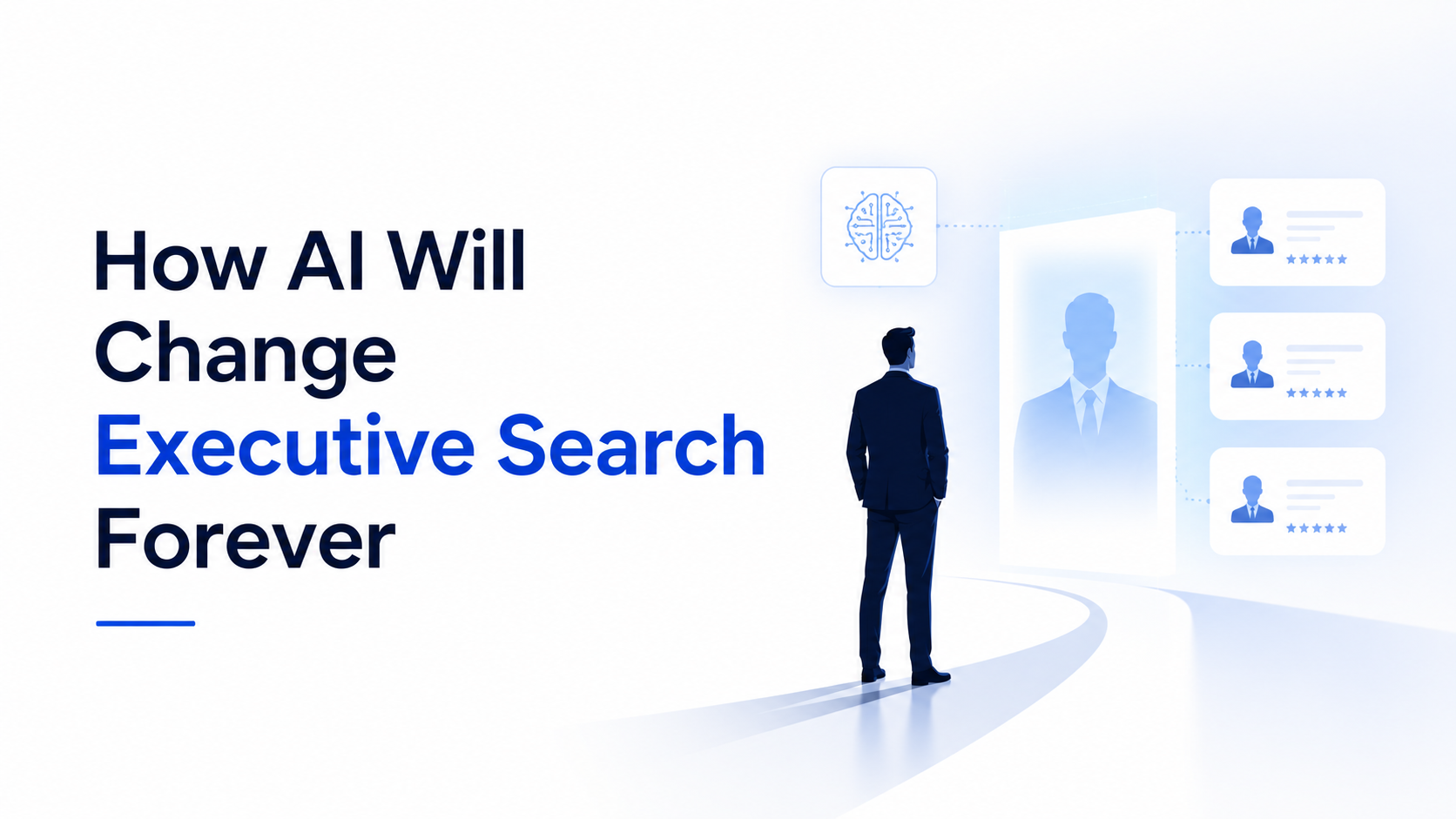
Patricia Thornton had built her executive search practice in San Francisco over eighteen years by doing one thing exceptionally well: she knew everyone. Her network of C-suite contacts, board members, and senior executives spanned technology, healthcare, and financial services. When a Fortune 500 company needed a new Chief Digital Officer, they called Patricia because she could identify candidates who were not on any public radar, access passive executives who would never respond to an inbound inquiry, and provide the kind of nuanced cultural assessment that no algorithm could replicate. But six months ago, one of her longest-standing clients, a major healthcare system, had hired a new Chief Information Officer through an AI-powered executive intelligence platform that had identified the candidate based on leadership trajectory analysis, board presentation patterns, and strategic decision-making signals extracted from public data. The candidate was exceptional. The client was thrilled. And Patricia had not been involved. For the first time in her career, she confronted a question that many executive search consultants will face in the coming years: when AI can identify, evaluate, and even engage senior executives at a fraction of the traditional cost and time, what happens to the value that executive search firms have built over decades?
Beyond the Rolodex: AI-Powered Executive Intelligence
The foundational advantage of executive search firms has always been proprietary access to senior talent. Search consultants maintained extensive personal networks, cultivated relationships with high-potential executives over years or decades, and leveraged these relationships to identify candidates who were invisible to traditional recruiting channels. This network advantage created a formidable barrier to entry and justified the premium fees that executive search firms commanded. AI is systematically dismantling this barrier by deriving executive intelligence from public data signals that no individual network, no matter how extensive,
could match in breadth or depth. Modern AI systems can analyze an executive's career trajectory, board memberships, published thought leadership, conference presentations, patent filings, regulatory filings, and strategic decision patterns to build a comprehensive leadership profile that reveals capabilities, inclinations, and growth potential that even a long-standing personal relationship might not surface. The executive who has been quietly transforming a mid-size company's digital capabilities may not attend the industry conferences where traditional search consultants network, but their digital footprint reveals a leadership pattern that AI can identify and evaluate.
The intelligence advantage of AI extends beyond identification to prediction. By analyzing the career paths, role transitions, and performance outcomes of thousands of executives, AI systems can identify patterns that predict which leaders are likely to succeed in specific organizational contexts. An executive who has successfully navigated a company through digital transformation in one industry may not be the best fit for a similar transformation in another industry with different regulatory constraints, competitive dynamics, and organizational cultures. AI models can assess these contextual factors and predict fit with a precision that generalist executive search consultants, who rely on pattern recognition from a limited set of past placements, cannot match. According to McKinsey, AI-powered leadership assessment tools are demonstrating twenty to thirty percent higher accuracy in predicting executive success at the three-year mark compared to traditional assessment methods that rely primarily on interview performance and reference checks, because the AI models incorporate a much broader set of behavioral and contextual signals into their predictions.
For executive search firms, the AI intelligence shift does not eliminate the need for human judgment, but it does change where that judgment creates the most value. When AI can identify candidates and predict fit with high accuracy, the search consultant's role shifts from being the primary source of candidate intelligence to being the interpreter and validator of AI-generated intelligence. The consultant evaluates whether the AI's assessment aligns with the specific nuances of the client's situation, provides context that the AI may miss, and manages the human dynamics of the search process that algorithms cannot navigate. This shift requires search consultants to develop new skills: the ability to critically evaluate AI outputs, the domain expertise to identify when AI recommendations need adjustment, and the interpersonal skills to guide clients through a search process where the candidate slate may look very different from what traditional methods would produce. how to evaluate an AI sourcing tool provides a framework for assessing the quality of AI-driven executive intelligence, because the accuracy of these systems depends heavily on the quality and breadth of the data they analyze, and search firms that understand these dependencies can better evaluate which AI tools are genuinely useful and which produce superficial insights.
Passive Candidate Identification at Unprecedented Scale
Executive search has always been fundamentally about engaging passive candidates, senior leaders who are not actively seeking new roles but who would be open to the right
opportunity. The challenge has always been scale: a single search consultant can maintain deep relationships with a few hundred executives at most, and even large search firms collectively maintain active relationships with only a small fraction of the senior talent pool. AI changes this equation by enabling the systematic identification and preliminary engagement of passive candidates across an entire industry or functional domain simultaneously. An AI system can scan thousands of executive profiles, identify those whose career trajectories, skill development patterns, and current role characteristics suggest openness to a new challenge, and prioritize outreach based on the predicted likelihood of a positive response. This capability does not replace the relationship-based approach that characterizes high-quality executive search, but it dramatically expands the candidate universe that a search firm can access for any given engagement.
The scale advantage of AI-powered passive identification is particularly significant for searches that require candidates from adjacent industries, emerging technology domains, or geographic markets where the search firm's traditional network may be shallow. A healthcare company seeking a Chief Technology Officer from the consumer technology sector, or a European manufacturer looking for a digital transformation leader from Silicon Valley, traditionally faced narrow candidate pools constrained by the search firm's network reach in those markets. AI systems that analyze cross-industry leadership patterns can identify executives whose experience translates across sectors, even when those executives have never worked in the target industry. According to Gartner, searches that leverage AI-powered cross-industry candidate identification produce candidate slates that are forty to fifty percent more diverse in background and perspective compared to slates generated through traditional network-based methods, because the AI is not constrained by the search consultant's existing relationships and can objectively evaluate transferable leadership capabilities across sector boundaries.
The critical question for search firms is how to combine AI-powered scale with the personal touch that distinguishes executive search from transactional recruiting. The most effective approach is to use AI for the identification and prioritization stages while preserving human-to-human engagement for the actual outreach and relationship development. AI identifies the candidate, scores their fit, and generates a personalized outreach strategy based on their career trajectory and likely motivations. The search consultant then executes the outreach, leveraging their credibility, industry knowledge, and relationship skills to engage the candidate in a meaningful conversation about the opportunity. This hybrid approach combines the best of both capabilities: AI's ability to process vast amounts of data and identify patterns that humans would miss, and the human consultant's ability to build trust, navigate complex negotiations, and manage the interpersonal dynamics that determine whether a senior executive will seriously consider a career move. AI tools for niche technical roles demonstrates how AI tools designed for specialized talent identification can be adapted for executive-level searches in technical and emerging domains, because the identification challenge is structurally similar even though the engagement approach must be calibrated to the seniority and expectations of executive candidates.
Predictive Cultural Fit: The Science of Executive Alignment
Cultural fit has always been one of the most important and most elusive dimensions of executive hiring. Search consultants assess cultural fit through interviews, reference checks, and intuitive judgment developed over years of placing leaders in similar organizational contexts. This approach has significant limitations. Interviews reveal how an executive presents themselves, not necessarily how they lead day to day. References are curated and often provide cautiously positive assessments rather than candid evaluations. Intuitive judgment, while valuable, is inherently subjective and difficult to scale or transfer between consultants. AI is introducing a more rigorous, data-driven approach to cultural fit assessment that analyzes behavioral patterns, leadership style indicators, decision-making approaches, and communication characteristics to predict how well an executive will align with a specific organizational culture. These systems analyze public signals such as how an executive communicates in public forums, the language they use in earnings calls and conference presentations, their pattern of strategic decisions, and their approach to organizational change, building a behavioral profile that can be compared against the cultural attributes of the hiring organization.
The predictive power of AI-driven cultural assessment comes from its ability to identify patterns that are invisible to individual human observation. A search consultant conducting interviews with a candidate and a hiring board can assess interpersonal dynamics and communication style, but they cannot systematically compare the candidate's behavioral patterns against hundreds of data points from the hiring organization's leadership team, culture surveys, and historical hiring outcomes. AI systems can perform this comparison at scale, identifying specific areas of alignment and potential friction that would be difficult for even the most experienced consultant to detect. According to Deloitte, organizations using AI-powered cultural fit assessment for executive hires report twenty-five percent higher new-hire satisfaction scores at the one-year mark and fifteen percent lower early departure rates among senior leaders, because the AI identifies misalignment risks during the search process that traditional assessment methods miss, allowing the organization to address these risks through targeted onboarding and integration support.
For search firms, the cultural fit capability represents both an opportunity and a risk. The opportunity is to offer clients a level of insight into candidate-organization alignment that was previously impossible, creating a differentiated service that justifies premium fees. The risk is over-reliance on AI-generated cultural assessments that may not capture the full complexity of human organizational dynamics. Cultural fit is not a static, quantifiable attribute. It evolves as both the leader and the organization change, and it is influenced by factors that are difficult to measure, such as the interpersonal chemistry between the new executive and specific members of the existing leadership team. The most effective search firms will use AI cultural assessment as one input among several, combining it with traditional methods such as in-depth interviews, social interactions, and stakeholder meetings to build a comprehensive picture of fit. agentic AI platforms vs automated ones explains why the most sophisticated executive
search platforms are integrating AI cultural assessment into agentic workflows that continuously refine their fit predictions as new information becomes available during the search process, because cultural alignment is too complex for a single static assessment and requires iterative evaluation as the search progresses and both the candidate and the client provide additional data.
Faster Searches, Deeper Diligence: The Time Paradox
One of the most significant impacts of AI on executive search is the compression of search timelines. Traditional C-suite searches typically take three to six months, with much of that time consumed by candidate identification, initial outreach, and preliminary assessment. AI can compress the identification and preliminary assessment phases from weeks to days, generating a qualified candidate slate much faster than traditional methods allow. This speed creates a paradoxical opportunity for search firms: the time saved on candidate identification can be reinvested in deeper due diligence, more thorough stakeholder alignment, and more comprehensive onboarding support, activities that add genuine value but are often compressed in traditional search engagements because the identification phase consumes so much of the project timeline. An AI-accelerated search that takes six weeks but includes extensive leadership assessment, detailed cultural analysis, and a structured integration plan may deliver more value than a traditional twelve-week search that spends most of its time on candidate identification and relatively little on assessment depth.
The deeper diligence enabled by AI acceleration is particularly valuable for the kinds of complex, high-stakes searches where executive search firms earn their fees. Board-level searches, turnaround situations, and succession planning engagements all require assessment depth that goes well beyond evaluating a candidate's resume and interview performance. When a company is hiring a CEO to lead a major transformation, the assessment should include analysis of the candidate's decision-making patterns under pressure, their approach to stakeholder management, their track record with organizational change of similar scope, and their alignment with the board's vision for the company's future. These dimensions of assessment are time-intensive when done thoroughly, and they are often the first things to be compressed when search timelines are tight. AI acceleration of the identification phase frees up time for this deeper assessment, potentially improving the quality of the hiring decision even as the overall search timeline shortens. According to EY, executive search engagements that use AI to accelerate the sourcing phase and reinvest the saved time in assessment depth report thirty to forty percent higher client satisfaction scores and twenty percent better retention rates at the two-year mark, because the hiring decision is based on a more thorough evaluation of the candidate's suitability for the specific challenges the organization faces.
The practical implication for search firms is that AI should be positioned not as a cost-reduction tool but as a quality-enhancement tool. Clients who engage executive search firms are not primarily seeking speed. They are seeking confidence that the leader they hire will succeed in their specific organizational context. AI enables search firms to deliver greater
confidence by supporting deeper, more rigorous assessment within a reasonable timeline. Firms that use AI solely to reduce costs and compress timelines will find themselves in a race to the bottom on fees, because faster and cheaper searches become commoditized. Firms that use AI to enhance the depth and quality of their assessment while maintaining or even extending the time spent on high-value advisory activities will strengthen their market position and justify their fees. how many follow-ups one hire needs illustrates why the post-placement period is increasingly important for executive search firms, because the deeper assessment that AI enables during the search is most valuable when it is followed by structured support during the executive's critical first year, and firms that combine AI-powered search with hands-on integration support deliver measurably better outcomes than firms that treat placement as the end of their engagement.
The Executive Search Firm of 2027 and Beyond
Looking ahead, the executive search firms that will thrive are those that treat AI not as a threat to their traditional model but as a capability that amplifies their unique strengths. The most successful firms will develop proprietary AI capabilities that are tailored to their specific market segments and client base, rather than relying on generic tools that any competitor can access. A firm specializing in healthcare executive search, for example, should train its AI models on healthcare-specific leadership success patterns, regulatory environment dynamics, and stakeholder structures that generic models cannot capture. This specialization creates a compounding advantage as the firm's AI systems learn from each engagement and become more accurate over time, building a proprietary intelligence asset that competitors cannot replicate. The firm's human consultants remain central to the value proposition, but they are augmented by AI capabilities that make them more effective, more consistent, and able to serve more clients at a higher level of quality.
The service portfolio of the future executive search firm will also expand beyond traditional retained search. As AI commoditizes the identification and preliminary assessment of candidates, search firms will need to offer services that create value beyond the placement itself. These services include ongoing executive talent advisory, where the firm provides continuous market intelligence about leadership talent in the client's industry and competitive landscape. They include succession planning support, where the firm uses AI to model leadership risk scenarios and identify internal development candidates who could fill critical roles. They include board advisory services, where the firm's market intelligence supports board decisions about executive compensation, leadership development investment, and organizational design. According to LinkedIn, executive search firms that have diversified into advisory services report that advisory revenue now accounts for twenty to thirty percent of total firm revenue, up from less than five percent a decade ago, because clients value the ongoing strategic insight that a search firm with deep market intelligence can provide.
The final dimension of the future executive search firm is its relationship to the broader AI ecosystem. Rather than viewing AI talent platforms as competitors, the most
forward-thinking firms are exploring partnership models where the firm's human expertise complements the platform's AI capabilities. An AI platform might handle the data processing, pattern recognition, and candidate identification while the search firm provides the strategic advisory, relationship management, and negotiation support that clients require for senior-level appointments. This partnership model could dramatically expand the addressable market for executive search, making high-quality leadership advisory accessible to mid-market companies that cannot afford traditional retained search fees but need senior-level talent guidance. SHRM notes that the mid-market executive search segment is the fastest-growing opportunity in the industry, because mid-market companies face the same leadership challenges as large enterprises but have historically lacked access to the caliber of executive search support that large companies take for granted. AI-enabled partnership models could close this gap. AI sourcing vs AI recruiting explains why the distinction between AI-powered sourcing and human-driven recruiting is especially relevant at the executive level, because executive search has always relied on a delicate balance between data-driven identification and relationship-driven engagement, and the firms that master this balance with AI augmentation will define the industry's future.