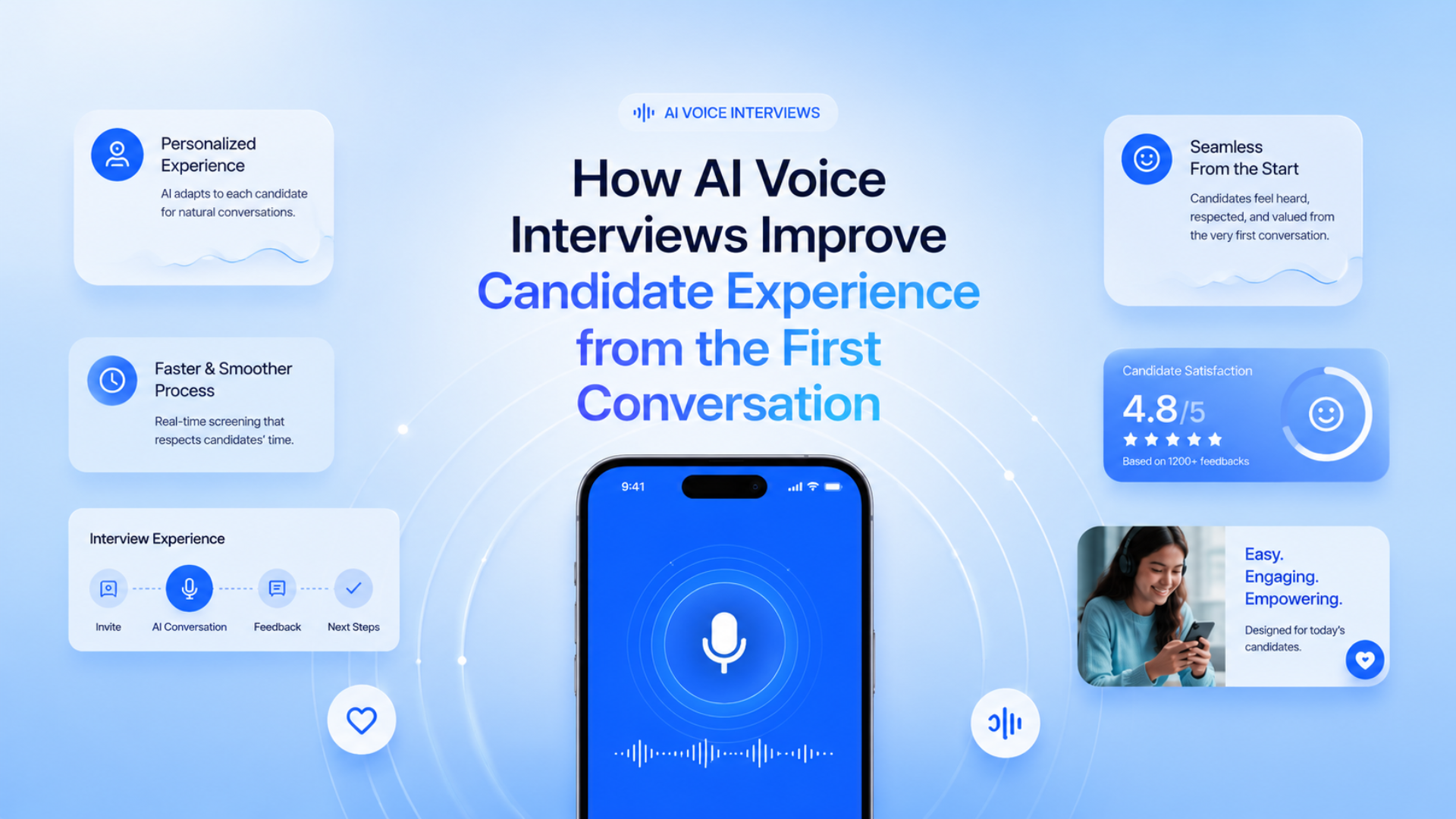
There is a persistent assumption in talent acquisition that AI and good candidate experience are in tension — that adding technology to the hiring process makes it colder, more impersonal, and less appealing to the candidates organizations most want to attract. This assumption is understandable. Recruiting is a human profession, and the idea of replacing a human conversation with a machine feels like a step away from the relationship-centered approach that defines great recruiting. But candidate experience data collected across thousands of employers tells a more nuanced story. The quality of the candidate experience is not determined by whether the first conversation is with a human or an AI. It is determined by whether the process respects the candidate’s time, communicates transparently, evaluates them fairly, and treats every applicant as someone worth a thorough assessment. AI voice interviews, when deployed with these principles in mind, can deliver a better first-conversation experience than traditional phone screens — not despite being automated, but because of what automation makes possible.
What Candidates Actually Experience in Traditional Screening
To understand how AI voice interviews improve candidate experience, it helps to start with a clear picture of what the traditional screening experience looks like from the candidate’s perspective. A candidate applies for a role. They wait. After several days or weeks, they receive an email asking them to schedule a phone screen. They coordinate with the recruiter’s calendar, often across time zones, sometimes requiring them to take a call during work hours from a private space they may not have easy access to. The call itself lasts 15 to 30 minutes. The recruiter asks questions, takes notes, and provides minimal feedback.
Then the candidate waits again. Days pass. Sometimes weeks. They hear nothing. Eventually, if they are rejected, they may receive a generic rejection email. If they advance, they receive a calendar invite for the next round with no context about what impressed the recruiter or what the hiring manager is looking for. At every stage, the candidate is in the dark about where they stand, what happens next, and whether the process is moving at all.
This experience is not the result of bad recruiters. It is the result of a system that overloads recruiters with volume, underinvests in process communication, and treats the screening stage as an internal evaluation step rather than a candidate-facing experience. The recruiter conducting the phone screen has 30 other candidates to call, requisition deadlines to meet, and hiring managers to update. They do not have time to send personalized updates between stages or provide detailed feedback to every candidate who did not advance. The system is not designed for candidate experience. It is designed for recruiter throughput, and candidate experience is a secondary consideration that receives attention only when there is surplus capacity — which, in most recruiting teams, there never is. Data from the Talent Board CandE Awards program consistently shows that the most common candidate complaints are not about the technology used but about the lack of timely communication, the absence of feedback, and the feeling of being processed rather than evaluated.
The economic cost of this poor experience is significant but frequently underestimated. Candidates who withdraw from hiring processes due to frustrating experiences represent lost talent that the organization already invested sourcing dollars to attract. Candidates who accept offers elsewhere because a competitor moved faster represent competitive losses that compound over time. And candidates who share negative experiences on employer review platforms create reputational damage that makes it harder and more expensive to attract the next wave of applicants. Gallup’s workplace research has found that negative candidate experiences directly reduce an employer’s ability to attract passive candidates by 30 to 40 percent, because the reputational effects of candidate experience extend well beyond the individuals who went through the process. The screening stage is where many of these negative experiences begin, not because the evaluation itself is unpleasant, but because the waiting, the uncertainty, and the lack of communication that surround it are.
Speed and Flexibility: Respecting the Candidate’s Time
The first and most immediate way AI voice interviews improve candidate experience is by eliminating the scheduling bottleneck that is the single biggest source of frustration in traditional screening. When a candidate receives an AI voice interview invitation, they can typically complete the conversation at any time within a defined window — early morning before work, during a lunch break, late at night after the kids are asleep. They do not need to coordinate with a recruiter’s calendar, arrange for privacy during business hours, or wait days for an available slot. The candidate controls when the conversation happens, which means it happens when they are at their best, not when the calendar permits.
This flexibility has a particularly significant impact on candidates who are currently
employed. A 2023 survey by LinkedIn’s talent solutions team found that 67 percent of employed job seekers cited scheduling difficulty as a barrier to engaging with new opportunities, and that the average employed candidate takes four to seven days to schedule a phone screen due to calendar conflicts. AI voice interviews collapse this timeline to zero. The candidate receives the invitation and completes the interview at the next convenient moment, often within hours. The follow-up communication — whether the candidate advances or not — arrives within 48 hours instead of two to three weeks. This speed is not a convenience. For candidates who are evaluating multiple opportunities simultaneously, the employer that responds fastest often wins, regardless of the role or compensation. Speed of response is one of the strongest predictors of candidate conversion, and AI voice interviews make the first-conversation stage fast by design.
Fairness and Consistency: Every Candidate Gets the Same Chance
The second way AI voice interviews improve candidate experience is by providing a more consistent and fair evaluation than most candidates receive in traditional phone screens. In a traditional process, the quality of the screening conversation varies based on the recruiter’s experience, energy level, and the 15 other things competing for their attention during the call. A candidate who speaks with a senior recruiter who asks thoughtful questions and takes detailed notes receives a fundamentally different evaluation than a candidate who speaks with a junior recruiter who is rushing through their call queue. Both candidates are being evaluated for the same role. Neither receives the same experience.
AI voice interviews eliminate this variability. Every candidate is asked the same questions, in the same order, with the same evaluation criteria applied to their responses. The candidate who completes the interview at midnight on a Tuesday is evaluated against the identical standard as the candidate who completes it at noon on Thursday. This consistency is not just a fairness benefit for candidates — though it is that — it is also a perception benefit. Candidates who understand that the process is standardized report higher satisfaction and higher trust in the evaluation, because they believe they are being assessed on their actual responses rather than on factors unrelated to their qualifications. Research from the National Bureau of Economic Research has found that candidates who perceive a selection process as fair are more likely to accept job offers, more likely to recommend the employer to peers, and less likely to file discrimination complaints — outcomes that benefit the organization as much as the candidate.
This perception of fairness has a compounding effect on employer brand. Candidates who feel they were evaluated fairly, even if they were not selected, are significantly more likely to reapply for future roles and to recommend the employer to their professional networks. In competitive talent markets, this goodwill is a tangible recruiting advantage. The candidate who was not selected for a marketing manager role today but had a positive screening experience may be the perfect fit for a senior marketing role six months later — and the fact that their first interaction with the organization was respectful and thorough makes them far more likely to engage again. PwC’s hiring trends research has found that organizations with above-average candidate experience scores see 25 to 30 percent higher
reapplication rates and significantly lower cost-per-hire for returning candidates, because the initial investment in a positive experience eliminates the need to re-attract talent that has already demonstrated interest.
Transparency: Telling Candidates What to Expect
The candidate experience improvement from AI voice interviews is not automatic. It depends directly on how the recruiting team communicates about the process. Organizations that simply send an AI interview link with no explanation will see candidate complaints, withdrawals, and negative employer brand reviews. Organizations that communicate clearly — explaining what the AI interview is, what it evaluates, how long it takes, and that a human recruiter will review the results before any decision is made — see the opposite: candidates who complete the interview, feel informed about the process, and report a positive experience. The difference is not the technology. It is the communication around it.
Effective transparency has three components. First, a pre-interview message that sets expectations: what the AI voice interview involves, why the company uses it, what the candidate should prepare for, and approximately when they will hear back. Second, the interview itself should open with a clear introduction from the AI that explains the format, the number of questions, and the option to re-record if the candidate is not satisfied with a response. Third, post-interview communication that acknowledges completion, provides a realistic timeline for next steps, and reinforces that a human will be involved in the decision. These communications do not require elaborate copywriting. They require honesty, clarity, and timing. The most successful teams treat candidate communication as a core part of the screening workflow, not an afterthought. As explored in How Many Follow-Ups Does One Hire Need?, the frequency and quality of communication throughout the hiring process is one of the strongest levers available for improving candidate experience, and the first conversation is where those communication standards are set.
Why the Best Candidate Experience Requires an Integrated Platform
The candidate experience improvements described in this article — faster response times, scheduling flexibility, consistent evaluation, and transparent communication — are all achievable with AI voice interviews. But they are most reliably achieved when the AI screening capability is embedded within an integrated platform rather than operating as a disconnected tool. The reason is straightforward: candidate experience is not determined by any single stage of the hiring process. It is determined by the continuity between stages. A candidate who has a smooth AI interview experience but then encounters a communication gap, a delayed follow-up, or a disconnected scheduling process will remember the gap, not the AI interview. The experience is only as strong as its weakest link.
This is why Huntlo approaches candidate experience as a platform-level design challenge, not a feature-level one. A candidate sourced through Huntlo’s AI engine across 50+ platforms receives branded outreach, completes an AI voice interview on their own
schedule, and receives timely follow-up communication — all within a single system where every interaction is tracked, every status update is automated, and the recruiter has full visibility into where every candidate stands. The candidate never falls through a gap between systems because there are no gaps. The AI screening stage flows into the recruiter review stage, which flows into interview scheduling, which flows into the hiring manager’s evaluation, with the candidate receiving clear communication at every transition. This end-to-end continuity is what transforms a good individual stage into a good overall experience, and it is what agentic AI recruiting platforms deliver that standalone screening tools cannot. The candidate does not experience the platform. They experience the process. And when the process is fast, clear, consistent, and respectful from the first conversation to the final decision, the candidate experience takes care of itself.
Related Topics:
The ATS Mistake Companies Keep Repeating
What’s the Difference Between AI Sourcing and AI Recruiting?
Why Do Some AI Recruiting Tools Have Outdated Candidate Data?