When Priya Sharma took over as Head of Global Sourcing at Navistar Technologies in mid-2024, her team of fourteen sourcers was spending an average of six hours per day on manual database searches, profile reviews, and outreach list building. The output was predictable: hundreds of profiles reviewed, dozens of messages sent, and a conversion rate that had been flat for eighteen months. Sharma had read about AI agent platforms that could operate autonomously, not just execute searches but discover candidates, evaluate fit, and even draft personalized outreach without continuous human direction. She piloted one platform on a senior engineering requisition that had been open for ninety days. Within two weeks, the AI agent had identified forty-three candidates the sourcers had never found, initiated contact with thirty-one, and received responses from nineteen. Three of those nineteen advanced to final interviews, and one received an offer within the first month. Sharma did not replace her sourcing team. She retrained them to manage the AI agent, review its recommendations, and focus on the relationship-heavy stages that the agent could not handle. The result was a sourcing operation that covered three times the talent surface area with the same headcount.
What Makes an AI Agent Different from a Sourcing Tool
The term AI agent has become prevalent in recruiting technology discussions, but most practitioners still use it interchangeably with AI tool or AI platform. The distinction matters because agents and tools operate according to fundamentally different logics. A sourcing tool executes a specific task when a human triggers it. A recruiter types a Boolean string, the tool returns matching profiles. A recruiter sets up an automation rule, the tool runs it on a
schedule. The tool does not decide what to do, when to do it, or whether the action is worth taking. An AI agent, by contrast, operates with a degree of autonomy. It receives a goal, such as find senior machine learning engineers in the automotive industry, and then independently determines the search strategy, selects data sources, evaluates candidates, and decides which ones to prioritize for outreach.
This autonomy is not binary but exists on a spectrum. At the most basic level, an AI agent might autonomously expand a recruiter's initial search query by identifying related skills and equivalent titles that the recruiter did not include. At an intermediate level, the agent might continuously monitor talent pools for new candidates who match an open requisition, proactively adding them to the pipeline without human intervention. At the most advanced level, the agent might operate an entire sourcing workflow from requisition analysis through candidate identification, evaluation, outreach, and initial response handling, requiring human involvement only for final candidate review and interview scheduling. McKinsey research on autonomous AI systems in enterprise operations describes this spectrum as the difference between automation, which executes tasks, and agency, which pursues goals.
The practical implication for recruiting teams is significant. Tools require continuous human input and supervision. Agents require human oversight but not continuous human input. A sourcer working with a traditional tool must initiate every search, review every result set, and manually compile outreach lists. A sourcer working with an AI agent defines the objective and parameters, reviews the agent's output, provides feedback, and focuses on the stages of the hiring process where human judgment is irreplaceable. This shift from task execution to goal management is what makes AI agents a genuinely different category of sourcing technology, not just an incremental improvement over existing tools.
From Boolean Queries to Intelligent Discovery
Traditional candidate sourcing is built on Boolean logic. Recruiters construct queries using AND, OR, and NOT operators to filter candidate databases according to specific criteria. The quality of the output depends entirely on the quality of the query, which depends on the recruiter's knowledge of relevant keywords, job titles, skill synonyms, and industry terminology. A recruiter who does not know that a machine learning engineer might also be called a data scientist, an applied scientist, or an AI research engineer will miss qualified candidates regardless of how sophisticated the underlying database is. Boolean sourcing is only as good as the human who writes the query.
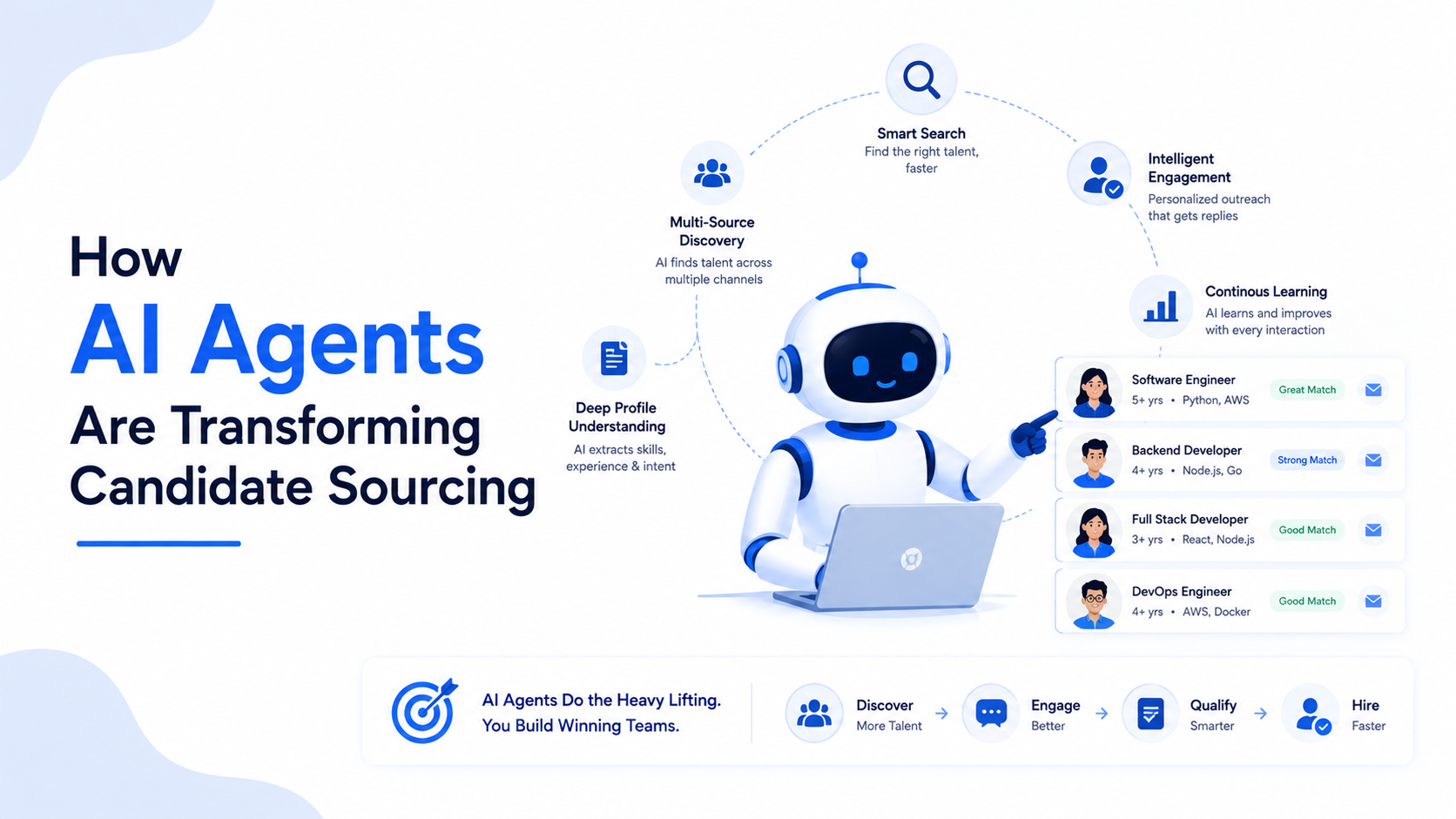
AI agents replace this manual query construction with intelligent discovery. Rather than requiring a human to enumerate every relevant keyword and title, the agent analyzes the job requirements, understands the underlying capability needs, and automatically identifies the full range of profiles that could match. It understands that a candidate with five years of experience building recommendation systems at an e-commerce company may be a strong match for a machine learning role in the automotive industry, even though neither the job title nor
the industry overlaps. LinkedIn data on AI-powered sourcing shows that intelligent discovery surfaces thirty to forty percent more qualified candidates than Boolean queries for the same requisition, because the AI understands semantic relationships that keyword matching cannot capture.
The research on why AI tools have outdated candidate data is directly relevant here. Boolean queries run against static databases will return whatever profiles exist in those databases, regardless of whether the information is current. AI agents can cross-reference multiple data sources, identify signals that indicate a candidate's status has changed, such as a recent promotion, a new skill endorsement, or a shift in job title, and adjust the candidate's relevance score accordingly. This real-time awareness makes AI agent sourcing not just broader but more accurate than traditional database searches, because the agent is evaluating candidates based on their current profile rather than their historical record.
Autonomous Outreach at Scale
Finding qualified candidates is only half the sourcing challenge. The other half is engaging them effectively. Traditional sourcing generates a list of names, and then a separate process, often manual, determines how and when to reach out. AI agents collapse these two stages into a single autonomous workflow. After identifying a qualified candidate, the agent can immediately draft a personalized message that references specific aspects of the candidate's background, select the communication channel most likely to generate a response, and time the message for optimal delivery based on response pattern data. No human needs to review the candidate list, write the messages, or click send. The agent handles the entire sequence.
The quality of autonomous outreach has improved dramatically in the past two years. Early AI-generated messages were identifiable by their generic tone and irrelevant personalization. Current AI agents generate messages that are contextually specific and professionally appropriate, referencing a candidate's recent work, explaining why a particular role aligns with their career trajectory, and addressing the specific concerns that passive candidates typically express. Gartner analysis of AI outreach effectiveness finds that well-tuned AI agent outreach achieves response rates comparable to or better than experienced human sourcers, particularly for initial contact where volume and consistency matter more than deep personalization.
However, the concern about should recruiters worry about AI replacing jobs remains a significant topic of discussion. The answer, based on current evidence, is that AI agents are replacing specific sourcing tasks rather than entire sourcing roles. The tasks being automated are the repetitive, high-volume, and data-intensive activities that take up the majority of a sourcer's day: query construction, profile screening, list building, and initial outreach. The tasks that remain firmly in the human domain are strategic requisition analysis, hiring manager consulting, candidate relationship development, and the nuanced negotiation that converts an interested candidate into an active applicant. Organizations that deploy AI agents effectively are not eliminating sourcing roles. They are redefining them.
Continuous Sourcing: Always-On Talent Pipelines
Perhaps the most transformative aspect of AI agent sourcing is the shift from reactive to continuous sourcing. Traditional sourcing is triggered by an open requisition. A hiring manager submits a role, the sourcing team begins searching, and the process continues until the role is filled. Then it stops. This reactive approach means that organizations are always starting from zero when a new role opens, even for role types they hire for repeatedly. AI agents enable a fundamentally different model: continuous sourcing, where the agent maintains an always-on talent pipeline that is proactively built and refreshed regardless of whether a specific requisition is open.
In a continuous sourcing model, the AI agent monitors the talent market for profiles that match the organization's ongoing hiring needs. When a strong candidate appears, whether through a career change, a new skill acquisition, or increased openness to opportunities, the agent adds them to the pipeline and initiates a lightweight engagement sequence. By the time a requisition officially opens, the pipeline already contains pre-qualified, pre-engaged candidates who can be immediately activated. Deloitte research on proactive talent acquisition finds that organizations with continuous sourcing capabilities fill positions forty to sixty percent faster than those relying on reactive sourcing, because they eliminate the cold-start phase that consumes the first two to three weeks of most hiring processes.
The challenge of more tools same hiring problems illustrates why continuous sourcing requires more than just adding another tool to the stack. Many organizations have sourcing tools, engagement platforms, candidate relationship management systems, and analytics dashboards, but these tools operate independently and require manual coordination. An AI agent that operates across all of these functions, discovering candidates, evaluating fit, managing engagement, and tracking pipeline health, delivers the integrated, always-on sourcing capability that individual tools cannot provide in isolation. The value is not in having more tools. It is in having an agent that orchestrates them toward a coherent sourcing objective.
Learning That Compounds Over Time
The defining characteristic that separates AI agents from traditional sourcing tools is the ability to learn and improve from outcomes. A Boolean search tool provides the same quality of results on day one thousand as on day one. An AI agent provides better results on day one thousand because it has accumulated data from hundreds of sourcing campaigns, thousands of candidate interactions, and dozens of hiring outcomes. It has learned which search strategies produce the best candidates for specific role types, which outreach messages generate the highest response rates for specific candidate profiles, and which early signals predict whether a candidate will ultimately accept an offer.
This compounding learning effect creates a significant competitive advantage for early
adopters. EY research on AI platform economics describes this as a data flywheel. Organizations that deploy AI sourcing agents early accumulate more outcome data, which improves their agent's performance, which produces better hires, which generates more outcome data. Late adopters start with a less-trained agent and face a widening performance gap that is difficult to close because the early adopter's agent has already learned from a larger and more diverse dataset. This dynamic is similar to the referral advantage that organizations build over time, where strong referral programs create a self-reinforcing cycle of better hires leading to more referrals. AI agents create a data-driven version of the same cycle.
The practical implication is that the return on investment from an AI sourcing agent increases over time in a way that traditional tool ROI does not. Gartner guidance on AI sourcing platform evaluation recommends that organizations assess not just initial deployment performance but the platform's ability to learn from outcomes, incorporate feedback, and improve its models. A platform that demonstrates strong learning capabilities will deliver significantly more value in year two than in year one, while a platform that operates as a static tool will deliver flat or declining value as the competitive environment changes. For organizations making multi-year sourcing technology investments, this learning trajectory is the most important evaluation criterion.
The Human Role in an Agent-Driven Sourcing Operation
The most common concern about AI sourcing agents is that they will eliminate sourcing roles entirely. The evidence from early adopters suggests a more nuanced outcome. Sourcing teams that deploy AI agents effectively are not smaller. They are differently deployed. Instead of spending their time on query construction, profile screening, and initial outreach, sourcers are focusing on activities that require human judgment, creativity, and relationship skills. They are doing deeper requisition analysis with hiring managers, understanding not just the technical requirements but the team dynamics and cultural factors that will determine whether a candidate succeeds. They are building relationships with passive candidates over weeks and months, providing the kind of human connection that even the most sophisticated AI cannot replicate.
SHRM research on the evolving role of recruiters in AI-enabled organizations identifies three capabilities that become more valuable, not less, when AI agents handle the operational aspects of sourcing. First, strategic workforce planning, the ability to anticipate hiring needs and align sourcing strategies with business objectives. Second, stakeholder management, the ability to influence hiring managers, set realistic expectations, and negotiate on candidate qualifications. Third, candidate experience design, the ability to ensure that every interaction a candidate has with the organization, whether initiated by an AI agent or a human recruiter, is consistent, professional, and compelling. These capabilities require the kind of contextual understanding and interpersonal skill that AI agents cannot provide.
The research on agentic AI platforms vs automated ones is directly relevant to understanding
how the human role changes. Automated platforms execute predefined tasks and require humans to manage the workflow. Agentic platforms manage their own workflows and require humans to set objectives, provide feedback, and handle exceptions. This means the human role shifts from process management to strategic direction. Sourcers become talent strategists who define what the agent should pursue, evaluate whether the agent's output meets the organization's standards, and step in when the situation requires human judgment. It is a more demanding role in some ways, because it requires broader skills and deeper strategic thinking, but it is also more impactful and more satisfying for most practitioners.
How to Deploy AI Sourcing Agents Effectively
For organizations considering AI sourcing agents, the deployment approach matters as much as the technology selection. The most common mistake is treating an AI agent as a drop-in replacement for existing sourcing tools and expecting immediate results. AI agents require a deployment process that includes data preparation, objective definition, feedback loop establishment, and gradual autonomy expansion. McKinsey and Deloitte both recommend a phased deployment approach where the agent initially operates in a recommendation mode, suggesting candidates and outreach strategies for human review, before gradually transitioning to autonomous operation as the organization builds confidence in the agent's judgment.
Data quality is the single most important prerequisite for successful AI agent deployment. Agents learn from outcome data, and if that data is incomplete, inconsistent, or biased, the agent's performance will reflect those problems. LinkedIn research on AI sourcing data infrastructure finds that organizations with integrated, high-quality talent data achieve significantly better AI performance than those with fragmented systems. Organizations need to ensure that their hiring outcome data, including which candidates were sourced, which advanced to interviews, which received offers, and which accepted, is consistently captured and connected to the sourcing data that the agent uses. This data infrastructure investment often requires more effort than the technology selection itself, but it is the foundation that determines whether the agent can learn and improve over time.
The evaluation of how to evaluate an AI sourcing tool should focus on learning capabilities rather than feature lists. Organizations should ask vendors to demonstrate how their agent improves over time, what specific outcome data the agent learns from, and what performance improvements existing customers have experienced over six, twelve, and eighteen month periods. Vendors of genuinely agentic platforms will have concrete answers to these questions. Vendors of automated tools marketed as agents will struggle, because their platforms do not actually learn from outcomes. The ability to distinguish between these two categories of technology is the most important skill an organization can develop when evaluating AI sourcing solutions.