The debate about AI in hiring has generated more opinion than evidence. Advocates claim the technology will revolutionize recruiting. Skeptics argue it cannot replicate human judgment. Both sides are partly right, but neither is engaging with the specific question that matters most for recruiting teams making adoption decisions: do AI voice interviews produce better first-round screening outcomes than the recruiter phone screens they replace or supplement? This question is answerable. Not with marketing claims, not with hypothetical scenarios, but with the research that exists on structured interview methodology, the data that has emerged from AI screening deployments, and the documented outcomes of organizations that have moved from manual to AI-led first-round evaluation. The evidence, when examined honestly, points to a clear conclusion.
The Foundational Evidence: Structured Interviews Outperform Unstructured Ones
The most important evidence for AI voice interviews is not about AI at all. It is about structured interviews, which have been studied extensively in industrial-organizational psychology since the 1980s. The research consensus, documented through multiple meta-analyses published by the Society for Industrial and Organizational Psychology, is unequivocal: structured interviews — where every candidate is asked the same predetermined questions, evaluated against the same predefined criteria, and scored using evidence-based rubrics — produce significantly higher predictive validity than unstructured interviews, where interviewers ask different questions, apply different standards, and make subjective overall judgments. The predictive validity coefficient for structured interviews consistently falls in the range of 0.51 to 0.63, depending on the specific methodology, while
unstructured interviews typically achieve coefficients of 0.20 to 0.38. This is not a marginal difference. It means that structured interviews are approximately twice as effective at predicting which candidates will succeed in a role.
AI voice interviews are, by design, structured interviews. The questions are predetermined. The evaluation criteria are explicit and consistent. The scoring is applied identically to every candidate. The AI does not ask a candidate about their weekend because they seem friendly, or spend extra time probing a topic that caught their interest — behaviors that are natural in human conversation but introduce variability that degrades predictive validity. The research on structured interviews applies to AI voice interviews because the structural characteristics that drive higher validity are identical. The AI does not improve on the structured interview methodology. It guarantees its consistent delivery. A human recruiter conducting a structured interview can follow the protocol perfectly for the first five candidates and then, as fatigue and familiarity set in, begin to drift. The AI does not drift. It applies the same evaluation standard to candidate one and candidate five hundred. This consistency is the practical mechanism through which AI voice interviews translate the theoretical advantages of structured interviewing into real-world hiring outcomes.
What Deployment Data Shows
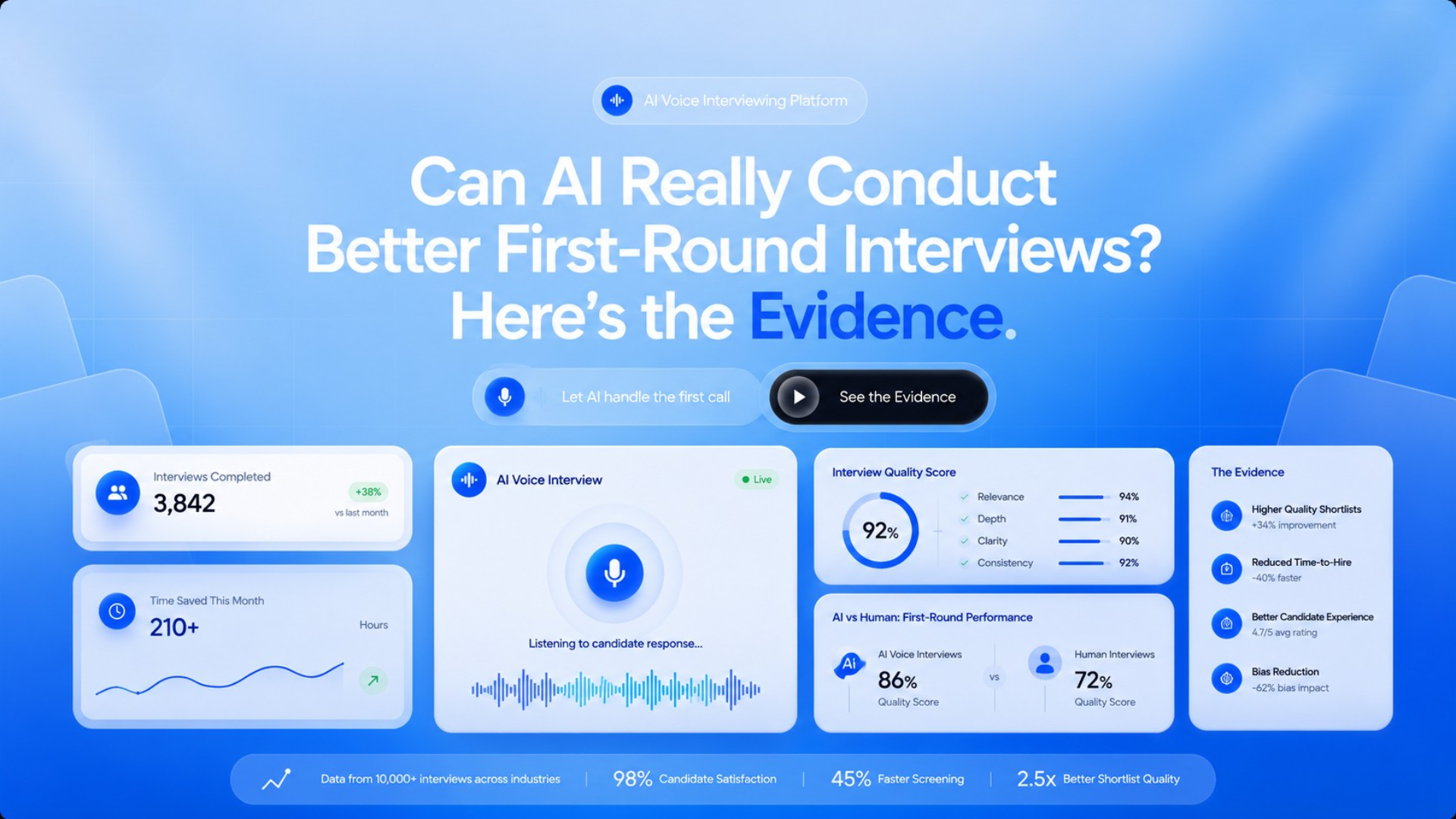
Beyond the foundational research on structured interviews, there is now meaningful deployment data from organizations that have implemented AI voice screening at scale. While much of this data is proprietary, several patterns have emerged consistently across published case studies and industry benchmarks. The first pattern is improved shortlist quality. Organizations using AI voice interviews for initial screening report that the candidates who advance to hiring manager interviews are, on average, stronger than those who advanced under manual screening. This is not because the AI identifies better candidates through some form of superior judgment. It is because the AI evaluates every candidate in the pipeline thoroughly, rather than evaluating only the candidates the recruiter had time to call before the shortlist deadline. In a 75-candidate pipeline where the recruiter could only phone-screen 25 before the deadline, the AI screens all 75, and the top 12 come from the full pool rather than from the 25 who happened to be called first.
The second pattern is reduced screening variability across recruiters. When multiple recruiters screen candidates for the same role, their shortlists often look very different — not because they are evaluating different candidates, but because they are applying different implicit standards. AI voice interviews produce the same evaluation for the same candidate regardless of which recruiter reviews the scorecard, because the evaluation was completed before any recruiter involvement. This standardization has a measurable impact on diversity outcomes as well. Research cited by Gartner’s HR research has found that organizations using structured AI screening see 15 to 20 percent more diverse shortlists than those relying on unstructured recruiter phone screens, because the AI evaluates candidates on their responses rather than on the subjective impressions that research has shown can be influenced by demographic factors like name, accent, or educational background.
The third pattern is faster time-to-shortlist without quality degradation. AI voice interviews can evaluate an entire applicant pool in the time it takes the slowest candidate to complete the interview — typically two to five days for a 100-candidate pipeline. Manual phone screening for the same pool, even with a dedicated recruiter, takes two to three weeks. The organizations reporting these results emphasize that speed without quality would be meaningless, but the combination of speed and maintained or improved shortlist quality is where the measurable ROI of AI voice interviews becomes clear. The hiring manager receives a better shortlist, faster, and the recruiter’s time is reallocated from repetitive screening calls to the candidate relationship work that actually requires human skills.
What the Evidence Does Not Show
Honest engagement with the evidence also requires acknowledging what it does not demonstrate. AI voice interviews have not been shown to outperform experienced, well-trained recruiters conducting thorough structured phone screens with adequate time. If a recruiter has the time, training, and discipline to conduct a proper structured interview with every candidate — asking the same questions, scoring against the same rubric, and documenting their evaluations — the predictive validity of that process is comparable to what AI produces. The problem is that this ideal scenario almost never occurs in practice. Recruiters are overloaded, timelines are tight, and the discipline required for truly structured human interviewing erodes quickly under operational pressure. The evidence does not say that AI is inherently better than a perfect human interviewer. It says that AI delivers the quality of a perfect structured interview consistently, at scale, in conditions where human interviewers consistently fall short of that standard.
The evidence also does not show that AI voice interviews are appropriate for every role or every hiring stage. Executive assessment, deep technical evaluation, and the kind of adaptive, exploratory conversation required for senior leadership roles remain firmly in the domain of experienced human interviewers. AI voice interviews are a first-round screening tool, and the evidence supports their use in that specific context. Claiming they can replace human evaluation at every stage of the hiring process is not supported by the data and undermines the credibility of the technology. The most effective deployment model, supported by both the research and the deployment data, uses AI voice interviews for initial screening and reallocates the recruiter’s time to the later stages where human judgment is both necessary and irreplaceable. This point is explored in Should Recruiters Worry About AI Replacing Their Jobs?, which argues that the real risk to recruiters is not AI replacing their judgment but failing to adopt tools that would make their judgment more impactful.
There is also an evidence gap that deserves acknowledgment. The long-term outcome data — how candidates screened by AI perform after hire compared to candidates screened by humans — is still limited. Most AI voice interview deployments are less than three years old, which means the performance data is still maturing. The structured interview research provides strong theoretical grounds for expecting equal or better outcomes, but the definitive longitudinal studies comparing AI-screened hires to human-screened hires over
multi-year tenures have not yet been published. Recruiting teams should be optimistic but intellectually honest about this gap. The best practice is to treat AI screening as an ongoing experiment where the outcomes are measured, the data is reviewed, and the configuration is refined based on what the actual performance data shows rather than what the vendor’s marketing materials claim. Organizations that approach AI voice interviews with this empirical mindset will build an evidence base specific to their roles, their candidates, and their hiring outcomes — which is ultimately more valuable than any industry-wide benchmark.
Candidate Experience Evidence: The Surprising Data Point
One of the most counterintuitive findings in the evidence base is the candidate experience data. The assumption that candidates prefer human phone screens over AI voice interviews is not supported by the data when the AI process is implemented with transparent communication and reasonable design. The Talent Board CandE Awards program has found that candidate satisfaction with AI-mediated screening processes, when candidates are properly informed about what to expect and the process is followed by timely human communication, is comparable to or higher than satisfaction with traditional phone screens. The key variable is not the technology. It is whether the process is designed around the candidate’s needs — clarity about what is happening, control over timing, and visible human involvement after the AI stage.
This finding matters for the evidence question because candidate experience is not just a feel-good metric. It directly affects the quality of the candidate pool that the first-round interview evaluates. When candidates have a positive screening experience, they are more likely to engage fully with the process, provide thorough responses, and remain available for later stages. When they have a negative experience, they withdraw, accept other offers, or disengage — and the first-round interview evaluates a smaller, less representative pool. The evidence that AI voice interviews can deliver equal or better candidate experience, when implemented correctly, means that the technology does not sacrifice candidate quality at the intake stage. It can actually improve it by making the process faster, more transparent, and more flexible for the candidate.
The candidate experience evidence also intersects with the quality-of-hire evidence in an important way. When AI voice interviews create a faster, more flexible first-round experience, more candidates complete the screening stage. A higher completion rate means the evaluation pool is larger and more representative. In a traditional phone screen process where candidates withdraw before being screened due to scheduling delays or lack of communication, the resulting shortlist is drawn from a biased subset of the applicant pool — the subset willing to navigate scheduling friction. AI voice interviews reduce that friction, increase completion rates, and produce shortlists drawn from a fuller pool. EY’s workforce advisory research has documented that organizations with higher screening completion rates also report higher quality-of-hire scores, suggesting that candidates lost to friction in traditional processes include a disproportionate share of high-quality applicants who have multiple options and low tolerance for slow hiring processes.
From Evidence to Outcomes: Why the Platform Determines the Result
The evidence reviewed in this article is clear: structured interviews outperform unstructured ones, AI delivers structured interviews with a consistency humans cannot match, and the deployment data shows improved shortlist quality, reduced variability, and faster time-to-shortlist. But there is an important caveat embedded in every one of these findings. The evidence supports AI voice interviews that are well-configured, properly integrated into the hiring workflow, and followed by human review and engagement. It does not support AI voice interviews that are deployed as standalone tools with generic configurations, disconnected from the rest of the hiring process, and reviewed by recruiters who do not understand how to interpret the scorecards. The difference between these two deployments is not the AI technology. It is the platform that surrounds it.
Huntlo provides the platform infrastructure that turns the evidence into outcomes. AI sourcing across 50+ platforms fills the pipeline. Automated outreach engages candidates. AI voice interviews evaluate every applicant against role-specific competency frameworks. Recruiters review structured scorecards and use them to conduct targeted, informed follow-up conversations. Interview scheduling, candidate communication, and hiring analytics operate within the same system, creating a data chain that connects every stage of the process. This integration is what makes the evidence actionable. A standalone AI screening tool produces the same structured evaluation data, but without the surrounding workflow, that data has to be manually extracted, transferred, and acted upon — creating the kind of operational friction that More Tools. Same Hiring Problems. identifies as the primary reason AI hiring tools underperform their potential. The evidence says AI can conduct better first-round interviews. The platform determines whether that evidence translates into your organization’s actual hiring outcomes.
Related Topics:
What Makes an AI Recruiting Platform “Agentic” vs Just Automated?
Agency Owners Are Solving Different Problems Than Recruiters Think
Why Referrals Outperform Cold Outreach