James Okafor, VP of People Analytics at a large financial services firm in Chicago, faced a room full of skeptical hiring managers. His team had spent nine months implementing an AI-powered candidate ranking system, and the initial results were promising: time-to-shortlist had dropped by thirty-five percent, and the diversity of candidate slates had improved measurably. But when he asked the hiring managers whether they trusted the system's recommendations, the response was telling. A few raised their hands tentatively. Most did not. One engineering director said flatly that he looked at the AI ranking and then did his own search anyway, treating the tool's output as a suggestion he could safely ignore. James realized that building the system had been the easy part. Building trust in the system was going to be much harder, and without trust, the tool would never deliver its full potential. The hiring managers were not being stubborn or technophobic. They had legitimate questions that the implementation team had not adequately addressed: How does the system make its decisions? What data does it rely on? Can it be audited for bias? What happens when it gets something wrong? These questions were not obstacles to overcome but prerequisites for the kind of genuine trust that would allow the organization to leverage AI effectively in its hiring process.
Why Trust Matters More Than Technology in AI Hiring
The most sophisticated AI hiring system in the world is worthless if the people who are supposed to use it do not trust it. This is not an abstract observation but a practical reality that determines whether AI investments deliver returns or become expensive shelfware. When hiring managers do not trust AI recommendations, they develop workarounds: conducting parallel manual searches, second-guessing every candidate the system surfaces, or ignoring the tool entirely and reverting to their established networks. When candidates do not trust AI evaluation, they disengage from the process, provide less information, or pursue opportunities with companies that offer more human interaction. When recruiters do not trust AI insights, they do not provide the feedback that the system needs to improve, creating a vicious cycle of
declining performance.
The trust deficit in AI hiring is well-documented and widespread. Surveys consistently show that a majority of job seekers are uncomfortable with AI making hiring decisions about them, even when they acknowledge that AI might be more consistent than human evaluators. Hiring managers express similar reservations, particularly when they cannot see how the AI reached its conclusions. This skepticism is not irrational. High-profile failures of AI hiring tools, including documented cases of gender and racial bias, have given the public legitimate reasons to question whether these systems are fair and reliable. SHRM has reported that trust-related concerns are now the primary barrier to AI adoption in human resources, surpassing cost and technical complexity for the first time.
Building trust is also a competitive advantage. Organizations that earn trust from candidates, hiring managers, and recruiters can deploy AI more aggressively, extract more value from their investments, and attract candidates who appreciate a transparent and fair process. In competitive talent markets, the quality of the hiring experience directly affects the quality of the talent pipeline, and trust is a fundamental component of that experience. Companies known for using AI responsibly and transparently gain an employer brand advantage that compounds over time as word spreads among candidate communities.
Transparency as the Foundation of Trust
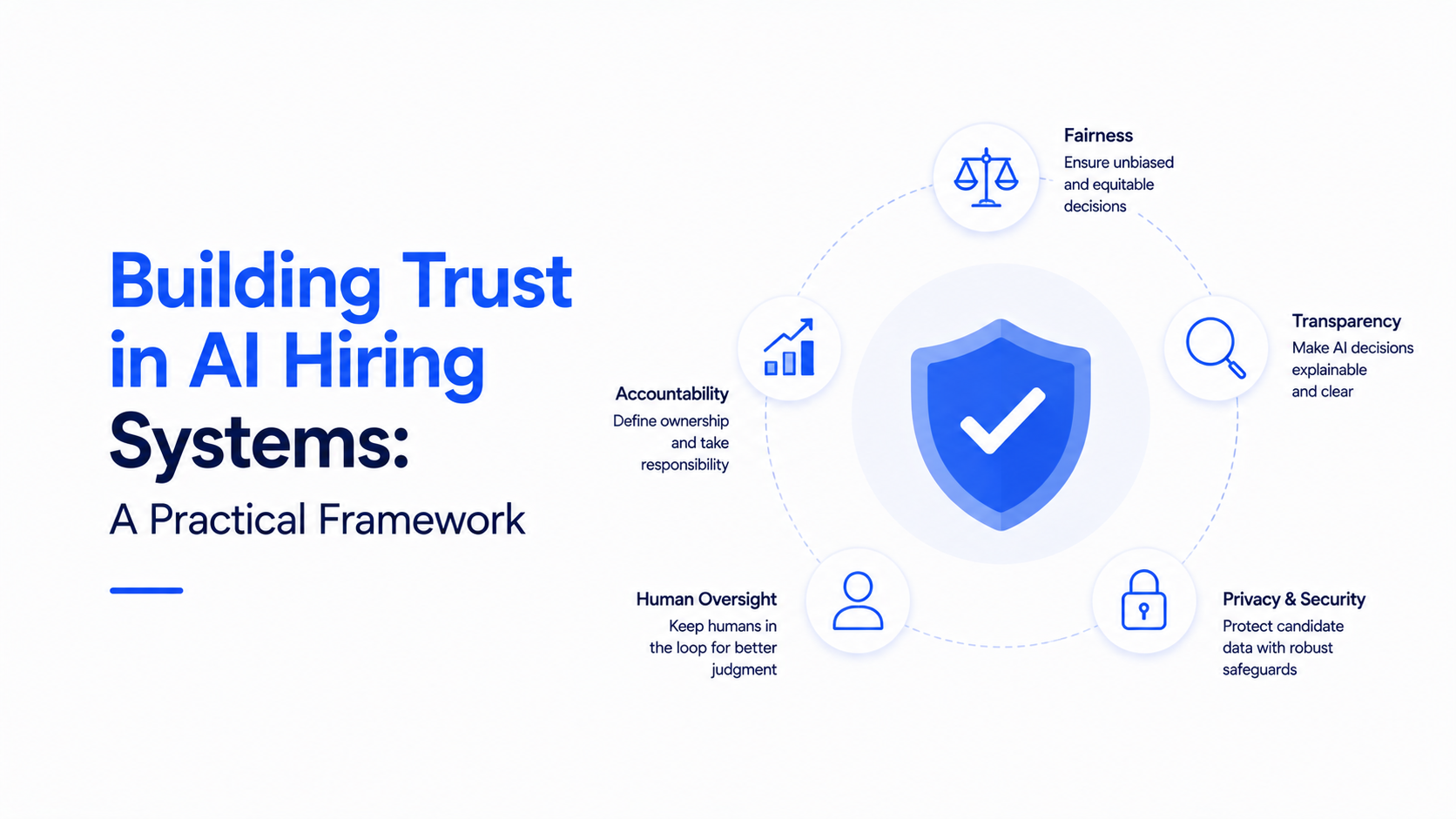
Transparency means different things to different stakeholders in the hiring process, and effective trust-building requires addressing all of them. For candidates, transparency means understanding what is being assessed, how their data is being used, and whether a human will review AI-generated decisions. For hiring managers, it means understanding the factors that influence candidate rankings, the limitations of the AI's analysis, and the degree to which they can override or supplement the system's recommendations. For recruiters, it means understanding how the AI prioritizes candidates, what signals it weighs most heavily, and how their feedback influences future recommendations.
Explainability is the technical capability that enables transparency. An explainable AI system can articulate, in terms its human users understand, why it made a specific recommendation. This might take the form of a candidate scorecard that shows which qualifications matched the job requirements, a ranking explanation that highlights the factors that differentiated top candidates, or a rejection reason that identifies the specific criteria a candidate did not meet. Explainability does not mean revealing the full algorithm, which would be neither practical nor particularly useful. It means providing enough information for users to assess whether the recommendation makes sense and to identify when the system might be missing something important. McKinsey has found that explainable AI systems achieve forty to sixty percent higher adoption rates than black-box alternatives, because users can verify that the system's logic aligns with their professional judgment.
Transparency also requires honest communication about what AI cannot do. Organizations
that oversell their AI capabilities, claiming the system makes perfect decisions or eliminates all bias, inevitably lose trust when reality fails to match the marketing. The most trusted AI hiring implementations are those that set realistic expectations from the outset: the system will surface relevant candidates, but human judgment is required for final evaluation; the system will identify patterns in candidate data, but those patterns should be validated against real-world outcomes; the system will improve over time, but only if humans provide accurate feedback. how to evaluate an AI sourcing tool provides a practical framework for assessing whether an AI tool's marketing claims align with its actual capabilities, a critical first step in building the kind of realistic expectations that sustain trust.
Bias Auditing: Proving Fairness Through Evidence
Bias auditing is the process of systematically testing an AI hiring system for patterns of unfair discrimination across protected characteristics including gender, race, age, disability, and other factors. Regular bias audits serve two essential trust-building functions. First, they provide evidence that the system is performing fairly, which gives stakeholders a concrete reason to trust it. Second, they identify problems early, before those problems compound into reputational damage or legal liability. Organizations that conduct regular audits and share the results with stakeholders demonstrate that they take fairness seriously, which builds more trust than any amount of marketing about the system's underlying fairness.
Effective bias auditing goes beyond checking aggregate outcomes. A system might produce equal overall selection rates for men and women while systematically disadvantaging women in specific role categories or seniority levels. Comprehensive auditing examines outcomes across multiple intersectional dimensions: not just gender alone but gender combined with experience level, educational background, and geographic location. It also examines the system's intermediate decisions, not just its final rankings. If the AI assigns lower initial scores to candidates from certain universities or certain employers, that pattern should be detected and investigated even if the final rankings appear balanced. Gartner recommends that organizations conduct bias audits at least quarterly, with more frequent audits during the first year of deployment when the system's behavior in the specific organizational context is still being understood.
Third-party audits add an additional layer of credibility. When an organization conducts its own bias audits, stakeholders may question whether the results are objective, particularly if the audits consistently show no problems. Independent audits by firms that specialize in AI fairness assessment carry more weight because they have no incentive to produce favorable results. Several major AI recruiting vendors now submit to annual third-party audits and publish the results, a practice that is rapidly becoming a market expectation rather than a differentiator. Organizations that implement AI hiring systems without committing to regular bias auditing are not just risking fairness violations; they are signaling to candidates, employees, and regulators that they are not taking the trustworthiness of their systems seriously. EY has documented that companies with third-party audited AI hiring systems face fewer regulatory
inquiries and employment discrimination claims than those that rely solely on internal testing.
Human Oversight: The Trust Bridge Between AI and Decisions
Human oversight is the mechanism through which trust in AI hiring systems is maintained and strengthened over time. The principle is straightforward: no hiring decision should be made solely by an algorithm without a human reviewer having the ability to examine, question, and override the recommendation. This does not mean that humans must review every AI output in detail. It means that the capability for human review must exist at every decision point, and that humans must actually exercise that capability often enough to maintain their skill at evaluating AI recommendations and to provide the feedback the system needs to improve.
The design of human oversight mechanisms matters significantly for trust. A system that allows human overrides but makes it difficult, slow, or administratively burdensome to exercise that option will not earn trust, because users will suspect that the organization prefers AI decisions to be accepted without challenge. Effective oversight systems make override processes straightforward and quick, track override patterns to identify systematic issues, and protect recruiters and hiring managers from any perceived penalty for disagreeing with the AI. When a hiring manager overrides an AI ranking to advance a lower-ranked candidate, that decision should be celebrated as valuable feedback, not questioned as a deviation from protocol. Deloitte has found that organizations where override rates are tracked and discussed openly have higher trust scores and better AI performance than organizations where overrides are discouraged or silently recorded.
Human oversight also serves as a safety net for edge cases that AI systems handle poorly. A candidate with a nontraditional career path might be underrated by an algorithm that expects linear progression. A candidate returning to the workforce after a gap might be penalized for resume characteristics that the AI interprets as weaknesses. A candidate from a different industry bringing transferable skills might not match the keywords the system expects. In all of these cases, a human reviewer who understands the broader context can correct the AI's narrow assessment. These corrections not only produce better immediate hiring decisions but also generate the training signals that help the AI system handle similar cases more appropriately in the future. why AI tools have outdated candidate data explains how systems without active human oversight tend to accumulate outdated assumptions that progressively erode both performance and trust.
Candidate Trust: Earning Confidence from the Other Side
While much of the focus on AI hiring trust centers on internal stakeholders, candidate trust is equally important and often harder to earn. Candidates interact with AI systems at their most vulnerable, when they are seeking employment and often anxious about the outcome. If they perceive the process as impersonal, opaque, or unfair, they disengage or share negative
experiences that damage the employer brand. Building candidate trust requires a different set of practices than building internal trust, because candidates have less context, less influence, and more at stake in the outcome.
Clear disclosure is the foundation of candidate trust. Candidates should know at the outset of the process which stages involve AI evaluation, what data is being collected and how it will be used, and how they can request human review if they believe the AI has made an error. This disclosure does not need to be lengthy or technical, but it must be honest and accessible. Many organizations now include a brief AI transparency statement in their application confirmation emails, explaining in plain language what candidates can expect. LinkedIn data shows that candidates who receive clear AI disclosure at the start of the process are twenty-five percent more likely to complete the application and thirty percent more likely to recommend the company to other candidates, even if they are not selected.
Providing candidates with meaningful feedback is another powerful trust-building practice. Traditional hiring processes often leave candidates in the dark, receiving a generic rejection email if they are not selected and no explanation of why. AI systems can generate specific, constructive feedback at scale, explaining which qualifications matched and which did not, and offering suggestions for future applications. This feedback demonstrates that the process was thoughtful and individualized, even if the outcome was negative. Candidates who receive detailed feedback, even rejections, report significantly higher trust in the hiring organization and are more likely to reapply for future roles. why referrals outperform cold outreach demonstrates that trust built through positive candidate experiences, including for rejected candidates, generates measurable referral value that improves future hiring outcomes.
Measuring and Demonstrating AI Hiring Performance
Trust is built through evidence, and evidence requires measurement. Organizations that implement AI hiring systems without rigorous performance measurement cannot demonstrate to stakeholders that the technology is working as intended. Performance measurement for AI hiring should cover four dimensions: accuracy, which measures whether the AI's predictions about candidate quality align with actual outcomes; fairness, which measures whether outcomes are consistent across demographic groups; efficiency, which measures whether the system is delivering the expected time and cost savings; and satisfaction, which measures whether candidates, recruiters, and hiring managers find the process acceptable.
Accuracy is the most intuitive performance dimension but also the most frequently mis-measured. Many organizations track whether AI-screened candidates perform well after being hired, which is important but insufficient. True accuracy measurement also requires tracking whether good candidates are being screened out. If the AI achieves high precision, meaning most of its recommended candidates perform well, but low recall, meaning it misses many qualified candidates, the system may be optimizing for safety rather than effectiveness. McKinsey advises organizations to track both precision and recall separately and to set explicit targets for both, because over-optimizing for either one at the expense of the other will
eventually erode trust among stakeholders who notice the gaps.
Sharing performance data internally builds trust by demonstrating accountability. When hiring managers see quarterly reports showing how the AI system's recommendations correlated with actual new-hire performance, they develop confidence in the tool's value. When recruiters see data showing how their feedback improved the system's accuracy over time, they feel ownership of the AI's success. When candidates see that the company publishes its AI hiring metrics, they perceive the organization as credible and self-aware. Gartner recommends establishing a formal AI hiring performance dashboard that is accessible to all stakeholders and updated at least monthly, creating a shared basis for evaluating whether the technology is earning the trust it requires to be effective.
Governance Structures That Sustain Trust Over Time
Trust is not a one-time achievement but an ongoing commitment that requires formal governance structures. An AI hiring system that is trustworthy at launch can become untrustworthy over time if it is not continuously monitored, maintained, and updated. Data drift, where the characteristics of the candidate pool change in ways the AI was not trained to handle, is a particularly insidious threat because it degrades performance gradually and may not be noticed until trust has already been damaged. Governance structures provide the mechanisms for detecting and addressing these threats before they become serious.
Effective AI hiring governance typically includes a cross-functional committee that meets regularly to review system performance, assess risk, and make decisions about configuration changes. This committee should include representatives from talent acquisition, hiring management, legal and compliance, data science, and employee resource groups that can provide perspective on fairness concerns. The committee's authority should include the ability to pause or modify the AI system if performance or fairness issues are detected. Organizations that centralize AI governance in a single function, typically IT or data science, often miss the cross-functional perspective needed to identify trust-threatening issues that span multiple domains. Deloitte has documented that cross-functional AI governance committees identify and resolve trust issues forty percent faster than organizations that rely on a single functional owner.
Documentation is a critical but often overlooked component of governance. Every significant decision about the AI system, from initial configuration to algorithm updates to override policy changes, should be documented with rationale, supporting data, and the names of the decision-makers. This documentation serves multiple purposes: it provides an audit trail for regulators, a knowledge base for future team members, and a transparency mechanism for stakeholders who want to understand how the system has evolved. Organizations that maintain thorough AI governance documentation are better positioned to respond to regulatory inquiries, legal challenges, and stakeholder concerns because they can demonstrate a history of thoughtful, evidence-based decision-making. agentic AI platforms vs automated ones highlights why governance is especially important for agentic AI systems that make autonomous
decisions, because the autonomy that makes these systems powerful also makes robust oversight essential.
Overcoming Specific Trust Barriers
Different stakeholder groups have different trust barriers, and effective trust-building requires addressing each one specifically. Hiring managers often distrust AI because they believe it cannot evaluate the intangible qualities they value, such as cultural fit, leadership potential, or communication style. The solution is not to argue that AI can assess these qualities but to acknowledge the limitation and position AI as a tool that handles the measurable aspects of evaluation, freeing hiring managers to focus their attention on the intangible ones. When hiring managers understand that AI is not trying to replace their judgment but to inform it, resistance typically decreases significantly.
Recruiters sometimes distrust AI because they fear it will make their skills obsolete or reduce their professional autonomy. This fear is understandable given the narrative that AI will replace recruiters, but it is also counterproductive because it prevents recruiters from engaging with tools that could genuinely improve their effectiveness. Addressing this barrier requires demonstrating that AI handles the tasks recruiters least enjoy, sourcing, screening, scheduling, while amplifying the tasks they find most rewarding, relationship building, strategic advising, and offer management. should recruiters worry about AI replacing jobs provides evidence that AI is creating more strategically important roles for recruiters rather than eliminating them, a message that resonates strongly once recruiters see it reflected in their actual daily work.
Candidates distrust AI hiring for reasons that are both rational and emotional. They worry about being reduced to a set of keywords, about algorithms that cannot see past resume gaps or nontraditional backgrounds, and about receiving impersonal rejections from machines. Addressing candidate distrust requires both better communication, which addresses the rational concerns, and better human touchpoints, which address the emotional ones. A candidate who receives an AI-screened rejection but can reach a human recruiter to discuss feedback and future opportunities will trust the process far more than one who receives a faceless automated message. Industry best practices recommend that organizations maintain human-escalation pathways at every stage of the AI hiring process and ensure that candidates who use these pathways receive prompt, thoughtful responses.
The Long-Term Payoff of Trusted AI Hiring
Organizations that invest in building trust in their AI hiring systems reap compounding returns over time. Trust enables broader adoption, which generates more data, which improves system performance, which builds more trust. This virtuous cycle is powerful but fragile; it can be broken by a single high-profile fairness incident, a poorly handled candidate complaint, or a governance failure that exposes the system to regulatory scrutiny. Sustaining trust
requires the same kind of ongoing investment and attention that the technology itself requires.
The competitive advantages of trusted AI hiring are substantial and multi-dimensional. Organizations with trusted AI systems can deploy the technology more broadly, covering more roles and more stages of the hiring process, because stakeholders are willing to rely on the system's recommendations. They can attract better candidates because their transparent, fair process is a differentiator in competitive talent markets. They can make faster hiring decisions because hiring managers trust the candidate slates they receive. And they can build stronger employer brands because candidates share positive experiences with their networks. LinkedIn has found that organizations with high candidate trust in their AI hiring processes receive forty percent more inbound applications from passive candidates than organizations with low trust, a significant competitive advantage in any talent market.
Ultimately, building trust in AI hiring systems is not a technical challenge but an organizational one. It requires leadership commitment, cross-functional collaboration, sustained investment in transparency and fairness, and a willingness to be honest about both the capabilities and the limitations of the technology. Organizations that approach AI hiring trust as a strategic priority, rather than an afterthought to be addressed after deployment, consistently achieve better outcomes across every dimension that matters: hiring quality, candidate experience, recruiter effectiveness, and regulatory compliance. The question is not whether to invest in trust but how quickly to begin, because every quarter of delayed trust-building is a quarter of unrealized value from the AI systems the organization has already purchased.