Catherine Osei, a former management consultant who had recently taken over as CEO of her family's mid-size recruitment business in Johannesburg, faced a choice that would determine whether the fifty-year-old firm survived its next decade. The business was profitable, with steady revenue from a loyal client base and a team of twenty experienced recruiters who consistently delivered placements. But Catherine had spent her consulting career advising companies through technology-driven industry transformations, and she recognized the pattern forming in recruitment. AI was automating the operational tasks that had traditionally defined recruiting efficiency. Clients were demanding data-driven insights alongside candidate delivery. New competitors were entering the market with technology-native models that had lower cost structures and broader data capabilities. Her firm's traditional model, talented recruiters using standard tools to source and place candidates, was not failing today. But it was failing to build the capabilities that would determine competitive success in five years. Catherine needed to redesign the recruitment company for a market that would be fundamentally different from the one her father had built the business to serve.
What the Future Recruitment Company Looks Like
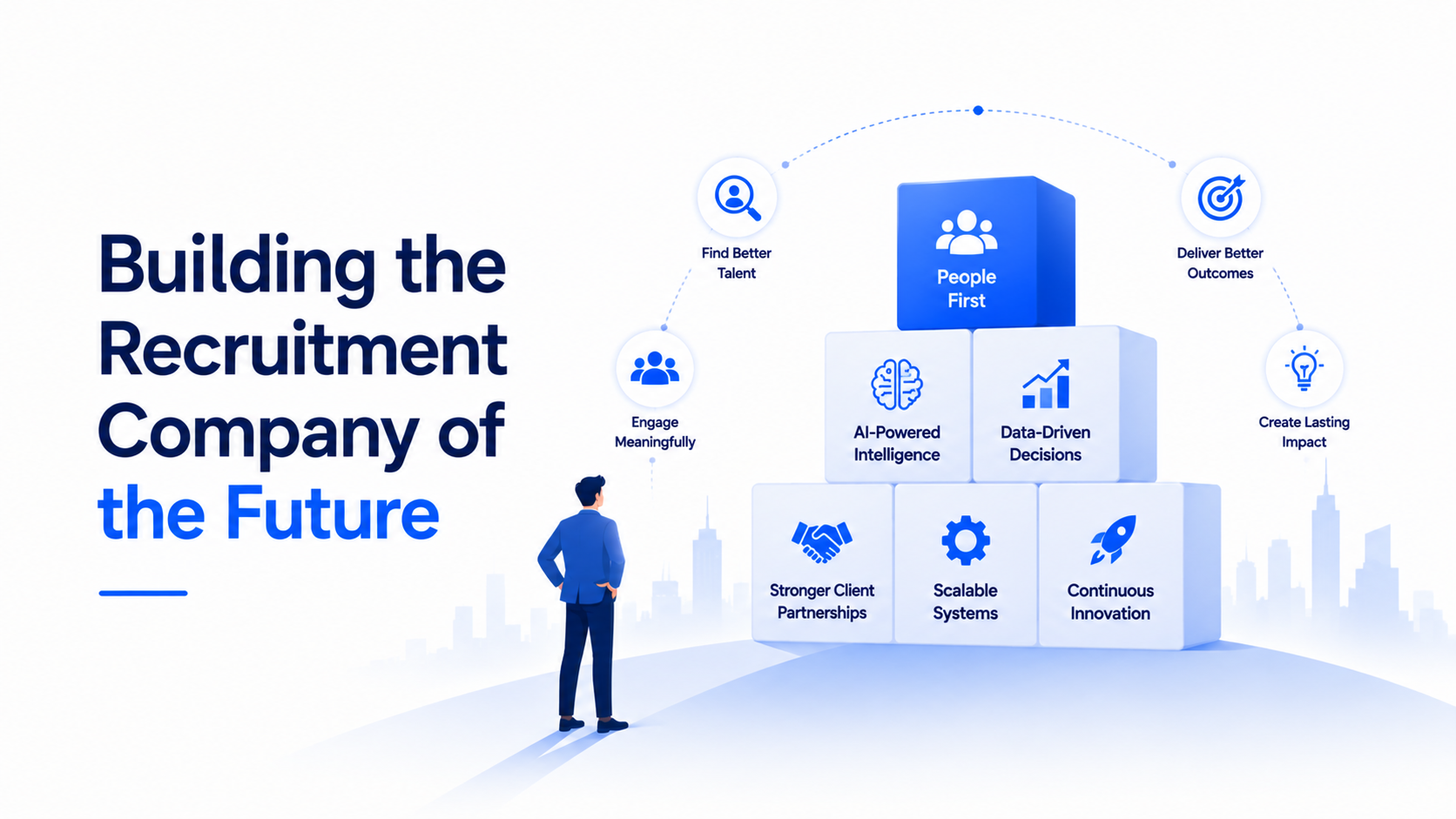
The recruitment company of the future operates on fundamentally different principles than the firms that dominate the industry today. Today's typical recruitment firm is organized around recruiter productivity. Success is measured by the number of placements per recruiter, the revenue per head, and the gross margin on placement fees. The firm's primary assets are its recruiters and their individual networks. Technology supports the recruiters but does not define the firm's capabilities. The future recruitment company is organized around data and intelligence. Success is measured by the quality of hiring outcomes, the depth of client strategic impact, and the proprietary intelligence the firm delivers. The firm's primary asset is its data platform, which captures, structures, and analyzes every candidate interaction, placement outcome, and market signal. Recruiters operate within this data-rich environment, amplified
by AI tools that handle operational tasks and informed by analytical insights that improve every decision they make. The organizational structure, technology architecture, client engagement model, and revenue model all reflect this data-centric orientation.
The practical implications of this shift are visible across every dimension of the business. The future firm employs fewer traditional recruiters and more talent consultants, data analysts, and client success managers. The technology platform is not a collection of point solutions for sourcing, screening, and communication, but an integrated intelligence system that serves as the firm's central operating platform. The client value proposition extends beyond candidate delivery to include talent market intelligence, workforce planning support, and strategic talent advisory. The revenue model includes placement fees, intelligence product subscriptions, and outcome-based retainers. The firm's competitive moat is built on proprietary data assets and analytical capabilities rather than on individual recruiter relationships. This vision is not speculative. The components exist today. What differentiates the future firm from today's is the deliberate integration of these components into a coherent operating model designed for a market where AI has transformed the economics and capabilities of recruiting.
The firms that are building this future today share several characteristics. They treat data as a strategic asset, investing in its collection, structuring, and analysis with the same rigor that traditional firms invest in recruiter training and client entertainment. They embed AI into every stage of the recruiting process, not as a tool that recruiters use when they choose to, but as the default operating environment that coordinates and optimizes all recruiting activity. They measure success by outcomes, quality of hire, client retention, strategic impact, rather than by activities, calls made, resumes sent, interviews scheduled. And they invest deliberately in the organizational culture and talent model that supports this new operating approach, hiring and developing people who combine domain expertise with analytical capability and who are motivated by strategic impact rather than by transactional volume. agentic AI platforms vs automated ones describes how agentic AI platforms serve as the technological foundation of the future recruitment company, because the platform provides the integrated intelligence layer that coordinates sourcing, screening, engagement, and analytics into a unified operating system that amplifies every team member's effectiveness.
The Technology Architecture That Enables the Future
The technology architecture of the future recruitment company is built on three layers. The foundation layer is the data platform, a centralized system that consolidates all of the firm's candidate, client, placement, and market data into a unified, queryable, and analytically accessible format. This is not the firm's applicant tracking system, though it integrates with the ATS. The data platform is a separate analytical infrastructure designed to support the querying, modeling, and intelligence-generation capabilities that the firm's competitive advantage depends on. It stores structured data from the ATS, CRM, financial systems, and operational tools, and it also captures and processes unstructured data from candidate communications, recruiter notes, interview feedback, and market intelligence sources. The data platform is the
firm's most important technology investment, because every analytical capability, every predictive model, and every intelligence product depends on the quality, completeness, and accessibility of the data it provides.
The intelligence layer sits above the data platform and provides the analytical capabilities that convert raw data into strategic insight. This layer includes the AI models that power candidate matching, demand forecasting, supply prediction, and outcome estimation. It includes the business intelligence tools that produce dashboards, reports, and analytics for internal use and client delivery. And it includes the automation engine that executes the operational workflows, candidate sourcing, screening, engagement, scheduling, and follow-up, that keep the recruiting process moving efficiently. The intelligence layer is where the firm's proprietary analytical capabilities live, and it is the layer that creates the most significant competitive differentiation, because the models and algorithms trained on the firm's proprietary data produce insights that no external tool can replicate. The intelligence layer should be designed for continuous improvement, with feedback loops that capture the accuracy of predictions and the outcomes of recommendations, using this feedback to refine and improve the models over time. According to McKinsey, professional services firms that build integrated intelligence layers on top of unified data platforms report two to three times faster improvement in service quality metrics compared to firms that deploy analytical tools in isolation, because the integrated architecture enables the cross-functional data analysis that drives the most valuable insights.
The experience layer is the third and most visible technology component, encompassing the interfaces through which recruiters, clients, and candidates interact with the firm's technology. For recruiters, this includes the workspace where they manage candidate pipelines, review AI-generated insights, and coordinate with clients. For clients, this includes the portals and dashboards where they track search progress, review candidate profiles, and access intelligence products. For candidates, this includes the communication channels through which they engage with the firm. The experience layer must be designed around the specific needs and workflows of each user group, because the value of the underlying data and intelligence is only realized when it is accessible and actionable for the people who need it. The most common mistake firms make is investing heavily in the data and intelligence layers while neglecting the experience layer, producing powerful analytical capabilities that nobody uses because the interfaces are poorly designed or do not fit naturally into existing workflows. The experience layer should embed intelligence into the flow of work rather than requiring users to seek it out, presenting relevant insights at the moment they are most useful. more tools same hiring problems explains why firms that invest in integrated platforms that combine data, intelligence, and experience in a single system outperform firms that assemble multiple point solutions, because the integrated approach ensures that insights flow seamlessly from data to decision without the fragmentation and inconsistency that multiple disconnected tools create.
The Talent Model for the Future Recruitment Firm
The future recruitment firm requires a different talent model than the traditional firm, and this difference extends beyond simply adding data analysts to the team. The traditional recruitment firm's talent model is built around individual recruiter capability. The firm's value is delivered primarily through the skills, networks, and relationships of its recruiters, and the organizational structure reflects this by organizing teams around recruiters and measuring their individual productivity. The future firm's talent model is built around team-based value delivery, where recruiters, data analysts, client success managers, and market intelligence specialists collaborate within a technology-enabled operating system to produce outcomes that no individual could deliver alone. The recruiter's role evolves from sole practitioner to team member, contributing domain expertise and relationship skills within a system that provides data-driven insights, automated operational support, and analytical decision support.
The specific roles that the future recruitment firm needs reflect this team-based model. Senior talent consultants focus on complex client engagements where strategic advisory, deep market knowledge, and high-touch relationship management create the most value. They operate with the full support of the data and intelligence platform, which provides them with market analysis, candidate matching, and outcome predictions that inform their advisory recommendations. Client success managers own the end-to-end client relationship, ensuring that the firm's services are delivered consistently, that intelligence products are provided on schedule, and that the client's evolving needs are anticipated and addressed proactively. Data and analytics specialists maintain the data platform, build and refine analytical models, and produce the intelligence products that differentiate the firm's client offering. Sourcing specialists, who may be AI-augmented rather than human, handle the high-volume operational tasks of candidate identification and initial engagement. This role distribution ensures that each team member focuses on the activities where human capability creates the most value, with AI handling everything else. According to Gartner, recruitment firms that restructure their teams around this specialized, collaborative model report twenty-five to thirty-five percent improvements in both client satisfaction and employee engagement, because the model allows each person to work in their area of greatest strength rather than requiring every recruiter to be a generalist.
The cultural dimension of the talent model is as important as the structural dimension. The future recruitment firm needs a culture that values data-driven decision-making, continuous learning, and collaborative problem-solving. Recruiters who have built their careers on intuition and personal networks may resist the shift to a data-informed operating model, particularly if they perceive it as diminishing their autonomy and professional judgment. Building the right culture requires leadership that consistently demonstrates the value of data-driven insights, creates safe spaces for experimentation and learning, and celebrates outcomes that result from the combined efforts of human expertise and AI capability rather than attributing success solely to individual recruiter heroics. The most effective leaders in future recruitment firms are those who model the new behaviors themselves, using data and intelligence in their own decision-making, seeking analytical input before making strategic choices, and visibly valuing the contributions of data analysts and technologists alongside those of experienced recruiters. should recruiters worry about AI replacing jobs explains why the firms that navigate this cultural transition most successfully are those that position the AI and data
capabilities as amplifiers of recruiter expertise rather than replacements for it, because this framing preserves recruiter identity and motivation while opening them to the new capabilities that the technology provides.
The Client Value Proposition of the Future
The client value proposition of the future recruitment company extends well beyond filling open positions. While candidate delivery remains a core service, it is embedded within a broader offering of strategic talent intelligence and advisory that addresses the client's talent challenges at a systemic level rather than at a transactional level. The future firm's client engagement typically includes three integrated components. The first is talent market intelligence, delivered on a regular schedule regardless of whether an active search is underway. This intelligence includes compensation benchmarking drawn from the firm's own transaction data, candidate availability and pipeline assessments for the client's critical role types, competitive talent dynamics showing how competitors are hiring and what that means for the client's talent position, and workforce risk analysis identifying roles and skill areas where the client is vulnerable to talent loss. This intelligence stream creates ongoing value and dependency, because the client's talent planning processes begin to incorporate the firm's market insights as a standard input.
The second component is evidence-based candidate delivery, where candidates are presented with data-supported assessments of their fit, predicted success probability, and alignment with the client's specific organizational context. This goes beyond the traditional approach where a recruiter provides a verbal assessment of a candidate's strengths and weaknesses. The future firm provides structured evaluation data, showing how the candidate's profile compares to successful past placements in similar roles, what the firm's predictive models indicate about the candidate's likely performance and retention, and what market intelligence suggests about the candidate's availability, motivation, and compensation expectations. This evidence-based approach gives hiring managers greater confidence in their decisions and reduces the reliance on subjective judgment that introduces inconsistency and bias into the hiring process. The third component is strategic talent advisory, where the firm helps the client anticipate and prepare for future talent needs rather than just responding to current vacancies. This advisory service leverages the firm's market intelligence and predictive capabilities to help the client with workforce planning, employer brand positioning, and talent risk mitigation, positioning the firm as a strategic talent partner rather than a transactional hiring service. According to Deloitte, organizations that engage recruitment partners offering integrated intelligence, evidence-based delivery, and strategic advisory report thirty to forty percent higher satisfaction with their talent acquisition function and twenty to twenty-five percent lower total talent acquisition costs, because the integrated approach reduces hiring mistakes, improves retention, and enables more strategic talent allocation.
The pricing model for this expanded value proposition also evolves. The future firm offers tiered engagement structures that reflect the breadth and depth of the client relationship. A
basic tier provides candidate delivery with standard market intelligence. A premium tier adds dedicated talent consulting, customized intelligence products, and quarterly strategic reviews. A strategic partner tier embeds the firm deeply in the client's talent planning process, providing continuous advisory, predictive workforce analytics, and priority access to the firm's candidate intelligence. This tiered model creates a natural growth path for client relationships, where the client's investment in the relationship increases as they experience the value of the intelligence and advisory capabilities. It also creates clear differentiation between competitors who offer only candidate delivery and the future firm that offers a comprehensive talent intelligence and advisory partnership. why AI tools have outdated candidate data explains why firms that continue offering only transactional placement services without the intelligence and advisory layers are competing on a playing field that shrinks every year, because clients increasingly expect strategic value from their recruitment partners and will shift spend to firms that deliver it.
The Roadmap: From Today's Firm to Tomorrow's
The transformation from a traditional recruitment firm to a future-oriented recruitment company does not happen overnight, and it does not require a single massive investment. The most successful transformations follow a phased roadmap that builds capability progressively while demonstrating value at each stage. The first phase, which typically spans six to twelve months, focuses on data foundation. The firm consolidates its existing data from all systems into a unified platform, establishes data quality standards and governance processes, and begins capturing the operational data, candidate interactions, placement outcomes, and market signals that will fuel the analytical capabilities of subsequent phases. This phase delivers immediate value even before advanced analytics are deployed, because the data consolidation process itself reveals process inefficiencies, data gaps, and improvement opportunities that the firm can address immediately. The key success metric for this phase is not analytical sophistication but data completeness and consistency, because the quality of everything that follows depends on the quality of the data foundation.
The second phase, spanning months twelve through twenty-four, focuses on intelligence deployment. The firm builds its first predictive and analytical models, typically starting with the highest-impact use cases such as demand forecasting for critical roles, candidate matching optimization, and time-to-fill prediction. It develops its first client-facing intelligence products, beginning with the reports and analyses that are easiest to produce from the available data and most immediately valuable to clients, such as compensation benchmarking and candidate availability assessments. It begins integrating AI automation into the recruiting workflow, starting with the operational tasks that offer the clearest efficiency gains, such as candidate sourcing, resume screening, and interview scheduling. The second phase also includes the beginning of the organizational evolution, with the first data-focused hires and the initial training programs that help existing recruiters work effectively within the new data-driven environment. According to EY, organizations that phase their recruitment transformation over an eighteen to twenty-four month period, rather than attempting to implement all capabilities
simultaneously, report forty to fifty percent higher adoption rates and sixty percent lower implementation costs, because the phased approach allows time for organizational learning, process adjustment, and incremental capability building that the big-bang approach does not support.
The third phase, beginning around month twenty-four and extending indefinitely, focuses on strategic differentiation. The firm refines its analytical models based on accumulated outcome data, expands its intelligence product portfolio, deepens its client advisory capabilities, and evolves its business model toward outcome-based pricing and strategic partnership structures. This phase is also when the compounding effects of the data asset become most visible, because the firm's predictions become more accurate, its market intelligence becomes more comprehensive, and its candidate matching becomes more precise with every engagement. The competitive advantage that the firm has been building through data investment, technology deployment, and organizational evolution becomes a widening moat that late-adopting competitors cannot easily cross, because they would need to replicate not just the firm's technology but its accumulated data, its refined analytical models, its embedded client relationships, and its evolved organizational culture. The firms that commit to this roadmap and execute it consistently will emerge as the defining recruitment companies of the next decade. how to evaluate an AI sourcing tool provides a framework for assessing a firm's current position on this transformation roadmap and identifying the highest-priority investments for advancing to the next phase, because the assessment evaluates the firm's data maturity, technology integration, organizational readiness, and client value proposition to produce a customized transformation plan that accounts for the firm's specific starting point and competitive context.