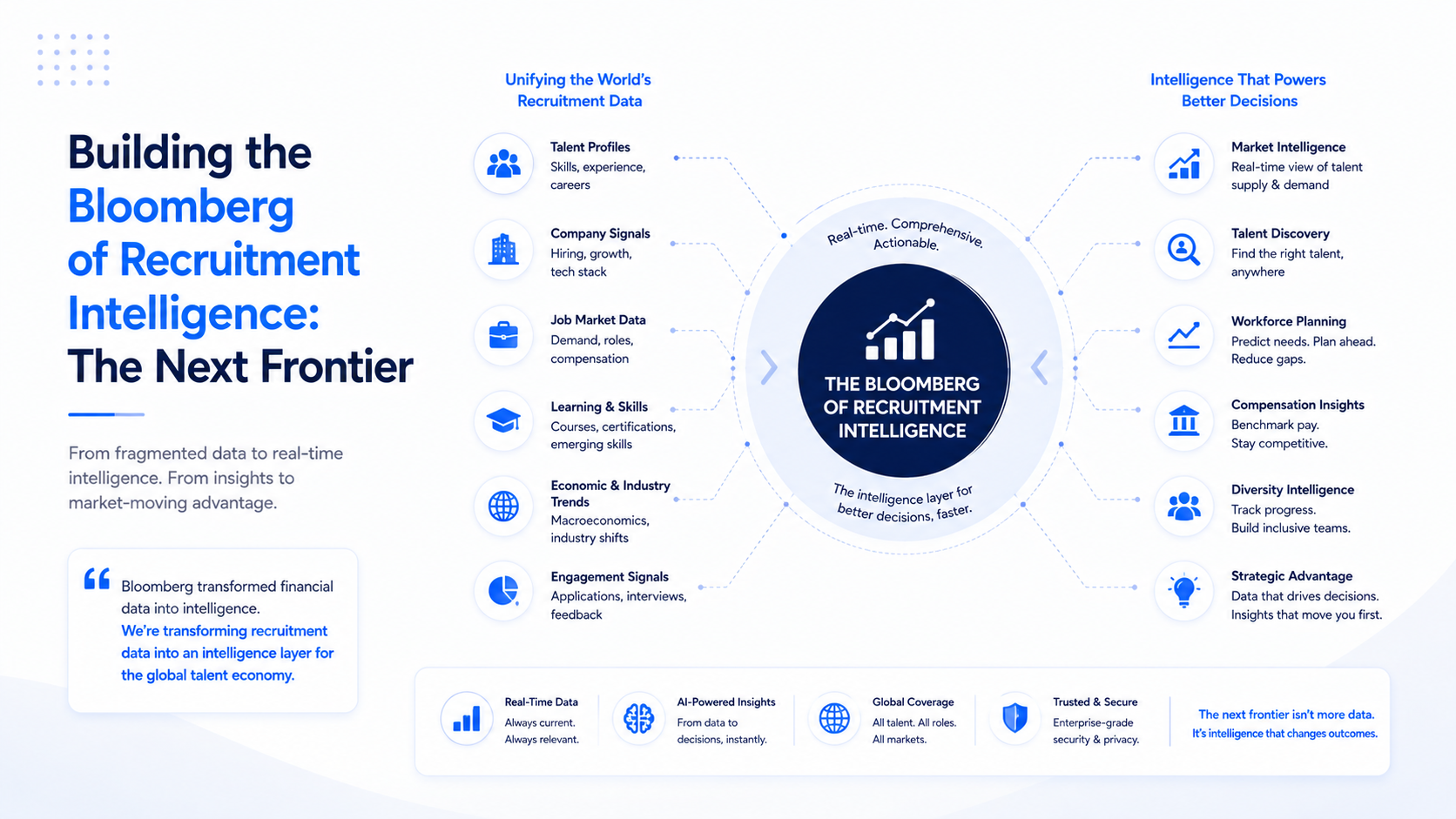
Michael Brennan had spent twelve years as a hedge fund portfolio manager before transitioning into venture capital, and the metaphor that guided his investment thesis was one he knew intimately. In the 1980s, Bloomberg had transformed financial decision-making by taking data that was fragmented, expensive, and slow to access, market prices, trading volumes, analyst estimates, economic indicators, and putting it on a single terminal with real-time analytics that traders could query, visualize, and act on instantly. Before Bloomberg, traders relied on phone calls to brokers, printed price sheets, and delayed market reports. After Bloomberg, they had a unified data layer that made markets transparent and decision-making fast. Brennan believed the recruitment industry was at the same inflection point that financial markets had been in the early 1980s. Talent data, hiring demand signals, compensation benchmarks, skill supply trends, and competitive hiring patterns were fragmented across dozens of platforms, expensive to access through consultants and surveys, and slow to arrive through quarterly or annual reports. The company that built the equivalent of the Bloomberg terminal for recruitment intelligence, a unified, real-time data platform that made talent markets as transparent and actionable as financial markets, would create enormous enterprise value by giving organizations the same advantage in talent decision-making that Bloomberg gave traders in financial decision-making. He began looking for the team and the technology that could build it.
The Parallels Between Financial Markets and Talent Markets
The structural parallels between financial markets in the early 1980s and talent markets today are striking enough to make the Bloomberg analogy more than a rhetorical flourish. In 1981, financial market data was fragmented across exchanges, brokers, and data vendors, each
providing a partial view of the market. Traders who wanted a comprehensive picture of a stock had to call multiple brokers, compare prices across exchanges, and manually reconcile conflicting information. The data was expensive to acquire, because each data source charged separate fees. It was slow to arrive, because real-time data feeds were technically complex and prohibitively costly for all but the largest institutions. And it was difficult to analyze, because the tools for querying, visualizing, and modeling market data were primitive or nonexistent. Bloomberg addressed all four problems simultaneously by building a single terminal that aggregated data from hundreds of sources, delivered it in real time, and provided analytical tools that made the data actionable. The result was a transformation in how financial decisions were made, and Bloomberg's terminal became the indispensable infrastructure of the financial industry.
Talent markets today exhibit the same four characteristics that made financial markets ripe for Bloomberg's disruption. Talent data is fragmented across applicant tracking systems, job boards, professional networks, compensation surveys, and HRIS platforms, each providing a partial view of the talent landscape. Hiring managers who want a comprehensive picture of the talent market for a specific role must consult multiple sources, reconcile conflicting data points, and make decisions based on incomplete information. The data is expensive to acquire, because high-quality compensation benchmarks, talent supply assessments, and competitive hiring intelligence are sold as premium products by consulting firms and data vendors, often requiring annual subscriptions or per-report purchases that can cost tens or hundreds of thousands of dollars. The data is slow to arrive, because the most widely used talent market reports, compensation surveys, labor market analyses, and competitive intelligence reports, are published quarterly or annually, providing snapshots that are outdated by the time they reach decision-makers. And the data is difficult to analyze, because the tools for querying, visualizing, and modeling talent data are far less sophisticated than the tools available for financial data analysis. According to McKinsey, the talent data available to the average enterprise hiring leader today is comparable in quality, timeliness, and accessibility to the financial data available to traders before Bloomberg, and the enterprise value of closing this gap is proportionally large.
The economic magnitude of the talent market further strengthens the Bloomberg analogy. The global financial data market, which Bloomberg helped create and dominates, is estimated at thirty to thirty-five billion dollars annually. The global recruitment market, including staffing, direct hiring, and recruitment technology, is estimated at over five hundred billion dollars annually. The data and intelligence layer of this market, the equivalent of the financial data layer that Bloomberg monetizes, is currently estimated at only five to eight billion dollars, suggesting that the recruitment intelligence market is dramatically underpenetrated relative to the market it serves. If recruitment intelligence captured the same six to seven percent share of its core market that financial data captures of the financial services market, the recruitment intelligence opportunity would be thirty to thirty-five billion dollars annually, roughly the size of the entire financial data market today. This arithmetic suggests that the Bloomberg of recruitment intelligence, if built effectively, could become one of the largest enterprise data
platforms in the world. The question is not whether the market opportunity exists. It is whether a team with the right combination of data assets, AI capabilities, and go-to-market strategy can build the platform to capture it. agentic AI platforms vs automated ones explains why the data collection challenge in recruitment is fundamentally different from financial markets, because recruitment data must be actively generated through AI-driven interactions rather than passively collected from market feeds, which makes the platform architecture required to build the Bloomberg of recruitment intelligence fundamentally different from and potentially more defensible than the architecture that powered Bloomberg's terminal.
What a Recruitment Intelligence Terminal Would Deliver
A recruitment intelligence terminal, modeled on the Bloomberg paradigm, would provide a unified, real-time interface to the talent market that serves multiple user personas with different but interconnected data needs. For talent acquisition leaders, the terminal would provide real-time visibility into hiring demand signals, showing which companies in which geographies are actively hiring for which skills, at what compensation levels, and with what time-to-fill patterns. This competitive hiring intelligence would enable talent acquisition leaders to understand their competitive position in the talent market, adjust their recruiting strategy based on competitor activity, and anticipate talent scarcity before it affects their hiring timelines. For HR business partners and workforce planners, the terminal would provide real-time skill supply analytics, showing the availability, concentration, and mobility patterns of specific talent segments across geographies and industries. This supply intelligence would enable workforce planners to make data-driven decisions about where to locate teams, which skills to build versus buy, and how to anticipate skill gaps before they become business constraints. For compensation and total rewards leaders, the terminal would provide real-time compensation market data, showing not just benchmark salary ranges from surveys but actual offer acceptance rates, counteroffer frequency, and compensation negotiation patterns that reveal the real market clearing price for specific talent.
For business executives and strategy leaders, the terminal would provide talent market intelligence that connects talent data to business strategy. A consumer products company considering entry into a new market could use the terminal to assess the availability of local talent with the required skills before committing to a market entry decision. A technology company evaluating an acquisition target could use the terminal to assess the target's talent density, retention risk, and competitive vulnerability before finalizing the acquisition price. A manufacturing company planning a factory expansion could use the terminal to compare the talent supply characteristics of potential locations, including skill availability, wage levels, competitor presence, and talent pipeline strength, alongside traditional factors like tax incentives, logistics infrastructure, and energy costs. These strategic use cases represent the highest-value applications of recruitment intelligence, because they connect talent data to decisions with millions or tens of millions of dollars in business impact, decisions that are currently made with far less talent market visibility than they deserve. The recruitment intelligence terminal
would not replace existing HR technology. It would sit above it as an intelligence layer that aggregates data from ATS, HRIS, job boards, professional networks, and public data sources into a single analytical environment. According to Gartner, the concept of a talent intelligence layer that sits above operational HRTech systems and provides strategic analytics is emerging as one of the fastest-growing segments of the HRTech market, with adoption growing at thirty to forty percent annually as organizations recognize that operational systems alone cannot provide the strategic talent insights that business leaders increasingly demand.
The technical architecture of a recruitment intelligence terminal would need to solve three core data challenges that distinguish talent markets from financial markets. The first challenge is data standardization. Financial markets have standardized data formats for prices, volumes, and corporate events that make aggregation straightforward. Talent markets have no equivalent standardization. A software engineer role at one company is not directly comparable to a software engineer role at another company, because the required skills, experience levels, and responsibilities differ. The terminal would need an AI-powered normalization layer that maps heterogeneous job titles, skill descriptions, and role requirements into a standardized taxonomy that enables meaningful comparison across companies and geographies. The second challenge is data freshness. Financial market data updates in milliseconds. Talent market data, particularly data about hiring activity, compensation, and candidate availability, changes more slowly but still requires regular updating to be strategically useful. The terminal would need both real-time data feeds from platforms that generate live hiring signals and periodic data ingestion from sources like compensation surveys and labor market reports. The third challenge is data coverage. Financial markets have a finite set of traded instruments that can be comprehensively tracked. Talent markets are effectively infinite, because every working professional is a potential data point. The terminal would need to prioritize data coverage based on the talent segments that matter most to its enterprise clients while continuously expanding its coverage breadth. AI tools for niche technical roles illustrates why the data standardization challenge makes specialized talent segments an effective starting point for building a recruitment intelligence terminal, because the skill taxonomies within specialized segments like healthcare, semiconductor engineering, or quantitative finance are more defined and more stable than general-purpose skill taxonomies, making normalization more accurate and the resulting intelligence more actionable.
The Data Assets Required to Build It
Building a recruitment intelligence terminal requires assembling data assets across five categories that collectively provide a comprehensive view of the talent market. The first category is hiring demand data, which captures what roles organizations are trying to fill, how quickly they are trying to fill them, and how their hiring patterns are changing over time. Hiring demand data is the talent market equivalent of buy-side order flow in financial markets, because it reveals where capital, in the form of hiring budgets, is being deployed and where talent demand is increasing or decreasing. Sources of hiring demand data include job postings scraped
from job boards and company career pages, public requisition data from government labor agencies, and proprietary data from ATS and recruiting platforms that show not just posted jobs but active requisitions, hiring velocity, and time-to-fill patterns. The second category is talent supply data, which captures the availability, skills, and career trajectories of the workforce. Talent supply data is the talent market equivalent of the float of available securities, because it reveals the pool of talent that could potentially fill open roles. Sources of talent supply data include professional network profiles, resume databases, GitHub and other technical platforms, certification registries, and alumni databases.
The third category is compensation data, which captures what organizations are actually paying for specific talent, not just what salary surveys report as benchmark ranges. Actual compensation data includes offer letters, accepted salaries, signing bonuses, equity grants, and counteroffer details, all of which reveal the real market clearing price for talent more accurately than survey-based benchmarks. This data is harder to acquire than hiring demand or talent supply data because it is more sensitive and less publicly available, but it is also more valuable, because compensation is the primary mechanism through which talent markets clear. The fourth category is hiring outcome data, which captures what happened after the hiring process, including quality of hire metrics, retention data, performance outcomes, and internal mobility patterns. Hiring outcome data is the talent market equivalent of post-trade analytics in financial markets, because it reveals which hiring decisions produced good outcomes and which did not, enabling the kind of retrospective analysis that improves future decision-making. The fifth category is labor market signal data, which captures macroeconomic and industry-level trends that influence talent markets, including layoff announcements, funding rounds, company growth rates, industry expansion and contraction patterns, and geographic economic development trends. This contextual data provides the background against which hiring demand, talent supply, and compensation data should be interpreted.
The competitive advantage of a recruitment intelligence terminal depends on the uniqueness and comprehensiveness of its data assets. Data that is available from public sources or easily purchased from data vendors does not create a defensible advantage, because any competitor can acquire the same data. The most defensible data assets are proprietary data that is generated through the platform's own operations and that cannot be replicated without building equivalent scale. For a recruitment intelligence terminal, the most defensible data asset is interaction data, the record of actual candidate-employer interactions, including sourcing activities, screening conversations, outreach responses, interview outcomes, and hiring decisions, that reveals how the talent market actually functions in practice, not just what job postings and profiles suggest in theory. This interaction data is the equivalent of the trading data that makes Bloomberg's terminal indispensable. A job posting tells you what an employer wants to hire. Interaction data tells you what candidates actually respond to, how they engage, what they negotiate, and whether they accept, which is the information that makes the difference between a market snapshot and market intelligence. According to LinkedIn, recruitment platforms that generate and retain proprietary interaction data achieve fifteen to twenty-five percent higher prediction accuracy for talent market trends than platforms relying on public or
purchased data, because the interaction data captures real-time behavioral signals, such as candidate responsiveness, offer acceptance patterns, and counteroffer frequency, that are the most reliable leading indicators of talent market dynamics. why AI tools have outdated candidate data explains why platforms relying on static data sources, such as scraped job postings or purchased resume databases, cannot build the real-time intelligence layer that a recruitment terminal requires, because static data becomes stale quickly and cannot capture the dynamic interactions that drive talent market movements.
The AI Engine That Powers the Intelligence
Data alone does not make a Bloomberg terminal. The data must be processed, analyzed, and delivered through AI-powered analytical capabilities that make the raw data actionable for different user personas. The AI engine of a recruitment intelligence terminal would need to perform four core functions. The first function is talent market indexing, the ability to create standardized indices that measure the health, activity, and trajectory of talent markets at the level of specific skills, geographies, industries, and companies. Just as Bloomberg provides stock indices, bond indices, and commodity indices that summarize market conditions, a recruitment intelligence terminal would provide talent supply indices that measure the availability of specific skills, hiring demand indices that measure the intensity of competition for those skills, compensation indices that track real-time wage movements, and competitive hiring indices that rank companies by their hiring velocity and talent acquisition aggressiveness. These indices would enable talent acquisition leaders to quickly assess market conditions and make data-driven decisions without manually analyzing raw data.
The second AI function is predictive analytics that forecast talent market trends before they become visible in lagging indicators. A hiring demand spike for machine learning engineers in a specific geography will first appear as an increase in job postings, but by the time the posting volume increase is statistically significant, the talent market has already tightened and compensation has begun to rise. A predictive AI model can detect the early signals of this demand spike, such as increased sourcing activity by competitors, increased candidate inquiry rates, and changes in the ratio of job postings to qualified candidates, and forecast the tightening market before it becomes a hiring constraint. Similarly, predictive models can forecast skill shortages by analyzing the trajectory of skill supply against the trajectory of hiring demand, identifying skills that will become scarce six to twelve months before the scarcity manifests in extended time to fill and compensation inflation. The third AI function is natural language querying that allows users to ask questions about the talent market in plain language and receive analytical answers with supporting data visualizations. A talent acquisition leader should be able to ask, what is the competitive hiring intensity for senior data scientists in Austin, and receive a dashboard showing the top hiring competitors, their hiring velocity, compensation ranges, and time-to-fill benchmarks, without writing a query or navigating a complex reporting interface. This natural language interface is what makes the terminal accessible to non-technical users and is a critical enabler of broad adoption across the
enterprise.
The fourth AI function is scenario modeling that allows users to simulate the talent market impact of different strategic decisions. A workforce planner should be able to model the talent supply implications of opening a new office in Denver versus expanding the existing office in Austin, comparing the two locations on talent availability, compensation costs, competitor density, and pipeline strength. A compensation leader should be able to model the impact of a ten percent above-market compensation strategy on offer acceptance rates, time to fill, and quality of hire. A business development leader should be able to model the talent risk profile of entering a new geographic market, including the availability of required skills, the competitive intensity for those skills, and the compensation premium required to attract talent away from incumbent employers. These scenario modeling capabilities transform the terminal from a reporting tool into a strategic decision-support system, which is what elevates it from a nice-to-have analytics product to a must-have enterprise platform. According to Deloitte, the organizations most likely to invest in recruitment intelligence platforms are those with annual hiring volumes exceeding five hundred roles and annual recruiting spend exceeding five million dollars, because these organizations have sufficient scale and strategic complexity that the value of real-time talent market intelligence, predictive analytics, and scenario modeling significantly exceeds the platform investment. how to evaluate an AI sourcing tool provides a framework for evaluating recruitment intelligence platforms that focuses on the quality and depth of the underlying data assets rather than the features of the user interface, because the analytical capabilities of a Bloomberg-style terminal are only as good as the data that feeds them, and platforms with shallow or stale data cannot deliver the intelligence quality that enterprise buyers require regardless of how sophisticated their visualization and querying tools are.
The Path to Building It and Who Will Win
Building the Bloomberg of recruitment intelligence requires a combination of three capabilities that are rarely found in a single organization. The first capability is data scale, the ability to collect, process, and maintain a talent market dataset that is large enough, fresh enough, and comprehensive enough to generate reliable intelligence. Data scale requires either a massive user base that generates organic interaction data or the technical capability to aggregate and normalize data from hundreds of external sources, or ideally both. The second capability is AI sophistication, the ability to build and maintain the models that power talent market indexing, predictive analytics, natural language querying, and scenario modeling. AI sophistication requires a team of researchers and engineers with deep expertise in applied machine learning, natural language processing, and time-series forecasting, combined with domain expertise in talent markets that enables the team to build models that capture the specific dynamics of how talent markets function. The third capability is enterprise go-to-market, the ability to sell, implement, and support a platform that serves large, complex organizations with demanding security, compliance, and integration requirements. Enterprise go-to-market
requires an experienced sales team, a robust implementation methodology, and the credibility to win the trust of C-suite buyers who are making strategic investments.
The candidates most likely to build the Bloomberg of recruitment intelligence fall into three categories. The first category is AI-native recruiting platforms that have already accumulated large proprietary datasets through their core recruiting operations. These platforms have the data scale and the AI sophistication, and they are building the enterprise go-to-market capability. Their advantage is the proprietary interaction data that only a platform managing live recruiting processes can generate. Their challenge is that their data is biased toward the recruiting process itself, meaning it captures demand-side signals, what employers are trying to hire, more completely than supply-side signals, what talent is available and how it is moving. The second category is professional network platforms that have massive talent supply data through their user bases. These platforms have the data scale on the supply side and existing enterprise relationships. Their advantage is the breadth and depth of their talent profiles. Their challenge is that their data is biased toward the supply side, and they lack the demand-side interaction data, screening outcomes, hiring decisions, and offer negotiations, that provides the most valuable intelligence. The third category is purpose-built talent intelligence startups that are focused specifically on building the intelligence layer rather than the operational recruiting platform. These startups have the advantage of focus, but they face the challenge of acquiring data at sufficient scale without the organic data generation that a recruiting platform or professional network provides. According to EY, the most likely winner is an AI-native recruiting platform that expands its data assets through strategic data partnerships, because the combination of proprietary interaction data, which only a recruiting platform generates, and supplementary data from partners, which fills supply-side and contextual gaps, creates the most comprehensive and defensible data asset for talent intelligence.
The timing for building the Bloomberg of recruitment intelligence has never been better, because three enabling conditions are converging simultaneously. First, AI model capabilities have advanced to the point where the natural language querying, predictive analytics, and scenario modeling functions described above are technically feasible and commercially viable. Two years ago, the models required to power these functions were too slow, too expensive, or too inaccurate for enterprise deployment. Today, they are fast enough, cheap enough, and accurate enough to deliver real value to enterprise users. Second, enterprise demand for talent intelligence has reached an inflection point, driven by the increasing strategic importance of talent acquisition, the growing complexity of global talent markets, and the frustration with the slow, fragmented, and expensive talent data that has historically been available. Enterprise buyers are actively seeking solutions that provide real-time, comprehensive talent market visibility, and they are willing to invest significant budgets in platforms that deliver it. Third, the data infrastructure required to build a comprehensive talent market dataset is more accessible than ever, because the proliferation of job boards, professional networks, government labor databases, and API-enabled HRTech platforms provides more data sources to aggregate from than at any previous point in the industry's history. SHRM reports that seventy-eight percent of talent acquisition leaders say that real-time talent market intelligence would
significantly improve their hiring decisions, and that they would be willing to pay premium prices for a platform that provided it, because the current fragmented data environment forces them to make multi-million-dollar hiring investment decisions based on incomplete, outdated, and inconsistent information. AI sourcing vs AI recruiting demonstrates why the platform that unifies sourcing intelligence and recruiting intelligence into a single analytical environment will have a significant advantage over platforms that serve only one side of the talent market, because the most valuable insights emerge from the interaction between supply-side data, who is available, and demand-side data, who is hiring, and only a unified platform can provide both perspectives in a single analytical framework.