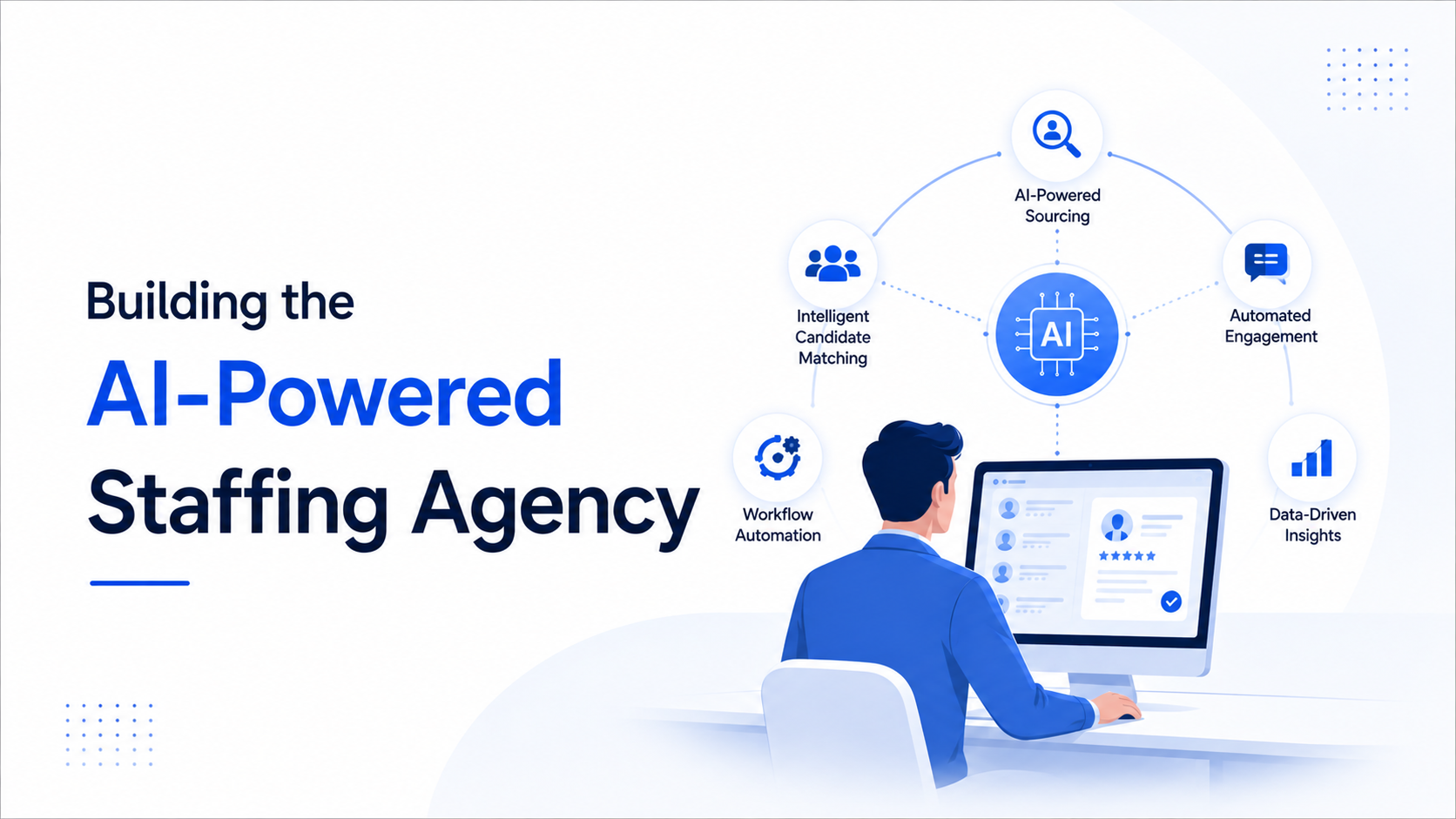
Rachel Kim had spent nine years as a senior recruiter at a traditional staffing firm in Atlanta before deciding to launch her own agency. She knew the business from the ground up, from writing job descriptions and screening resumes to managing client relationships and negotiating offer packages. What she did not know was how to build an agency that would not face the same slow, manual, relationship-dependent limitations that were causing her former employer to lose clients to technology-forward competitors. Rachel's founding decision was unconventional for the staffing industry: before she hired a single consultant or signed a single client, she invested forty percent of her startup capital in AI infrastructure. Her platform could source candidates from multiple data sources simultaneously, screen them against role-specific criteria, automate personalized outreach sequences, and provide clients with real-time dashboards showing pipeline progress. Six months after launching, her firm had eight clients and was filling roles in half the time it took her former employer, with higher placement retention rates and lower cost per hire. Rachel's approach was not about replacing recruiters with technology. It was about building a firm where technology handled the volume-intensive, data-heavy aspects of recruiting so that her small team of consultants could focus entirely on the human interactions that close deals and build lasting client relationships.
Why AI-First Beats AI-Later Every Time
The most fundamental advantage of building a staffing agency with AI infrastructure from the start is architectural coherence. When AI is integrated into the firm's foundation, every process, data flow, and client interaction is designed around the assumption that AI capabilities are available. Candidate data is collected in structured formats that AI systems can process. Client requirements are captured in ways that AI matching models can use directly. Workflow stages are designed with AI checkpoints where automated analysis supplements
human judgment. This architectural coherence is impossible to achieve when AI is added to an existing firm, because legacy processes, data structures, and organizational habits create friction that limits how effectively AI can be integrated. A firm that was built to operate manually and then adds AI tools is like a building that was designed without elevators and then retrofitted with them. The elevators work, but they are constrained by the building's original layout in ways that a purpose-built elevator system would not be.
The cost advantage of building AI-first is also significant. A new agency that starts with AI infrastructure does not need to maintain parallel systems, one for manual operations and one for AI-enhanced operations, during a transition period. It does not incur the cost of retraining experienced consultants who are accustomed to manual methods and resistant to changing their workflows. It does not face the productivity dip that typically accompanies technology transitions in established firms. According to McKinsey, organizations that build AI capabilities into their operating model from inception achieve full productivity and quality benefits within three to six months of launch, while organizations that add AI to existing operations typically require eighteen to twenty-four months to achieve comparable results, because the legacy systems and habits of the existing organization create persistent drag on AI adoption and effectiveness.
The talent advantage compounds over time. AI-first agencies attract a different caliber of recruiting professional, consultants who are excited about working with advanced tools and who see the firm as a place where they can develop skills that will define the next decade of the recruiting industry. These technology-forward recruiters are more productive, more adaptable, and more likely to stay with a firm that invests in their professional development through continuous exposure to evolving AI capabilities. The firm's AI systems also improve with every placement and every candidate interaction, creating a proprietary intelligence asset that appreciates in value as the firm grows. This compounding effect means that an AI-first agency that is twelve months old may have a more effective matching model than a traditional firm that has been operating for a decade, because the AI-first firm's model has been trained on recent, relevant data with continuous feedback loops from the start. agentic AI platforms vs automated ones explains why agencies built on agentic AI platforms from inception have a structural advantage over firms trying to add AI capabilities to legacy operations, because the agentic architecture assumes that AI agents coordinate tasks across the entire recruiting workflow rather than being inserted into discrete steps of a manual process.
The Technology Stack Every AI Staffing Agency Needs
The technology stack for an AI-powered staffing agency consists of four integrated layers. The first layer is the data platform, which consolidates candidate information from job boards, professional networks, public professional signals, referral submissions, and historical placement records into a unified candidate intelligence database. This database must support real-time updates, because candidate information changes frequently, and it must be structured in ways that AI models can query efficiently. The second layer is the AI processing
engine, which includes candidate matching algorithms, skill extraction models, engagement optimization, and predictive analytics. This engine operates on the data platform to produce the insights and recommendations that drive the firm's recruiting activities. The third layer is the workflow orchestration layer, which manages the sequence of recruiting activities from requisition through placement, determining when AI acts autonomously, when it provides recommendations for human review, and when human judgment is required before proceeding. The fourth layer is the client and consultant interface, which presents AI-generated insights in actionable formats through dashboards, alerts, and integrated communication tools.
Selecting the right platform for this stack is one of the most consequential decisions a founding team will make. The platform should support all four layers rather than requiring the firm to assemble capabilities from multiple vendors with incompatible data models and workflows. Integration complexity is the silent killer of AI staffing startups, because every disconnected system creates data gaps that degrade AI performance and every integration point requires ongoing maintenance that diverts resources from client-facing activities. The platform should also support configurability rather than rigidity, allowing the firm to adapt workflows, matching criteria, and engagement strategies as it learns what works for its specific market segments and client base. According to Gartner, staffing startups that select integrated AI platforms report sixty percent lower technology overhead in their first two years compared to startups that assemble their stack from multiple point solutions, because integrated platforms eliminate the data synchronization, API management, and vendor coordination costs that consume disproportionate time and money in multi-vendor environments.
Data governance must be established from day one, not added after the firm reaches a size where compliance becomes urgent. Candidate data privacy regulations vary by jurisdiction and are evolving rapidly, and a firm that collects and processes candidate data without proper governance structures in place faces both legal risk and reputational damage. The data governance framework should define what data is collected, how it is stored, who has access to it, how long it is retained, and how candidates can request access to or deletion of their information. These policies should be documented, enforced through technical controls, and reviewed regularly as regulations evolve. The AI matching and screening models must also be auditable, meaning the firm should be able to explain why a candidate was or was not recommended for a specific role, which requires the AI platform to provide transparency into its decision-making process rather than operating as a black box. how to evaluate an AI sourcing tool provides a framework for evaluating whether an AI recruiting platform meets the governance requirements that an AI-first staffing agency needs, because the platform's data handling practices, model transparency, and compliance features are as important as its matching accuracy and user experience.
Designing the Team Around AI, Not Despite It
The organizational design of an AI-powered staffing agency should reflect the reality that AI handles the data-intensive aspects of recruiting while humans handle the
relationship-intensive aspects. This means the traditional recruiter role, which combined data processing and relationship management in a single position, needs to be split into specialized functions that align with the AI-human division of labor. The most effective team structure includes three primary roles: talent intelligence specialists who work with the AI platform to define matching criteria, monitor model performance, and ensure data quality; client engagement consultants who manage client relationships, understand hiring needs at a strategic level, and present AI-generated insights in business-relevant terms; and candidate relationship managers who engage with candidates, conduct assessments beyond what AI can evaluate, and guide candidates through the hiring process. This specialization allows each team member to focus on what they do best rather than spreading their time across tasks that AI can handle more efficiently.
The specialized team structure also changes how the firm scales. In a traditional agency, growth requires hiring more generalist recruiters, each of whom must be trained in all aspects of the recruiting process. In an AI-powered agency, growth can be achieved by adding capacity to the specific function that represents the current bottleneck. If sourcing is the constraint, the firm can invest in expanding its AI data sources or hiring additional talent intelligence specialists. If client acquisition is the constraint, the firm can hire additional client engagement consultants without needing to also hire sourcing and screening capacity, because the AI platform handles those functions at scale regardless of the number of client-facing consultants. This functional specialization creates operational flexibility that allows the firm to grow efficiently and adapt quickly to changing market conditions. According to Deloitte, AI-powered staffing agencies with specialized team structures achieve twenty-five to thirty percent higher revenue per employee compared to traditional agencies with generalist recruiter roles, because specialization eliminates the productivity losses that occur when generalist recruiters switch between fundamentally different types of work throughout the day.
Training and development must also be redesigned for the AI-powered agency. Traditional recruiter training focuses on sourcing techniques, screening methodologies, and candidate engagement skills. AI-powered agency training must include all of these but also develop AI literacy, the ability to interpret AI recommendations critically, identify when the AI's suggestions need adjustment, and provide structured feedback that improves model performance over time. Consultants who understand how their AI platform works, including its strengths, limitations, and the data it relies on, are far more effective than consultants who treat the AI as a magic box that produces candidate lists. This AI literacy requirement means that hiring criteria for the firm must include aptitude for working with data and technology alongside the traditional requirements for communication skills, industry knowledge, and relationship-building ability. should recruiters worry about AI replacing jobs explores why recruiters who develop AI literacy are positioning themselves for long-term career success, because the ability to work effectively alongside AI is becoming a core competency for recruiting professionals, and the agencies that invest in developing this competency in their teams will have a significant advantage in both recruiting and retaining top talent.
Service Models That Only AI-Enabled Agencies Can Offer
One of the most compelling strategic advantages of building an AI-powered staffing agency is the ability to offer services that traditional agencies cannot deliver profitably. The first is continuous talent pipeline management, where the agency maintains an always-active candidate pool for each client's critical role categories, providing real-time visibility into available talent and reducing time-to-shortlist from weeks to hours when a new requisition arrives. This service is only practical with AI because maintaining active pipelines across multiple role categories for multiple clients simultaneously requires data processing and candidate engagement at a scale that no manual process can sustain. The AI platform monitors candidate availability, tracks career progression, and triggers engagement when candidates' profiles match emerging client needs, ensuring that the pipeline is always current and that clients have access to pre-qualified candidates the moment a need arises. According to EY, clients who engage staffing agencies for continuous pipeline management report forty to fifty percent reductions in time-to-fill and thirty percent higher satisfaction with candidate quality compared to traditional transactional search engagements, because the continuous model eliminates the cold-start problem that makes every new search feel like starting from zero.
The second AI-exclusive service is talent market intelligence, where the agency provides clients with ongoing analytics about compensation trends, skill availability, competitor hiring activity, and emerging talent pools in their industry and geographic markets. This intelligence is generated by the AI platform's continuous analysis of market data, including job postings, candidate movement patterns, and compensation benchmarking across the agency's client base and the broader market. Traditional agencies can provide anecdotal market intelligence based on their consultants' experience, but they cannot deliver the systematic, data-driven analysis that an AI platform produces by processing thousands of data points in real time. This service positions the agency as a strategic talent advisor rather than a transactional placement provider, creating deeper client relationships and more resilient revenue streams. The intelligence service can be offered as a subscription complement to placement services or as a standalone advisory engagement, providing the agency with recurring revenue that does not depend on placement volume.
The third AI-exclusive service model is outcome-based pricing, where the agency's fees are tied to measurable hiring outcomes such as retention, performance ratings, or time-to-productivity rather than to the placement itself. Traditional agencies charge contingency or retained fees based on the act of placing a candidate, regardless of how that candidate performs after joining the client's organization. AI makes outcome-based pricing practical because the agency can use its data and analytics capabilities to predict and manage the factors that influence hiring outcomes. The AI matching model can assess candidate-organization fit more accurately, reducing the risk of placements that fail. The engagement optimization system can maintain candidate relationship continuity through the offer and onboarding process, reducing the risk of candidates dropping out after accepting an offer. This ability to manage and
predict outcomes allows the agency to price based on results rather than activities, creating a compelling value proposition for clients who are tired of paying placement fees regardless of whether the hire succeeds. AI sourcing vs AI recruiting explains why the distinction between AI-powered sourcing and AI-driven recruiting is crucial for outcome-based pricing models, because the agency's ability to manage the full candidate lifecycle from identification through onboarding is what enables it to take accountability for hiring outcomes rather than just candidate delivery.
The Growth Playbook for AI Staffing Agencies
Growth for an AI-powered staffing agency follows a different trajectory than growth for a traditional firm. In a traditional agency, growth is primarily a function of headcount, more recruiters mean more requisitions handled and more placements made. In an AI-powered agency, growth is a function of data, technology, and specialization depth. The firm's AI platform becomes more effective as it processes more data, meaning each new client and each new placement improves the platform's performance for all other clients. This network effect means that growth accelerates over time rather than requiring proportional headcount increases. The practical implication is that AI-powered agencies should prioritize depth over breadth in their early stages, focusing on one or two industry verticals or functional domains where the AI platform can build deep, specialized matching models that outperform generalist competitors. A firm that is the best at placing data engineers in the healthcare industry will attract more healthcare clients seeking data engineers, generating more placement data that makes the firm even better at that specific niche.
Client acquisition for an AI-powered agency also benefits from a differentiated value proposition. When a founder can demonstrate real-time pipeline dashboards, predictive matching accuracy metrics, and talent market intelligence that no traditional competitor can provide, the sales conversation shifts from price negotiation to value demonstration. Prospective clients are more willing to engage with a new firm when they can see tangible, data-driven evidence of the firm's capabilities rather than relying on the founder's personal reputation and case studies alone. According to LinkedIn, AI-powered staffing startups report forty to fifty percent higher conversion rates from initial meeting to signed contract compared to traditional startup agencies, because the AI platform's analytical capabilities provide credible, visible evidence of the firm's value proposition that overcomes the natural skepticism clients feel when considering a new, unproven staffing partner.
The long-term competitive advantage of an AI-powered staffing agency is built on three compounding assets. First, the data asset, the firm's proprietary candidate intelligence database, grows in value with every interaction and becomes increasingly difficult for competitors to replicate. Second, the model asset, the AI matching and prediction models trained on the firm's own placement outcomes, improves continuously and creates performance advantages that generic platforms cannot match. Third, the relationship asset, the deep client and candidate relationships built through AI-enhanced service delivery, generates loyalty and referrals
that compound over time. These three assets reinforce each other: better data produces better models, better models produce better placements, better placements produce stronger relationships, and stronger relationships produce more data. This virtuous cycle means that the AI-powered staffing agency that invests strategically in its first two to three years can build a competitive position that is extraordinarily difficult for later entrants to challenge. why referrals outperform cold outreach shows how AI infrastructure that systematically captures and leverages relationship data amplifies referral-based growth, because the system ensures that every successful placement generates structured intelligence that benefits future searches, turning individual recruiter relationships into a firm-wide strategic asset rather than a personal network that walks out the door when a consultant leaves.