When Daniel Torres became VP of Recruiting at Pacific Logistics Group in early 2025, the company was receiving over twelve thousand applications per month for warehouse and logistics roles across thirty-seven locations. The recruiting team of eight could not phone-screen candidates fast enough, and the average time from application to first human conversation was nineteen days. By then, half the qualified candidates had already accepted other offers. Torres had seen demonstrations of AI voice technology at a recruiting conference and decided to pilot a voice AI agent for initial phone screens on a single location. The AI conducted structured five-minute conversations, asked role-specific questions, evaluated responses for relevance and communication clarity, and flagged candidates who met the threshold for human follow-up. Within six weeks, the pilot location reduced time-to-first-conversation from nineteen days to three days, the human recruiters focused only on pre-qualified candidates, and the hiring managers reported that the candidates advancing from the AI screen were comparable in quality to those from traditional phone screens. Torres expanded the pilot to all thirty-seven locations within three months.
What AI Voice Recruiting Actually Means
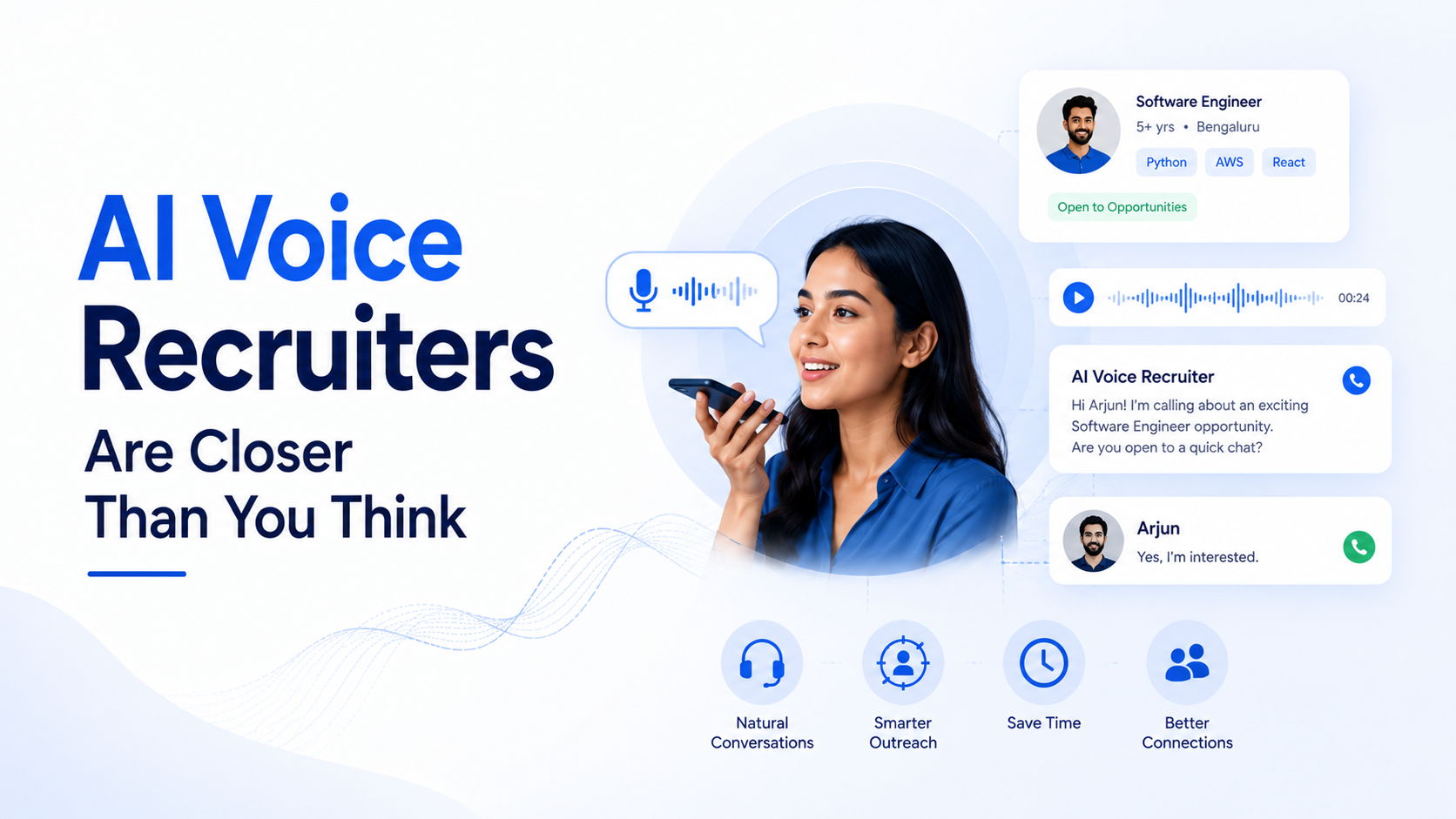
AI voice recruiting is not a single technology but a combination of capabilities that together enable a machine to conduct a structured conversation with a candidate over the phone or through a voice interface. The core components include automatic speech recognition that converts the candidate's spoken words into text, natural language understanding that interprets what the candidate means rather than just what they said, natural language generation that formulates follow-up questions and responses in real time, and text-to-speech that delivers those responses in a natural-sounding voice. When these components work together seamlessly, the result is a conversation that feels sufficiently human-like that many candidates do
not realize they are speaking with an AI until they are told.
The current generation of AI voice systems is not capable of unstructured conversational recruiting. They cannot build rapport the way an experienced recruiter can, read emotional subtext in a candidate's tone, or make nuanced judgments about cultural fit. What they can do is conduct structured, consistent, repeatable screening conversations at scale. They ask the same core questions to every candidate, evaluate responses against predefined criteria, and produce a structured assessment that human recruiters can review in seconds rather than spending twenty to thirty minutes on each phone screen. McKinsey research on AI in candidate assessment notes that structured, consistent evaluation is one of the areas where AI actually outperforms human judgment, because humans are subject to fatigue, bias, and inconsistency that machines are not.
The practical implication is that AI voice recruiters are not a replacement for human phone screens in the general case. They are a replacement for the specific, high-volume, structured screening conversations that consume a disproportionate amount of recruiter time and where the primary objective is to verify basic qualifications and communication skills. For organizations hiring at volume, this is a significant portion of the total screening workload. For organizations hiring for senior or highly specialized roles where the initial conversation is more exploratory and less structured, human phone screens remain more appropriate. The question of agentic AI platforms vs automated ones is directly relevant here, because voice AI is one of the most visible examples of how agentic AI platforms operate with autonomy, pursuing a screening objective without continuous human direction.
The Technology Behind Voice AI Recruiting
The technology stack that powers AI voice recruiting has improved dramatically in the past three years. Speech recognition accuracy for standard English conversations now exceeds ninety-five percent in most commercial platforms, compared to eighty-five to ninety percent just two years ago. This improvement matters because recognition errors that were merely annoying at eighty-five percent accuracy become disqualifying at the scale of thousands of phone screens, where even a five percent error rate means hundreds of candidates receive incorrect assessments. The current generation of speech recognition systems handles accents, dialects, and moderate background noise effectively enough for structured screening conversations, though they still struggle with very heavy accents, multiple speakers, or extremely noisy environments like manufacturing floors.
Natural language understanding has advanced even further than speech recognition. Modern NLU systems do not just transcribe what a candidate says but interpret the meaning and relevance of their response. If a candidate is asked about their experience with inventory management systems and responds by describing a process they used at a previous job without explicitly naming the system, the AI can recognize that the response demonstrates relevant experience even though the candidate did not use the expected terminology. Gartner analysis of conversational AI maturity finds that NLU capabilities in recruiting-specific applications have
reached a level where they can reliably evaluate candidate responses for role relevance, communication clarity, and completeness across a wide range of standard screening questions.
The text-to-speech component has also improved significantly. Early voice AI systems sounded robotic and stilted, which immediately signaled to candidates that they were not speaking with a human and often reduced the quality of the conversation. Current systems use neural voice synthesis that produces natural intonation, appropriate pacing, and conversational fillers that make the interaction feel more human. This is not just an aesthetic improvement. Research consistently shows that candidates respond more openly and provide more detailed answers when they perceive the conversation as natural, which means better voice synthesis directly improves the quality of the screening data that the AI collects. LinkedIn data on candidate experience in AI-screened processes finds that voice quality is one of the strongest predictors of candidate satisfaction with AI interactions.
What Voice AI Can Assess
The assessment capabilities of AI voice recruiters are broader than most practitioners assume but narrower than vendors sometimes suggest. At the most basic level, voice AI can verify that a candidate meets the minimum qualifications for a role by asking about their experience, skills, and availability. At an intermediate level, it can evaluate communication skills including clarity of expression, ability to organize thoughts, responsiveness to follow-up questions, and professional demeanor. At the most advanced level, it can assess domain knowledge by asking technical questions and evaluating the accuracy and depth of the candidate's responses. Deloitte research on AI assessment capabilities finds that voice AI can reliably evaluate communication skills and basic domain knowledge across most standard screening formats.
What voice AI cannot assess is anything that requires contextual judgment. It cannot evaluate whether a candidate would be a good cultural fit for a specific team, because cultural fit assessment requires understanding the team dynamics, the hiring manager's preferences, and the subtle social cues that indicate how a candidate would interact with colleagues. It cannot assess leadership potential through conversational nuance, because leadership assessment requires interpreting how a candidate frames their experiences, what they choose to emphasize, and how they handle ambiguity. It cannot build the kind of relationship with a candidate that makes them feel valued and excited about the opportunity, because relationship building requires empathy, genuine curiosity, and the ability to make a candidate feel heard. LinkedIn research on AI assessment limitations confirms that human judgment remains essential for evaluating the contextual and relational factors that determine long-term hiring success.
The concern about should recruiters worry about AI replacing jobs is particularly relevant to voice AI because the technology feels more threatening to recruiters than other forms of AI automation. When AI screens resumes, the recruiter can tell themselves that they add value through their judgment and expertise. When AI conducts a conversation that sounds increasingly human-like, the recruiter's value proposition feels more directly threatened. The evidence, however, is consistent with what organizations have observed in other AI recruiting
applications: voice AI replaces specific tasks, particularly high-volume structured screening, rather than entire roles. Recruiters who spend less time on repetitive phone screens can spend more time on the relationship-building, strategic consulting, and negotiation activities that require human capabilities.
Where Voice AI Creates the Most Value
The highest-value use cases for AI voice recruiting share common characteristics: high volume, structured evaluation criteria, and a screening stage that is primarily about verifying basic qualifications and communication skills. High-volume hiring for logistics, retail, customer service, and administrative roles fits this profile precisely. These roles receive large numbers of applications, the screening criteria are well-defined and consistent, and the phone screen is primarily a communication check rather than a deep technical assessment. Organizations in these segments report the strongest ROI from voice AI because the technology replaces a high-volume, repetitive task that is expensive in human time but straightforward in its requirements.
Campus recruiting is another high-value use case. Campus hiring events generate hundreds or thousands of initial conversations in a compressed timeframe, and human recruiters cannot give each candidate meaningful attention. AI voice systems can conduct initial screening conversations with every candidate before or after the event, ensuring that no qualified candidate is missed due to recruiter bandwidth constraints. The challenge of more tools same hiring problems is particularly acute in campus recruiting, where organizations often add point solutions for each stage of the process without achieving an integrated workflow. Voice AI that connects to the broader recruiting platform can ensure that the screening data flows directly into candidate evaluation and pipeline management, eliminating the manual data transfer that plagues multi-tool campus recruiting operations.
International hiring presents a different but equally compelling value proposition. Organizations hiring across multiple countries face language barriers, time zone challenges, and scale requirements that make human phone screening expensive and logistically complex. AI voice systems that operate in multiple languages can conduct initial screens in the candidate's preferred language, operate around the clock without time zone constraints, and maintain consistent evaluation standards across regions. EY research on global talent acquisition technology finds that AI voice capabilities are one of the fastest-growing investment areas for multinational employers, because they address the scale and language challenges that traditional recruiting operations cannot solve cost-effectively.
Candidate Experience and Trust
Candidate experience is the factor that will determine whether AI voice recruiting achieves widespread adoption or remains a niche tool. Candidates who feel they were treated fairly and respectfully by the AI will speak positively about the organization and will be more
likely to accept an offer if they advance. Candidates who feel the AI was impersonal, confusing, or unfair will share their negative experience, potentially damaging the employer brand. The candidate experience dimension of voice AI is not a secondary consideration. It is a primary factor that determines whether the technology creates or destroys value for the organization.
The research on why referrals outperform cold outreach is relevant here because candidate experience directly affects referral rates. Candidates who have a positive experience, whether with a human recruiter or an AI voice system, are more likely to refer friends and colleagues to the organization. This means that the quality of the AI voice interaction does not just affect the candidate who experiences it. It affects the organization's ability to attract future candidates through referral networks. Organizations that deploy voice AI without investing in conversation quality, clear communication about what is happening, and a smooth handoff to human recruiters will see short-term efficiency gains but long-term damage to their talent brand.
Transparency is the most important design principle for AI voice recruiting from a candidate experience perspective. Candidates should know early in the interaction that they are speaking with an AI, should understand what the AI is evaluating and how the assessment will be used, and should have a clear path to reach a human recruiter if they prefer. SHRM guidance on AI in candidate assessment recommends that organizations disclose AI involvement at the beginning of the interaction, provide candidates with the option to speak with a human instead, and ensure that AI assessments are reviewed by a human before any negative hiring decision is made. Organizations that follow these principles report significantly higher candidate satisfaction scores and lower opt-out rates than those that try to pass the AI off as human or that do not provide a human alternative.
Integration with the Broader Recruiting Stack
AI voice recruiting does not operate in isolation. Its value depends on how well it integrates with the broader recruiting technology stack, including the applicant tracking system, the sourcing platform, the scheduling tool, and the candidate relationship management system. A voice AI system that produces a structured assessment but cannot automatically update the candidate record in the ATS, trigger an interview scheduling workflow, or pass the assessment data to the hiring manager for review creates manual work that partially offsets the time savings it was supposed to deliver. The most effective voice AI implementations are those that are deeply integrated into the recruiting workflow, not those that operate as standalone tools.
This integration challenge is a specific instance of a broader problem in recruiting technology. Gartner research on recruiting technology integration finds that the average enterprise recruiting stack contains seven to twelve discrete tools, and that the lack of integration between these tools is the primary source of inefficiency in most recruiting operations. Voice AI that operates as yet another disconnected tool adds to this problem rather than solving it. Voice AI that is built into or deeply integrated with the existing platform reduces tool fragmentation and creates a more coherent recruiter and candidate experience.
The question of how to evaluate an AI sourcing tool applies directly to voice AI. Organizations considering voice AI should evaluate platforms not just on the quality of the voice conversation but on the quality of the integration with their existing systems. A voice AI platform with excellent conversational capabilities but poor ATS integration will create more work than it saves. A platform with good conversational capabilities and deep integration will multiply the value of the entire recruiting stack by ensuring that screening data flows automatically into every downstream process. The integration evaluation should be the primary decision criterion, not the voice quality alone.
Preparing for Voice AI Adoption
Organizations that want to be ready for AI voice recruiting should begin preparing now, even if they are not ready to deploy immediately. The first preparation step is defining which screening conversations are appropriate for voice AI and which require human judgment. This means mapping the current phone screening process, identifying the questions and evaluations that are structured and repeatable, and separating them from the assessments that require contextual human judgment. The structured, repeatable portion is the candidate for voice AI automation. The judgment-dependent portion remains with human recruiters. This mapping exercise often reveals that a larger portion of the screening process is structured and repeatable than recruiters initially assume.
The second preparation step is building the data feedback loop that voice AI requires to maintain and improve its performance. Voice AI systems, like all AI systems, improve over time when they receive feedback on the accuracy of their assessments. This means the organization needs a process for recruiters to review AI assessments, confirm or correct them, and feed those corrections back into the system. McKinsey and Deloitte both recommend that organizations establish this feedback mechanism before deploying voice AI, because without it the system will not improve and the quality of its assessments will degrade as the hiring market and role requirements change.
The third preparation step is change management for the recruiting team. Recruiters who have built their careers on their ability to conduct phone screens need to understand that voice AI is not making their skills obsolete. It is changing the mix of skills that are most valuable. The ability to conduct structured phone screens will become less important. The ability to evaluate AI assessments, build relationships with pre-qualified candidates, and consult strategically with hiring managers will become more important. Organizations that communicate this transition clearly and invest in upskilling their recruiters will see faster adoption and better results than those that deploy the technology without preparing the team for the shift in how they add value.